



Last Updated 3 months ago by Kenya Engineer
In Kenya’s rapidly evolving built environment, developers, contractors, and engineers are constantly seeking ways to deliver quality structures faster and more cost-effectively. With urbanization accelerating and infrastructure demands rising, selecting the right construction method has never been more critical.
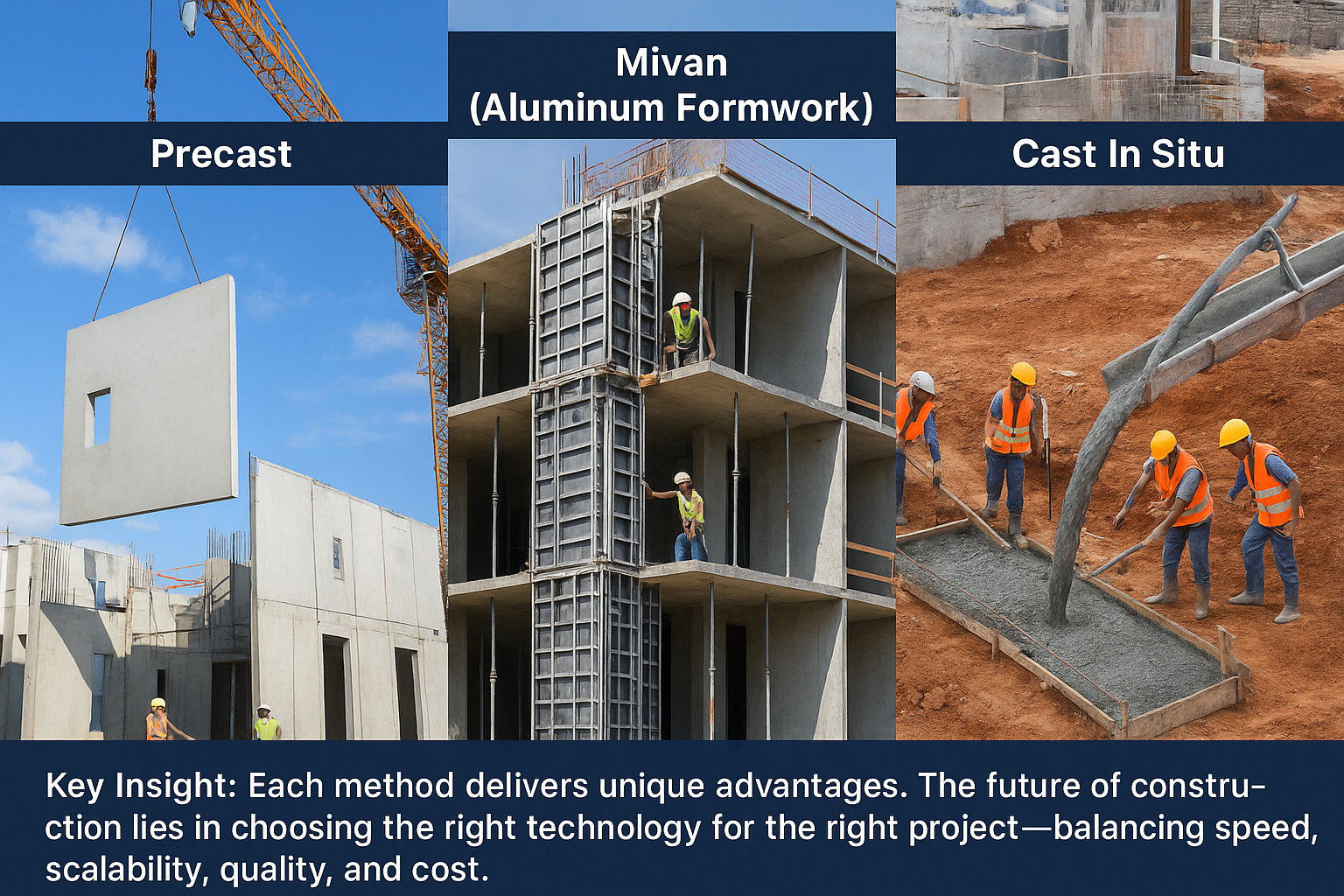
Among the techniques shaping modern construction are Precast Construction, Mivan (Aluminum Formwork) Technology, and Cast In Situ (Traditional) Construction. Each approach brings unique advantages and trade-offs, making it essential to match the method to the project’s needs, budget, and timelines.
- Precast Construction — Speed Meets Precision
Imagine walking into a site where most of the building’s structural components are already manufactured, tested, and ready to assemble. That’s the essence of precast construction.
Structural elements such as beams, slabs, columns, and wall panels are factory-cast in controlled environments and then transported to the site for assembly. This approach drastically reduces on-site activity while maintaining consistent quality.
Why It’s Gaining Traction
Fast Execution: Since most components are ready-made, construction timelines shrink significantly.
High Quality: Controlled factory environments ensure uniformity and structural reliability.
Sustainability: Minimal material waste and optimized production improve overall project efficiency.
Reduced On-site Labor: Fewer workers are needed on-site, addressing labor shortages.
Best Suited For Large-scale, time-sensitive, and durability-focused projects — such as shopping malls, bridges, and modern office complexes — where speed and consistency are paramount.
- Mivan Construction — Reinventing High-Rise Development
When you see a high-rise apartment block mushrooming seemingly overnight, there’s a good chance Mivan technology is at play. Originating from Malaysia, this system leverages monolithic cast-in-situ concrete using reusable aluminum formwork, making it ideal for mass housing and high-density developments.
Why Developers Love It
Rapid Construction Cycles: Entire floors can be completed in a matter of days.
Smooth Finishes: The aluminum formwork delivers clean, uniform surfaces that often require minimal plastering.
Structural Strength: Monolithic casting creates seamless, stronger structures.
Best Suited For High-rise residential towers, large housing estates, and commercial blocks, where quick turnaround and consistent quality are non-negotiable.
- Cast In Situ Construction — Flexibility Above All
For decades, Kenya’s skyline has been shaped by traditional cast in situ construction. In this method, concrete is poured, cured, and set directly on-site using conventional formwork. While it might seem slower compared to modern methods, its enduring popularity speaks volumes.
Why It Still Dominates
Design Flexibility: Changes can be incorporated mid-construction without significant disruption.
Lower Upfront Investment: It requires less specialized equipment compared to precast or Mivan systems.
Wide Acceptance: Most contractors and labor teams are familiar with this approach, reducing the need for specialized training.
Best Suited For Customized residential houses, budget-sensitive low-rise buildings, and small-scale projects where adaptability and affordability are key.
Key Takeaway: Matching Technology to Project Goals
Each method delivers distinct advantages, but there’s no one-size-fits-all solution. The future of construction lies in making informed choices that balance speed, scalability, quality, and cost:
- Precast construction thrives where time and precision matter most.
- Mivan technology is redefining urban mass housing.
- Traditional cast in situ methods remain unbeatable for flexibility and affordability.
As Kenya continues its transformation, engineers and developers who embrace the right technology for the right project will set the pace for sustainable, efficient, and innovative construction.

-
Product on sale
 AWEBook Volume 2Original price was: KShs 3,500.00.KShs 3,000.00Current price is: KShs 3,000.00.













 Construction.)