


Last Updated 9 months ago by Kenya Engineer
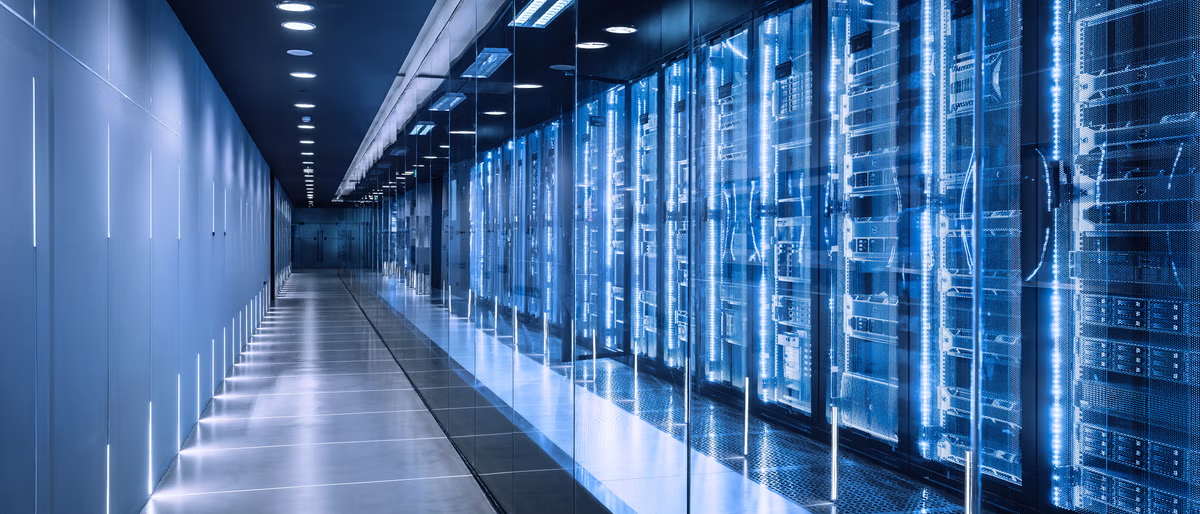
The rapid rise of artificial intelligence (AI) workloads is forcing a fundamental rethink of how data centers are powered. Traditional power architectures—largely designed around alternating current (AC) systems and relatively modest compute densities—are increasingly misaligned with the demands of modern AI infrastructure.
In this context, Hitachi and Hitachi Energy have announced technical support for an 800-volt direct-current (VDC) power architecture, a design direction initially outlined by NVIDIA to support next-generation AI computing platforms. The move signals a broader industry shift toward higher-voltage DC systems as data center power densities continue to rise.
Why AI Is Stress-Testing Conventional Power Systems
AI training and inference workloads rely on highly parallelized, accelerator-heavy computing systems that consume far more power per rack than conventional enterprise servers. In many cases, rack power densities are increasing from tens of kilowatts to well over 100 kW per rack.
Conventional AC-based architectures require multiple power conversion stages—from grid to uninterruptible power supply (UPS), from AC to DC, and then again at the server or accelerator level. Each conversion stage introduces energy losses, heat generation, and additional cooling requirements. As compute loads scale, these inefficiencies compound, increasing both operational costs and system complexity.
The Case for 800 VDC Architectures
High-voltage DC architectures aim to simplify power distribution by reducing the number of conversion steps between the grid and the computing equipment. In an 800 VDC configuration, electricity can be delivered closer to the load in DC form, minimizing losses associated with repeated AC-DC conversions.
Hitachi Energy’s proposed grid-to-rack approach focuses on integrating transformers, power electronics, and digital grid technologies to support higher-voltage DC delivery directly to server racks. From an engineering perspective, this architecture offers several advantages:
-
Higher efficiency due to fewer power conversion stages
-
Reduced thermal load, lowering cooling requirements
-
Improved scalability, supporting larger AI clusters
-
Simplified power distribution, particularly at hyperscale levels
These benefits are becoming increasingly important as data centers transition from general-purpose IT facilities into what some industry players describe as “AI factories.”
Infrastructure Scale and System-Level Implications
Industry forecasts suggest that global AI data center capacity could reach approximately 125 GW between 2025 and 2030, a scale comparable to the total installed electricity generation capacity of some mid-sized European countries. Meeting this demand is not only a computing challenge but also a grid infrastructure challenge.
Such growth places pressure on:
-
Transmission and distribution networks
-
Transformer manufacturing capacity
-
Grid stability and power quality
-
Cooling water and thermal management systems
High-voltage DC architectures alone do not solve these issues, but they form part of a broader system-level response that includes grid digitalization, advanced protection schemes, and closer integration between utilities and large energy consumers.
For Emerging Markets and Africa
For regions such as Africa, where grid reliability, capacity constraints, and energy efficiency remain critical concerns, the evolution of data center power architectures raises important questions. High-density AI facilities could exacerbate existing grid stresses if deployed without adequate planning. At the same time, more efficient power architectures could reduce overall energy waste and improve system resilience.
Advanced DC systems may also align more naturally with renewable energy sources and battery energy storage systems, both of which natively operate in DC. This creates opportunities for tighter coupling between data centers, renewables, and storage—potentially allowing large facilities to contribute to grid stability rather than functioning solely as passive loads.
The shift toward 800 VDC power architectures reflects a deeper transformation in how digital infrastructure and power systems are co-designed. As AI workloads scale globally, power engineering considerations are moving from the background to the center of data center design discussions.
For engineers, utilities, and policymakers—particularly in developing regions—the key challenge will be ensuring that data center growth is aligned with long-term grid modernization, skills development, and sustainable energy planning. The evolution of power architectures is no longer a niche technical detail; it is becoming a foundational factor in the future of digital and energy infrastructure.

-
Product on sale
 AWEBook Volume 2Original price was: KShs 3,500.00.KShs 3,000.00Current price is: KShs 3,000.00.














 workloads is forcing a fundamental rethink of how data centers are powered.)