Last Updated 2 months ago by Kenya Engineer
For more than a decade, Mwache Dam has appeared repeatedly in Kenya’s plans to solve the Coast’s chronic water shortages.
The project has survived changes in government, financing arrangements, design development, land-acquisition challenges and construction delays. It has also evolved from an early multipurpose concept that included hydropower into a major water-storage and bulk-water supply project centred on Mombasa and Kwale.
Now, the project is entering its most consequential phase.
The main dam has reached the final stages of construction, with the Government targeting reservoir impoundment in October 2026. Recent government reporting has put the main dam at about 90 per cent complete and the overall project at approximately 82 per cent.
When operational, the project is expected to provide a major new source of bulk water for the Coast, with the associated treatment system designed to produce approximately 186,000 cubic metres of treated water a day.
That is equivalent to about 68 million cubic metres of treated water a year.
For a region where water shortages have constrained households, tourism, industry and urban development, the implications are considerable.
But Mwache is not simply an 84-metre-high concrete wall across a river.
It is a system of storage, water treatment, pumping, transmission, reservoirs, distribution infrastructure, irrigation, catchment management and environmental safeguards. The success of the investment will ultimately be measured not by the height of the dam or the volume of concrete placed, but by how reliably water moves from the Mwache catchment to consumers and productive users.
A project that has evolved over decades
The modern Mwache project has its origins in a much earlier search for additional water resources for the Coast.
A feasibility study was being pursued by 2011, when the project was conceived as a multipurpose development with potential applications extending beyond domestic water supply and irrigation. Earlier proposals included the possibility of hydropower generation.
By the middle of the decade, however, the emphasis had shifted towards water security.
The project became part of the World Bank-supported Kenya Water Security and Climate Resilience Project and was developed primarily around the need to capture flows from the Mwache River basin for domestic and irrigation use.
The World Bank’s original project appraisal envisaged a concrete gravity dam approximately 78 metres high with a reservoir capacity of about 118 million cubic metres. The design subsequently evolved substantially.
The structure now being built is approximately 84 metres high with a crest length of about 526 metres. Current project information gives the reservoir capacity as up to 136 million cubic metres, although earlier Government project documents have cited approximately 127 million cubic metres.
The difference reflects the development of the project through detailed design and construction rather than a simple change in the amount of water available.
The dam’s final configuration includes the main dam together with upper and lower check dams and associated infrastructure.
The basic purpose, however, remains the same: capture water during periods of high flow and make it available when rainfall and river flows are lower.
A dam built using roller-compacted concrete
The most distinctive engineering feature of Mwache is the construction method.
The main structure is a roller-compacted concrete, or RCC, gravity dam.
RCC uses concrete with a relatively low water content and low slump that can be placed in horizontal layers and compacted using heavy vibratory rollers. The approach combines aspects of conventional concrete construction with the high-volume placement techniques associated with earthworks.
For a large gravity dam, the attraction is construction speed.
Mwache requires approximately 610,000 cubic metres of RCC in the main structure. The volume is sufficiently large that the economics and programme depend heavily on the ability to produce, transport, place and compact concrete continuously and consistently.
The concrete mix itself was therefore a major engineering exercise.
Before construction, extensive trials were undertaken using locally available aggregates and different cementitious materials. The work produced several viable mixtures incorporating cement with supplementary materials including fly ash and natural pozzolan.
Some of the trial mixes contained remarkably low quantities of Portland cement relative to the total cementitious material. One of the successful combinations used approximately 34 kg of cement per cubic metre together with about 186 kg of fly ash, while another used about 50 kg of cement with approximately 170 kg of natural pozzolan.
The significance was not simply reducing cement consumption.
A successful RCC mix had to achieve the required strength and durability while remaining workable enough to allow the exceptionally high placement rates required for the dam.
The construction method also required tight control of layer thickness, compaction, temperature, moisture and quality testing.
The RCC was placed in successive lifts, with the dam’s geometry incorporating stepped downstream faces. At the peak of construction, the project required a highly coordinated production chain involving aggregate processing, batching, transportation, placement and compaction.
The result is a structure in which construction methodology is itself a major part of the engineering solution.
The contractor and engineering team
The project brings together Chinese, Japanese, Kenyan, Swiss and British engineering expertise.
The main construction contractor is Sinohydro Corporation Limited, which signed the construction contract in 2019. Physical works eventually commenced in March 2022 after delays associated particularly with land acquisition and resettlement.
The design and supervision arrangements have involved Nippon Koei of Japan, Mangat I.B. Patel (MIBP) of Kenya and AF-Consult of Switzerland, with specialist RCC advice from Dr M.R.H. Dunstan of the United Kingdom.
The combination is significant because Mwache is not simply a conventional concrete dam built using established local practice. The project required specialist experience in RCC design, materials and construction at a scale that had not previously been demonstrated in Kenya.
The dam is widely described by the project authorities as the largest RCC gravity dam in East Africa.
Why RCC matters at Mwache
The engineering case for RCC at Mwache is closely linked to the scale of the structure.
A conventional mass-concrete dam can require large volumes of concrete to be placed through conventional formwork and cooling arrangements. RCC allows much higher placement rates, provided that the concrete production and compaction process can be maintained continuously.
That creates an important trade-off.
The technology can accelerate construction and reduce costs, but only when the entire production system is engineered around it.
Aggregate quality and grading, cementitious materials, batching, transportation distances, placing equipment, roller compaction, temperature control and quality assurance all become part of one integrated operation.
Mwache’s trial-mix programme was therefore not an isolated laboratory exercise. It was intended to establish combinations of locally available materials that could support the construction programme while meeting the performance requirements of a major gravity dam.
The project also includes foundation treatment, drainage and grouting works designed to manage seepage and uplift and to establish the required interaction between the dam and its foundation.
Once the reservoir begins filling, those systems will become part of the dam’s permanent safety regime.
From construction contract to delayed reality
The history of Mwache illustrates one of the recurring challenges of major infrastructure projects in Kenya: the period between approving a project and actually constructing it can be considerably longer than the original programme suggests.
The construction contract was signed in August 2019, but physical works did not begin until March 2022.
Land acquisition and compensation were among the factors that delayed commencement.
The original World Bank project appraisal had identified several thousand people who would be affected by the reservoir and associated infrastructure. Resettlement therefore became an integral part of project implementation rather than a secondary administrative exercise.
The project has included compensation, relocation and livelihood-restoration measures, alongside community facilities and other social infrastructure.
This has also affected the project’s financing requirements and timetable.
The Government has subsequently authorised additional financing to complete the project, with the latest publicly announced package amounting to approximately US$128 million, or about KSh16.6 billion at the time of announcement.
That additional financing is being used to address remaining construction requirements as well as land compensation, environmental safeguards and catchment-restoration activities.
The figures attached to Mwache should therefore be read in the context of a project whose scope, prices, design and implementation period have evolved over time.
Who is paying for Mwache?
The financing structure is as important as the engineering.
The dam itself is principally a publicly financed infrastructure project supported through the World Bank’s financing to Kenya.
The original World Bank appraisal allocated approximately US$165 million of the US$200 million Kenya Water Security and Climate Resilience Project to the Mwache component, including the dam and associated investments.
The Government was also required to meet important counterpart obligations, particularly relating to land acquisition and resettlement.
Mwache is therefore not a privately financed dam operating under a build-own-operate-transfer model.
The downstream water infrastructure has a different financing arrangement.
The Agence Française de Développement (AFD) is supporting the Improvement of Drinking Water and Sanitation Systems in Mombasa – Mwache Project being implemented through the Coast Water Works Development Agency (CWWDA).
This distinction is important because the dam and the water-treatment system are separate investments even though they are functionally dependent on one another.
The dam creates the storage resource.
The treatment plant turns raw reservoir water into potable water.
The transmission system moves it towards the areas of demand.
The distribution network takes it to individual consumers.
Without all four stages, the full economic value of Mwache cannot be realised.
The missing link between the reservoir and the consumer
This may be the most important aspect of the project as it approaches impoundment.
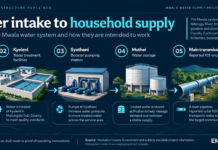
CWWDA’s current project programme includes a 186,000 cubic metre per day water treatment plant, together with a raw-water pumping station and clear-water storage.
The associated transmission system is being developed through three principal corridors.
The South Mainland transmission system includes approximately 28 kilometres of pipeline and a 28,000 cubic metre terminal tank at Dongo Kundu.
The West Mainland system comprises approximately 12 kilometres of transmission pipeline, together with 14,000 cubic metre and 16,000 cubic metre terminal storage facilities at Bonje and Changamwe-Birikani.
The North Mainland system comprises approximately 22 kilometres of transmission pipeline and a 14,000 cubic metre terminal tank at Nguu Tatu.
The wider programme also includes distribution infrastructure.
But these works have not all reached the same stage as the dam.
CWWDA currently lists the treatment plant and several transmission packages at various stages of design, prequalification and bidding.
This creates an important distinction between impoundment and water supply.
When the dam begins filling, Mwache will have crossed an enormous engineering milestone.
It will not, by itself, mean that 186,000 cubic metres of treated water will immediately begin flowing to Mombasa consumers.
The raw water must first be abstracted, treated, stored and transmitted.
The downstream infrastructure must therefore advance broadly in step with the reservoir.
The economics of 186,000 cubic metres a day
The headline figure of 186,000 cubic metres per day is substantial.
At full annual operation, that represents almost 68 million cubic metres of treated water.
For Mombasa, this is important not simply because households need more water.
The Coast is one of Kenya’s most strategically important economic regions.
Mombasa is the country’s principal maritime gateway and supports port operations, logistics, manufacturing, tourism, hospitality, construction and a large service economy.
Kwale is simultaneously undergoing rapid infrastructure and economic development, including industrial, tourism and agricultural activity.
Reliable bulk water is therefore an economic input.
Hotels need it.
Hospitals need it.
Manufacturers need it.
Schools and public institutions need it.
Industrial parks need it.
New housing developments need it.
And agriculture needs predictable water supplies if irrigation is to become a larger part of the coastal economy.
A reliable bulk-water source can consequently have a multiplier effect far beyond the direct value of the water sold.
It can reduce the cost of alternative supplies, improve the reliability of industrial operations, support investment decisions and make urban expansion easier to accommodate.
The World Bank’s original economic analysis found the Mwache investment economically viable under several water-allocation scenarios, with particularly strong returns when the wider benefits of improved water availability were taken into account.
The challenge now is to convert that projected economic value into actual service.
Irrigation is another part of the equation
The dam is also intended to support irrigation in Kwale.
Current project plans have referred to approximately 2,000 hectares of irrigation development, although some Government communications have expressed the area in excess of 6,000 acres.
The irrigation component should nevertheless be treated carefully.
The reservoir may provide the water resource, but the complete irrigation scheme requires its own intake, conveyance, distribution, farm-level infrastructure, drainage, energy systems where required and agricultural-development programme.
The Ministry of Water has been advancing feasibility and preliminary design work for the irrigation component.
That means the irrigation economy around Mwache is still being developed rather than already existing at full scale.
This distinction matters.
A dam can make irrigation possible without automatically creating irrigated agriculture.
The final economic return will depend on what crops are grown, the reliability of supply, farm productivity, market access, energy requirements and the ability of farmers to finance and maintain irrigation infrastructure.
What happens upstream?
The reservoir will fundamentally change the hydrology of the Mwache River basin.
Land upstream of the dam will interact with a large new storage reservoir rather than simply with a flowing river system.
The most direct social consequence is land acquisition and resettlement.
But there is another issue that will determine the reservoir’s long-term performance: sediment.
A reservoir is a storage asset whose useful capacity can decline if large quantities of soil and other sediment are transported into it over time.
Mwache’s catchment is therefore part of the dam’s infrastructure, even though it lies outside the concrete structure itself.
The project has incorporated catchment-management measures intended to reduce erosion and protect the reservoir.
This is a long-term undertaking.
A catchment programme that is effective during construction but abandoned after commissioning would leave the reservoir progressively exposed to sedimentation.
The engineering life of Mwache will consequently depend partly on activities taking place kilometres upstream from the dam.
The upper and lower check dams also have a role in managing sediment and flows within the system.
That is a reminder that the project is not simply one large dam, but a collection of hydraulic and environmental structures designed to work together.
And what happens downstream?
The downstream river system presents a different set of engineering and environmental questions.
Once the reservoir begins operating, river flows will increasingly be governed by the reservoir’s operating regime rather than solely by rainfall.
That provides an opportunity to regulate water availability, but it also means that downstream releases have to be carefully managed.
Environmental flows, river ecology, downstream users and the connection between the river and coastal ecosystems all need to be considered alongside the requirement to store water for Mombasa and Kwale.
The project’s environmental and social safeguards recognise these issues.
For the engineers operating Mwache in future, the central question will be how to balance storage against releases under changing hydrological conditions.
That will become increasingly important as rainfall patterns become less predictable.
The reservoir has been conceived partly as a response to climatic variability.
Its long-term performance will therefore depend on operating the asset under precisely the uncertainty that made the project necessary in the first place.
Water security in a changing climate
Mwache’s value is closely tied to the Coast’s vulnerability to variations in rainfall.
A river can carry substantial flows during wet periods and provide inadequate supply during prolonged dry conditions.
A reservoir changes that equation by storing part of the excess and making it available later.
But storage does not eliminate hydrological risk.
A reservoir can only release water that has first entered it.
If a prolonged drought reduces inflows, the operator must manage the available storage carefully.
Climate variability therefore makes reservoir operation, catchment management and demand forecasting increasingly important.
The project will need accurate hydrological monitoring and a disciplined operating regime to determine how much water can safely be committed to domestic supply, irrigation and environmental releases.
The engineering challenge continues long after construction.
Dam safety begins after completion
Mwache’s transition from construction project to operating infrastructure will also bring a new set of responsibilities.
A large gravity dam requires permanent monitoring.
Instrumentation can be used to monitor parameters such as seepage, deformation, uplift and other indicators of structural behaviour.
The reservoir itself requires monitoring of water levels and inflows.
The spillway and other hydraulic structures must remain available to safely manage flood events.
The foundation drainage and grouting systems must continue to perform as intended.
These systems are not visible to most consumers, but they are fundamental to the safety and longevity of the asset.
The World Bank project incorporated independent dam-safety review arrangements during design and construction.
Once the project is operational, responsibility shifts increasingly towards the institutions responsible for operating and maintaining the dam and associated water infrastructure.
The quality of that long-term institutional management will be just as important as the quality of construction.
The real measure of success
Mwache has generated impressive construction numbers.
An 84-metre-high RCC dam.
A 526-metre crest.
Approximately 610,000 cubic metres of RCC.
Up to 136 million cubic metres of reservoir storage under current project descriptions.
A planned 186,000 cubic metres a day of treated water.
Thousands of hectares of potential irrigation.
These are substantial engineering achievements.
But they are only inputs.
The ultimate test will be what happens after commissioning.
How much water will actually be captured each year?
How much will be treated?
How much will reach consumers?
How much will be lost through the transmission and distribution systems?
How much energy will be required to move and treat it?
How much will the water cost to produce and deliver?
How much agricultural production will irrigation generate?
How many new households and businesses will receive reliable supply?
How effectively will sediment be controlled?
And how well will the dam perform over its design life?
Those questions shift the discussion from construction progress to infrastructure performance.
The October milestone
The planned October 2026 impoundment will mark the beginning of the next chapter in Mwache’s history.
For the first time, the reservoir will begin behaving as the storage system for which the project was conceived.
But filling the reservoir will also expose the project to a different set of tests.
Hydrological assumptions will meet actual river inflows.
Sediment-management measures will begin their long-term work.
Dam instrumentation will start generating data under rising hydraulic loads.
Downstream environmental conditions will have to be monitored.
And the treatment and transmission system will need to advance so that stored water can ultimately become useful water.
The significance of Mwache therefore goes beyond the completion of another major dam.
It represents an attempt to build a new water-security backbone for one of Kenya’s most economically important regions.
Its success will depend on whether the separate pieces of that backbone are completed and operated as one system.
The concrete structure is approaching completion.
The bigger engineering task is making everything connected to it work.
-
Product on sale
 AWEBook Volume 2Original price was: KShs 3,500.00.KShs 3,000.00Current price is: KShs 3,000.00.