Last Updated 2 months ago by Kenya Engineer
Artificial intelligence is often discussed as though it were weightless. Algorithms run in the cloud. Models live on servers. Users interact with applications through screens.
But behind every AI model is an increasingly physical engineering problem.
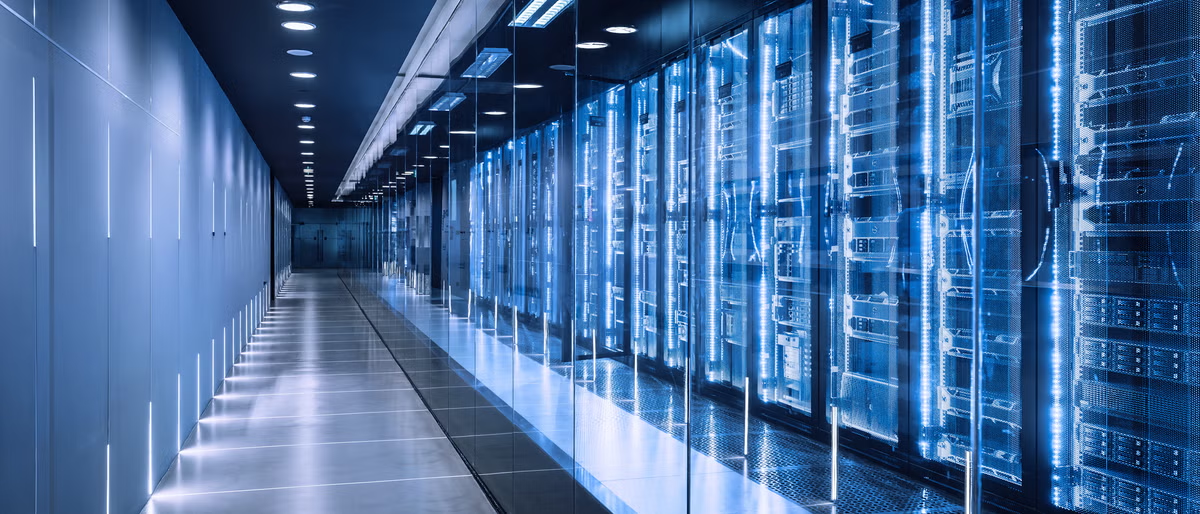
There are servers to power, heat to remove, networks to connect, batteries and UPS systems to protect, control systems to coordinate and buildings capable of carrying the electrical and thermal loads.
That reality was one of the clearest engineering messages to emerge from ITW Africa and Datacloud Africa in Nairobi.
Kenya’s Principal Secretary for ICT and the Digital Economy, Stephen Isaboke, captured the point from a policy perspective when he said that “AI is actually also a physical infrastructure”, linking AI development directly to fibre, data centres, power and trusted data.
For data-centre engineers, the implications are much more specific.
AI is changing the density, architecture and operating model of the data centre.
The rack is becoming the problem
Traditional data-centre design could often treat computing capacity as something spread relatively evenly across a room.
AI changes that assumption.
Accelerated computing packs large numbers of GPUs and other high-performance processors into comparatively small physical spaces. The result is a dramatic increase in the amount of electrical power — and therefore heat — concentrated in an individual rack.
Vertiv’s recent analysis notes that rack densities have risen rapidly, with some current AI platforms reaching hundreds of kilowatts per rack and projections extending considerably higher as accelerated computing develops.
That changes almost everything downstream.
A rack consuming more electricity produces more heat.
More heat requires greater heat-removal capacity.
Greater heat-removal capacity affects cooling architecture.
Higher electrical loads affect busways, switchgear, UPS systems, distribution voltages, transformers and generators.
And once those systems become more densely loaded, the consequences of a failure become more significant.
This is why AI infrastructure cannot simply be treated as “more servers”.
It is a different engineering problem.
When air stops being enough
Air cooling remains fundamental to data-centre infrastructure, but AI’s increasing thermal density is driving greater use of liquid cooling.
The reason is basic physics.
Air has relatively poor heat-transfer characteristics compared with liquid. As more heat is concentrated around processors, removing that heat efficiently becomes increasingly difficult without moving enormous quantities of air and consuming significant cooling energy.
Vertiv has described liquid cooling and direct-to-chip approaches as leading responses to extreme densification. Its current AI infrastructure work also points to the need to consider power and thermal systems together rather than as separate design packages.
That integrated approach is important for Africa.
A data centre designed around AI cannot simply install liquid-cooled servers after the building has been completed and assume the rest of the facility will adapt.
The cooling distribution units, manifolds, pumps, heat-rejection systems, water treatment where applicable, controls, leak detection and electrical systems all become part of the design conversation.
The question therefore changes from: How do we cool the servers? to: How do we engineer the entire thermal chain from the processor to the environment?
Power and cooling can no longer be separated
The same principle applies on the electrical side.
AI workloads are increasing rack power density at precisely the moment when data-centre operators are being asked to improve efficiency, resilience and sustainability.
Vertiv’s recent work points towards higher-voltage power architectures as one response to rising density. Higher voltage can reduce current for a given power transfer, potentially reducing conductor requirements and conversion losses, although it also introduces additional safety and engineering requirements.
This is why the traditional discipline boundaries inside a data-centre project are becoming less comfortable.
Electrical engineers need to understand the thermal consequences of higher-density loads.
Mechanical engineers need to understand the electrical implications of pumps, cooling equipment and heat rejection.
Controls engineers need to understand how IT workloads affect power and thermal behaviour.
And software increasingly becomes part of the physical infrastructure through DCIM, monitoring, automation and predictive control.
The BMS question
Building management systems have traditionally provided an important layer of visibility and control across mechanical and electrical infrastructure.
But AI-ready facilities raise a more difficult question: Is conventional building-level monitoring enough when the IT load itself is becoming highly dynamic?
The answer is increasingly pointing towards tighter integration between IT telemetry, facility controls and infrastructure management.
A modern AI facility may need to understand not simply whether a cooling system is operating, but how workload is changing, where heat is being generated, how much cooling capacity remains available and whether power distribution can accommodate the next workload increase.
That pushes data-centre infrastructure towards a more integrated digital control model.
Vertiv’s broader work on AI infrastructure similarly emphasises full-stack thinking, from grid and power systems through compute and thermal management to heat reuse and operational optimisation.
This is where engineering and data science begin to overlap.
A data centre generates enormous amounts of operational data: temperatures, pressures, electrical loads, UPS conditions, cooling performance, airflow, humidity, equipment status and workload information.
The next generation of infrastructure will increasingly use that information not merely to display what is happening, but to predict what is likely to happen next.
Commissioning becomes more important
There is another consequence that receives less attention than cooling.
As systems become more integrated and complex, commissioning becomes more important.
A conventional facility can have individually functioning electrical, mechanical and controls systems that nevertheless interact in unexpected ways once the IT load is introduced.
AI infrastructure makes that margin for error smaller.
The facility has to prove that power, cooling, controls and IT systems behave correctly not only under normal conditions but under changing loads, failures and transitions.
This is why the industry is moving towards increasingly integrated approaches to validating high-density infrastructure before it becomes operational. Recent industry work on AI data-centre design stresses that power, cooling and compute increasingly need to be planned as a single system rather than independent packages.
Africa has another constraint
For African markets, there is an additional layer. The engineering challenge is not only what happens inside the data hall. It begins outside the fence.
Power availability, grid reliability, transmission capacity, land, fibre connectivity, water availability where relevant, skilled technicians, equipment supply chains and the ability to maintain sophisticated cooling and electrical systems all influence whether an AI-ready facility can actually operate reliably.
That is why the discussions at ITW repeatedly connected AI infrastructure to power and connectivity.
Kenya’s government has explicitly argued that power planning can no longer sit separately from digital infrastructure planning.
The same principle applies at facility level.
The AI data centre of the future cannot be designed as a building with servers placed inside it.
It has to be designed as an integrated energy, thermal, electrical, computing and control system.
The opportunity for African engineers
That may ultimately be one of the most important implications of the AI infrastructure build-out.
Africa’s opportunity is not limited to hosting servers owned by foreign technology companies.
The sector will require electrical engineers, mechanical engineers, civil and structural engineers, controls specialists, network engineers, data scientists, cybersecurity professionals and technicians capable of operating increasingly sophisticated infrastructure.
The skills requirement is already being recognised by policymakers and industry. At ITW, speakers repeatedly linked infrastructure expansion with the need to develop local technical capacity.
For engineers, therefore, AI is not simply creating another technology sector.
It is changing the engineering specification of the digital infrastructure that Africa is building.
The most interesting question may not be whether Africa will build AI data centres.
It is whether the continent can develop the engineering capability to design, commission, operate and optimise them at scale.
That is where the AI opportunity becomes much more than a story about computing.
It becomes an infrastructure story.

-
Product on sale
 AWEBook Volume 2Original price was: KShs 3,500.00.KShs 3,000.00Current price is: KShs 3,000.00.