Last Updated 2 hours ago by Kenya Engineer
Electricity systems are becoming more difficult to manage using conventional forecasting and operational approaches alone. The rapid growth of renewable energy, distributed electricity generation, battery storage, electric vehicles and increasingly digital economies is changing both the supply and consumption of electricity.
For power system operators, the challenge is no longer limited to ensuring that sufficient generation capacity is available to meet anticipated demand. They must also manage greater variability in electricity supply, anticipate changing consumption patterns, monitor increasingly complex networks and respond to disturbances with minimal disruption.
These requirements are creating new opportunities for data science and machine learning in the electricity sector.
Modern power systems generate enormous quantities of information through smart meters, supervisory control systems, digital substations, weather monitoring equipment, generation facilities and network sensors. When properly collected and analysed, this information can help utilities forecast electricity demand, anticipate renewable generation, identify equipment abnormalities and improve decisions about how electricity is generated and distributed.
Machine learning is emerging as an important tool in this transition. Rather than replacing established power system engineering, it is extending the analytical capabilities available to engineers and system operators.
The implications are significant for electricity generation, transmission, distribution and the long-term planning of energy infrastructure.
Why electricity systems need better forecasting
Electricity networks operate under a fundamental requirement: generation and consumption must remain balanced continuously, while voltage, frequency and other operating parameters remain within acceptable limits.
When electricity demand rises, generating resources must respond accordingly. When generation falls unexpectedly, other sources or reserves must compensate. Failure to maintain this balance can affect system frequency and, under severe conditions, lead to widespread outages.
Historically, utilities have relied on statistical forecasting, engineering models, operating experience and established generation scheduling procedures to manage these requirements.
However, electricity systems are becoming more variable.
Solar and wind generation depend on weather conditions. Rooftop solar installations can alter the amount of electricity drawn from distribution networks. Electric vehicles introduce new charging demand, while battery storage creates additional flexibility by allowing electricity to be stored and released when required.
Industrial activity, temperature, rainfall, consumer behaviour, electricity tariffs and economic growth also influence demand.
A forecasting method that performs adequately under relatively stable conditions may struggle when several of these variables change simultaneously.
Machine learning provides additional ways of examining these relationships. Algorithms can analyse historical consumption, weather information, generation records and operational measurements to identify patterns and estimate future conditions.
The value of these predictions is not confined to forecasting demand. They can inform generation scheduling, renewable energy integration, network planning, maintenance and operational risk management.
Machine learning and electricity demand forecasting
Demand forecasting is one of the most established applications of data analytics in electricity systems.
Utilities require forecasts over different time horizons. Short-term forecasts support generation scheduling, reserve planning and operational decisions. Medium-term forecasts help with maintenance planning and resource allocation, while long-term forecasts inform investment in power stations, substations, transmission lines and distribution infrastructure.
Machine learning extends conventional statistical methods by identifying more complex relationships between electricity consumption and the factors influencing it.
These may include:
- Historical electricity consumption and daily demand patterns.
- Temperature, humidity, rainfall and other weather conditions.
- Working days, weekends and public holidays.
- Industrial and commercial activity.
- Electricity tariffs and consumer behaviour.
- Seasonal variations and longer-term economic trends.
Algorithms such as Random Forest, Gradient Boosting, XGBoost and artificial neural networks can be trained using historical datasets to estimate future demand.
For example, a model may learn that electricity consumption in a particular urban area rises during periods of high temperature, while demand in an industrial zone follows production schedules more closely.
The forecasts can then be used to estimate how much electricity will be required at different times and locations.
Better demand forecasting helps system operators plan generation more efficiently, reduce the risk of shortages and make more informed decisions about reserve capacity.
It can also support longer-term infrastructure investment by identifying where demand is likely to grow and which parts of the network may require reinforcement.
The performance of these models must nevertheless be tested against conventional forecasting methods. A more sophisticated algorithm is not automatically a more accurate one, particularly where historical demand patterns are relatively stable or available datasets are limited.
Renewable energy and the forecasting challenge
The growing contribution of renewable energy has made forecasting increasingly important to electricity system management.
Solar and wind power differ from conventional generation because their output depends on environmental conditions that cannot be directly controlled by the electricity operator.
Solar photovoltaic output is influenced by solar irradiance, cloud cover, temperature and the orientation and condition of the panels. Wind turbine output depends on wind speed, direction, turbulence and turbine operating characteristics.
These variables can change over relatively short periods, creating uncertainty for electricity system operators.
Machine learning can combine weather forecasts, satellite observations, historical generation records and information from individual installations to estimate future renewable electricity production.
For a wind farm, an analytical model could use wind speed, direction and atmospheric conditions to forecast generation over the next several hours or days.
For solar installations, models can incorporate cloud movement, solar irradiance, temperature and historical photovoltaic output.
These forecasts allow operators to anticipate changes in renewable generation and plan the availability of other generating resources, storage and demand-side flexibility.
Google’s wind forecasting project
An important early demonstration of this application came from Google and DeepMind.
In February 2019, Google reported applying machine learning to approximately 700 MW of wind generation capacity in its central United States renewable energy portfolio.
The system used a neural network trained on weather forecasts and historical turbine data to predict wind power output 36 hours ahead.
Based on these forecasts, the system recommended how much electricity should be committed to the grid at different times. The objective was to make wind generation more predictable and commercially useful by allowing electricity commitments to be made in advance.
Google reported that the approach increased the estimated value of its wind energy by approximately 20% compared with a baseline without time-based delivery commitments.
The significance of the project was not that machine learning could control the weather or eliminate variability in wind generation. Rather, better forecasts enabled the operator to make more informed decisions about when and how much electricity could be delivered.
The case illustrates how data science can help integrate variable renewable generation into electricity systems without changing the underlying physical characteristics of the energy source.
Optimising electricity generation and dispatch
Forecasting demand and renewable generation is only part of the challenge. Electricity system operators must also determine how available generating units should be scheduled to meet demand at the lowest feasible cost while maintaining system security.
Two important processes are unit commitment and economic dispatch.
Unit commitment determines which generating units should be operating or available over a specified period. Economic dispatch determines how much electricity each operating unit should supply.
These decisions must consider generation capacity, fuel availability, operating costs, minimum generation levels, ramp rates, maintenance schedules, transmission constraints and system reserves.
Machine learning can improve these processes by providing better forecasts of demand, renewable generation, equipment availability and potential network constraints.
The forecasts can then be incorporated into optimisation models that determine feasible operating schedules.
For example, if a wind farm is expected to experience a significant decline in output during the evening, the system operator can use the forecast to assess whether additional geothermal, hydroelectric, thermal generation or stored electricity will be required.
It is important to distinguish between prediction and optimisation. Machine learning estimates what is likely to happen, while power system optimisation models determine how the available generating resources should be scheduled within technical and operational constraints.
The combination provides a more informed basis for electricity dispatch.
Making transmission networks more intelligent
Transmission networks transport electricity from generating stations to major consumption centres through high-voltage lines and substations.
Their operation involves complex relationships between voltage, current, frequency, power flows, impedance and system stability.
Transmission operators must ensure that the network can accommodate changing electricity flows without exceeding the thermal, voltage or stability limits of its components.
Traditionally, these decisions have relied on engineering models, network studies, supervisory control systems and contingency analysis.
Machine learning is adding new capabilities to this process.
Congestion forecasting: Analytical models can help identify when transmission corridors are likely to approach their operating limits, allowing operators to examine alternative dispatch arrangements or network interventions.
Fault detection: Abnormal electrical measurements can be analysed to identify patterns associated with equipment faults or developing defects.
Dynamic line rating: Weather and conductor measurements can be combined to estimate the safe electricity-carrying capacity of transmission lines under prevailing conditions. This can help operators make better use of existing infrastructure where conventional ratings are conservative.
Vegetation monitoring: Drone and satellite imagery can be analysed to identify vegetation encroachment, damaged structures and other risks along transmission corridors.
Contingency screening: Machine learning can help screen large numbers of possible network disturbances and identify scenarios requiring detailed engineering assessment.
These applications can improve network visibility and support more efficient use of existing transmission infrastructure.
What the International Energy Agency is reporting
The International Energy Agency’s report, Modernising Grids in the Age of Electricity, published in September 2026, provides a useful assessment of how digital technologies and artificial intelligence are being introduced into electricity networks.
The report identifies forecasting, fault detection, diagnosis, asset monitoring, simulation and optimisation as important functions of AI in grid planning and operation.
It also documents deployments by several electricity system operators.
In France, the transmission system operator Réseau de Transport d’Électricité (RTE) has used AI-supported contingency screening, with the IEA reporting that the approach performs security assessments approximately 20 times faster than manual assessment.
In the United Kingdom, the National Energy System Operator (NESO) has used improved solar forecasting, with estimated annual reserve-cost savings of approximately £30 million.
In the United States, the California Independent System Operator (CAISO) has used AI-supported outage processing to reduce processing times from several hours to a few minutes.
China Southern Power Grid has also expanded the use of visual intelligence in transmission-line inspection. The IEA reports that the network’s line length nearly doubled over a decade while inspection staffing increased from approximately 60 to 80 people.
The examples demonstrate that AI applications in electricity networks are moving beyond research and experimentation. They are increasingly being incorporated into planning, inspection and operational workflows.
The IEA also highlights an important distinction: forecasting, inspection and decision-support applications are generally more mature than systems that allow AI to make direct, real-time control decisions affecting network operation.
Distribution networks: Understanding what happens closer to consumers
The transformation of electricity systems is also taking place at the distribution level.
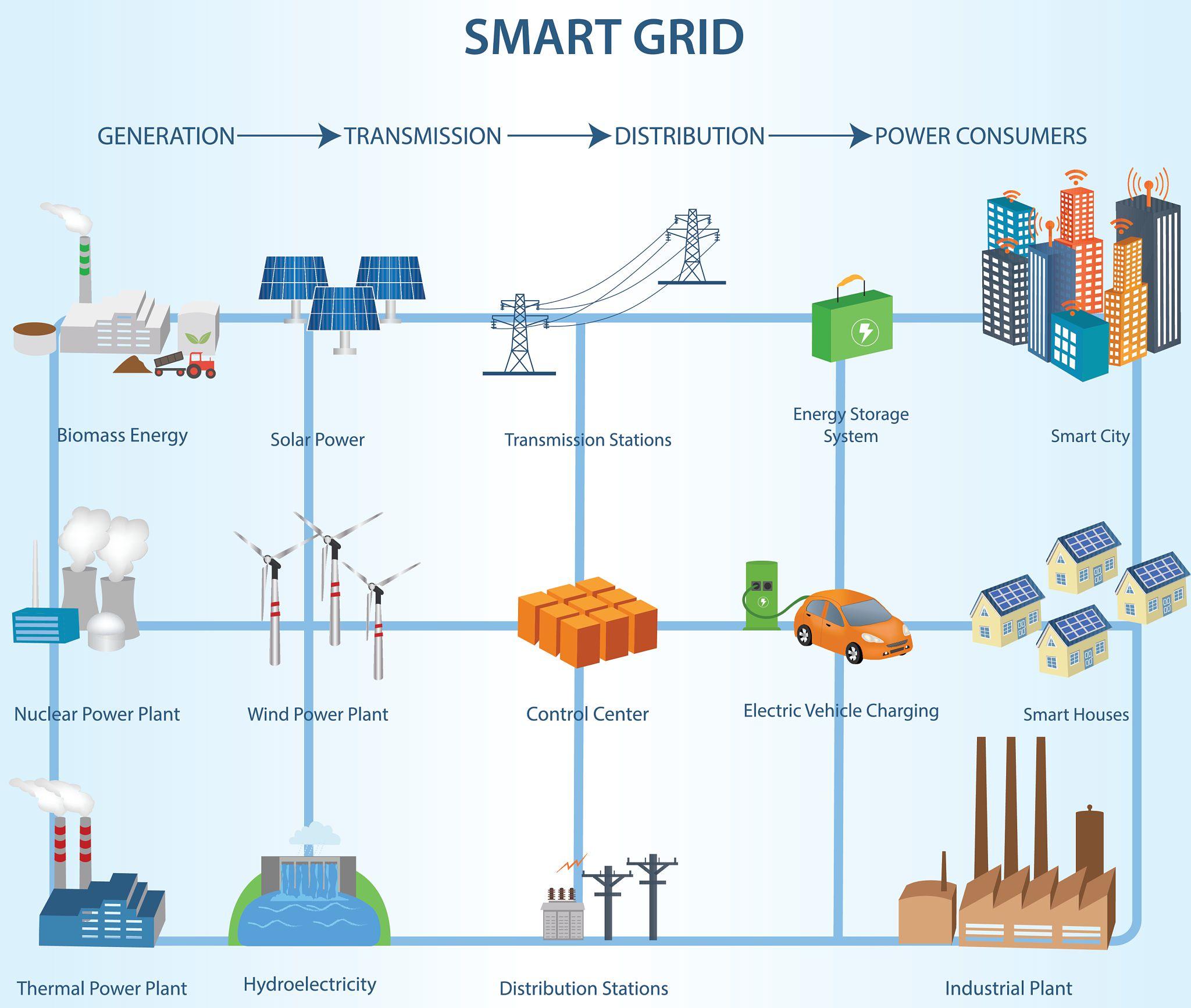
Traditionally, electricity flowed from high-voltage transmission networks through substations and progressively lower-voltage distribution infrastructure to consumers.
The increasing use of rooftop solar, battery storage, electric vehicle charging and other distributed energy resources is changing this arrangement.
Consumers can increasingly become electricity producers as well as users. Electricity may flow in different directions, while local demand and generation can vary significantly between locations.
Distribution utilities consequently require more detailed information about the condition and behaviour of their networks.
Smart meters, distribution automation systems, transformer monitoring equipment and other sensors provide additional information that can be analysed using machine learning.
One application is identifying overloaded distribution transformers. By examining smart meter readings, transformer loading and consumption patterns, a utility can identify areas where demand is approaching equipment capacity.
Another is detecting abnormal consumption patterns that may indicate electricity theft, meter problems or technical faults.
Machine learning can also support fault location, isolation and service restoration, commonly known as FLISR. These systems help distribution operators identify the likely location of a fault and determine how unaffected sections of a network can be restored.
Other applications include voltage monitoring, local demand forecasting, distributed generation management and prioritisation of network reinforcement.
The wider objective is to move towards distribution networks with greater visibility, where operational decisions are informed by more detailed and timely information.
Digital substations and the emergence of intelligent grids
The application of machine learning is being reinforced by advances in the physical and digital infrastructure of electricity networks.
Digital substations integrate protection, control, measurement and communication systems, allowing equipment to exchange information and enabling more extensive monitoring.
Phasor Measurement Units (PMUs) provide time-synchronised measurements of electrical quantities, including voltage and current phasors. Their information can support wide-area monitoring and help engineers understand the dynamic behaviour of electricity systems.
When these measurements are combined with SCADA information, smart meter data and analytical platforms, operators can obtain a more comprehensive picture of network performance.
Digital twins take the concept further by creating digital representations of physical electricity assets and systems.
A digital twin of a substation, for example, could combine equipment specifications, electrical measurements, maintenance histories and operational data. Engineers could use the model to assess asset condition, examine different operating scenarios and support maintenance planning.
Machine learning can help identify abnormal behaviour and estimate how equipment or network components may perform under changing conditions.
However, these systems depend on reliable measurements and sound engineering models. A digital representation is only as useful as the information and assumptions on which it is built.
Grid security, resilience and the limits of artificial intelligence
Electricity networks must be capable of responding to disturbances such as equipment failures, sudden changes in demand, extreme weather and faults on transmission or distribution infrastructure.
Machine learning can improve the identification and diagnosis of unusual system behaviour.
Anomaly detection models can examine voltage, current, frequency and equipment measurements against established operating patterns. Unusual behaviour may indicate developing faults, abnormal loading or other conditions requiring investigation.
Machine learning can also help analyse weather and infrastructure information to identify areas where storms, flooding, heat or vegetation encroachment could threaten electricity supply.
However, electricity systems are governed by physical laws. Power flows, voltage stability, frequency response, fault currents and thermal limits cannot be established reliably through statistical prediction alone.
Machine learning models learn relationships from data. They do not automatically understand every physical constraint governing the network.
This creates particular concerns when AI is introduced into safety-critical control systems.
A model that produces an inaccurate forecast may create additional operating costs. A model recommending an inappropriate switching operation or misjudging a network constraint could have much more serious consequences.
For this reason, machine learning should operate within established engineering protection, control and safety frameworks.
Hybrid approaches that combine machine learning with power system simulations, physical constraints, deterministic controls and human oversight offer a more appropriate route towards increasingly automated electricity networks.
The IEA’s 2026 assessment similarly observes that applications involving forecasting, inspection, maintenance and planning have advanced further than AI systems entrusted with direct real-time control.
Lessons for Africa
Africa’s electricity systems differ considerably in their generation mix, network coverage, electricity demand patterns and levels of digitalisation. Nevertheless, the need for better forecasting, improved asset management and more efficient network operation is common across the continent.
The opportunities for applying machine learning are particularly relevant as countries expand electricity access, integrate renewable generation and strengthen existing transmission and distribution infrastructure.
Kenya offers an interesting case because of its renewable electricity base, growing electricity demand and the increasing importance of digital infrastructure in the energy sector.
Improving electricity demand forecasting
Demand forecasting is a practical starting point.
A study published in Energy Informatics on 5 October 2026, titled Predictive Modelling of Urban Residential Power Consumption: An Explainable AI Approach to the Kenyan Prepaid Grid, examined electricity consumption in Kenya’s prepaid residential sector.
The researchers analysed a longitudinal dataset covering January 2017 to April 2026, incorporating historical electricity consumption, meteorological information and tariff-related variables.
They compared an XGBoost machine learning model with Ordinary Least Squares regression and a simple persistence benchmark.
XGBoost achieved a mean absolute error of 19.78 kWh, marginally better than the 20.03 kWh recorded by the conventional regression model. However, the regression model performed slightly better on root mean square error.
The study also found that recent electricity consumption history was substantially more influential in the predictions than weather and tariff variables.
This is an important result because it demonstrates that a more sophisticated machine learning model does not necessarily produce a substantial improvement over simpler statistical techniques.
The research provides a useful foundation for examining how Kenyan residential consumption patterns can be analysed to improve forecasting. It also highlights the importance of model transparency, appropriate benchmarks and testing against data from periods not used in model development.
Integrating renewable energy more effectively
Kenya has an established renewable electricity base, including geothermal, hydroelectric, wind and solar generation.
As variable renewable energy becomes more prominent, better forecasting can help system operators anticipate changes in available supply and prepare appropriate generation and reserve arrangements.
Machine learning could support solar and wind generation forecasts by combining weather information, historical generation records and operational data from individual installations.
This is particularly relevant as distributed solar installations and commercial and industrial renewable energy systems become more prominent.
The objective would be to improve the predictability of available electricity and help operators coordinate different generation resources more effectively.
Improving transmission and distribution reliability
Electricity distribution infrastructure faces challenges involving equipment failures, network congestion, technical losses and the difficulty of obtaining timely information from widely dispersed assets.
Machine learning could help utilities identify abnormal consumption patterns, prioritise transformer inspections, detect equipment deterioration and analyse outage records.
For Kenya Power, improved integration of smart metering, distribution automation, asset information systems and analytical platforms could strengthen network visibility and support more informed operational decisions.
A 2025 research paper, Data Stream Mining Techniques for Real-Time Monitoring and Control of Smart Power Grids in Kenya: Challenges and Opportunities, examined the potential for advanced data analytics in the Kenyan electricity system.
The researchers identified limitations involving data quality, computing infrastructure, technical skills, cost and the ability of existing systems to handle large volumes of rapidly changing information.
They proposed approaches including machine learning, adaptive clustering and edge computing as possible ways of improving fault detection, monitoring and network management.
The study is useful in identifying the opportunities and constraints, although its findings should be understood as a research assessment rather than an independent operational audit of every electricity utility’s systems.
Building local technical capacity
The transition towards data-driven electricity systems requires professionals who understand both power engineering and data science.
Electrical engineers, control engineers, data scientists, software developers and cybersecurity specialists will increasingly need to work together.
Universities and technical institutions can contribute by developing research and training programmes that combine power systems engineering, machine learning, statistical analysis and digital infrastructure.
Local research partnerships with utilities would also help develop models using actual operating conditions and electricity consumption patterns rather than relying exclusively on datasets developed in other countries.
The objective should be to build local analytical capacity alongside the physical infrastructure required to support digital electricity networks.
The infrastructure behind the intelligent grid
There is another dimension to the relationship between electricity and artificial intelligence that deserves attention.
The digital technologies used to monitor and manage power systems require substantial physical infrastructure. Smart grids depend on reliable communications networks, sensors, meters, data centres, computing platforms, cybersecurity systems and sophisticated control equipment.
These technologies consume electricity and require engineering support throughout their operational lives.
At the same time, the rapid expansion of artificial intelligence data centres is creating an additional source of electricity demand. Large computing facilities require reliable power supplies, backup generation, cooling systems and network connections.
The relationship between electricity and artificial intelligence is therefore becoming increasingly interconnected.
Electricity networks must support the growth of digital infrastructure, while machine learning and other analytical technologies are being used to improve the performance of those same networks.
This creates opportunities for electrical, electronic, telecommunications, computer and civil engineers to contribute to the development of more intelligent energy systems.
Towards a more intelligent electricity system
The application of machine learning to electricity generation and distribution is not a replacement for conventional power system engineering. It is an additional analytical capability that allows engineers and system operators to work with larger volumes of information and anticipate operating conditions more effectively.
The most immediate benefits are likely to emerge in demand forecasting, renewable generation prediction, equipment condition monitoring, outage analysis and network planning.
More advanced applications involving automated network control will require rigorous validation, reliable data infrastructure, cybersecurity safeguards and clearly defined engineering accountability.
For African electricity systems, the opportunity is to introduce these capabilities in ways that address practical operational challenges rather than pursuing digitalisation for its own sake.
For Kenya, improved electricity forecasting, better asset monitoring and more intelligent distribution network management could support the wider ambitions of reliable, affordable and increasingly renewable electricity.
Ultimately, the success of the data-driven grid will not be measured by the sophistication of its algorithms. It will be measured by whether electricity systems become more reliable, efficient, resilient and responsive to the needs of the people and industries they serve.
References and further reading
- International Energy Agency (2026), Modernising Grids in the Age of Electricity. https://www.iea.org/reports/modernising-grids-in-the-age-of-electricity
- International Energy Agency (2026), AI-Enhanced Solutions. https://www.iea.org/reports/modernising-grids-in-the-age-of-electricity/ai-enhanced-solutions
- Google DeepMind (2019), Machine Learning Can Boost the Value of Wind Energy. https://deepmind.google/blog/machine-learning-can-boost-the-value-of-wind-energy/
- Obasanjo, P., Mutinda, A. & Awuor, A. (2026), Predictive Modeling of Urban Residential Power Consumption: An Explainable AI Approach to the Kenyan Prepaid Grid, Energy Informatics. https://doi.org/10.1186/s42162-026-00696-9
- Mulevu, C.M., Okeyo, G.O. & Wafula, J.M. (2025), Data Stream Mining Techniques for Real-Time Monitoring and Control of Smart Power Grids in Kenya: Challenges and Opportunities, Discover Internet of Things. https://doi.org/10.1007/s43926-025-00146-0

-
Product on sale
 AWEBook Volume 2Original price was: KShs 3,500.00.KShs 3,000.00Current price is: KShs 3,000.00.