Last Updated 56 mins ago by Kenya Engineer
A railway operator does not have to wait for a broken overhead power line to discover that something is wrong. A power utility does not necessarily need to wait for a transformer to fail before identifying deteriorating insulation. Nor should an industrial plant have to experience an unexpected shutdown before recognising that a critical motor is developing a mechanical fault.
In many cases, the physical failure is the final stage of a deterioration process that has been developing for weeks, months or even years. The challenge for infrastructure operators has traditionally been detecting that deterioration early enough to intervene.
Advances in sensor technology, condition monitoring, data analytics and machine learning are changing how this challenge is approached. Equipment that was previously inspected at intervals can increasingly be monitored through continuous or more frequent measurements. Historical operating records can be combined with real-time information to identify abnormal behaviour, assess the likelihood of failure and help engineers determine when maintenance should be undertaken.
This is the basis of predictive maintenance, an approach that is gradually changing asset management across electricity networks, railways, manufacturing facilities, transport infrastructure and other engineering-intensive industries.
The transition is significant because the cost of infrastructure failure extends well beyond the price of replacing a damaged component. It can include service interruptions, lost production, emergency procurement, safety risks, environmental damage and disruption to businesses and communities that depend on the affected infrastructure.
The limitations of traditional maintenance
Maintenance programmes have traditionally relied on two principal approaches: reactive and preventive maintenance.
Reactive maintenance involves repairing or replacing equipment after a failure has occurred. Although unavoidable in certain circumstances, relying heavily on this approach can expose operators to unplanned expenditure and operational disruption. A failed pump may interrupt water supply, a damaged transformer may affect an entire distribution area, while the failure of a railway signalling component can disrupt transport services.
Preventive maintenance attempts to reduce these risks through scheduled inspections, servicing and component replacement. Interventions are planned according to operating hours, calendar intervals, manufacturer recommendations or established engineering standards.
The approach is valuable, but it has limitations. Equipment does not deteriorate uniformly. Two machines of the same model, installed at the same time, may experience different operating loads, environmental conditions and maintenance histories. Consequently, one may remain in good condition while the other develops a serious defect.
Replacing components solely because they have reached a predetermined operating age can result in unnecessary expenditure. Conversely, equipment approaching failure may deteriorate between scheduled inspections.
Predictive maintenance addresses this problem by placing greater emphasis on the actual condition and behaviour of an asset.
Rather than asking only when equipment was last serviced or how many hours it has operated, engineers can examine what the equipment is currently revealing about its condition.
How data science enables predictive maintenance
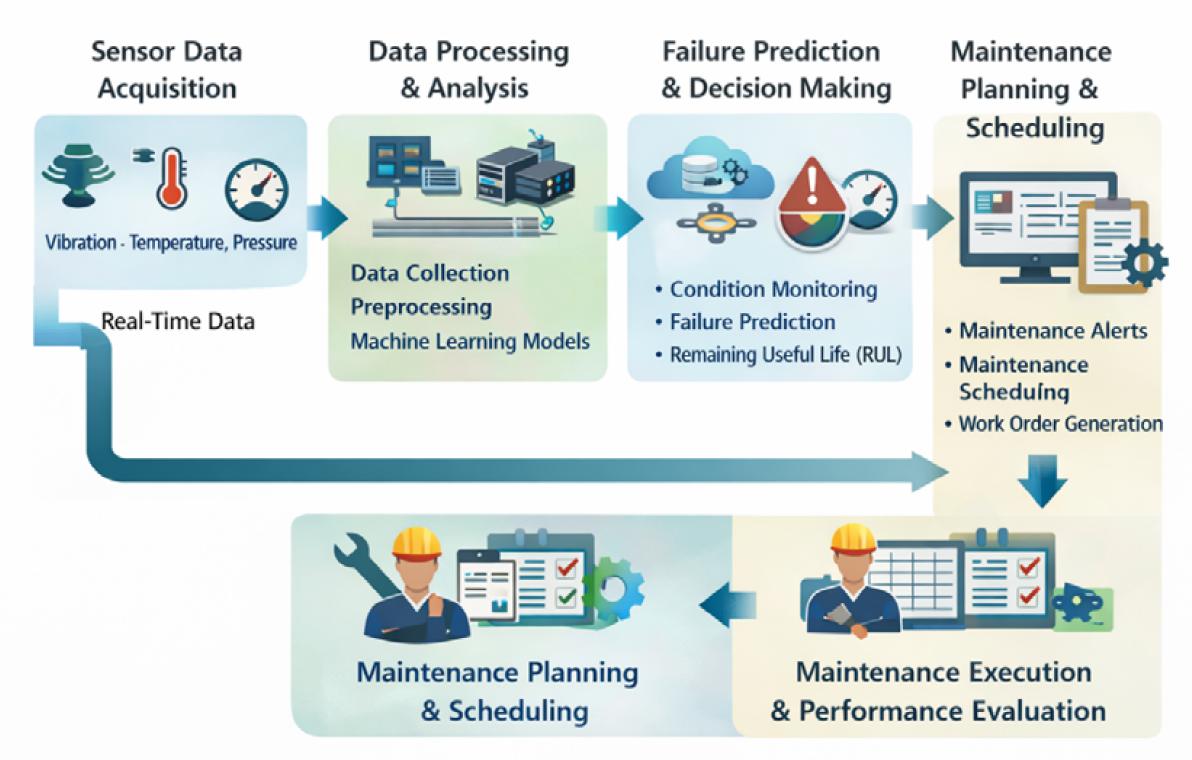
Predictive maintenance combines engineering diagnostics with statistical analysis and machine learning. Its effectiveness depends on the quality of information collected, the ability to interpret equipment behaviour and the translation of analytical findings into practical maintenance decisions.
The process generally involves four interconnected stages.
Condition monitoring and data acquisition
The starting point is obtaining reliable measurements from the equipment being monitored.
Industrial assets can generate information through sensors, Supervisory Control and Data Acquisition (SCADA) systems, programmable logic controllers, smart meters and dedicated diagnostic equipment.
Depending on the asset, measurements may include temperature, vibration, pressure, electrical current, voltage, rotational speed, acoustic emissions, operating hours and lubricant condition.
For a rotating machine, vibration measurements can reveal developing bearing or alignment problems. In a power transformer, oil temperature, dissolved gas analysis, moisture content and electrical loading provide information about insulation condition and internal faults.
Measurements may be collected continuously, at defined intervals or during scheduled diagnostic inspections.
Data preparation and engineering interpretation
Raw measurements are not automatically useful. They may contain noise, missing readings, communication errors or variations caused by changes in operating conditions.
Engineers must establish what constitutes normal behaviour for a particular asset and distinguish genuine deterioration from ordinary operational variation.
For example, an increase in motor temperature may indicate a developing fault, but it could also result from higher loading or changes in ambient temperature. An analytical model that ignores these factors may generate unnecessary warnings.
Historical maintenance records, equipment specifications, operating conditions and known failure mechanisms are therefore important components of the analysis.
Predictive modelling
Statistical and machine learning methods can then be used to identify patterns associated with developing faults.
Anomaly detection algorithms identify behaviour that differs from established operating patterns. Classification models can estimate whether an asset exhibits characteristics associated with a particular fault. Regression and time-series models can estimate changes in operating parameters, while survival analysis can help assess the probability of an asset remaining operational over a specified period.
The choice of technique depends on the equipment, available data and the maintenance decision being supported.
Importantly, not every predictive maintenance application requires artificial intelligence. Established statistical methods, engineering thresholds and conventional condition-monitoring techniques remain effective in many situations. Machine learning becomes particularly useful where large datasets contain complex relationships that are difficult to identify through conventional analysis.
Maintenance planning and intervention
The final stage is converting analytical findings into an engineering decision.
A system may identify an unusual vibration pattern in a pump or a deterioration trend in a transformer. Maintenance personnel must then investigate the warning, establish its significance and determine whether further testing, repair or replacement is required.
The appropriate intervention may be an immediate shutdown, a scheduled inspection, an increase in monitoring frequency or the procurement of replacement components ahead of a planned maintenance window.
The purpose is not to automate every maintenance decision. It is to provide engineers with better information and sufficient warning to act before a developing problem becomes an operational failure.
Predictive maintenance in practice
The application of data-driven maintenance is no longer confined to research laboratories. Railway operators, electricity utilities and renewable energy companies are already using advanced monitoring and analytical systems to improve the management of critical assets.
Railway infrastructure: Detecting defects through optical fibre sensing
One particularly interesting development comes from research undertaken at The Hong Kong Polytechnic University.
Researchers developed an optical fibre-based monitoring system designed to identify defects in railway tracks, overhead power lines, train wheels and structural components of railway vehicles.
The system uses specialised fibre optic sensors to measure physical changes such as strain, temperature, displacement and vibration. These measurements are analysed to identify developing abnormalities in railway infrastructure and rolling stock.
The technology was deployed on Hong Kong’s MTR network, where five systems were installed, and Singapore’s SMRT network, where two systems were installed in 2014 and 2016 respectively.
Its capabilities were demonstrated in the Netherlands in 2015. The monitoring system detected a developing overhead power-line defect along the Amsterdam–Schiphol Airport railway corridor several weeks before the anticipated failure.
The importance of this development lies in how infrastructure monitoring can be integrated into railway operations. Instead of relying exclusively on dedicated inspection activities, trains operating on the network can also contribute information about the condition of tracks, overhead lines and other components.
It is worth noting that this is a sensor-based, data-driven predictive maintenance system; its significance does not depend on describing every part of the technology as artificial intelligence.
The example demonstrates how engineering instrumentation, continuous measurements and analytical techniques can work together to provide earlier warnings of infrastructure deterioration.
Wind energy: Identifying turbine problems through SCADA data
Wind turbines present a particularly challenging maintenance environment, especially in offshore installations where accessing equipment can be expensive and weather-dependent.
Modern wind turbines generate substantial quantities of operational information through SCADA systems. These records include wind speed, rotational speed, generator temperature, gearbox temperature, electrical output and other operating parameters.
Researchers at the University of Edinburgh examined how machine learning could be used to identify developing faults in wind turbine pitch systems.
In a 2021 study published in Energies, the researchers used an Isolation Forest anomaly-detection algorithm to analyse SCADA data from turbines with hydraulic and electric pitch systems.
The study examined two case studies and found that abnormal behaviour could be detected approximately 12 to 18 months before failure in the unhealthy turbines investigated.
The findings are particularly relevant because pitch systems regulate the angle of turbine blades and are important for controlling power output and protecting turbines under changing wind conditions.
A developing fault in this system can affect turbine performance and potentially lead to costly repairs or downtime.
The research demonstrated how historical operational data can reveal changes in equipment behaviour long before a failure becomes immediately apparent. However, the reported warning period relates to the specific turbines and cases examined and should not be interpreted as a universal prediction capability for wind turbines.
Electricity utilities: Managing ageing transformer fleets
Electricity utilities face the challenge of maintaining large numbers of transformers, circuit breakers, transmission lines and other assets, many of which operate for several decades.
A case study published by Hitachi Digital Services describes a US electricity and gas utility managing ageing infrastructure, including transformers and substation equipment that had been operating for more than 40 years.
The utility had relied on scheduled inspections but faced difficulties consolidating equipment information held in different systems. The company deployed an asset performance management platform that combined transformer nameplate information, dissolved gas analysis, oil tests, electrical tests, inspection records and maintenance histories.
Predictive analytics and asset performance models were used to assess equipment condition and prioritise maintenance according to risk.
According to the vendor’s case study, the platform identified a transformer approaching failure, allowing the utility to intervene before an unexpected outage occurred.
The example illustrates an important aspect of predictive maintenance that is sometimes overlooked: the value of analytics does not come exclusively from sophisticated algorithms. Consolidating fragmented equipment records and making reliable condition information accessible to maintenance engineers can itself produce significant operational benefits.
Predicting failure is not the same as predicting the future
One of the common misconceptions surrounding predictive maintenance is that an analytical system can determine the exact date and time when a machine will fail.
In practice, most systems estimate the probability of failure, identify abnormal behaviour or assess the likelihood of deterioration within a defined period.
For an infrastructure operator, this information is often more useful than a precise-looking failure date.
Maintenance decisions must consider three important factors: the probability of failure, the consequences of failure and the cost and feasibility of intervention.
A transformer with a relatively low probability of failure may still deserve urgent attention if its failure could interrupt electricity supply to a major industrial area or critical public facility.
Conversely, a developing defect in a non-critical component may be monitored until an appropriate maintenance window becomes available.
This is the basis of risk-based asset management. Predictive analytics improves the information available to engineers, while reliability engineering and asset criticality determine how that information should influence maintenance priorities.
The implementation challenge
Despite the potential benefits, predictive maintenance is not achieved simply by installing sensors and purchasing an analytics platform.
Data quality is a fundamental requirement. Many infrastructure operators have maintenance records spread across paper files, spreadsheets and disconnected information systems. Historical failure records may be incomplete, while equipment measurements may not have been collected consistently.
There is also the challenge of rare failures. Major equipment breakdowns are relatively uncommon compared with normal operating conditions. This means that a machine learning model may have very few confirmed failure examples from which to learn.
A model can appear highly accurate because it correctly identifies normal operation while still failing to detect the relatively rare events that maintenance teams most need to anticipate.
Integration is another concern. Predictive maintenance platforms must work with existing SCADA systems, enterprise asset management software and maintenance management processes. The analytical output must reach the people responsible for making and implementing maintenance decisions.
Cybersecurity also becomes increasingly important as more operational equipment is connected to digital monitoring systems. Industrial control networks must be protected through appropriate access controls, network segmentation, monitoring and security procedures.
Finally, operators must establish whether the cost of sensors, communications infrastructure, software, data storage and specialist personnel is justified by the expected reduction in failures and downtime.
A carefully selected pilot involving a small number of critical assets is often a more sensible starting point than attempting to digitise an entire infrastructure network at once.
Lessons for Africa
The opportunity for predictive maintenance in Africa is considerable. Many countries are expanding electricity, transport, water and industrial infrastructure while simultaneously managing ageing assets and constrained maintenance budgets.
The challenge is to maintain reliable services while ensuring that limited resources are directed towards the equipment and infrastructure most likely to require attention.
Electricity transformers, generation equipment, water pumping stations, industrial machinery and critical transport infrastructure offer potential starting points.
Water utilities, for example, could monitor pump vibration, motor temperature, pressure, energy consumption and operating hours. Changes in these measurements could help identify developing mechanical problems before they interrupt water supply.
Electricity utilities could consolidate transformer loading records, oil-testing results, maintenance histories and temperature measurements to improve equipment condition assessment.
Railway and road agencies could explore the use of drone imagery, remote sensing and structural monitoring technologies to improve the frequency and quality of infrastructure inspections.
These applications do not necessarily require expensive, fully automated monitoring systems from the outset. A utility could begin by digitising its asset register and maintenance history, introducing condition-monitoring equipment on selected assets and developing analytical models around specific failure mechanisms.
Local universities and engineering institutions also have an important role to play. Research partnerships with infrastructure operators could help develop predictive maintenance models using local operating data and conditions rather than relying entirely on solutions developed for different environments.
The quality of the underlying information will be decisive. Without reliable asset registers, standardised maintenance records and dependable measurements, even sophisticated analytical platforms will struggle to deliver meaningful results.
From maintaining equipment to managing asset performance
Predictive maintenance is part of a broader change in infrastructure management. Increasingly, physical assets are being connected to digital monitoring systems, simulation platforms and decision-support tools.
Digital twins extend this approach by creating digital representations of physical assets and infrastructure systems. These representations can be updated using operational measurements, maintenance records and engineering information, allowing operators to assess performance and examine possible interventions under different conditions.
When combined with predictive analytics, digital twins can help engineers understand how an asset is likely to behave as operating conditions change.
The objective is not to remove engineers from maintenance decisions or eliminate physical inspections. It is to give them better information, more time to respond and a clearer basis for allocating maintenance resources.
For infrastructure operators, the benefits could include fewer unexpected breakdowns, improved equipment utilisation, more efficient maintenance scheduling and better service reliability.
The transition requires investment in data infrastructure, technical skills, reliable measurement systems and organisational readiness. But as infrastructure networks become more complex and the cost of unplanned failures increases, the ability to identify deterioration before it becomes a breakdown is becoming an increasingly important engineering capability.
The future of infrastructure maintenance will depend not only on how quickly organisations can respond when equipment fails, but also on how effectively they use engineering data to prevent those failures in the first place.
References and further reading
- Hong Kong Polytechnic University / University Grants Committee, Optical Fibre-Based Data-Driven Predictive Maintenance System, Research Assessment Exercise Impact Case Study. https://impact.ugc.edu.hk/case-study/uoa12-polyu-impact-case-study-003
- McKinnon, C. et al. (2021), Investigation of Isolation Forest for Wind Turbine Pitch System Condition Monitoring Using SCADA Data, Energies, 14(20), 6601. https://doi.org/10.3390/en14206601
- Hitachi Digital Services, A Regulated US Utility Prevents Critical Asset Failures with Predictive Intelligence. https://www.hitachids.com/customer-stories/a-regulated-us-utility-prevents-critical-asset-failures-with-predictive-intelligence/

-
Product on sale
 AWEBook Volume 2Original price was: KShs 3,500.00.KShs 3,000.00Current price is: KShs 3,000.00.