

Last Updated 58 mins ago by Kenya Engineer
As rooftop solar becomes increasingly common in Kenyan homes, businesses and institutions, a new question is becoming more important: what happens when a solar installation produces more electricity than the customer is using?
The answer isn’t that the surplus disappears. Depending on how the system has been designed and configured, excess electricity can either be stored, curtailed, diverted to other loads or exported to the electricity distribution network.
That last possibility is where Kenya’s net-metering framework becomes important.
Recent public discussion around unauthorised electricity exports has raised questions among solar customers about whether their installations are feeding power into the Kenya Power network and, if so, whether they are permitted to do so. The underlying issue is broader than a warning about penalties. It concerns the transition from a traditionally one-directional electricity system, where customers consume electricity from the grid, to one in which customers can also generate and supply electricity to it.
What does it mean to feed electricity into the grid?
Consider a house with a grid-connected solar photovoltaic system.
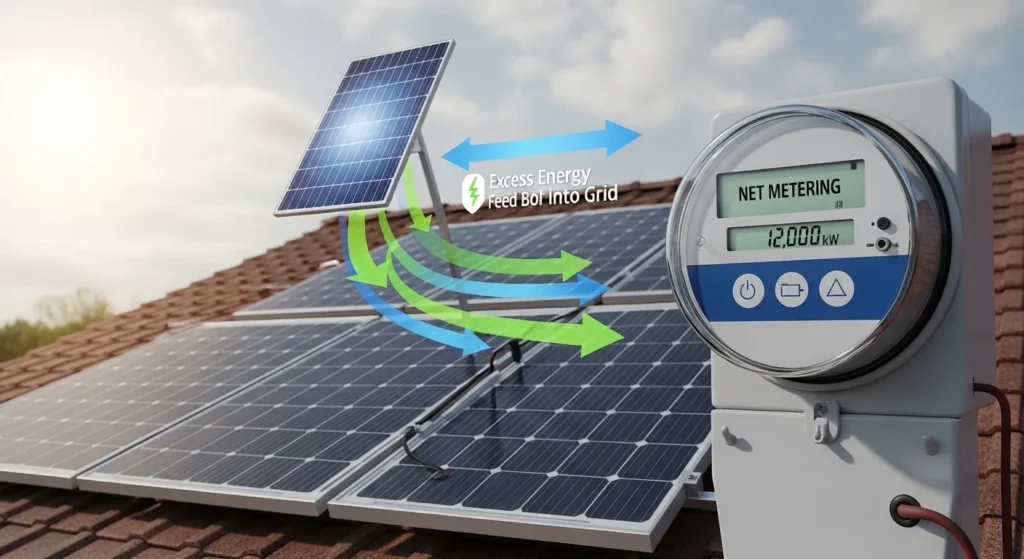
At 11 a.m., the solar panels may be producing 3 kW while the house is consuming only 1.5 kW. If the system is configured to export electricity, the difference — approximately 1.5 kW at that instant — can flow through the connection into the distribution network.
The direction of electricity flow has therefore changed. Instead of all electricity moving from the utility towards the customer, some is moving from the customer’s installation towards the grid.
This is commonly referred to as electricity export or reverse power flow.
It is important to distinguish this from simply having a solar system that produces more electricity than the house currently needs. A system may be configured so that excess production is curtailed, used to charge a battery or directed to another available load. In a zero-export configuration, for example, the inverter regulates the system so that electricity does not intentionally flow into the utility network.
Therefore, the presence of a solar inverter does not by itself mean that a customer is exporting electricity to Kenya Power.
Where does net metering come in?
Kenya’s Energy (Net-Metering) Regulations, 2024 provide a formal framework for consumers who want their renewable-energy systems to operate in parallel with the electricity distribution network and export electricity when they have excess generation.
EPRA defines net metering as a mechanism that allows consumers to supply electricity to the grid during periods of overproduction and subsequently make use of credited energy during other periods. The system uses a net meter capable of measuring electricity supplied to and received from the customer.
In practical terms, this means that a customer with an approved net-metering arrangement can generate electricity during the day, use what is needed on site and export qualifying surplus electricity to the grid. Electricity subsequently supplied by the utility is accounted for through the net-metering billing mechanism.
The framework is therefore not simply an arrangement for “selling solar power to Kenya Power”. It is a mechanism for accounting for electricity flowing in both directions between the customer and the distribution network.
Who qualifies for net metering?
The regulations apply to renewable-energy technologies with an installed capacity of less than 1 MW.
For domestic customers, the installed capacity eligible under the net-metering framework is capped at 4 kW for single-phase supply and 10 kW for three-phase supply.
For commercial and industrial customers, the regulations allow systems up to 1 MW, subject to the applicable maximum-load-demand requirements.
This distinction is important.
A 3.6 kW domestic solar system, for example, falls below the 4 kW limit applicable to domestic single-phase net-metering systems. But that does not automatically mean that the system has permission to export electricity.
The capacity threshold and the authorisation to export are separate issues.
Does every solar system automatically export?
No.
This is perhaps the most important point for ordinary solar customers. A solar installation can be designed and configured in several ways. A customer may have:
- a grid-connected system that is configured for zero export;
- a hybrid system that uses batteries to absorb excess generation;
- a system that diverts surplus electricity to loads such as water heating;
- or a system approved for export under a net-metering arrangement.
The actual behaviour depends on the inverter, its configuration, the electrical installation and the connection to the utility network.
A customer should therefore not assume that seeing solar production on an inverter display means that electricity is being “dumped” into the grid.
The relevant question is whether electricity is actually flowing from the customer’s installation into the distribution network.
What does an approved net-metering arrangement involve?
Net metering is not simply a setting that a solar installer switches on inside an inverter.
The 2024 regulations provide for a formal net-metering system agreement between the consumer and the licensee. The system operates in parallel with the licensee’s distribution facilities and uses appropriate metering to measure electricity supplied to and received from the consumer.
This matters because electricity distribution networks have to be operated within technical and safety limits.
A distribution network was traditionally designed around electricity flowing from substations towards customers. Distributed generation introduces the possibility of power flowing in the opposite direction along parts of the network.
That can have implications for protection systems, voltage levels, power quality, equipment operation and network planning.
Consequently, connecting a generating system to the grid is not simply a matter of having spare electricity and a compatible inverter.
What happens to exported electricity?
Under Kenya’s current net-metering regulations, a consumer receives a credit for electricity exported to the licensee during a billing period.
The credit is equivalent to 50 percent of the exported electricity.
For example, if a customer exports 100 kWh during a billing period, 50 kWh is credited for billing purposes. The customer is still billed according to the applicable retail tariff for electricity supplied by the utility, with the exported-energy credit incorporated into the calculation.
The regulations also provide for unused credit units to be carried forward to the next billing period. However, unused credits are forfeited at the end of the licensee’s financial year.
This is an important distinction from the idea that the utility simply buys every unit of surplus rooftop solar electricity from the customer at the prevailing electricity tariff.
Net metering is a crediting mechanism, and the credit is specifically defined by the regulations.
So what is the concern about unauthorised exports?
The issue arises when electricity is being supplied into the distribution network without the appropriate approved arrangement.
A grid-connected generating system has to operate within the technical requirements applicable to the distribution network. The regulations provide mechanisms for addressing violations and allow a licensee to disconnect a net-metering system or the supply to the premises where continued operation would jeopardise the safety, reliability or security of the distribution system, or present an imminent physical threat to people or property.
EPRA, as the sector regulator, has responsibility for enforcing electricity regulations, codes and standards and for imposing sanctions and penalties where applicable under the law.
This is why solar customers should distinguish between having excess solar generation and exporting electricity into the grid without an approved arrangement.
They are not necessarily the same thing.
Why does the grid care about a few kilowatts from a house?
One household exporting a small amount of electricity may appear insignificant. The engineering challenge becomes more significant when distributed generation is deployed at scale.
Imagine a neighbourhood where hundreds of houses have rooftop solar. On a sunny afternoon, electricity demand may fall while solar production rises. If many installations simultaneously export their surplus, sections of the low-voltage network could experience substantial reverse power flows.
The consequences depend on the characteristics of the network and the generation systems involved. Engineers have to consider issues such as voltage rise, protection coordination, power quality and the ability of network equipment to accommodate two-way flows.
This is one reason grid-connected solar should be considered as part of the electricity network rather than simply as an appliance installed behind the customer’s meter.
Where batteries fit into the picture
Energy storage can reduce the amount of surplus electricity that needs to be exported.
A hybrid solar system can charge its batteries when solar production exceeds the immediate demand of the premises. The stored energy can then be used later, including during periods when solar production falls.
For customers whose priority is self-consumption rather than grid export, this can also reduce dependence on an export arrangement.
However, batteries do not eliminate the need to understand the electrical configuration of the system. The inverter and associated protection and control equipment still determine how the installation interacts with the grid.
What should a solar customer check?
Customers with grid-connected solar should establish four basic facts about their installation.
First, what is the rated capacity of the solar inverter and the overall generating system?
Second, is the inverter configured for zero export, or is grid export technically enabled?
Third, does the installation have an approved net-metering arrangement with the relevant distribution licensee?
Fourth, is the meter capable of correctly recording electricity flowing in both directions where such an arrangement has been approved?
These questions are particularly relevant when installing or modifying a solar system. Customers should ask their installer to explain the inverter’s operating mode rather than assuming that every grid-connected solar system behaves in the same way.
What net metering means for Kenya’s energy transition
Net metering represents a significant change in the relationship between electricity consumers and the distribution network.
A household or business with renewable generation can potentially become both a consumer and a producer of electricity. The distribution network therefore becomes a platform through which electricity can move in both directions.
That development creates opportunities. Distributed solar can increase the use of renewable energy, reduce daytime demand from the grid and allow consumers to make greater use of electricity generated on their own premises.
It also creates engineering and regulatory requirements. As distributed generation grows, the electricity network needs appropriate protection, metering, control systems, standards and planning.
Kenya’s net-metering regulations provide part of that framework.
The important message for solar customers is therefore not simply that exporting electricity can attract consequences. It is that grid-connected generation needs to be understood as a regulated electrical connection, not merely as surplus energy looking for somewhere to go.
For a customer whose solar system is producing more electricity than the premises currently require, the next step should be to establish how the system is configured. The excess may be charging a battery, being curtailed, serving another load or — where the system is configured and approved for it — being exported to the grid.
Understanding which of these is actually happening is the starting point for understanding both the technical and regulatory implications of rooftop solar in Kenya.

-
Product on sale
 AWEBook Volume 2Original price was: KShs 3,500.00.KShs 3,000.00Current price is: KShs 3,000.00.