

Last Updated 40 mins ago by Kenya Engineer
Walk onto a major construction site and the most obvious machines are usually the cranes, excavators, concrete pumps, trucks and generators. Inside a factory, attention tends to go to the production line itself. In a data centre, the servers and electrical infrastructure command much of the attention.
Yet behind many of these visible systems are utilities that are easier to overlook.
Compressed air is one of them. So is cooling.
Neither necessarily attracts much attention when everything is working. But when a compressor cannot maintain pressure, a pneumatic tool stops performing properly, a chiller trips or a precision cooling system loses its ability to control temperature, the consequences can quickly move from inconvenience to lost productivity, damaged equipment or interrupted production.
This makes compressed air and cooling rather unusual forms of infrastructure. They are rarely the headline systems on a project, but in many applications they are essential to keeping the headline systems operating.
Air as a working utility
Compressed air has become an integral part of industrial production because it can provide a convenient and controllable source of power at the point of use.
In a factory, it can operate pneumatic actuators and tools, assist with material handling, support packaging and instrumentation, and form part of production processes. In construction, portable compressors can supply air to rock drills, breakers, sandblasting equipment, concrete spraying systems and other pneumatic tools.
Atlas Copco’s construction equipment operation in Kenya identifies applications ranging from foundation and geothermal drilling to road construction, tunnelling, shotcrete, sandblasting and cable installation. Its Kenya operation supplies both mobile air compressors for construction and industrial compressed-air systems.
The attraction of compressed air on a construction site is partly its mobility. A compressor can be brought to where the work is taking place, including locations where permanent electrical infrastructure is not yet available.
That makes the compressor more than another machine on the site. It becomes part of the temporary utility infrastructure of the project.
Kaeser’s portable compressor range, for example, is designed around applications including drilling, blasting, cable blowing, air hammers and concrete spraying. The company’s construction solutions include both portable and stationary configurations and different combinations of combustion-engine and electrically driven equipment.
The engineering challenge, however, is not simply producing air. It is producing the right quantity, pressure and quality of air for the application without wasting unnecessary energy.
The hidden cost of compressed air
Compressed air has a reputation for being convenient. It does not necessarily have a reputation for being efficient.
That distinction matters because the energy used to produce compressed air can become a significant operating cost. The US Department of Energy’s Better Plants programme notes that more than 80 per cent of the input energy in air compressors can be lost as heat, illustrating why compressed air needs to be considered as an energy system rather than simply a machine.
The compressor itself is only one part of that system.
There are air receivers, dryers, filters, piping, controls and end-use equipment. Each introduces its own engineering considerations. A compressor that is appropriately sized but connected to an inefficient distribution system may still deliver poor overall performance.
Leaks are another deceptively simple problem. The US Department of Energy’s compressed-air guidance notes that leaks can sometimes waste 20–30 per cent of compressor output in poorly maintained systems, while also causing pressure drops and forcing compressors to operate for longer.
The lesson is that buying a more efficient compressor is only part of the answer.
System pressure, demand patterns, storage capacity, controls, piping and maintenance all matter. So does the question of whether compressed air is actually the appropriate way to perform a particular task.
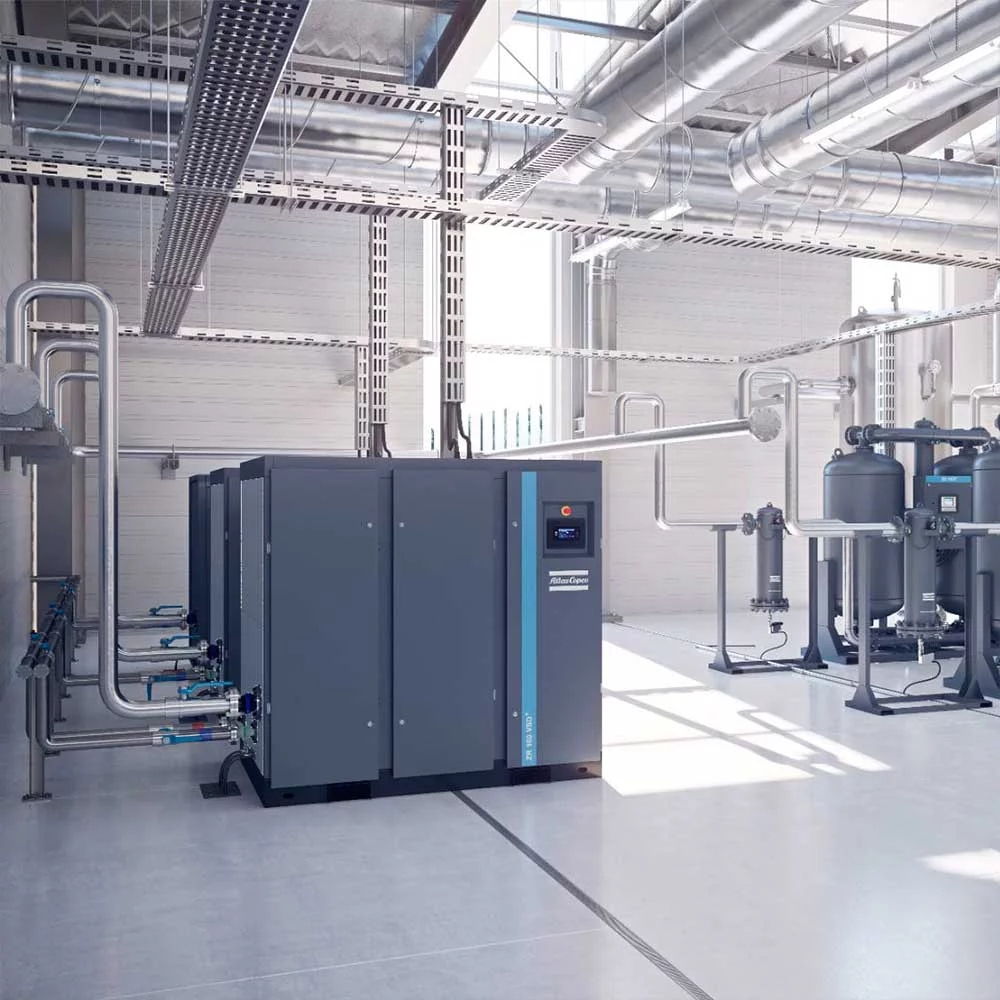
This is why manufacturers such as Kaeser and Atlas Copco increasingly position compressed air as a system engineering problem, rather than simply an equipment purchase. Kaeser, for example, offers compressors alongside dryers, filters, piping, storage, controls and measurement systems, while Atlas Copco’s industrial portfolio similarly extends from compressors and air treatment to controllers, piping and energy recovery.
Cooling is infrastructure too
The same principle applies to cooling.
For an office or commercial building, air conditioning may primarily be associated with occupant comfort. In industrial environments, however, cooling can be part of the production process itself.
Manufacturing equipment generates heat. Electrical and electronic equipment generates heat. Data centres generate large and continuous heat loads. Food processing and cold-chain operations require controlled temperatures. Hospitals and laboratories have environmental requirements that go beyond ordinary comfort.
The engineering response can range from conventional air-conditioning systems to large chillers, cooling towers, air-handling units and dedicated precision-cooling systems.
Kenya already has a growing ecosystem of specialist contractors working in these areas. Companies operating in the market offer industrial HVAC, chillers, cold rooms, process cooling, ventilation and precision cooling for applications ranging from manufacturing and hospitality to healthcare and data centres.
That range of applications is important because cooling is not one technology.
A split air conditioner serving an office has a very different duty from a chiller serving a manufacturing process. A data-centre cooling system has different requirements again, particularly around redundancy, temperature control and continuous operation.
The engineering starts with understanding the heat load rather than simply selecting an air-conditioner based on the size of a room.
For larger buildings and industrial facilities, the choice between air-cooled and water-cooled chillers, the design of chilled-water distribution, pump efficiency, controls, heat rejection and maintenance can have a major effect on operating costs.
Some Kenyan HVAC specialists are already positioning system design and optimisation alongside installation. Air Design Kenya, for example, notes that air conditioning is a significant energy user in buildings and highlights chiller efficiency, heat recovery and lower-global-warming-potential refrigerants as part of modern system design.
Kenya’s cooling challenge
The issue becomes more significant as Kenya’s built environment becomes more dependent on mechanical cooling.
The IEA’s Kenya 2024 energy review found that most air-conditioners available in the Kenyan market were still in the lower efficiency categories and highlighted the country’s dependence on imported air-conditioning equipment. It also found that higher-efficiency models could sometimes be available without a proportionately higher purchase price, suggesting that equipment selection can have an important bearing on long-term energy consumption.
That shifts the conversation away from simply asking how much an air-conditioning system costs to install.
The more useful question is what it will cost to operate over its working life.
For a large building, factory or mission-critical facility, electricity consumption over many years can outweigh the initial equipment purchase. Maintenance, refrigerant management, component replacement and system optimisation add to the lifecycle cost.
The same principle applies to compressors.
Atlas Copco notes that energy can account for a substantial proportion of a compressor’s lifecycle cost, while its industrial range includes variable-speed, oil-free and other technologies intended for different operating requirements.
The implication for project designers and facility managers is straightforward: equipment selection needs to be based on the duty cycle and lifecycle rather than the purchase price alone.
When the utility has to move
There is another important difference between construction and established industrial facilities.
A factory can have a dedicated compressor room. A commercial building can have a plant room designed around its chillers. A data centre can incorporate cooling into the facility’s original architecture.
A construction site has to create its infrastructure as the project moves.
The compressor may have to travel from one part of the site to another. Its fuel supply, access, ventilation, noise, exhaust emissions and weather exposure all become practical engineering considerations.
The same is increasingly true of temporary power and cooling systems.
Construction projects may require temporary facilities before permanent building services are commissioned. Industrial operators may require temporary cooling during maintenance or equipment failure. A critical facility may need standby systems to maintain operations while the primary plant is unavailable.
This is one reason the distinction between equipment and service is becoming less clear.
A compressor or chiller is no longer necessarily considered simply a machine that is bought, installed and left to operate. Remote monitoring, preventive maintenance, energy audits, condition monitoring and service agreements are becoming increasingly important components of the system.
Kaeser, for instance, describes remote monitoring and condition monitoring for portable compressors, while Atlas Copco’s Kenyan operation provides local compressor parts and service support alongside equipment sales.
For a contractor or plant operator, the value is not simply in having a machine. It is in having the machine available when it is required.
The rise of smarter utilities
This is also where digital technology is beginning to change traditionally mechanical systems.
Modern compressors can monitor pressure, temperature, operating hours, energy consumption and other parameters. Cooling systems can similarly be integrated into building-management and monitoring systems.
Instead of waiting for equipment to fail, operators can increasingly monitor trends and identify abnormal behaviour.
That creates opportunities for predictive maintenance.
A compressor whose operating profile is gradually changing may be indicating a developing mechanical problem. A cooling system that is consuming progressively more energy for the same cooling output may have problems with heat exchange, airflow, controls or other components.
The data therefore becomes another layer of the utility.
This is particularly relevant in Kenya as industrial facilities, commercial buildings and data centres become more sophisticated. The engineering challenge is shifting from simply installing mechanical equipment to managing the performance of interconnected systems throughout their operating life.
Designing for the conditions
Kenya also presents some practical conditions that need to be considered in equipment selection.
Construction sites can be dusty. Equipment may operate for long periods in exposed environments. Industrial facilities can have demanding duty cycles. Nairobi’s relatively mild climate does not eliminate the need for careful cooling design, while facilities in hotter parts of the country face different ambient conditions.
Altitude matters too.
For compressors, the characteristics of the air entering the machine and the required discharge pressure affect performance. For cooling systems, ambient conditions influence heat rejection and system capacity.
These are not reasons to simply specify larger equipment.
Oversizing can itself introduce inefficiencies, particularly where equipment spends much of its operating life at low load. Proper load assessment, controls and system design therefore become important.
The goal is not the biggest compressor or the largest chiller.
It is the system that delivers the required service reliably and efficiently.
The infrastructure we notice only when it fails
There is a common characteristic linking compressors, chillers, ventilation systems and other mechanical services.
They are largely invisible to the people who depend on them.
A production worker does not necessarily think about the compressed-air network when a pneumatic tool operates. An office occupant is unlikely to consider the chilled-water plant when a building maintains a comfortable temperature. A data-centre operator is concerned with server availability rather than the cooling system itself.
But engineering has always depended on systems that work quietly in the background.
As Kenya builds more factories, warehouses, hospitals, data centres, commercial buildings and infrastructure projects, these systems will become increasingly important. Their contribution may not be measured in the height of a building or the capacity of a crane, but in the continuity of the processes taking place inside.
The compressor and the chiller are therefore more than pieces of mechanical equipment.
They are part of the invisible utility infrastructure of modern construction and industry.
And as energy costs, reliability requirements and environmental considerations become more important, the engineering question will increasingly be not simply whether these systems can provide compressed air or cooling, but how efficiently, intelligently and reliably they can do so.

-
Product on sale
 AWEBook Volume 2Original price was: KShs 3,500.00.KShs 3,000.00Current price is: KShs 3,000.00.