

Last Updated 2 hours ago by Kenya Engineer
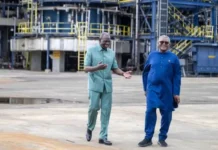
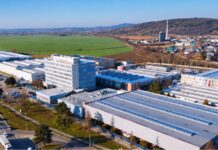
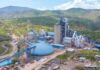
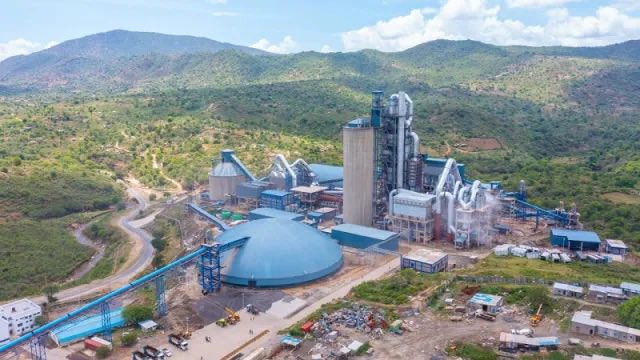
The announcement that Devki Group has begun construction of a KSh50 billion cement plant at Ngaaie in Mwingi North, Kitui County, could easily be read as another major private-sector investment story. It is, after all, a very large cement plant, the first of its kind in Kitui County and an investment that Devki says should begin operations by the middle of 2027.
But the more interesting story may not be the cement plant itself.
Ngaaie is emerging at the intersection of several infrastructure and economic developments that could, over time, change the industrial geography of eastern Kenya. There is the limestone beneath the ground, a major private investment above it, an increasingly interconnected electricity network around Mwingi and Kitui, improving road connectivity and, further into the future, the proposed High Grand Falls hydropower project.
Individually, these are separate projects. Collectively, they raise a more interesting question: could Ngaaie become one of the anchors of a new industrial corridor in eastern Kenya?
From limestone to industry
Devki Group’s decision to establish the plant at Ngaaie is fundamentally a resource-based industrial investment. The area contains substantial limestone deposits, providing the raw material required for cement and clinker production.
The KSh50 billion project is expected to be operational around mid-2027. Devki Executive Chairman Narendra Raval has said that locating production closer to regional markets should also help reduce transport costs. The company has not, however, publicly disclosed the plant’s final cement or clinker production capacity, so comparisons with other large cement plants should be treated cautiously.
The investment is not entirely new territory for the location. The Ngaaie limestone resource had previously attracted the attention of Athi River Mining, which had planned a cement project there before its financial difficulties. National Cement, now part of Devki Group, acquired ARM’s Kenyan assets in 2020 for KSh5 billion.
The significance of the present development is therefore not simply that another cement company has discovered limestone in Kitui. It is that a long-discussed mineral resource is now moving towards large-scale industrial exploitation.
A 2024 environmental assessment for Simba Cement’s Ngaaie operations provides an indication of the industrial infrastructure associated with the mineral resource. The proposed development covered limestone mining, crushing, two clinker lines and a 30 MW captive power plant, together with associated facilities.
That illustrates an important characteristic of heavy industry: the factory is only one component of the infrastructure required to turn a mineral deposit into an economic asset.
The infrastructure around the factory
A cement plant doesn’t operate just because limestone exists.
It requires reliable electricity, water, transport, telecommunications, fuel, machinery, workers, housing and a supply chain capable of moving enormous quantities of raw materials and finished products.
Some of that infrastructure will be developed directly by Devki. Other components will depend on public infrastructure and the wider regional economy.
KETRACO’s Mwingi–Kitui–Wote–Sultan Hamud transmission corridor is a 153-kilometre 132 kV network incorporating substations at Kitui, Wote and Sultan Hamud and an extension of the Mwingi substation. The project was designed to improve reliability and provide alternative supply paths across the region.
When KETRACO first described the economic rationale for strengthening the lower eastern grid, it explicitly identified reliable electricity as a potential catalyst for agro-processing and general industrial development.
More recently, the Kitui–Wote section has strengthened the network further. The reinforced corridor provides alternative supply paths and improves the ability of the system to transfer load during outages and maintenance.
For a major industrial load such as cement manufacturing, this distinction matters. Industrial investors do not only need electricity; they need electricity with sufficient capacity, voltage stability and reliability.
In that respect, the electricity infrastructure around Kitui and Mwingi has been developing in parallel with the county’s broader industrial ambitions.
Roads will determine how far the economic benefits travel
Electricity is only one side of the equation.
A cement factory creates an enormous logistics requirement. Limestone must move from extraction areas to the processing plant, while clinker and cement have to leave the plant for distribution to customers.
That makes road infrastructure particularly important.
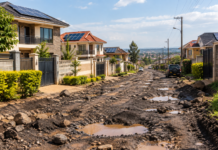
The Government has been advancing road connectivity around the wider Mwingi area. In November 2025, the State Department for Roads announced the launch of tarmacking works on the 13-kilometre Kamuwongo–Kandwia road, part of the Mwingi–Kamuwongo–Ciangera corridor connecting Mwingi with the Ena–Chiakariga road. The stated objective includes improving access to markets and stimulating regional trade.
The road is not being built specifically for Devki, and it would be wrong to imply that it is. But it illustrates the infrastructure environment into which the Ngaaie plant is arriving.
Kitui County itself identifies the Mwingi and surrounding area as an economic and investment zone, citing its proximity to the Garissa–Mwingi–Thika highway, natural resources including limestone, access to electricity and potential for industrial and agricultural value addition.
That is significant.
Ngaaie is not just an industrial investment appearing in an infrastructure vacuum. It is arriving in a part of the county that has already been identified as having the ingredients for an economic zone.
Then there is High Grand Falls
The most intriguing piece of the longer-term picture is perhaps High Grand Falls.
The proposed multipurpose High Grand Falls project has been discussed for many years, but it has recently regained attention. In January 2026, KenGen described the proposed project as a 700 MW hydropower development and said it was intended to strengthen Kenya’s long-term electricity supply while supporting industrial expansion and economic growth.
The project is considerably broader than power generation. Government project information describes High Grand Falls as a multipurpose development incorporating hydropower, irrigation, water security and flood management. Investment Kenya currently describes the project as a proposed 500–700 MW development with a reservoir of roughly 5–6 billion cubic metres.
Its geographical relevance to this story is obvious. The project is associated with the Tana River system around the Kitui–Tharaka Nithi area, placing another major infrastructure investment within the broader geography of eastern Kenya.
More importantly, the relationship between High Grand Falls and the electricity grid is already visible in KETRACO’s transmission planning.
The company’s 2024–2043 Transmission Master Plan includes a proposed 400 kV transmission connection from the High Grand Falls area towards the main grid. The plan identifies a roughly 200-kilometre double-circuit 400 kV line and a new 400 kV substation at High Grand Falls as part of the infrastructure required to evacuate the proposed hydropower generation. KETRACO’s subsequent 2025–2044 planning documentation also identifies High Grand Falls Stage 1 and 2 at 693 MW and associated 400 kV transmission infrastructure.
This does not mean that the Ngaaie cement plant will be directly supplied by High Grand Falls, nor that a High Grand Falls transmission line has been confirmed to pass directly alongside the Devki site.
What can be said is that a major industrial investment is emerging in the same broad region in which Kenya is planning substantial new electricity generation and transmission infrastructure.
That creates an interesting possibility for the future.
Industrial loads can change the economics of infrastructure
Infrastructure is often planned ahead of demand. But large industrial projects can also create demand that changes the economics of infrastructure.
A cement plant is a classic example of a significant industrial load. It requires power not just for lighting and offices but for crushing, grinding, conveying, material handling and other energy-intensive processes.
The presence of a large industrial customer can therefore reinforce the case for strengthening transmission and distribution infrastructure.
The relationship can work in both directions.
Reliable electricity makes an industrial investment more viable. The industrial investment, in turn, creates a predictable load around which additional infrastructure and commercial activity can develop.
The same principle applies to roads.
A major factory generates truck movements, which creates pressure for better roads. Better roads reduce logistics costs, making the industrial location more competitive and potentially attracting additional businesses.
The factory can therefore become an anchor around which infrastructure demand grows.
The bigger opportunity is beyond cement
This is perhaps the most important question for Kitui. Will Ngaaie remain a large cement-production site, or can it become the nucleus of a broader industrial ecosystem?
Cement production creates opportunities for transport companies, mechanical and electrical maintenance firms, equipment suppliers, laboratories, construction contractors, warehouses, accommodation, food businesses and other services.
There can also be opportunities further down the value chain.
The availability of cement close to eastern and northern markets could support construction activity, while the presence of a large industrial operation can create a pool of technical skills and suppliers that did not previously exist locally.
Kitui County has itself been promoting mineral-based industrialisation. Government statements have highlighted limestone, coal, gemstones, iron ore, graphite, copper and gypsum among the county’s mineral resources, while identifying cement production, mining and value-added mineral processing as potential areas for investment.
The question, therefore, is whether Ngaaie becomes an isolated factory or the beginning of a much wider process of value addition.
But industrialisation also has a social and environmental cost
The story should not be told entirely as an infrastructure success story. Ngaaie has already experienced some of the complications associated with large-scale industrial development.
In 2024, residents raised compensation concerns relating to land, graves and other developments on land associated with the proposed cement project. The disputes were reported as threatening to delay the project.
The project’s environmental assessment also identifies issues associated with limestone extraction, including dust, noise, soil disturbance, traffic and other environmental and occupational impacts.
These are not reasons to oppose industrial development. They are engineering and planning issues that need to be addressed if the economic benefits of the project are to be sustainable.
A successful industrial corridor cannot simply move minerals out and products in. It must also create durable local value while managing the environmental and social consequences of the activity.
From project to corridor
There is a tendency in Kenya to assess infrastructure projects individually. A cement plant is considered a private investment. A transmission line is considered a power project. A road is considered a transport project. A dam is considered an energy or water project.
But economic transformation often happens at the points where these systems intersect. Ngaaie presents an opportunity to look at infrastructure differently.
The limestone provides the resource. Devki provides the industrial investment. The electricity network provides the power infrastructure. Roads provide the logistics connection. The surrounding towns provide labour and services. And projects such as High Grand Falls could, if realised, substantially alter the region’s future energy and water infrastructure.
None of these projects guarantees the creation of an industrial corridor. But together they create the conditions under which one could emerge.
The real test will be what happens beyond the factory gate.
If roads, power, water, skills, logistics and urban infrastructure develop alongside the cement plant, Ngaaie could become considerably more important to eastern Kenya than the KSh50 billion price tag initially suggests.
It could mark the point at which one of Kitui’s long-promised mineral resources begins to connect with the infrastructure needed to turn raw materials into sustained industrial activity.
-
Product on sale
 AWEBook Volume 2Original price was: KShs 3,500.00.KShs 3,000.00Current price is: KShs 3,000.00.