


Last Updated 4 hours ago by Kenya Engineer
Corrosion is one of the most predictable forms of deterioration affecting infrastructure, yet it is still too often addressed only after damage has become visible. For infrastructure owners, the consequences can extend well beyond appearance: premature corrosion can shorten asset life, increase maintenance and replacement costs, and, in critical structures, affect safety and reliability.
This is the context in which the International Zinc Association (IZA) Africa has spent the past seven years promoting greater understanding of zinc-based corrosion protection across Southern Africa and beyond. Since 2019, the organisation has used technical seminars, webinars, publications and industry engagement to encourage engineers, architects, contractors, galvanizers and asset owners to consider corrosion protection as part of the design and lifecycle management of infrastructure rather than as an afterthought. IZA Africa has also developed a technical zinc library in partnership with Kenya Engineer, making reference material available to engineers and other professionals in the region.
 As Africa enters another period of significant infrastructure development, the question of durability is becoming increasingly important. In this interview, IZA Africa’s Simon Norton reflects on the organisation’s work over the past seven years, the role of zinc in South Africa’s industrial economy, the gaps in Africa’s corrosion-engineering capacity and the opportunities for deeper engagement with Kenya and East Africa. He also looks ahead to the next seven years, including the need for greater lifecycle thinking, engineering education and research into more sustainable zinc production.
Seven years of technical engagement
Kenya Engineer: IZA Africa is marking seven years of technical leadership and industry engagement in Southern Africa. Looking back to 2019, what has changed most in the way zinc and corrosion protection are understood and applied?
Simon Norton: Over the past seven years, we have made significant progress in keeping zinc and corrosion protection on the Southern African and continental engineering agenda, particularly through technical education, industry engagement, media releases, publications and knowledge sharing. Since 2019, IZA Africa has delivered engineering seminars, webinars, technical presentations and publications covering hot dip galvanizing, zinc-rich paints, zinc thermal spray applications and the benefits of effective corrosion protection.
 We have also strengthened relationships with consulting engineers, architects, contractors, universities, galvanizers and industry bodies. One of the most important lessons for me is that technical knowledge must be continually reinforced. Engineering practices change, people move between organisations and new generations of engineers enter the profession, so there is always a need to communicate the benefits of sound corrosion protection.
The past seven years have also been challenging. COVID-19, supply chain disruption and geopolitical events created considerable pressure across industry. Despite that, our focus remained on ensuring that engineers, specifiers and other industry professionals understand that corrosion protection is not simply a coating decision but an important part of infrastructure durability and lifecycle management.
Kenya Engineer: IZA Africa has established that 408,839 tonnes of refined zinc were used in South Africa between 2019 and 2025. What does this tell us about zinc’s role in the country’s industrial and infrastructure economy, and where is that demand coming from?
Simon Norton: The figure demonstrates that zinc is a vital industrial material in South Africa. More than 408,000 tonnes of refined zinc were used between 2019 and 2025, with an estimated value of about US$1.19 billion, and more than 60% of this tonnage is associated with protecting steel against corrosion by means of galvanizing. A typical hot dip galvanizing kettle can hold 50–80 tons of molten zinc and South Africa alone has over 60 galvanizing kettles hard at work almost every day protecting steel.
Hot dip galvanizing is an important driver of zinc demand, with applications extending across structural steel, power transmission pylons, railway power lines, mine shaft steel and much more. Zinc is also used in continuously galvanized products such as roof sheeting, light metal building structures and cladding and as powder and flake in zinc-rich paints. We mustn’t forget that zinc is widely used across Sub-Saharan Africa to enrich soil with zinc oxide and zinc sulphate-containing fertilizers.
 The broader point is that zinc is not simply a commodity that enters the economy and disappears. When it is used to protect steel, it contributes to a long and extended service life for infrastructure and can reduce the need for maintenance, repair and premature replacement.
South Africa remains the continent’s largest consumer of refined zinc and consumes more refined zinc than the rest of Africa put together. Countries such as Egypt, Morocco, Kenya, Nigeria and Ethiopia represent important and growing markets for zinc in their industrial growth and South Africa is challenging them to get their civil engineering and construction industries to demand hot dip galvanized steel.
Designing for corrosion rather than repairing it
Kenya Engineer: Corrosion is often treated as a maintenance problem rather than a design consideration. Why does this matter, and what are the consequences for the service life, safety and whole-life cost of African infrastructure?
Simon Norton: Corrosion is one of the most predictable and preventable engineering problems we face, yet it is still too often treated as something to deal with once deterioration becomes visible. By that stage, the cost of intervention can be considerable.
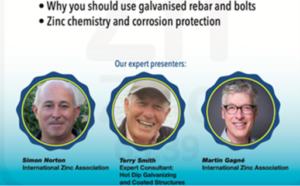 That’s why we at IZA Africa are working so hard to make contact with consulting engineers and specifiers so as to introduce them to the amazing benefits of galvanized steel structures and galvanized rebar.
Steel is fundamental to modern infrastructure, from power transmission networks and railway pylons to industrial facilities, ports, buildings and public utilities. If steel structures are inadequately protected, particularly at the coast and in deep mines, then premature corrosion will reduce service life, result in replacement or repair costs and ultimately affect the safety and reliability of an asset.
The same applies to reinforced concrete. Many ageing bridges, wastewater facilities, water treatment plants and coastal structures experience deterioration because the reinforcing steel corrodes due to carbonation and chloride ingress from salt seawater. As the steel corrodes, the resulting rust (iron oxide) has a much greater volume than uncorroded steel rebar, resulting in cracking, spalling and loss of structural integrity.
This is why we need to move from reactive maintenance and repair towards sound design and proactive asset management. The most cost-effective time to address corrosion is during the design and specification stage, when the appropriate protection system can be incorporated into the project rather than added later at considerably greater cost.
Kenya Engineer: Zinc can be used in several differing applications, including hot dip galvanizing, zinc thermal spray, zinc-rich paints and zinc-aluminium coatings. How should engineers determine which protection system is appropriate for a particular application and environment?
Simon Norton: There is no single corrosion protection system that is appropriate for every application. The selection must be based on the environment, the material, the design of the structure, the expected service life and the practical requirements of the project.
 Hot dip galvanizing provides a durable, metallurgically bonded zinc coating and is particularly effective for fabricated steel components that can be hot dip galvanized in a galvanizing kettle. Zinc thermal spray is useful for large or complex structures that may be difficult or impractical to galvanize and can be applied to bridges, transmission towers, industrial facilities, marine structures and mining infrastructure.
Zinc-rich paints can also provide effective protection where galvanizing or thermal spraying is not practical, provided that the steel surface is correctly prepared and the coating system is properly specified and applied. Zinc-aluminium systems such as Zincalume® and Galvalume® are very widely applied to thin steel sheet in a continuous galvanizing mill and are then given a coloured organic top coat and used for roofing and cladding.
The important point is that engineers should assess the exposure environment and the requirements of the asset first, and then select the appropriate protection system. In rehabilitation projects, for example, a proper inspection and assessment of the structure should precede the specification of the protection system.
Kenya Engineer: What are the most common mistakes you see in the design, specification, fabrication and maintenance of corrosion-protected steel, and how can they be avoided?
Simon Norton: One of the biggest mistakes is leaving corrosion protection until too late in the project. It should be considered from the design stage rather than treated as an additional requirement once the structure has already been fabricated.
A second problem is designing the steel components to fit into the galvanizing kettle without having to double dip. Often the design engineer does not ask the galvanizer to organic coat the galvanized steel at his plant straight after galvanizing, which saves a lot of time and effort at the construction site.
 When it comes to epoxy zinc-rich paints or inorganic zinc-rich paints, correct specification is key and sound surface preparation is vital to the performance of a coating system. The protection system needs to be appropriate for the environment and the intended service life, and the application needs to be carried out correctly.
Another common problem is focusing on the initial price rather than the whole-life cost. A cheaper corrosion protection system, for example organic paint systems, may require more frequent maintenance, repairs or even premature replacement, which can make it considerably more expensive over the life of the asset. Rather select and specify hot dip galvanized steel with a Duplex coating over the zinc.
Good corrosion protection therefore depends on collaboration between the designer, corrosion specialist, fabricator, applicator and asset owner. In rehabilitation work especially, the structure should first be properly inspected and assessed so that the appropriate protection system can be specified rather than simply applying a coating without understanding the underlying problem.
Where does Africa stand?
Kenya Engineer: How would you assess Africa’s current capacity for effective corrosion protection, in terms of engineering expertise, standards, facilities, inspection and skills, and where are the biggest gaps?
Simon Norton: The technical capability and capacity in corrosion engineering is sadly lacking across Africa, so there is a critical need to strengthen and grow engineering knowledge and practical expertise in corrosion management.
 One of IZA Africa’s observations over recent years has been that there remains a large knowledge gap within the engineering and consulting profession. Changes in the consulting engineering landscape have meant that some organisations and engineers require additional technical support in understanding the available zinc-based corrosion protection technologies and their appropriate applications as compared to cheap, quick-fix solutions.
That is why education and knowledge sharing remain such an important part of IZA Africa’s role. We have delivered seminars and webinars, published technical guides, supported engineering events and engaged directly with galvanizers and other industry participants. One of our most successful outlets for new knowledge is the KENYA ENGINEER ZINC LIBRARY, where IZA Africa has provided a rich store of comprehensive reference literature on zinc in corrosion protection of steel. The objective is not simply to promote zinc, but to ensure that engineers and asset owners understand how to assess corrosion risk, specify the correct protection system and manage assets over their intended service lives.
While South Africa has 27 hot dip galvanizers with very large galvanizing kettles and three very large continuous sheet galvanizers, the rest of Sub-Saharan Africa is very poorly served with hot dip galvanizers, as witnessed by the relatively small consumption of refined zinc.
Kenya Engineer: IZA Africa has traditionally had a strong Southern African focus. What opportunities do you see for deeper engagement with Kenya and East Africa, and what role can partnerships with engineers, universities, industry bodies and other stakeholders play?
Simon Norton: Kenya and East Africa represent an important opportunity for IZA Africa because the region is investing in infrastructure and has a growing need for durable, cost-effective corrosion protection.
We have already established a presence within the Kenyan engineering community. IZA Africa created a zinc library on the Kenya Engineer website, and thousands of users have downloaded technical material. We have also continued to work through technical publications and engineering engagement to make practical information available to professionals. IZA Africa has released a large number of media releases and technical articles to KENYA ENGINEER and we are hoping that this will spread the message. We hope in 2027 to present live Zinc and Corrosion Protection seminars in Kenya to the benefit of the East African engineering profession.
Going forward, deeper engagement with consulting engineers, universities, industry associations and standards bodies would provide an effective way of extending this knowledge. The objective should be to build local technical capability and encourage corrosion protection to be considered as part of infrastructure design, procurement and lifecycle management.
Africa’s infrastructure needs should be substantial and ensuring that new assets deliver their intended service life will require greater emphasis on durability from the outset.
Building technical capacity
Kenya Engineer: What skills and knowledge do engineers and other professionals need to develop to manage corrosion more effectively, and how can IZA Africa support that development?
Simon Norton: Engineers need a sound understanding of corrosion mechanisms, environmental exposure, material selection and the different corrosion protection systems available. Just as importantly, they need to understand how design, specification, fabrication, surface preparation, application and maintenance all influence the eventual performance of a protection system.
There is also a need to think in terms of lifecycle performance rather than simply initial construction cost. Engineers and asset owners need to be able to evaluate how a protection system will perform over the intended life of the structure and what maintenance it will require.
IZA Africa contributes through technical seminars, webinars, publications, specialist training and direct engagement with engineers and industry. We have published guides on galvanizing and have presented technical information at engineering and industry events. We also work with galvanizers and other industry participants to support the practical application of good corrosion-protection practice.
IZA Africa has published two key publications, namely Essentials of Galvanizing and Expert Guide to Galvanizing, and shortly we will ensure that we launch these on Kenya Engineer and in the Zinc Library.
What most engineers lack is a good knowledge of chemistry, as electrochemistry and corrosion go together, so in 2027 we hope to present an introduction to electrochemistry and the chemistry of zinc.
Ultimately, technical knowledge is one of the most important investments we can make because the longer infrastructure lasts, the greater the return to governments, businesses and communities.
Kenya Engineer: As Africa invests in new infrastructure while dealing with climate and sustainability pressures, how can zinc-based corrosion protection contribute to longer asset lives, resource efficiency and more resilient infrastructure?
Simon Norton: One of the most effective ways of improving the sustainability of infrastructure is to make it last longer. If an asset reaches the end of its useful life prematurely because of corrosion, the resources, energy and capital required to repair or replace it are significant.
Zinc-based corrosion protection can extend the service life of construction steel and reduce the frequency of maintenance and replacement. Hot dip galvanizing, for example, provides long-term protection, while zinc thermal spray can be used on large and complex structures where long service life and reduced maintenance are important.
This is particularly relevant to infrastructure in demanding environments, including coastal areas, mining operations, industrial processing facilities and water treatment infrastructure. The correct protection system, selected according to the exposure conditions, can help infrastructure owners move from repeated reactive repairs towards long-term asset management.
For me, sustainability in infrastructure should therefore include durability. Building something that lasts for decades, rather than something that needs significant intervention after a relatively short period, is an important part of using resources responsibly.
Zinc is highly recyclable and once hot dip galvanized steel is recovered the steel can be fed into a furnace and the zinc recovered as a vapour. Zinc dust and recycled zinc are a very important benefit that using zinc brings to sustainability.
Looking to the next seven years
Kenya Engineer: Looking ahead to the next seven years, what would you like to see change in zinc use, engineering practice and the durability of African infrastructure, and what is the biggest misconception about corrosion protection that still needs to be overcome?
Simon Norton: The biggest gap in the zinc business in Africa is that the continent has no zinc refinery for producing high-purity refined zinc. There was a zinc refinery in Johannesburg until 2011 which Exxaro closed down and another in southern Namibia which Vedanta shuttered in 2020 and now all Africa’s raw zinc concentrate goes overseas for refining into zinc. Then Africa has to buy its own mineral wealth back again as refined zinc. Southern Africa needs a zinc refinery and to that end the Department of Chemical Engineering at the University of Cape Town has been researching zinc refining since 2021.
Corrosion engineering needs to be part of the civil engineering and construction undergraduate courses at good universities. It’s at the ground level that young undergraduates will pick up the key aspects of zinc in corrosion protection.
I would like to see corrosion protection become a much more fundamental part of infrastructure planning and procurement across Africa. We need to move away from judging projects mainly on their initial construction cost and place greater emphasis on durability, lifecycle cost and the performance that an asset is expected to deliver over decades.
There is significant potential for greater zinc use in construction, mining, rail, energy, transport and other infrastructure applications. But that potential will depend on infrastructure investment, appropriate policy direction and, importantly, greater understanding among engineers, specifiers, asset owners and decision-makers.
We need to see more hot dip galvanizers open in Kenya and East Africa.
 The biggest misconception is perhaps that corrosion is simply an inevitable repair problem. Corrosion itself is a natural process, but premature infrastructure deterioration is not inevitable. With appropriate design, material selection and corrosion protection, we can significantly extend the service life of steel and reinforced concrete structures.
Over the next seven years, I would like to see stronger technical partnerships, greater investment in engineering education and much wider adoption of lifecycle thinking. If Africa is going to invest in the next generation of infrastructure, we need to make sure that we are building for the next generation, rather than simply for the next procurement cycle.
From mineral resources to a regional zinc value chain
Kenya Engineer: IZA Africa has supported research at the University of Cape Town into a potentially lower-energy process for refining zinc from locally produced concentrates. What is the significance of this research, and what could it mean for the future of zinc production in South Africa and Africa?
Simon Norton: IZA Africa has been involved in encouraging research at the University of Cape Town into a potentially clean, green, low-energy-consuming process to refine zinc from locally produced concentrates. The research is significant because South Africa has the mineral resources and industrial capability to play a stronger role in the zinc value chain, while conventional refining processes can be energy intensive.
The UCT research is investigating an alternative process based on alkaline ammonia chemistry, with the potential to reduce energy requirements and improve the environmental performance of zinc refining. The work has also explored the potential for renewable electricity to contribute to the process.
It is important to emphasise that this remains a research project rather than a commercially proven refining technology. The value of the work at this stage is in establishing whether the process can ultimately provide a technically and economically viable alternative. If that potential can be demonstrated, it could contribute to more efficient local zinc production and strengthen the broader African zinc value chain.
For IZA Africa, encouraging this type of research is part of a broader commitment to the long-term development of the zinc industry and growing African scholarship. We need not only to promote the applications and benefits of zinc, but also to encourage research and innovation that can make its production more efficient and sustainable.
-
Product on sale
 AWEBook Volume 2Original price was: KShs 3,500.00.KShs 3,000.00Current price is: KShs 3,000.00.