
Last Updated 2 hours ago by Kenya Engineer
Kenya’s nuclear ambitions will require more than reactor construction, electricity generation and the development of scientific expertise. They will also depend on the country’s ability to manage radioactive waste safely throughout the life of its nuclear facilities, from commissioning and operation to decommissioning and eventual disposal.
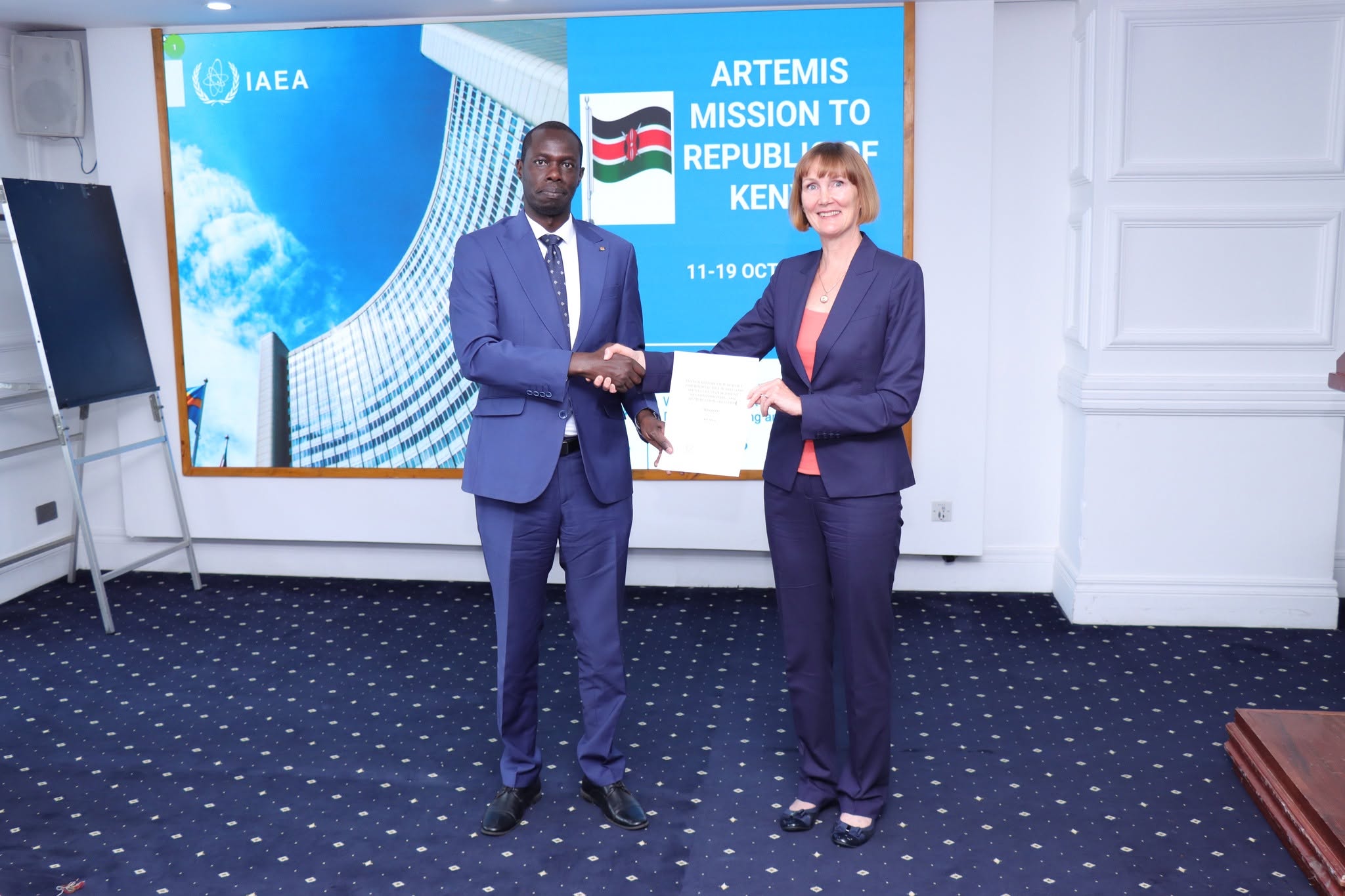
That responsibility is receiving renewed attention following the conclusion of an eight-day ARTEMIS mission by the International Atomic Energy Agency (IAEA), which assessed Kenya’s national arrangements for radioactive waste and spent nuclear fuel management, decommissioning and remediation.
The mission concluded with the handover of its findings by IAEA representative Anna Clarke to James Keter, Director General of the Kenya Nuclear Regulatory Authority (KNRA). The government welcomed the assessment and called for a comprehensive implementation plan to translate its recommendations into practical measures.
The review comes at a significant stage in Kenya’s nuclear development programme. The country is preparing to establish a research reactor at Konza Technopolis while pursuing a separate nuclear power project in Siaya County. Both initiatives will require an institutional and technical framework capable of maintaining safety standards over several decades.
The ARTEMIS findings provide an opportunity to examine whether the systems required to support that ambition are being developed alongside the projects themselves.
The infrastructure behind nuclear safety
Radioactive waste management is a specialised engineering undertaking that begins long before a nuclear facility starts operating. Its requirements depend on the types of radioactive materials produced, their activity levels, their physical and chemical characteristics and the duration for which they remain hazardous.
Waste may arise from reactor operations, maintenance, research activities, medical applications and the handling of radioactive materials. Spent nuclear fuel, where applicable, presents additional challenges because it contains radioactive substances that require specialised handling, shielding and carefully controlled storage.
The appropriate management route differs between waste categories. Some materials may require segregation, treatment and conditioning before storage or disposal. Others need more extensive containment and monitoring arrangements. The engineering objective is to prevent unacceptable exposure to workers and the public while protecting soil, surface water and groundwater from contamination.
These responsibilities require dedicated facilities and equipment, including radiation monitoring systems, shielded handling arrangements, secure storage infrastructure, ventilation and containment systems where appropriate, and equipment for characterising and monitoring radioactive materials.
They also require reliable records. Operators and regulators must be able to track radioactive materials, document their characteristics and account for their movement between facilities. Emergency plans, trained personnel, maintenance programmes and independent inspections form part of the same safety system.
The infrastructure must be designed around the anticipated waste streams rather than developed as an afterthought. Decisions about reactor technology, operating procedures, site layout and material handling can influence the quantities and characteristics of waste generated, as well as the cost and complexity of managing it.
Two nuclear projects, different requirements
Kenya’s emerging nuclear programme comprises facilities with different purposes and engineering demands.
At Konza Technopolis, the government is planning a multipurpose research reactor intended to support scientific research, education, specialist training, industrial applications and the production of medical radioisotopes. Reporting published on 19 October 2026 put the proposed facility’s estimated cost at KSh36.7 billion and described it as a 10-megawatt thermal open-pool reactor.
Unlike a commercial nuclear power plant, a research reactor is not primarily designed to generate electricity. Its value lies in the neutron source it provides for scientific experiments, material testing and other applications. Medical radioisotopes can also support the diagnosis and treatment of certain diseases, subject to the availability of appropriate production and medical infrastructure.
These benefits will depend on the supporting systems being developed alongside the reactor. Radioisotope production, for example, requires appropriate processing facilities, radiation protection, quality assurance, transport arrangements and controls over radioactive materials. Research activities will also generate materials that must be assessed and managed according to their radioactive characteristics.
The planned nuclear power project in Siaya presents a different set of challenges. Kenya has targeted 2034 for the first grid connection, although the schedule remains subject to project development, technology selection, financing, licensing and construction.
A power reactor would introduce requirements associated with spent fuel, operational waste, reactor maintenance and eventual decommissioning. The scale and nature of these obligations would depend on the technology selected and the eventual design of the facility.
The two projects should therefore not be treated as interchangeable. Nevertheless, developing research and regulatory capabilities through the research reactor programme could contribute to the country’s wider nuclear ambitions. That contribution will depend on the facilities, expertise and institutional arrangements established, as well as the extent to which experience can be applied to the separate power project.
Regulation must extend beyond licensing
The Kenya Nuclear Regulatory Authority has a central role in ensuring that nuclear and radiation-related activities meet the required safety standards. Its responsibilities must extend beyond assessing whether a facility is suitable to begin operations.
Effective regulation requires the capacity to examine technical designs, review safety assessments, inspect facilities, evaluate operating procedures and verify compliance throughout a facility’s lifetime. Regulators must also be able to assess changes in operating conditions, investigate incidents and enforce corrective measures where necessary.
These functions require specialised personnel and sustained investment in technical capability. Expertise in radiation protection, nuclear engineering, materials science, environmental monitoring, waste management and emergency preparedness is essential to effective oversight.
Regulatory independence is equally important. Decisions must be based on safety requirements and technical evidence, even where a project is subject to pressure to meet construction schedules or development targets.
The ARTEMIS mission is relevant in this respect because it examines national arrangements for radioactive waste and spent nuclear fuel management, including the institutional and regulatory framework supporting them. Its findings can help identify good practices and areas where further development is needed.
However, the completion of the mission does not, by itself, establish that Kenya has implemented the necessary improvements or that every aspect of its arrangements has been endorsed. The practical value of the assessment will depend on the recommendations made, the actions agreed by the responsible institutions and the evidence of progress over time.
Publication of the findings, or at least a clear summary of the recommendations and proposed implementation measures, would help engineers, policymakers and the public understand the work that remains.
Decommissioning must be planned from the beginning
One of the most consequential aspects of nuclear infrastructure planning is what happens when a facility reaches the end of its useful life.
Decommissioning involves more than shutting down a reactor. Depending on the facility and the selected strategy, it may require the removal of radioactive materials, dismantling of equipment, decontamination of structures, management of radioactive waste and verification that the site meets the conditions required for its subsequent use.
These activities can be technically complex and expensive. Their scope depends on the reactor design, operating history, contamination levels and the decommissioning strategy adopted.
Planning for them early allows operators to consider how equipment will be removed, which materials may become radioactive, how waste will be packaged and transported, and what facilities will be needed to support the work.
Financial arrangements are equally important. Decommissioning obligations and waste management costs should be incorporated into the economic planning of nuclear facilities rather than left entirely to future governments or taxpayers. The precise funding model will depend on the ownership and financing structure of each project, but the underlying obligation must be clear from the outset.
Remediation also requires attention. Where radioactive contamination affects land, buildings or other parts of the environment, assessment and restoration must be undertaken using appropriate technical standards and monitoring procedures.
These are long-term responsibilities. A facility may operate for decades, while certain radioactive materials require management over much longer periods. Institutional continuity, reliable records and arrangements for maintaining oversight must therefore extend beyond the operating life of the installation.
The financing and institutional challenge
For Kenya, the cost of developing nuclear infrastructure cannot be assessed solely through the capital expenditure required to construct a reactor.
The wider programme must account for regulatory institutions, technical training, laboratories, radiation monitoring, waste treatment and storage, emergency preparedness, environmental surveillance and eventual decommissioning. Some capabilities may serve multiple facilities, while others will be specific to individual projects.
The sequencing of investment will be important. Building a reactor before the necessary regulatory expertise, waste management arrangements and supporting infrastructure are sufficiently developed could create delays and additional costs. Conversely, developing these capabilities early can improve project preparedness and help identify technical and financial risks before major construction commitments are made.
The government will also need to coordinate the institutions responsible for nuclear development, regulation, environmental protection, emergency response and public health. Their respective mandates and responsibilities should be clear, with adequate resources and mechanisms for information-sharing.
Public confidence will depend partly on how these arrangements are communicated. Communities near proposed nuclear facilities need credible information about radiation risks, environmental monitoring, emergency procedures and the management of radioactive materials. Consultation should be supported by accessible technical information and opportunities for concerns to be addressed through established regulatory processes.
For engineers and contractors, the programme could create opportunities in civil and structural engineering, specialised mechanical and electrical systems, instrumentation and control, radiation monitoring, environmental engineering and facility maintenance. Realising these opportunities will require appropriate qualification, quality assurance and compliance with nuclear-specific technical standards.
Turning the ARTEMIS findings into action
The conclusion of the IAEA mission provides a basis for the next stage of Kenya’s preparations. The immediate priority is to establish what the assessment recommends and how those recommendations will be implemented.
A credible implementation plan would identify the responsible institutions, the resources required, measurable milestones and timelines for completing priority actions. It should also distinguish between improvements that can be made within existing arrangements and those requiring new legislation, specialist personnel, additional facilities or significant capital investment.
Progress should be assessed against evidence rather than policy commitments alone. This could include the adoption of necessary regulations, recruitment and training of specialist staff, development of waste management strategies, establishment of monitoring systems and demonstration that the institutions involved can carry out their respective functions.
The findings should also inform the planning of the Konza research reactor and the proposed Siaya nuclear power project, while recognising that each facility will require its own safety assessments, licensing decisions and technical arrangements.
Kenya’s nuclear programme offers potential benefits in electricity generation, scientific research, medical applications and industrial development. Those benefits, however, must be matched by the capacity to manage the risks and long-term obligations associated with radioactive materials.
The engineering test is not only whether Kenya can construct and operate nuclear facilities. It is whether the country can provide the infrastructure, expertise, financing and regulatory oversight needed to manage them safely throughout their lifetimes.
The ARTEMIS mission has provided an opportunity to assess an important part of that preparedness. The measure of its success will ultimately be the actions Kenya takes in response, and whether those actions are in place before the country’s nuclear facilities begin operating.

-
Product on sale
 AWEBook Volume 2Original price was: KShs 3,500.00.KShs 3,000.00Current price is: KShs 3,000.00.