
Last Updated 56 mins ago by Kenya Engineer
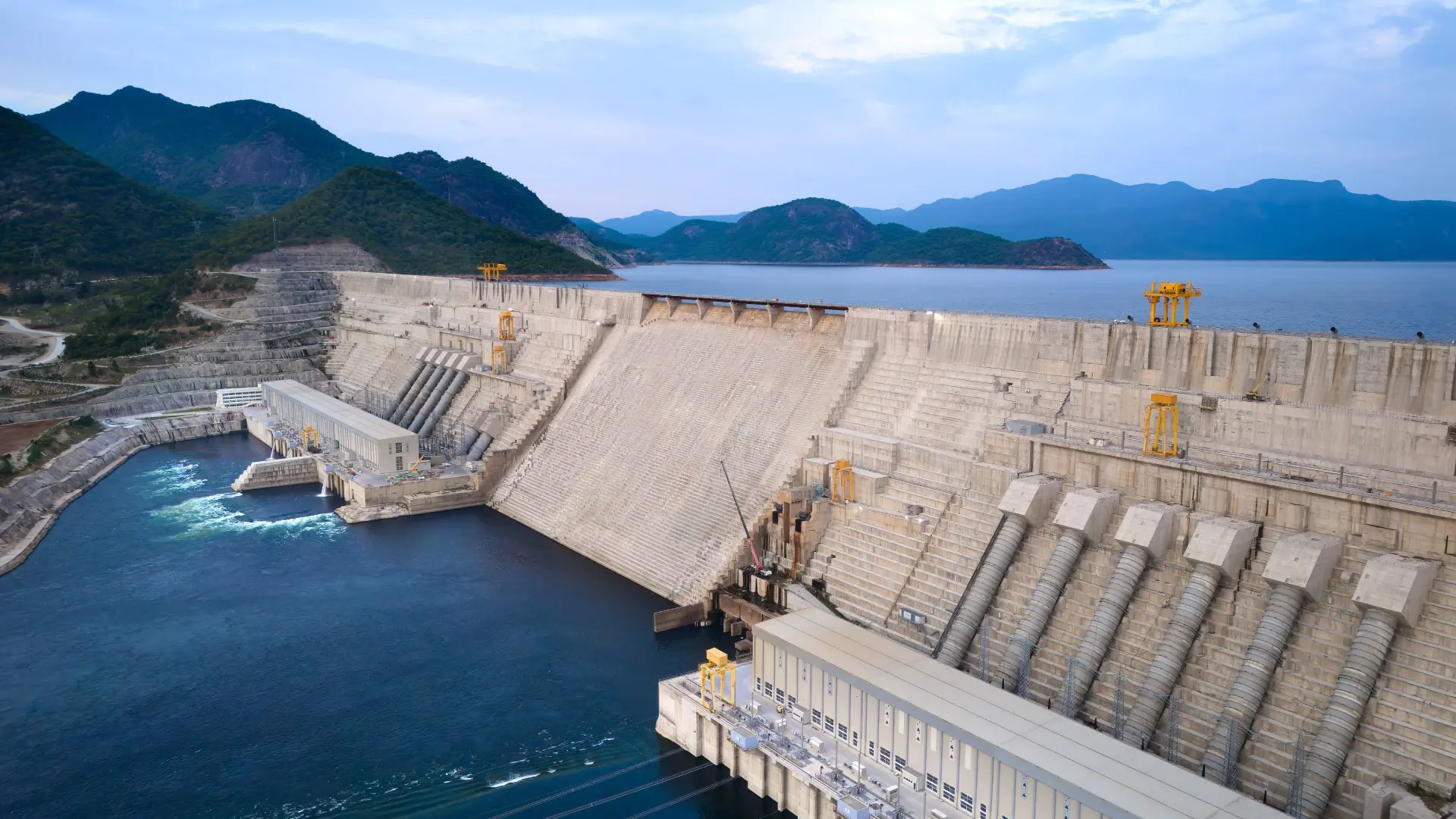
When Ethiopia inaugurated the Grand Ethiopian Renaissance Dam (GERD) on 9 September 2025, it brought to a milestone a project that had occupied engineers, policymakers and diplomats for more than a decade. Built across the Blue Nile near the Sudanese border, the dam was conceived as the centrepiece of Ethiopia’s ambition to expand electricity access, support industrialisation and become a major regional power exporter.
Its installed generating capacity of 5,150 MW places it among the world’s largest hydropower installations. The project has also become a defining piece of infrastructure in the debate over how countries sharing an international river can develop its resources.
Yet the dam’s significance extends beyond its concrete structure, reservoir and generating units. Its longer-term value depends on how effectively the generating plant operates, how much electricity the national grid can absorb, whether transmission infrastructure can carry surplus power to neighbouring countries, and how the reservoir is managed alongside the water needs of downstream states.
More than a year after its inauguration, GERD offers an opportunity to assess the relationship between a major engineering achievement and the wider systems required to turn installed capacity into dependable electricity.
From a national power project to a regional asset
Construction began in 2011, with Ethiopia financing much of the project through domestic resources. The government presented the dam as a national development undertaking intended to address electricity shortages and create the capacity to support a growing economy.
The project’s scale is substantial. The dam is approximately 145 metres high and 1.8 kilometres long, creating a reservoir with a storage capacity of about 74 billion cubic metres. Its location on the Blue Nile gives it access to a river system with significant seasonal flows, although the amount of water available for generation varies with hydrological conditions.
The generating station has 13 turbine-generator units and a total nameplate capacity of 5,150 MW. That capacity represents the maximum combined rated output of the installed generating equipment, not a guarantee that the plant will continuously deliver that level of power.
The distinction is important in hydropower engineering. Actual production depends on water availability, reservoir levels, hydraulic head, turbine operating conditions, equipment availability and the ability of the electrical network to receive the output.
Ethiopian officials have described GERD as a major expansion of national generating capacity. At the end of 2025, Ethiopian Electric Power said the country’s total installed electricity capacity had risen to approximately 10,000 MW following the dam’s entry into operation.
The scale of the addition is significant for a country whose electricity demand is expected to grow alongside industrial development, urbanisation and expanded access to power. But the practical benefits will depend on more than the capacity installed at the dam itself.
Sustained performance
The inauguration marked a major project milestone, but evaluating the dam’s performance requires a different set of measurements.
Installed capacity, annual electricity generation, plant availability and capacity factor each describe a different aspect of performance. Installed capacity measures the rated output of the generating equipment. Annual generation measures the electricity actually produced over a period. Availability indicates how much of the equipment is ready to operate, while capacity factor compares actual generation with the theoretical output if the plant ran at full capacity throughout the period.
For a hydropower facility, capacity factor is influenced by inflows, reservoir management, dispatch decisions and maintenance. A plant can have all its generating units installed and still produce substantially less than its nameplate capacity over a year.
This is particularly relevant to GERD because its public profile has often been expressed in terms of the 5,150 MW figure. The engineering assessment should instead examine annual generation, unit-level commissioning and availability records, reservoir conditions, and the amount of electricity delivered to the grid.
As of October 2026, publicly accessible reporting provides evidence of the dam’s operating status and its growing role in electricity exports. However, a sufficiently detailed, independently verified operating series is not readily available to establish whether actual generation has consistently matched the project’s original production expectations.
That limits the conclusions that can be drawn. The dam’s inauguration and reported contribution to exports demonstrate progress, but they do not by themselves establish its annual capacity factor or prove that every original performance target has been met.
A comprehensive assessment would require Ethiopian Electric Power to publish regular data on monthly generation, turbine availability, water releases and reservoir levels. Such information would make it possible to compare operating results with design expectations and to understand how the plant balances domestic supply against export commitments.
The transmission system behind the generation
The electricity generated at GERD must pass through transmission infrastructure capable of carrying large power flows over long distances while maintaining voltage stability, frequency control and system security.
This requirement has wider implications for Ethiopia. The country needs to connect the dam’s output to demand centres, reinforce its domestic transmission network and coordinate the operation of a much larger generating fleet.
The issue is especially important where generation is concentrated far from major centres of electricity consumption. Transmission bottlenecks can constrain dispatch even when generating equipment and water resources are available. Distribution networks must then carry the electricity onward to businesses and households.
Ethiopia’s export ambitions introduce another layer of complexity. Cross-border electricity trade requires interconnectors, converter stations, substations, protection systems, operating agreements and coordination between national utilities. Export capacity is determined by the capabilities of this wider system, not by the generating capacity of GERD alone.
The Ethiopia–Kenya Electricity Highway illustrates the point.
The approximately 1,045-kilometre high-voltage direct-current (HVDC) interconnector links the Wolayita-Sodo area of Ethiopia with the Suswa substation in Kenya. Developed at a cost of about US$1.26 billion, the project was financed largely through support from the World Bank and the African Development Bank.
The line was designed for transfers of up to 2,000 MW, substantially greater than the initial volume of electricity traded between the two countries. Its converter stations enable electricity to move between the two national networks while providing a degree of operational separation between their alternating-current systems.
The distinction between design capacity and actual transfers is again important. Although the interconnector can ultimately carry much more power than Kenya initially contracted to import, the volume transferred commercially depends on the power-purchase agreement, technical readiness, network constraints and available generation.
The World Bank’s review of the Eastern Electricity Highway Project recorded 1,008 GWh of Ethiopian electricity exports to Kenya in financial year 2023/24. Transfers were initially restricted to 200 MW, with further increases dependent on additional technical works and system reinforcement.
The transmission project demonstrates that regional power integration is an infrastructure programme in its own right. It requires coordinated investment on both sides of the border.
What GERD means for Kenya
Kenya’s growing purchases of Ethiopian electricity provide one of the clearest examples of the regional power trade that GERD was intended to support.
According to data reported from Kenya’s Energy and Petroleum Regulatory Authority, imports from Ethiopia reached 1,274.42 GWh in the financial year ending June 2025. Ethiopia supplied approximately 83 per cent of Kenya’s total electricity imports during that period.
The figures illustrate the growing role of cross-border electricity trade in Kenya’s supply mix. Ethiopian hydropower can help reduce the need to dispatch more expensive thermal generation when domestic supply is constrained, although the actual cost benefit depends on contract terms, transmission charges, exchange-rate movements and the alternative sources of electricity available.
The relationship has also moved beyond the initial supply arrangement. In July 2026, Kenya Power signed a fresh electricity supply agreement with Ethiopian Electric Utility, providing a commercial framework for continued imports through the HVDC interconnector.
In September 2026, Ethiopian Electric Power announced that preparations were under way to increase supply to Kenya from 200 MW to 400 MW, with the higher level expected from December, subject to technical preparations and trial operations.
The increase would strengthen the electricity link between the two countries. It would also make Kenya’s supply security more closely connected to Ethiopia’s ability to generate, transmit and deliver electricity under agreed operating conditions.
However, the available import figures should not be attributed exclusively to GERD. Ethiopia has other hydropower stations and generating assets, and electricity entering Kenya travels through the national transmission system. Without plant-specific dispatch and export records, it is not possible to determine what proportion of Kenya’s imports originated from GERD.
Ethiopian Electric Power reported in September 2026 that GERD accounted for 52 per cent of the country’s electricity-export revenue. This is a significant indication of the dam’s reported commercial contribution, although the figure is an official Ethiopian statement rather than an independently audited breakdown of export sales.
For Kenya, the central question is whether additional electricity can be delivered reliably and at a competitive cost. The dam’s contribution will ultimately be measured through generation, export volumes, supply reliability and the economics of the electricity delivered, rather than installed capacity alone.
The Nile dispute remains unresolved
GERD’s engineering achievements have not resolved the dispute over the river on which it depends.
Egypt relies heavily on the Nile for its freshwater supply and has argued that the dam’s filling and operation could threaten downstream water security, particularly during prolonged droughts. Sudan has its own concerns, including the need to coordinate water releases and protect infrastructure downstream.
Ethiopia maintains that GERD is principally a hydropower project and that electricity generation does not consume water in the same way as large-scale irrigation. Water passing through turbines can continue downstream. Nevertheless, reservoir storage changes the timing of river flows, and the operation of a large upstream reservoir can affect the management of water available to downstream users.
The central disagreement isn’t just whether Ethiopia can generate electricity from the Blue Nile. It concerns how the reservoir should be filled and operated, how drought conditions should be managed, what information should be shared, and how the three countries should coordinate decisions that affect the river system.
Ethiopia inaugurated the dam without securing the binding operating agreement sought by Egypt. The failure to reach an agreement after years of negotiations has left a major infrastructure asset operating within an unresolved transboundary water-management dispute.
The issue returned to the diplomatic agenda in January 2026, when US President Donald Trump offered to restart American mediation between Egypt and Ethiopia. Earlier US-led efforts had collapsed in 2020 after Ethiopia withdrew from the negotiations. Subsequent talks under the African Union also failed to produce a comprehensive agreement.
In August 2026, attention shifted towards Ethiopia’s reported plans to advance additional hydropower projects on the Blue Nile, including Karadobi, Mandaya and Beko Abo. Their future development could make the question of basin-wide coordination more important still.
For engineers, these developments underline that dam safety and performance cannot be assessed solely within the boundaries of the project site. Reservoir operations, hydrological forecasting, downstream monitoring, flood management and communication between river-basin authorities are also critical elements of responsible infrastructure operation.
GERD could help moderate some seasonal flow extremes and reduce sediment reaching downstream reservoirs under certain operating conditions. Those potential benefits, however, depend on how the system is managed. They do not remove the need for agreed procedures covering droughts, exceptional releases, data exchange and emergency coordination.
The next phase is about operation and integration
The completion of GERD represents a major achievement in Ethiopia’s infrastructure development. Its long-term contribution, however, will depend on the performance of the generating plant and the supporting systems around it.
Domestically, Ethiopia must continue reinforcing transmission and distribution networks so that additional generation can support households, industry and public services. Regionally, it must expand the technical and commercial arrangements required to deliver electricity across borders without compromising system stability.
For Kenya, the Ethiopia–Kenya interconnector shows how generation infrastructure in one country can support electricity supply in another. The planned increase in imports demonstrates the potential for regional trade, but also highlights the importance of commissioning works, grid reinforcement and dependable operating arrangements.
A fuller assessment of GERD will require transparent data on actual generation, plant availability, reservoir operations and export volumes. It will also require evidence of how the additional electricity affects access, industrial activity, supply costs and reliability in Ethiopia and neighbouring markets.
The project has moved beyond construction into a phase in which performance and system integration will determine much of its value. Its success will be measured not only by the power its turbines can generate, but by how reliably that electricity reaches users and how effectively the countries sharing the Nile manage the river on which the project depends.

-
Product on sale
 AWEBook Volume 2Original price was: KShs 3,500.00.KShs 3,000.00Current price is: KShs 3,000.00.