Last Updated 2 hours ago by Kenya Engineer
The reliability of medical equipment can be as important as its availability. In hospitals where patient monitoring is essential to clinical decisions, a malfunctioning device can leave healthcare workers without the information needed to identify changes in a patient’s condition. Yet across many African healthcare systems, maintaining sophisticated imported equipment can be difficult, particularly when replacement components, specialist technicians and manufacturer support are not readily accessible.
It was this challenge that prompted Nigerien engineer Mamane Kabirou Ousseini to develop Likita Care, an integrated medical monitoring platform designed around local manufacturing, maintainability and digital connectivity.
The innovation won the 2026 Africa Prize for Engineering Innovation, receiving the £50,000 grand prize from the Royal Academy of Engineering at an awards ceremony in Johannesburg, South Africa, on 28 October 2026.
Developed through Ousseini’s company, YAYI MAKE Niger, Likita Care brings together electronic patient-monitoring devices, clinical software and locally accessible manufacturing processes. Its development reflects a broader engineering question facing African healthcare systems: how can medical technology be designed, manufactured and maintained closer to the facilities that depend on it?
From equipment maintenance to local manufacturing
Ousseini’s experience in maintaining and repairing medical equipment in Niger’s hospitals exposed him to a recurring problem. Monitoring devices imported from outside the country could become unusable when spare parts were unavailable or when the specialist support required to repair them could not be accessed.
The problem extended beyond the initial cost of purchasing equipment. Hospitals could invest in sophisticated monitoring systems but struggle to keep them operational throughout their service life.
This is a familiar challenge in medical engineering. Equipment procurement is only one part of the lifecycle. Installation, calibration, maintenance, replacement components, technical training and after-sales support all influence whether a device remains useful in a clinical environment.
Likita Care was conceived as a response to this problem. Rather than developing another monitoring device dependent on an external manufacturer’s maintenance infrastructure, the team sought to create equipment that could be manufactured, assembled and repaired locally.
The approach places particular emphasis on digital fabrication and the integration of locally produced physical components with electronic systems and software.
Engineering the patient-monitoring system
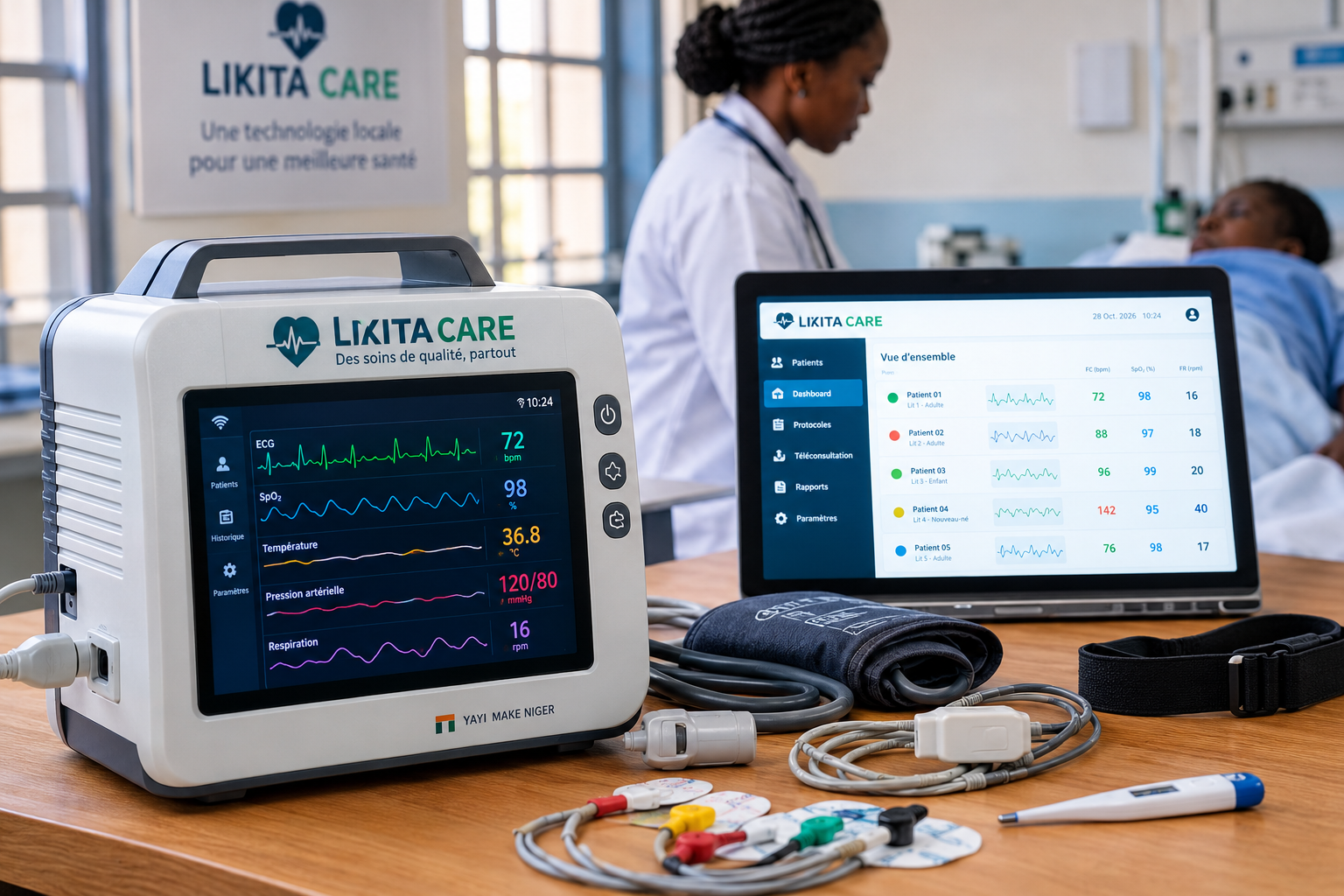
At its core, Likita Care is a multiparameter patient-monitoring system. Its original design was documented in a research paper published in November 2023 in the International Journal of Innovation and Applied Studies, titled Design and Manufacturing of a New Generation of Multiparametric Monitor Called Likita Care by the Startup YAYI MAKE Niger.
The paper describes a system comprising two principal sections: an electronic subsystem and a software platform.
The electronic subsystem is organised into three functional modules:
- A control and signal-processing module.
- A communication module.
- A power-supply module.
These modules are assembled into a monitoring device capable of acquiring and processing several physiological measurements simultaneously.
The original monitor was designed to measure six parameters: body temperature, heart rate, respiratory rate, blood pressure, electrocardiogram (ECG) and peripheral oxygen saturation (SpO₂).
Each measurement provides a different aspect of a patient’s physiological condition. Temperature readings help identify abnormal changes in body temperature, while respiratory rate and oxygen saturation provide information about breathing and oxygenation. Blood pressure measurements indicate the pressure exerted by circulating blood against arterial walls, and heart-rate monitoring provides information about cardiac activity.
ECG monitoring goes further by recording the electrical activity of the heart. It provides a waveform that healthcare professionals can examine for abnormalities in cardiac rhythm and electrical conduction.
Combining these measurements in one instrument allows healthcare workers to observe several aspects of a patient’s condition without relying on separate standalone devices for each parameter.
Signal acquisition and processing
The electronic design has to accommodate signals that differ considerably in their physical characteristics.
Temperature, for example, is obtained through a sensing element that responds to changes in thermal conditions. Blood pressure measurements require a pressure-sensing arrangement, while oxygen saturation monitoring relies on optical measurements.
ECG acquisition presents a different engineering challenge because the electrical signals generated by the heart are relatively small and must be captured from electrodes placed on the patient’s body.
An ECG monitoring circuit therefore requires appropriate signal conditioning and processing before the waveform can be presented for clinical interpretation. Electrical interference, movement artefacts and other sources of noise can affect the quality of acquired signals.
The control and signal-processing module is responsible for coordinating the acquisition and processing of the physiological measurements. The communication module provides the link between the monitoring hardware and the software platform, while the power-supply module provides the electrical energy required to operate the system.
The published 2023 research describes these functional modules but does not provide sufficient information to establish the exact electronic components, sensor models, sampling frequencies or signal-processing algorithms used in the latest commercial platform.
This distinction is important because medical monitoring equipment must produce measurements that are sufficiently accurate and consistent for its intended clinical application.
Wireless connectivity and centralised patient monitoring
A notable feature of the original Likita Care design is its integration with a web-based monitoring platform.
The device uses Wi-Fi connectivity to transmit patient measurements to the software interface. This creates an opportunity for healthcare workers to monitor patients through a centralised system rather than relying exclusively on information displayed at each individual bedside instrument.
The 2026 platform has expanded this approach. According to the Royal Academy of Engineering, its software incorporates a central dashboard capable of supporting simultaneous monitoring of approximately 10 to 20 patients.
Such an arrangement can be particularly useful in healthcare facilities where staff must supervise several patients across a ward or treatment area.
Instead of repeatedly checking each monitoring device, healthcare workers can access measurements through a common interface. The system also supports digital clinical protocols and telemedicine functions, extending its role beyond the collection and display of physiological data.
The effectiveness of this arrangement, however, depends on the reliability of the entire communication chain. Wireless connectivity, network availability, software stability and appropriate access controls all become part of the equipment’s operational requirements.
Medical monitoring platforms must also account for what happens when connectivity is interrupted. Local data retention, recovery after network failure and continuity of monitoring are important considerations when deploying connected equipment in facilities with inconsistent infrastructure.
Expanding the platform to cardiac and prenatal monitoring
The current Likita Care platform is broader than the original multiparameter monitor described in the 2023 research paper.
The Royal Academy of Engineering identifies three principal device categories within the platform: a patient-monitoring system, a cardiograph and a cardiotocograph, alongside a temporal thermometer.
A cardiograph is used to record and examine cardiac electrical activity, while a cardiotocograph (CTG) is used in obstetric care to monitor the foetal heart rate and uterine activity.
CTG monitoring is particularly important during pregnancy and labour, when healthcare professionals need to assess foetal wellbeing and identify patterns that may require further clinical attention.
The integration of these specialised instruments into a common technology platform creates opportunities for shared software, monitoring infrastructure and technical support.
The Academy reports that the expanded system tracks 12 vital-sign parameter indicators across adults, newborns and foetuses.
This represents a significant extension of the original six-parameter monitor. However, the available technical publication does not document the detailed architecture of every device in the newer platform, and the 12 indicators should not be interpreted as 12 measurements acquired by a single instrument.
Artificial intelligence in patient monitoring
Another development highlighted in the 2026 Africa Prize announcement is the incorporation of an embedded artificial intelligence module.
The AI component is intended to help interpret vital signs in real time, adding an analytical layer to the system’s conventional measurement and display functions.
In a typical monitoring workflow, sensors acquire physiological information, electronic circuits process the signals, and software presents the resulting measurements to healthcare workers. An AI-enabled layer can potentially examine combinations of measurements, identify patterns and highlight readings that may require closer attention.
For example, changes in respiratory rate, heart rate and oxygen saturation may collectively provide information that would be less apparent when each parameter is considered independently.
However, AI-assisted monitoring must be approached carefully. A system that identifies patterns or flags abnormal readings is not automatically equivalent to a clinically validated diagnostic system.
Its usefulness depends on the quality and representativeness of the data used in its development, the performance of its algorithms across different patient populations, and the way its outputs are presented to healthcare professionals.
The available project documentation does not disclose the specific AI architecture, training datasets, validation methodology or sensitivity and specificity of the model. These remain important technical considerations as the platform moves towards wider commercial deployment.
Digital manufacturing and the case for local production
One of the most significant aspects of Likita Care is its manufacturing approach.
The project uses digital fabrication techniques, including 3D printing and CNC cutting, alongside electronics assembly. These processes allow physical enclosures and other components to be produced locally and integrated with the electronic and software systems.
3D printing is particularly useful during product development because it allows engineers to produce and modify enclosures without necessarily investing in expensive moulds and dedicated tooling.
Design changes can be incorporated into digital models and translated into new physical components relatively quickly. This can shorten prototyping cycles and make it easier to adapt equipment to local operating requirements.
CNC cutting provides another route for manufacturing accurately shaped components from suitable materials, while electronics assembly brings together the boards, connectors, power systems and other elements required for operation.
The combination offers a practical approach to producing relatively specialised equipment in smaller manufacturing environments.
For medical devices, however, ease of fabrication must be accompanied by rigorous quality control. Enclosures, electrical connections, insulation, cleaning requirements, sensor interfaces and mechanical durability all have to be considered in the final design.
Medical equipment also requires appropriate electrical safety testing, electromagnetic compatibility assessment and verification of measurement performance.
Local manufacturing is most valuable when it creates the capacity to maintain consistent quality throughout production and the subsequent service life of the equipment.
From prototype to deployment
Likita Care has progressed beyond the initial research and development stage.
According to the Royal Academy of Engineering, more than 70 monitoring units have been produced and deployed in Niger. The system is being used across five medical centres and has undergone testing involving more than 100 patients, with over 4,000 patient data points collected.
These figures indicate that the innovation has moved into practical deployment, although they do not by themselves establish the accuracy of every measurement or the clinical effectiveness of the AI component.
The distinction between product deployment and clinical validation is particularly important in medical engineering. A device may function reliably as an electronic system while still requiring further evaluation to establish that its measurements meet the performance requirements of its intended clinical application.
For Likita Care, the next phase will involve strengthening its commercial operations and expanding production capacity.
The £50,000 Africa Prize award is intended to support commercialisation in Niger and preparations for expansion into neighbouring West African markets.
Engineering opportunities and challenges ahead
The development of Likita Care raises important questions about the future of medical equipment manufacturing in Africa.
The continent has a substantial demand for reliable healthcare technology, but many facilities depend on equipment sourced from international manufacturers. This can create challenges involving procurement costs, foreign currency exposure, maintenance contracts, replacement parts and access to specialised technical support.
Locally manufactured equipment offers a potential alternative, particularly where the design is informed by the operating conditions of the facilities expected to use it.
Nevertheless, scaling medical technology requires more than the ability to produce working prototypes.
Manufacturers must establish repeatable production processes, reliable supply chains, documented quality-management procedures and effective technical support. Devices must also comply with applicable medical-device regulations in each market where they are sold.
Interoperability is another consideration. As hospitals adopt digital health systems, monitoring equipment increasingly needs to exchange information with other clinical platforms and electronic medical records.
Data security, patient privacy, software updates and cybersecurity must therefore be considered alongside the physical design of the equipment.
For a connected monitoring platform incorporating AI, these requirements become even more significant.
A case for African medical engineering
Likita Care’s recognition through the 2026 Africa Prize for Engineering Innovation highlights the potential of African engineering enterprises to develop technologies addressing practical infrastructure and service-delivery challenges.
Its contribution lies in bringing together several engineering disciplines: biomedical instrumentation, electronics, signal processing, software development, wireless communication and digital manufacturing.
The project also demonstrates the importance of considering equipment maintenance at the design stage rather than treating it as a problem to be addressed after installation.
For healthcare facilities, the value of a monitoring device is determined not only by the measurements it can produce, but also by whether it can be kept operational, supported and repaired throughout its service life.
As Ousseini and the YAYI MAKE Niger team prepare to expand production, the longer-term test will be whether the platform can maintain measurement reliability, meet regulatory requirements and establish a sustainable manufacturing and maintenance network across the region.
For Africa’s medical engineering sector, that is an important proposition: developing equipment locally is one achievement; building the technical and industrial capacity to support it over its entire lifecycle is the larger undertaking.

-
Product on sale
 AWEBook Volume 2Original price was: KShs 3,500.00.KShs 3,000.00Current price is: KShs 3,000.00.