Last Updated 2 hours ago by Kenya Engineer
Infrastructure projects have traditionally been managed through a collection of drawings, engineering calculations, construction records, inspection reports and operational databases. Each provides information about a particular stage of an asset’s life, but the information is often held in separate systems and may not be updated consistently as the project moves from design to construction and eventually into operation.
Digital twin technology is changing this approach. By creating a digital representation of a physical asset and connecting it to relevant information from the real world, engineers can develop a more continuous understanding of how infrastructure is designed, built, operated and maintained.
The concept is gaining attention across transport, energy, water, manufacturing and urban planning. Its appeal lies in the ability to bring together engineering models, geospatial information, sensors, operational records and analytical tools within a common digital environment. Instead of relying exclusively on periodic inspections and historical reports, infrastructure operators can use a continuously updated representation of an asset to examine its current condition, test possible interventions and anticipate future performance.
For countries investing heavily in new infrastructure while also managing ageing assets, the technology presents an opportunity to improve planning, reduce avoidable costs and make better use of engineering information.
Beyond three-dimensional models
Digital twins are sometimes confused with Building Information Modelling (BIM), computer-aided design or three-dimensional visualisations. These technologies are important foundations, but they do not necessarily constitute a digital twin.
A BIM model, for example, can provide a detailed representation of a building or infrastructure project, including its geometry, materials, components and technical specifications. It can support design coordination, quantity estimation, construction planning and the management of project information. However, a model that remains unchanged after construction is completed does not necessarily reflect the condition or behaviour of the physical asset during operation.
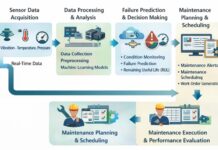
A digital twin goes further by maintaining a meaningful connection with its real-world counterpart. Information from sensors, inspection systems, maintenance records and operational databases can be used to update the digital representation. Depending on the application, the twin may also incorporate engineering simulations, analytical models and machine learning algorithms to examine how the physical asset is likely to behave under different conditions.
The UK Government’s 2025 definition describes a digital twin as a digital representation connected to its real-world counterpart through two-way information flows, operating within a defined level of accuracy and validation. This is an important qualification. A digital twin should be capable of representing relevant behaviour within known assumptions and tolerances; a visually impressive model alone is insufficient.
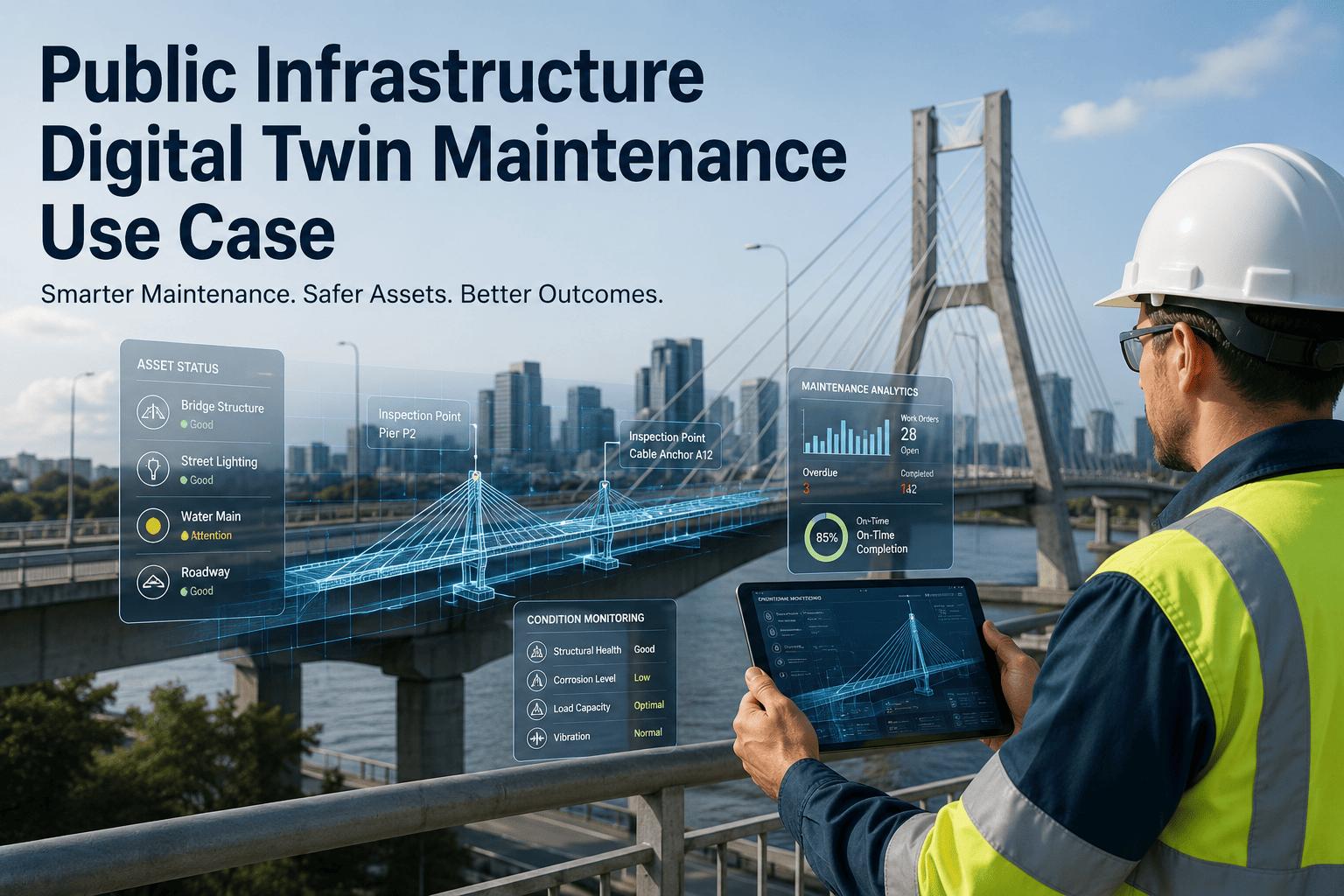
The distinction can be understood through a bridge. A conventional engineering model may describe the bridge’s dimensions, structural elements, materials and design loads. A digital twin could incorporate that information alongside traffic volumes, strain measurements, vibration readings, temperature, inspection findings and maintenance history. Engineers could then compare actual behaviour with expected performance and investigate changes that may indicate deterioration or unusual loading.
The International Organization for Standardization’s ISO/IEC 30173:2023 provides internationally recognised terminology and concepts for digital twins, helping organisations establish a common understanding as the technology develops.
Changing the infrastructure design process
One of the most valuable applications of digital twins is the ability to test infrastructure decisions before committing substantial resources to construction.
Traditional design processes already use structural analysis, hydraulic modelling, traffic simulation, geotechnical investigation and other engineering tools. Digital twin approaches can bring these models and datasets together, allowing design teams to examine how different components interact within a wider system.
For a proposed road, engineers could combine terrain models, drainage information, traffic forecasts, land-use data and environmental conditions. They could test alternative alignments, examine the effect of heavy rainfall, assess potential congestion and identify locations where additional drainage or structural capacity may be required.
In a water treatment facility, a digital representation could combine process equipment, pumps, pipelines, instrumentation, energy consumption and hydraulic models. Engineers could simulate changes in demand, equipment capacity or operating conditions before implementing them physically.
This capability is particularly useful for complex infrastructure where decisions in one discipline can have consequences for another. A change in road alignment may affect drainage, land acquisition, utility relocation and bridge requirements. A new electricity substation may influence network capacity, land use and future demand. Bringing these elements into a connected digital environment can improve coordination and expose potential conflicts earlier in the project.
Digital twins can also support construction planning. When linked to construction schedules, procurement information and site progress records, the digital representation can help project teams compare planned and actual progress, examine construction sequencing and identify emerging coordination problems.
However, the quality of the resulting analysis remains dependent on the accuracy of the underlying information. A sophisticated digital environment cannot compensate for incorrect surveys, incomplete drawings, unreliable assumptions or poorly coordinated design data.
From construction records to operational intelligence
The greatest long-term value of a digital twin may emerge after an infrastructure project has been commissioned.
Infrastructure owners often inherit large quantities of documentation at handover. These may include as-built drawings, equipment schedules, operation manuals, test certificates, inspection records and maintenance instructions. If these records are incomplete, inconsistent or difficult to retrieve, the operational team may struggle to establish the actual configuration of the asset.
A properly developed digital twin can provide a structured information environment that remains useful throughout the operational life of the infrastructure.
For a water distribution network, it could connect pipeline locations, diameters, materials, pressure zones, pumping stations, reservoirs, flow meters and maintenance history. Data from pressure and flow sensors could help operators identify unusual changes, investigate possible leakage and assess the effect of shutting down a particular section for repairs.
For a highway, the system could combine bridge and pavement information, traffic volumes, drainage assets, geospatial data, inspection results and maintenance interventions. Engineers could use this information to prioritise inspections, assess deterioration and plan rehabilitation works.
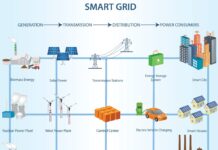
In electricity networks, digital twins can help operators examine the condition of transformers, substations, cables and other assets while also simulating how changes in demand or generation could affect network performance.
The underlying principle is that infrastructure management becomes more informed when design intent, construction history and operational behaviour can be considered together.
Singapore’s digital twin approach to electricity infrastructure
Singapore provides a useful example of how digital twins can be applied to infrastructure planning and operation.
In October 2023, Singapore’s Energy Market Authority announced progress on the development of the country’s first national electricity-grid digital twin, involving the government, SP Group, Nanyang Technological University and other research partners.
The initiative was designed around two complementary models: a Digital Asset Twin and a Digital Network Twin.
The Digital Asset Twin was being developed to represent SP Group’s physical electricity network assets. Its intended functions included monitoring asset condition and performance, identifying potential operational risks and supporting decisions on maintenance and asset renewal. SP Group had also developed the core of an asset dashboard and initial artificial intelligence engines and algorithms intended to integrate with real-time sensor information.
The Digital Network Twin was intended to support network planning and simulation. By modelling the effect of changes in electricity demand, the system could help assess the infrastructure implications of growing electric vehicle adoption and other changes associated with the energy transition.
One of the applications identified was the assessment of substation capacity and the infrastructure upgrades required to accommodate electric vehicle charging.
The significance of this initiative lies in its combination of two different engineering questions. The asset model addresses the condition and performance of existing equipment, while the network model examines how the wider electricity system may respond to future changes.
For infrastructure operators, this distinction is important. Managing individual assets efficiently does not automatically guarantee that the overall network will have sufficient capacity, resilience or flexibility. Both levels of analysis are required.
Digital twins in water infrastructure
Water and wastewater infrastructure presents another important application because its operation involves interconnected processes, equipment and networks that are often geographically extensive.
Singapore’s Tuas Water Reclamation Plant illustrates how digital engineering tools are being applied to a major water infrastructure development.
The plant forms part of the country’s Deep Tunnel Sewerage System and is designed to treat up to 800,000 cubic metres of used water per day. UES Holdings, which worked on instrumentation and monitoring systems for the project, reported using an integrated BIM platform and digital twin tools to support design and construction.
The project demonstrates the potential of bringing together engineering models, instrumentation information and construction data in a complex treatment facility. Such an approach can support coordination between disciplines and provide a structured digital foundation for subsequent operations.
During operation, a connected representation of treatment equipment, pumps, process conditions, energy consumption and instrumentation can help operators understand how the facility is performing. Engineers can examine the effect of changing process conditions, investigate abnormal readings and evaluate alternative operating strategies.
These applications are particularly relevant to water utilities facing pressure to improve service reliability, reduce non-revenue water, manage energy costs and extend the life of existing infrastructure.
The prospect of connected infrastructure systems
The concept is also expanding beyond individual assets.
A digital twin of a building, bridge or power substation can provide useful information about that particular asset. However, many infrastructure challenges require a wider perspective.
A transport corridor, for example, may include roads, bridges, drainage systems, traffic signals, railway crossings and utility networks. A digital representation that connects relevant information across these assets could help planners examine the consequences of proposed interventions across the entire corridor.
At city level, digital twins can bring together information about buildings, transport, land use, utilities, population movement and environmental conditions.
Singapore’s Virtual Singapore initiative is an example of this broader approach. Developed as a dynamic three-dimensional city model and collaborative data platform, it brings together geospatial and other datasets to support urban planning, policy analysis and the examination of different development scenarios.
The UK has also developed a National Digital Twin Programme, guided by the Gemini Principles. These principles emphasise public benefit, value creation, data quality, security, openness, clear governance and the ability of connected digital systems to evolve.
The long-term ambition is not necessarily to create one enormous model containing every infrastructure asset. It is to enable different digital twins to exchange appropriate information and work together where there is a clear operational or public benefit.
This requires common data structures, reliable interfaces, agreed responsibilities and consistent approaches to information management.
What stands in the way of adoption?
Despite the potential, digital twin implementation is not a matter of purchasing software and installing sensors. It requires a combination of engineering, data management, information technology and institutional capability.
Data quality is one of the most immediate challenges. Many existing infrastructure assets have incomplete drawings, outdated records, undocumented modifications or inconsistent maintenance histories. Bringing these records together may require significant surveying, digitisation and verification before a useful digital representation can be developed.
Interoperability presents another difficulty. Infrastructure projects frequently involve different consultants, contractors, equipment manufacturers, software platforms and asset owners. If each party uses incompatible data formats or proprietary systems, transferring information across the asset lifecycle becomes difficult.
Cybersecurity and data governance also require attention. A digital twin connected to operational infrastructure may contain sensitive information about the configuration, performance and vulnerabilities of critical systems. Access controls, secure communications, data ownership and clear responsibility for updates must be considered from the beginning.
There is also the question of cost. High-resolution sensors, communications infrastructure, cloud computing, software licences and specialist skills can make comprehensive digital twin systems expensive. The investment must be justified by measurable operational benefits rather than the desire to adopt fashionable technology.
The UK’s National Digital Twin Programme provides a useful policy lesson in this respect. Its principles emphasise measurable benefits, incremental development, accessibility, interoperability and long-term governance. These are practical requirements for any organisation seeking to move from isolated digital models to useful operational systems.
Opportunities for Kenya and Africa
For Kenya and other African countries, digital twins offer opportunities in both new infrastructure development and the management of existing assets.
The region is investing in roads, railways, electricity networks, water systems, ports, industrial facilities and urban infrastructure. These projects generate substantial amounts of engineering information, much of which could be used more effectively if it were captured, organised and maintained throughout the asset lifecycle.
Road authorities, for example, could begin with digital representations of selected highways and bridges, integrating available survey information, traffic data, inspection records and maintenance history. Over time, additional monitoring systems could be introduced at high-risk locations to improve condition assessment and maintenance planning.
Water utilities could develop digital representations of selected distribution zones, combining network maps, meter readings, pressure information and repair records to improve leakage investigations and infrastructure renewal decisions.
Energy utilities could use digital asset information to monitor transformers, substations and distribution equipment, while network models could help assess the effect of new generation, changing demand and distributed energy resources.
The most practical approach would be to start with a clearly defined engineering problem rather than attempting to create a digital twin of an entire city or national infrastructure network from the outset.
A pilot involving a critical bridge, a water distribution zone, a power substation or an industrial facility could establish the data requirements, demonstrate operational value and develop the skills needed for wider deployment.
Universities and engineering institutions also have a role in developing local expertise in BIM, geospatial systems, sensor technologies, data analytics, simulation and infrastructure information management.
Building infrastructure that remains intelligent throughout its life
Digital twins represent an important evolution in the way infrastructure information is created and used. Their greatest contribution is not the ability to display a physical asset in three dimensions, but the opportunity to connect engineering knowledge with the changing behaviour of the real-world system.
For designers, this can improve coordination and allow alternative solutions to be tested before construction. For contractors, it can support construction planning and information handover. For operators, it can improve asset visibility, condition monitoring and maintenance decisions. For governments and infrastructure owners, connected digital representations can support more informed investment and long-term planning.
The technology will not eliminate the need for site inspections, engineering calculations, physical testing or professional judgement. Nor will every bridge, road or water pipeline require an expensive, continuously connected digital twin.
Its value will depend on selecting appropriate applications, maintaining reliable information and ensuring that the digital representation answers a real engineering or operational question.
As infrastructure systems become more complex and investment pressures increase, the ability to understand how assets are performing and how they may respond to future conditions will become increasingly important. Digital twins provide a way of building that understanding into infrastructure management, from the earliest design decisions to decades of operation.
References and further reading
- UK Government, Digital Twin (official), 29 October 2025. https://www.gov.uk/government/publications/digital-twin-definition/digital-twin-official
- International Organization for Standardization, ISO/IEC 30173:2023 – Digital twin: Concepts and terminology. https://www.iso.org/standard/81442.html
- Singapore Energy Market Authority, Leveraging Digital Solutions to Future-Proof Singapore’s Energy Grid, 24 October 2023. https://www.siew.gov.sg/resources/press-releases/detail/2023/10/24/leveraging-digital-solutions-to-future-proof-singapore-s-energy-grid
- United Nations Economic Commission for Europe, Digital Twin and Official Statistics – Virtual Singapore case study. https://unece.org/sites/default/files/2023-11/HLG2023_S3_1_Digital%20Twin%20and%20Official%20Statistics%20.pdf
- Bentley Systems, UES Holdings Creates Digital Twin to Ensure Singapore’s Water Sustainability, 24 April 2026. https://www.bentley.com/en/user-stories/ues-holdings-creates-digital-twin-to-ensure-singapores-water-sustainability/
- UK Government, National Digital Twin Programme Principles. https://www.gov.uk/government/publications/what-a-digital-twin-is-and-how-you-can-contribute/national-digital-twin-programme-ndtp-principles
- Institution of Civil Engineers, The Gemini Principles Overview. https://www.ice.org.uk/areas-of-interest/digital/gemini-principles-overview

-
Product on sale
 AWEBook Volume 2Original price was: KShs 3,500.00.KShs 3,000.00Current price is: KShs 3,000.00.