Last Updated 1 hour ago by Kenya Engineer
A report published by Business Daily on November 2, 2026, has brought renewed attention to one of the more significant developments in Kenya’s electricity sector. Kenya Electricity Generating Company (KenGen) has secured approximately Sh10.5 billion in financing for a utility-scale Battery Energy Storage System (BESS), with support from the World Bank and the United Nations-backed Green Climate Fund.
The financing comprises US$45 million (approximately Sh5.84 billion) from the Green Climate Fund and €32.08 million (approximately Sh4.65 billion) from the World Bank’s International Development Association (IDA). The project is intended to provide a way of storing surplus electricity, particularly from renewable generation, and making it available when demand increases.
The proposed installations are planned for four locations: Olkaria, Kipevu, Embakasi and Muhoroni. KenGen’s published project description identifies a 100 MW/100 MWh system, although earlier planning and feasibility documents have considered larger storage configurations. The final installed capacity and duration will depend on the detailed technical and procurement arrangements.
The significance of this investment goes beyond the installation of battery containers at four sites. It reflects a growing recognition that Kenya’s electricity system needs greater flexibility as the generation mix evolves. The country has invested heavily in geothermal, hydroelectric and wind power, and is preparing to add more solar generation. The challenge now is to ensure that electricity produced at one time can be used when it is needed, while maintaining the frequency, voltage and reliability of the interconnected grid.
For a power system with a substantial renewable energy base, the ability to store and dispatch electricity is becoming an increasingly important part of infrastructure planning.
The problem Kenya is trying to solve
Kenya’s electricity generation mix has a distinctive characteristic. Unlike many countries that depend heavily on coal and natural gas, the country obtains a substantial proportion of its electricity from renewable sources, particularly geothermal and hydroelectric generation, supplemented by wind and solar.
Geothermal power is especially important because it can provide relatively steady output throughout the day and night. Unlike wind and solar, its generation does not depend directly on prevailing weather conditions. However, operating a power system with a large geothermal base alongside variable renewable generation introduces a challenge that is less obvious to electricity consumers.
Electricity demand is not constant throughout the day. Consumption generally falls during the late-night and early-morning hours before rising as households, businesses and industries become active. Demand also increases in the evening as commercial activity continues and households switch on lighting, cooking appliances and other electrical equipment.
Generation, however, does not necessarily follow the same pattern.
Wind farms may produce substantial electricity at night when wind conditions are favourable, while solar installations generate their output during daylight hours. Geothermal plants, meanwhile, are designed to operate continuously and are not as easily adjusted as conventional thermal generating stations.
When electricity generation exceeds the amount the grid can safely absorb, the system operator must reduce output from selected generating stations. This process is known as curtailment.
Kenya has experienced this problem on a significant scale. Data published by the Energy and Petroleum Regulatory Authority (EPRA) shows that 511.72 GWh of geothermal electricity was curtailed between July and December 2024. This represented approximately 7.1 per cent of the geothermal energy generated during the period and was more than double the 236.21 GWh curtailed in the corresponding period a year earlier.
For the financial year ended June 2025, total geothermal energy curtailment stood at 668.70 GWh, compared with 812.80 GWh in the preceding financial year.
These figures illustrate the difficulty of balancing a generation system in which some power stations operate most efficiently when producing continuously, while demand and other renewable generation fluctuate.
Curtailment is sometimes necessary to maintain grid stability. It is not automatically evidence of poor system management. The difficulty is that repeated reductions in available generation can represent lost energy, underutilised generating assets and additional costs elsewhere in the electricity system.
The Ministry of Energy’s assessment, referenced in KenGen’s BESS feasibility study, identified energy storage as one of the interventions that could help address this imbalance.
How a utility-scale battery storage system works
A Battery Energy Storage System is considerably more sophisticated than a collection of rechargeable batteries.
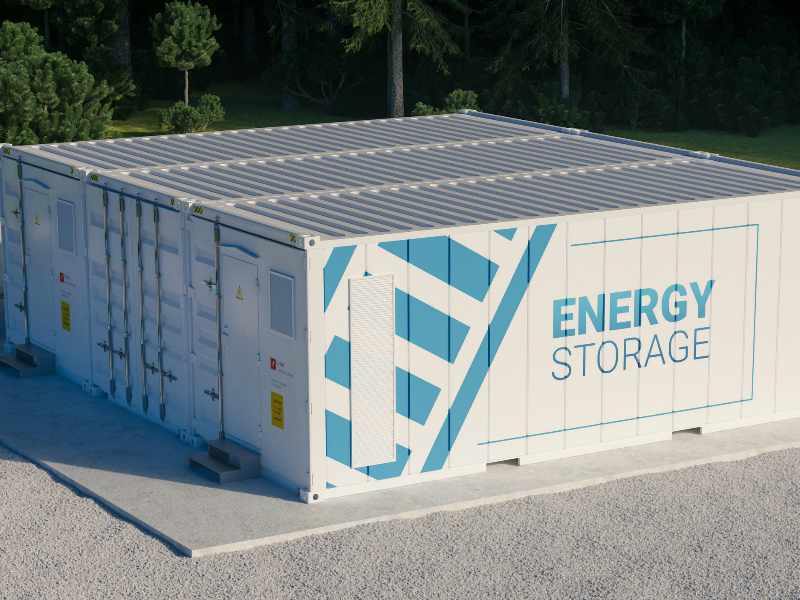
At utility scale, it is an integrated electrical installation comprising battery modules, power conversion equipment, control systems, protection devices, cooling arrangements and grid connection infrastructure.
The batteries store electricity in chemical form. When charging, electrical energy supplied from the grid is converted into chemical energy through electrochemical reactions within the battery cells. During discharge, these reactions are reversed, releasing electrical energy that is converted back into grid-compatible alternating current.
The process is managed through several interconnected systems.
Battery modules and racks: These contain the individual electrochemical cells arranged into modules and larger assemblies. The configuration determines the overall energy capacity of the installation. Lithium-ion technology is widely used in modern grid-scale installations because of its energy density, response characteristics and established supply chain, although KenGen has not yet publicly confirmed the chemistry selected for this project.
Battery Management System (BMS): The BMS monitors individual cell and module conditions, including voltage, current and temperature. It helps maintain safe operating limits, balances cell performance and protects the battery against conditions that could accelerate degradation or create safety risks.
Power Conversion System (PCS): Batteries store and release direct current (DC), whereas the national electricity grid operates on alternating current (AC). The PCS, using bidirectional power electronics, converts electricity between these two forms. It also regulates the power entering or leaving the battery installation and can provide reactive power support where the inverter is appropriately designed and configured.
Energy Management System (EMS): This is the supervisory control layer that determines when the batteries should charge or discharge. It uses information about electricity demand, generation availability, grid conditions, battery state of charge and operating requirements to optimise the installation.
Thermal management and safety systems: Battery installations generate heat during operation. Cooling systems maintain suitable operating temperatures, while fire detection, suppression, electrical isolation and monitoring systems help manage the risks associated with battery faults and thermal runaway.
At the grid connection point, transformers, switchgear, circuit breakers, protection relays and metering equipment allow the installation to operate safely alongside existing substations and transmission infrastructure.
The various systems must work together under carefully defined operating conditions. A battery installation that has sufficient energy capacity but inadequate inverter response, protection coordination or control integration will not deliver the full range of services expected from it.
This is why the engineering design and grid integration studies are as important as the battery technology itself.
Understanding the proposed 100 MW capacity
One important distinction in discussions about battery storage is the difference between megawatts and megawatt-hours.
Megawatts (MW) describe the rate at which electricity can be delivered or absorbed. Megawatt-hours (MWh) describe the quantity of energy that can be stored or delivered over time.
KenGen’s current project webpage describes the proposed installation as a 100 MW/100 MWh system. In practical terms, this means that the system could theoretically discharge at a rate of 100 MW for one hour when fully charged, before accounting for operating reserves, conversion losses and other technical constraints.
A 100 MW/200 MWh configuration, by comparison, could theoretically sustain the same 100 MW output for two hours.
This distinction is important because a battery’s usefulness depends on both its power rating and its storage duration. A system designed to provide rapid frequency response has different energy requirements from one intended to shift several hours of electricity from overnight or daytime periods into the evening peak.
There are also differences between the various capacity figures appearing in the project’s planning documents.
KenGen’s 2024 feasibility-study terms of reference refer to the Ministry of Energy’s recommendation for 100 MW/200 MWh BESS projects. The World Bank’s GREEN Programme Phase 2 appraisal document discusses an initial installation of up to 200 MWh and cites a technical assessment identifying an immediate need for 400 MW of one-hour battery storage capacity. KenGen’s current project webpage, however, lists 100 MW/100 MWh.
These figures reflect different planning assessments and project configurations. They should not be interpreted as confirmation that the entire national storage requirement will be met by the initial KenGen project.
The detailed feasibility work is expected to establish the optimum capacity, energy duration, technology and operating configuration.
Four strategic locations across the national grid
The proposed sites are particularly significant because battery storage is most useful when it is positioned in locations where it can respond effectively to generation and network requirements.
The four locations identified for KenGen’s project are Olkaria, Kipevu, Embakasi and Muhoroni.
Olkaria – Central Rift Valley
Olkaria is the centre of Kenya’s geothermal electricity industry. The concentration of geothermal generating stations in the area makes it a logical location for storage infrastructure.
Geothermal plants are designed for relatively continuous operation, but their output can be constrained when electricity demand falls below available generation. A battery installation connected to the network around Olkaria could absorb some of the excess electricity during periods of low demand and release it when the system requires additional supply.
The location could also support the integration of additional renewable generation from the Rift Valley and improve the flexibility of power dispatch from this important generation corridor.
Kipevu – Coastal region
The coastal region has a significant electricity demand base, including port operations, manufacturing, commercial activity and residential consumption.
A battery installation at Kipevu could provide local grid support, helping to manage peak demand and improve the availability of power in the coastal network.
Its position within the wider transmission system also makes it relevant to the movement of electricity between generation centres and coastal load centres.
Embakasi – Nairobi metropolitan area
Nairobi is Kenya’s largest concentration of electricity consumers, with demand coming from commercial buildings, industries, transport infrastructure, data centres, institutions and households.
An installation around Embakasi could provide support close to a major electricity consumption centre. This could help manage local peak demand, improve voltage performance and provide fast-response services to the network.
Locating storage close to demand can also help reduce the need to transport every additional unit of peak electricity over long distances, although the extent of any network benefit would depend on detailed power-flow studies.
Muhoroni – Western region
Muhoroni provides a strategic location for supporting the western electricity network.
The region has industrial, agricultural and residential electricity requirements, while its supply depends on the wider national transmission system and generation from several parts of the country.
A battery installation in this area could provide additional operational flexibility, supporting local network conditions and helping manage demand during periods of constrained supply.
The four sites are therefore not merely geographical distribution points. Their selection is intended to provide storage at different parts of the electricity network, where the installations can perform complementary functions.
KenGen’s 2024 terms of reference identified the proposed substations as Olkaria II 220 kV, Kipevu 132 kV, Embakasi 220 kV and Muhoroni 132 kV. The World Bank documentation also identifies the sites as assets associated with KenGen, KETRACO and Kenya Power.
Beyond storing electricity: supporting grid stability
The most important contribution of utility-scale batteries may extend beyond shifting electricity from one part of the day to another.
Modern battery installations can respond to changes in grid conditions within very short periods, making them useful for several ancillary services.
One of these is frequency regulation.
Electricity grids must maintain a stable operating frequency. Kenya’s interconnected power system operates at a nominal frequency of 50 Hz. When generation and consumption become unbalanced, system frequency begins to deviate from this value.
If demand exceeds generation, frequency tends to fall. If generation exceeds demand, frequency tends to rise.
A battery equipped with suitable power electronics and control systems can respond rapidly by increasing or reducing its power output, or by changing its charging demand. This helps the system operator manage frequency deviations and maintain a stable operating environment.
Battery installations can also provide fast and backup reserves. These services allow the grid to respond to sudden changes in generation, unexpected equipment outages or rapid increases in electricity consumption.
Another potential service is voltage support. Through appropriately configured inverters, a battery installation can inject or absorb reactive power to help maintain voltage within acceptable operating limits.
This is particularly useful in networks where renewable generation, long transmission lines and changing load conditions can create voltage management challenges.
Other potential applications include peak shaving, ramp-rate management, reactive power compensation and black-start support. Black-start capability would require suitable equipment and system arrangements to help energise parts of the network following a major blackout.
KenGen’s feasibility-study terms of reference specifically require the assessment of these services, including fast frequency reserves, spinning reserves, voltage support, black-start capability and the potential to defer some transmission and distribution investments.
It is important, however, to distinguish between services that battery technology can technically provide and those that the final KenGen installations will actually be contracted and configured to deliver.
The operating requirements, control systems and commercial arrangements will determine the services available to the national grid.
The connection with geothermal, wind and solar power
Kenya’s energy transition is often discussed in terms of adding more generation capacity. However, the value of new generating capacity depends partly on whether the electricity can be accommodated and delivered when required.
Battery storage offers a way of improving the utilisation of existing generation assets while creating room for additional renewable power.
For geothermal generation, storage could help absorb electricity during periods when demand is low, reducing the need to curtail output. The electricity can then be released during higher-demand periods.
For wind power, batteries could help manage periods when wind generation is strong but system demand is relatively low. The stored energy could subsequently be dispatched when wind generation falls or demand increases.
Solar generation presents another opportunity. Solar output is generally concentrated during daylight hours, while electricity demand often rises again in the evening. Storage can help move some of that daytime generation into the evening period.
However, battery storage is not a substitute for all forms of generation flexibility.
A one-hour or two-hour battery system cannot economically provide the same function as a generating station capable of supplying electricity continuously over several days. Prolonged periods of low wind, reduced solar output or unusually high demand require a wider combination of generation, storage, imports and demand-side management.
Kenya will still need dependable geothermal generation, flexible hydropower, adequate transmission capacity and regional electricity interconnections.
The value of BESS lies in allowing these different resources to work together more efficiently.
Financing a new category of energy infrastructure
The Sh10.5 billion financing secured for the project is significant because battery storage has traditionally faced a difficult investment case.
Unlike a conventional power station, which generates electricity from an energy source, a battery primarily earns value by storing electricity and delivering it at another time or by providing services that improve grid operation.
Its financial performance therefore depends on several factors, including the price difference between charging and discharging periods, the value of ancillary services, operating efficiency, battery degradation and the number of charge-discharge cycles over its useful life.
The financing structure announced by KenGen provides an important foundation for the project.
The Green Climate Fund’s contribution of US$45 million is approximately Sh5.84 billion, while the World Bank’s IDA financing of €32.08 million is approximately Sh4.65 billion.
The funding is being channelled through the Kenya Green and Resilient Expansion of Energy (GREEN) Programme, which supports broader improvements in electricity infrastructure and renewable energy integration.
The World Bank’s programme documentation identifies battery storage as a dedicated investment component, with KenGen responsible for implementation. The wider programme also includes grid stabilisation equipment and transmission infrastructure.
One important feature of the original programme design is the proposed commercial arrangement between the different electricity sector institutions.
The World Bank envisaged a tolling model for the first battery installation. Under such an arrangement, a battery owner or operator makes storage capacity available to an electricity sector participant, which pays for the agreed service and dispatches energy according to defined contractual conditions.
The World Bank documentation also identifies the need for appropriate purchase agreements with Kenya Power and ancillary service arrangements involving KETRACO.
These arrangements are important because a battery installation must have a clear operating and revenue framework. Without one, even a technically successful project could struggle to recover its investment and operating costs.
The precise interest rates and other detailed financial terms of the newly reported financing have not been fully disclosed in the available public reporting.
Engineering, procurement and implementation challenges
The successful implementation of a utility-scale battery project requires more than securing financing and purchasing battery equipment.
One of the first challenges is selecting the appropriate technology and storage duration.
Lithium-ion batteries currently dominate many grid-scale storage markets, but different chemistries have different characteristics in terms of energy density, cycle life, thermal behaviour, cost and degradation. The procurement process will need to consider performance over the full operating life rather than focusing only on the initial purchase price.
The second consideration is the electrical integration of the installations.
Each proposed site will require detailed studies to determine the available connection capacity, fault levels, protection coordination, voltage performance and impact on existing transmission and distribution equipment.
KenGen’s feasibility-study terms of reference require the use of power-system simulation tools, including updated models compatible with PSS®E, to examine system performance with and without the proposed battery installations.
The studies are expected to assess normal operating conditions as well as contingency scenarios, including the loss of key network components. This is essential in ensuring that the charging and discharging of the batteries does not introduce new network constraints.
Safety will also require careful attention.
Large battery installations contain substantial quantities of stored energy. Faults, internal short circuits, poor thermal management or defective battery cells can lead to thermal runaway, a condition in which heat generated within a cell triggers further reactions and potentially causes fire.
The design must therefore incorporate appropriate separation distances, ventilation, temperature monitoring, fire detection and suppression systems, emergency isolation arrangements and well-developed response procedures.
Environmental considerations will be equally important. Battery manufacturing, transportation, eventual replacement and end-of-life disposal all have environmental implications. The project should establish clear arrangements for battery recycling, recovery of valuable materials and responsible disposal of components that cannot be reused.
There is also the question of long-term maintenance and technical expertise.
Battery systems require continuous monitoring and periodic maintenance. Their performance gradually declines through ageing and repeated charge-discharge cycles. Operators must understand how to manage degradation, maintain system availability and plan for eventual augmentation or replacement.
The development of local technical capacity will be important if Kenya is to retain the knowledge required to operate and maintain these installations without excessive dependence on external contractors.
What happens next?
KenGen’s BESS project has been in preparation for several years.
In November 2023, the company was identified as the implementing agency for the battery storage component under the World Bank-funded GREEN Programme. The following year, KenGen issued terms of reference for a feasibility study covering the proposed sites, technical requirements, system sizing, grid integration and commercial arrangements.
The company’s current project webpage identifies the feasibility study as ongoing, while Business Daily’s November 2026 report, citing KenGen’s latest annual report, indicates that the project has progressed to the design and tendering stage.
The difference in the publicly reported status requires clarification from KenGen, but the secured financing is an important development in moving the project towards implementation.
The next stages will involve finalising the technical specifications, confirming the optimal capacity and storage duration, procuring the implementing consultant and engineering, procurement and construction contractor, completing detailed designs, and undertaking construction, testing and commissioning.
The World Bank programme also places emphasis on institutional capacity building. Its project documentation includes training for personnel from KenGen, Kenya Power, KETRACO, EPRA and the Ministry of Energy in battery storage, system stabilisation technologies, operations and maintenance, and commercial arrangements.
This is an important part of the investment. The country will need engineers, technicians, control-room operators and regulatory specialists who understand how to manage storage assets as part of an increasingly complex electricity system.
A more flexible electricity system
Kenya’s proposed battery storage investment comes at a time when electricity demand is rising and the country is continuing to expand its renewable generation capacity.
The project will not eliminate the need for additional generation, transmission investment or regional electricity imports. Nor will a 100 MW battery installation resolve every challenge facing the national grid.
Its potential contribution is more specific and arguably more important. It can help the electricity system make better use of the generation capacity already available, respond more quickly to changes in supply and demand, and improve the ability to accommodate additional renewable energy.
For KenGen, it represents an expansion beyond conventional electricity generation into energy storage and grid support services. For Kenya’s electricity sector, it introduces an important new tool for managing a changing generation mix.
The real test will be how effectively the installations are designed, integrated and operated, and whether the expected benefits translate into measurable reductions in curtailment, improved grid performance and lower system operating costs.
As Kenya’s power system evolves, the ability to generate electricity will remain essential. Increasingly, however, the ability to store it and deliver it at the right moment will be just as important.

-
Product on sale
 AWEBook Volume 2Original price was: KShs 3,500.00.KShs 3,000.00Current price is: KShs 3,000.00.