

Last Updated 1 day ago by Kenya Engineer
East Africa has spent decades building roads, railways, ports, border facilities and urban transport systems, but the next challenge may be less about building individual pieces of infrastructure and more about making them work together.
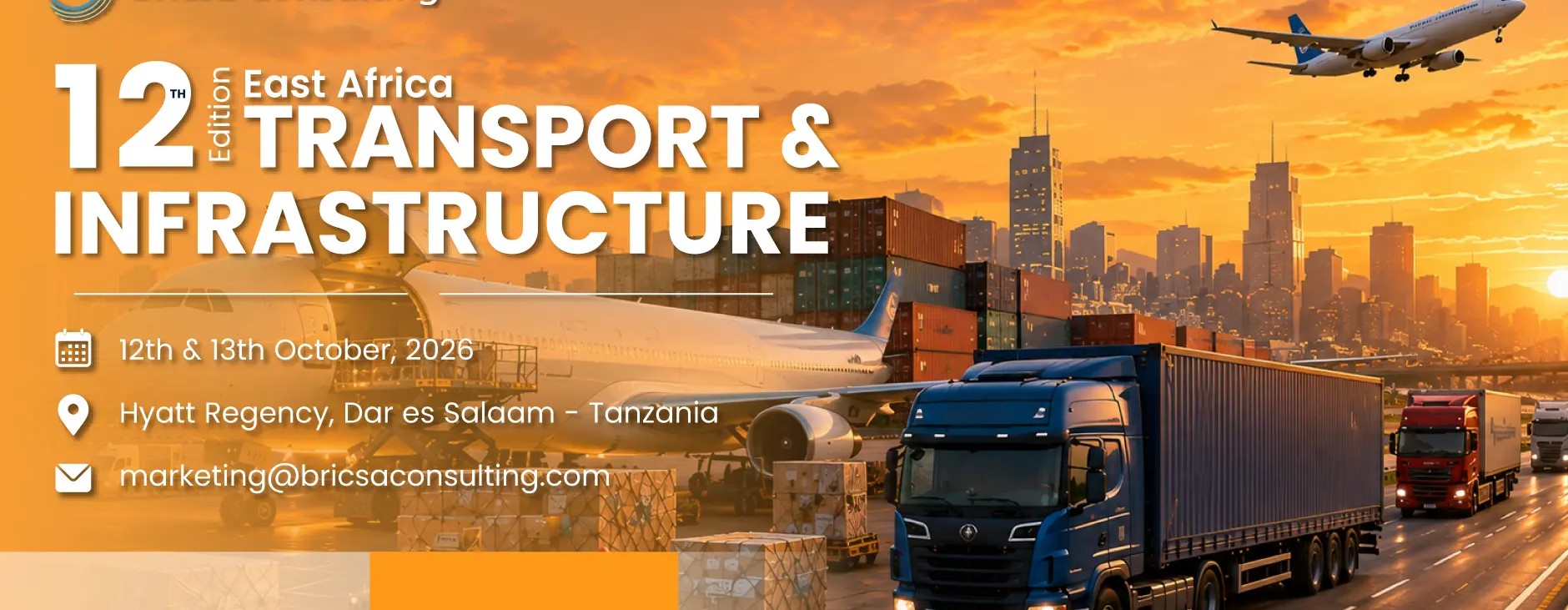
That question will be central to the 12th East Africa Transport & Infrastructure Conference, scheduled for 12–13 October 2026 in Dar es Salaam, Tanzania. Organised by Bricsa Consulting, the conference is expected to bring together government authorities, transport operators, infrastructure developers, financiers, engineering and construction firms, consultants, technology companies and logistics professionals. Its programme covers sustainable infrastructure, multimodal transport and logistics, rail, ports and roads, urban mobility, digital transformation and regional investment.
But the significance of the meeting extends beyond the projects that may be presented or discussed there. East Africa is increasingly developing transport infrastructure at the scale of corridors rather than individual countries. A road improvement in Kenya can affect the competitiveness of Ugandan manufacturers. A railway in Tanzania can change the economics of trade into Rwanda, Burundi or the Democratic Republic of Congo. A more efficient port can have consequences hundreds or even thousands of kilometres inland.
The region’s transport infrastructure is therefore becoming a networked engineering problem.
The corridor is becoming the real unit of infrastructure
The East African Community identifies ten major regional road corridors covering about 14,460 kilometres. Two of the most important are the Northern Corridor, anchored by the port of Mombasa, and the Central Corridor, anchored by Dar es Salaam. The Northern Corridor serves Kenya, Uganda, Rwanda, Burundi and eastern DRC, while the Central Corridor connects Tanzania with Zambia, Rwanda, Burundi, Uganda and eastern DRC.
That geography helps explain why Dar es Salaam is an appropriate location for a regional transport discussion.
Tanzania is not simply expanding its domestic transport network. It is strengthening the infrastructure through which landlocked and land-linked economies reach international markets. The country’s 2026/27 budget has prioritised continued investment in the Standard Gauge Railway, roads, water and energy infrastructure, while the government has also been positioning Dar es Salaam as an increasingly important regional logistics hub.
The Port of Dar es Salaam illustrates the scale of the change. Tanzania Ports Authority has been modernising the port while also trying to improve the wider logistics chain around it. In August 2026, the authority said a new cargo-handling area at Kurasini was 98 per cent complete and had been directed to begin operations by November. The first phase is planned to handle 150,000 TEUs, with a second phase expected to raise capacity to 700,000 TEUs. The facility is also being linked to road and railway infrastructure.
This is an important shift in the way ports need to be understood.
A port can increase its berth capacity, deepen its channel and deploy more sophisticated terminal equipment, but those improvements have limited value if trucks cannot move efficiently away from the port or if railway capacity cannot absorb additional cargo.
The port, road, railway, dry port, border crossing and customs system are effectively one piece of infrastructure from the perspective of a shipper.
Mombasa and Dar es Salaam are competing and complementary gateways
The competition between East Africa’s principal maritime gateways is often presented as a contest between Mombasa and Dar es Salaam. There is certainly a competitive dimension, particularly as both ports seek cargo from the same hinterland markets.
But there is another way to look at the relationship.
Both ports are becoming anchors for increasingly extensive multimodal corridors. The EAC’s own planning recognises the Northern and Central corridors as strategic regional infrastructure, while its development strategy points to growing investment in rail and road links connecting ports to inland markets.
For East African industry, the most important question may therefore not be which port wins, but whether businesses can reliably choose between multiple gateways according to price, transit time, reliability and destination.
That requires interoperability.
A container arriving at Mombasa or Dar es Salaam may move by ship, road, railway, inland waterway and road again before reaching its final destination. Every change between modes introduces the possibility of delay, damage, additional handling costs or administrative friction.
The engineering challenge is consequently no longer simply to make each mode efficient in isolation. It is to make the interfaces between modes efficient.
Rail is being asked to do more than move passengers
Railways are central to this transition.
Kenya’s Mombasa–Nairobi Standard Gauge Railway has already demonstrated the potential for rail to move large volumes of freight between a port and an inland logistics centre. The EAC’s latest development strategy says the Mombasa–Nairobi SGR has reduced freight transit times between the two cities substantially and that Kenya and Tanzania have made the most significant progress in developing and operating standard-gauge railways within the region. Tanzania’s Central Corridor SGR is being developed in phases towards the country’s interior and ultimately towards the Great Lakes region.
The strategic question is what happens when these national railway investments are viewed as pieces of a regional system.
Railways crossing national borders need compatible technical standards, signalling systems, rolling stock requirements, safety regimes, operating procedures and customs arrangements. They also need reliable interchange with ports, roads and inland terminals.
A railway that stops at a national border, or whose cargo must undergo lengthy administrative procedures before continuing, is technically functional but commercially inefficient.
This is why the revival of Uganda’s railway links and the development of the Central Corridor are important beyond the individual projects themselves. The EAC says its regional railway planning is intended to support an interoperable network, harmonised regulatory frameworks and greater use of public-private partnerships.
The road problem is no longer simply about building more kilometres
Roads will remain the dominant mode for much of East Africa’s freight and passenger movement, particularly for first- and last-mile connectivity.
The issue is increasingly one of performance.
The Northern Corridor Transport Observatory’s first-quarter 2026 report provides a useful illustration. Transit time from Mombasa to Malaba improved by 33 per cent compared with the same quarter of 2025, while Mombasa–Busia improved by 26 per cent. Yet the average times remained above the corridor’s distance-based benchmarks.
That distinction matters.
A road can be newly constructed and still form part of a slow transport system. Trucks can lose hours at borders, weighbridges, congested urban sections, inspection points or other administrative interfaces. The Northern Corridor’s 2025 performance data also identified border delays, road conditions, congestion and procedures involving electronic cargo-tracking equipment among the factors affecting transit times.
The implication for infrastructure planning is significant.
East Africa does not necessarily need to solve every transport problem by adding another road. In some cases, the higher-value investment may be an interchange, bypass, weighbridge, border facility, logistics centre, bridge, drainage improvement, traffic-management system or digital platform that removes a bottleneck from an existing corridor.
That is a different philosophy of infrastructure development.
One-stop borders show what integration can achieve
The One Stop Border Post has become one of the more tangible examples of regional transport integration.
Instead of treating a border as two separate national administrative systems, the model attempts to bring agencies from neighbouring countries into a coordinated process. The EAC reports that OSBPs at locations including Malaba, Busia, Rusumo and Nimule have contributed to reducing clearance times. Its latest development strategy also identifies OSBPs as an important component of corridor efficiency.
Yet physical infrastructure alone does not eliminate border delays.
The EAC Secretary General’s July 2026 assessment is revealing. Following visits to the Sirari–Isebania and Busia–Busia OSBPs, the Community called for domestic administrative bottlenecks to be removed, arguing that such delays increase the cost of doing business and undermine regional competitiveness. The EAC has set a target of raising intra-EAC trade to 50 per cent by 2030.
This points towards an important concept for the next generation of transport infrastructure: the digital border.
Electronic cargo tracking, pre-arrival processing, digital customs documentation, vehicle identification, automated weighing, data exchange and risk-based inspection can potentially reduce the amount of time a physical vehicle needs to spend at a border.
But these systems need to talk to each other.
Digital transformation could become the invisible layer of the corridor
Digitalisation is one of the conference’s stated themes, and perhaps one of the most consequential.
A modern transport corridor generates enormous quantities of data. Ports know when vessels arrive and containers are discharged. Terminal operators know where containers are stored. Customs authorities know when cargo is cleared. Road agencies know traffic conditions. Trucking companies know vehicle locations. Rail operators know wagon movements. Border agencies know when cargo enters and leaves a country.
The challenge is turning those separate data streams into a functioning logistics system.
A regional freight platform could, for example, allow a shipper to track a container from vessel discharge at Mombasa or Dar es Salaam through a railway terminal, border crossing and final inland destination.
For operators, the value would be greater visibility. For governments, the same information could support congestion management, infrastructure planning, road maintenance and enforcement.
The engineering challenge then moves into data architecture, interoperability, cybersecurity and communications networks.
The physical corridor acquires a digital twin of sorts.
Urban transport presents a different engineering problem
Regional trade is only one part of the equation.
East Africa is urbanising rapidly, and the same transport systems that move freight between countries also pass through cities where they compete for road space with pedestrians, motorcycles, buses, private vehicles and increasingly electric mobility.
Dar es Salaam is particularly relevant because the city has already invested in Bus Rapid Transit through the Dar Rapid Transit Agency. The conference programme includes urban mobility, while the speaker list includes DART and transport authorities from several countries.
The engineering challenge is to avoid designing urban transport as isolated projects.
A BRT system needs appropriate road geometry, stations, traffic management, pedestrian access, drainage, lighting, fare collection, fleet maintenance and, increasingly, digital passenger information. Rail-based urban transport introduces another set of interfaces with roads and existing development.
The quality of an urban transport system therefore depends as much on integration as on the vehicle itself.
Climate resilience is becoming a transport requirement
There is another factor that is becoming harder to ignore: climate.
Roads, bridges, railways, ports and drainage systems are long-lived assets. Their design lives can extend for decades, meaning infrastructure being built today will operate under climatic conditions that may differ from the historical data used to design it.
The EAC’s latest development strategy explicitly identifies climate resilience as an emerging challenge for regional roads, alongside maintenance and fragmented regulatory systems.
For engineers, this changes the design question.
A culvert is no longer simply sized according to historical rainfall assumptions. Bridges need to consider changing flood risks. Pavements must withstand temperature and rainfall stresses. Embankments need protection against erosion. Ports need to consider sea-level and extreme-weather risks. Drainage systems become critical transport infrastructure rather than secondary civil works.
The cost of building resilience at the design stage may be substantially lower than reconstructing a failed asset after a major flood or landslide.
Financing will determine which corridors actually get built
The scale of East Africa’s infrastructure ambitions makes financing another central issue.
The EAC has explicitly called on Partner States to adopt sustainable financing models for infrastructure.
This is where transport infrastructure increasingly intersects with the PPP debate.
Large corridors can involve billions of dollars in roads, railways, ports, bridges, logistics parks and border facilities. Governments may not have sufficient fiscal space to finance all of these assets directly.
But private capital will not simply finance infrastructure because a government has identified it as strategically important.
Projects need credible demand forecasts, appropriate risk allocation, land availability, predictable regulation, bankable revenue structures and sufficiently mature engineering and environmental studies.
That makes project preparation as important as construction.
A corridor can exist on a government master plan for years without becoming an investable project.
The next generation of corridors may be built around economic activity
There is also a more fundamental question about what these corridors are intended to carry.
Historically, much transport infrastructure in East Africa has been designed around moving imports from ports into inland markets. The next phase could increasingly be about moving regional production in both directions.
Agricultural products, manufactured goods, minerals, construction materials and processed commodities all require dependable transport.
The African Development Bank has repeatedly framed regional corridors as instruments of economic integration rather than simply transport projects. Its work in East Africa includes support for roads and multimodal links intended to connect agricultural and mineral-producing areas to markets and ports. In Tanzania, for example, the Bank has recently supported completion of road links intended to connect western regions to the Central Corridor and the Port of Dar es Salaam, with expected benefits for agriculture, mining, tourism and agro-processing.
This is perhaps the most important reason for thinking about transport infrastructure as an economic system.
A road that lowers the cost of transporting maize is agricultural infrastructure. A railway serving a mineral-processing zone is industrial infrastructure. A port linked efficiently to a manufacturing cluster is trade infrastructure. A commuter rail line connected to housing and employment centres is urban infrastructure.
The boundaries between transport and economic infrastructure are becoming increasingly difficult to separate.
East Africa has many corridors. The challenge is making them behave like one network
The region already has the basic ingredients.
There are ports at Mombasa, Dar es Salaam, Tanga, Lamu and elsewhere. There are major road corridors crossing national boundaries. Railways are being upgraded and extended. One Stop Border Posts are operating at strategic crossings. Dry ports and logistics centres are expanding. Digital cargo tracking and customs systems are becoming more important.
The question is whether these investments can be coordinated sufficiently to produce a transport network that is predictable for businesses.
That means agreeing on technical standards where necessary, simplifying border procedures, maintaining roads after construction, coordinating infrastructure investment, improving data sharing and designing ports, railways and roads as connected parts of the same logistics chain.
The EAC has already identified the problem at policy level. Its July 2026 transport sector meeting called for stronger regional connectivity and sustainable financing, while its latest development strategy recognises both the progress made and the remaining problems of fragmented regulations, maintenance, non-tariff barriers and climate resilience.
The engineering challenge now is to translate that regional ambition into physical systems that work reliably across borders.
That may ultimately be the more important conversation in Dar es Salaam.
East Africa does not lack transport projects. It has roads waiting for better logistics systems, ports requiring efficient hinterland connections, railways seeking sufficient freight volumes, cities struggling with congestion and borders trying to process increasing trade.
The next stage of regional infrastructure development may therefore depend less on how many kilometres of road or railway are added and more on whether the different pieces can be designed, financed, operated and maintained as one transport system.
For engineers, that means the corridor itself is becoming the project.

-
Product on sale
 AWEBook Volume 2Original price was: KShs 3,500.00.KShs 3,000.00Current price is: KShs 3,000.00.