

Last Updated 1 day ago by Kenya Engineer
For years, mini-grids have occupied a somewhat unusual position in Africa’s electricity debate. They have been presented as a solution for communities too remote or too expensive to connect to national grids. That description remains valid, but it increasingly understates what modern mini-grids can do.
Solar generation, batteries, smart meters, remote monitoring and digital payments are turning mini-grids into sophisticated local power systems capable of supporting households, businesses, schools, health facilities and productive activities.
The question is no longer whether mini-grids can electrify remote communities. It is whether they can become a bankable, scalable and integrated component of Africa’s wider electricity infrastructure.
That question will be relevant at the East Africa Mini-Grid Investment Forum, scheduled for 20–21 November 2026 in Nairobi. The event appears on the current regional energy-events calendar alongside other major electricity-access and energy-transition forums.
Mission 300 is attempting to connect 300 million Africans to electricity by 2030, while the IEA estimates that nearly 600 million people in Africa still lack access. Grid expansion will be essential, but the economics of reaching every settlement with conventional infrastructure are difficult.
That leaves decentralised systems with an increasingly important role.
The mini-grid is no longer just a smaller power station
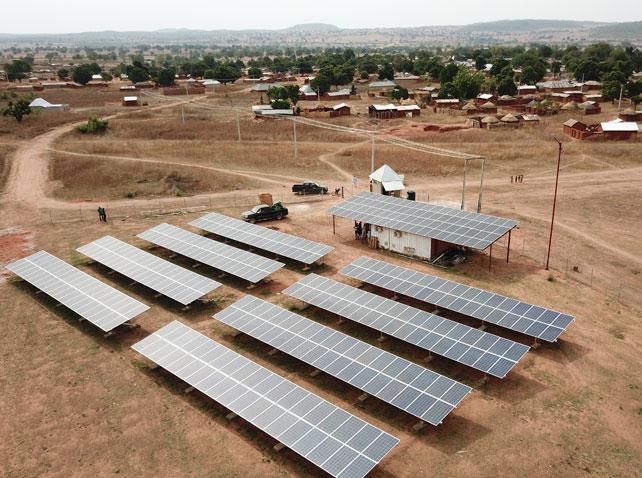
A modern solar mini-grid can look surprisingly similar to a conventional electricity network at the system level. It has generation, energy storage, distribution lines, meters, protection equipment, control systems and customers.
The difference is that the entire system is designed around a smaller geographic area.
Solar PV provides generation. Batteries store excess energy and supply customers when solar output falls. Inverters manage conversion and power quality. Smart meters measure consumption and can support prepaid or pay-as-you-go models. Remote monitoring allows operators to see system performance without necessarily sending technicians to the site.
The World Bank has described modern solar mini-grids as capable of providing high-quality, 24-hour electricity to communities beyond the conventional grid, with enough power for appliances such as refrigerators, welding equipment, milling machines and electric vehicles.
That is a substantial change from the image of the mini-grid as merely a collection of solar panels powering a few lights.
It is becoming a local utility.
The numbers explain why the technology matters
The scale of the opportunity is enormous.
The World Bank has estimated that achieving the potential of solar mini-grids could require more than 217,000 new mini-grids serving about 490 million people by 2030, at a cumulative investment requirement of roughly US$127 billion. At the pace prevailing when the analysis was published, only about 44,800 new mini-grids serving 80 million people would be built by 2030.
The numbers have changed as the market and wider electrification programmes have evolved, but the underlying message remains relevant.
The challenge is no longer proving that mini-grids work technically. It is figuring out how to deploy them at scale.
Africa needs a mix of grid and off-grid solutions
There is a tendency to frame grid extension and mini-grids as competing technologies. In reality, they can be complementary. A national grid makes sense where population density and demand can support the cost of transmission and distribution infrastructure.
A mini-grid can make more sense where communities are geographically dispersed, demand is initially low or extending the main grid would take years.
Stand-alone solar systems can fill an even smaller-scale role.
The IEA’s electricity-access analysis explicitly identifies grid expansion, mini-grids and stand-alone systems as components of a cost-effective pathway towards universal access.
The challenge is therefore one of integrated electrification planning.
Governments need to determine which technology is appropriate for which location rather than treating one technology as the universal answer.
Kenya provides an important case study
Kenya is particularly relevant to this discussion because the country has become one of Africa’s leading markets for off-grid solar.
The IEA’s 2025 Kenya Energy Policy Review found that electricity access had risen from 37 per cent in 2013 to 79 per cent in 2023 and noted that Kenya accounted for nearly three-quarters of solar home-system sales in East Africa in 2023. It also reported that roughly one in five Kenyan households was using solar-powered mini-grids or stand-alone systems.
This gives Kenya experience that goes beyond the hardware. The country has developed expertise in mobile-money payments, pay-as-you-go energy services, remote monitoring and private-sector distribution models.
Those capabilities are potentially as important as the declining cost of solar modules.
A mini-grid succeeds not only because it can generate electricity cheaply but because it can collect revenue reliably enough to remain operational.
The hardest problem may be demand
This is where mini-grid economics become complicated. A community may need electricity desperately but still consume very little electricity.
Lighting, phone charging and a few household appliances do not necessarily generate enough revenue to repay the capital cost of a power system.
A mini-grid therefore needs demand.
The IEA’s research is particularly relevant here. It finds that businesses consume almost three times as much electricity per connection as households, while schools and healthcare facilities can consume even more. Productive-use applications such as irrigation pumps, cold storage and small enterprises can therefore transform the economics of an electricity-access project.
This suggests that mini-grid planning cannot be separated from local economic development.
If a system is built in an agricultural area, the design should consider irrigation, milling, refrigeration and agro-processing. In a fishing community, cold storage could become a major load. In a trading centre, workshops, welding, retail refrigeration and digital services could create demand.
Electricity becomes an input into economic activity rather than merely an end product.
The anchor customer may be as important as the household
This changes the way a mini-grid should be designed.
Instead of asking only how many households live within the service area, developers may need to ask what businesses, schools, health facilities, water systems or agricultural operations can act as anchor loads.
A reliable anchor load can improve the utilisation of the generation and distribution infrastructure throughout the day.
A cold-storage facility, for example, may consume electricity during daylight hours when solar generation is abundant. An irrigation pump can similarly provide daytime demand.
Households can then form an additional evening load.
This improves utilisation of the system and potentially reduces the amount of battery capacity required.
The engineering design and the commercial model become closely connected.
Batteries are changing the economics
Storage is arguably the technology that has changed the mini-grid proposition most dramatically. Without storage, solar mini-grids are constrained by the timing of sunlight. With batteries, electricity generated during the day can be supplied after sunset.
But storage also introduces new engineering considerations.
Battery sizing has to account for demand profiles, solar-resource variability, degradation, depth of discharge, temperature and expected system life.
The operator needs a strategy for replacing batteries when they reach the end of their useful life.
The system also needs appropriate battery-management, thermal and protection systems.
This means the mini-grid of the future is increasingly a power-electronics and software system as much as a solar installation.
Digital technology may be what makes distributed energy scalable
A conventional utility needs physical infrastructure and people on the ground.
A mini-grid spread across hundreds of remote communities cannot necessarily rely on frequent physical visits.
Remote monitoring therefore becomes fundamental.
Operators can monitor battery state of charge, inverter performance, solar production, voltage, frequency, faults and customer demand remotely.
Smart meters can provide consumption data and support prepaid electricity. Digital payment platforms can automate collection. Predictive analytics could eventually identify failing components before they cause outages.
This has an important consequence for the business model.
The more systems can be monitored and managed remotely, the more geographically dispersed a mini-grid operator can become without increasing its field workforce at the same rate.
The scalability problem therefore becomes partly a digital infrastructure problem.
But technology does not solve weak economics
The industry’s biggest challenge remains finance.
The IEA found that private finance represented only about 25 per cent of electricity-access financing commitments in sub-Saharan Africa in 2023. Mini-grid developers face particularly difficult conditions because they require substantial upfront capital while serving customers with limited ability to pay.
Equity is particularly scarce.
Developers need equity to develop projects, conduct surveys, acquire equipment, obtain permits and establish operations before a project generates enough cash flow to support debt.
But investors often want to see an established business model before providing capital. This creates a familiar problem in infrastructure finance.
The projects need capital to become bankable, but investors want them to be bankable before providing the capital.
Regulation can make or break the market
Mini-grids also sit in a complicated regulatory position.
A developer needs to know what tariffs it can charge, what licences are required, how long approvals will take and what happens if the national grid eventually reaches the community.
That last question is particularly important.
If a mini-grid is developed in an area that later receives a national-grid connection, the operator could find itself competing with a much larger utility.
A regulatory framework therefore needs to establish what happens to the mini-grid. Can it connect to the national grid? Can the utility purchase the system? Can the developer continue operating a local network? Will customers be transferred? Who compensates the original investor?
These questions directly affect investment risk.
The IEA identifies clearer mini-grid regulations, standardised tariffs and reduced approval times as important tools for increasing private investment.
The arrival of the grid should not mean the death of the mini-grid
There is another possibility. A mature mini-grid could eventually become a grid asset.
Instead of treating it as stranded infrastructure when the national network arrives, the system could potentially be interconnected and become a distributed generation and storage resource.
Its solar panels could continue generating electricity. Its batteries could provide local storage. Its distribution network could serve customers while the wider grid supplies additional power.
This would require appropriate technical standards, protection systems, metering and regulatory arrangements. But it points to a different way of thinking about rural electrification. Today’s mini-grid could become tomorrow’s distributed-energy node.
Productive electricity could change the investment proposition
This is perhaps the most important lesson emerging from the sector. The objective should not be to build as many mini-grids as possible.
It should be to build productive mini-grids.
A community with electricity but no economic activity remains a difficult market.
A community where electricity enables irrigation, refrigeration, water pumping, welding, grain milling, digital services and small manufacturing can create a much stronger demand base.
This is why electricity-access programmes increasingly need to be connected to agriculture, water, health, education and local enterprise development.
The power project cannot be designed independently of the economy it is intended to serve.
Mini-grids could also become part of a more resilient power system
There is a broader systems argument. Distributed generation reduces the dependence of some communities on long transmission lines.
During major grid failures or extreme weather events, local generation and storage can potentially provide resilience.
This does not mean mini-grids can replace national transmission networks. Rather, they can provide another layer of resilience within a larger system.
As climate risks increase and electricity demand grows, that distributed layer could become increasingly valuable.
The investment forum comes at an important moment
The East Africa Mini-Grid Investment Forum takes place against a much larger shift in how electricity access is being financed.
Mission 300 is attempting to mobilise governments, development finance institutions and private investors around country-level electricity-access programmes. The World Bank and AfDB have already reported more than 50 million people gaining access through the initiative.
The challenge now is moving from individual projects to a repeatable investment model. Can developers reduce the cost of project development? Can governments create predictable regulations? Can financiers provide patient equity? Can productive-use programmes increase electricity demand? Can digital platforms reduce operating costs? Can local banks and pension funds eventually participate? And can mini-grids be designed from the beginning to integrate with national grids rather than exist as isolated systems?
Those questions may ultimately determine whether mini-grids remain a niche solution for difficult-to-reach communities or become one of the principal building blocks of Africa’s future electricity system.
For East Africa, the opportunity is particularly significant.
The region has some of Africa’s strongest off-grid markets, substantial renewable-energy resources, rapidly expanding digital-payment infrastructure and a large population of rural and peri-urban communities whose electricity demand is likely to grow as incomes and productive activity increase.
The next stage is therefore not to prove that a solar mini-grid can power a village.
It is to demonstrate that hundreds or thousands of decentralised power systems can operate reliably, attract investment, support productive economies and eventually become part of an integrated regional electricity system.
That is a much bigger engineering challenge. And potentially a much bigger market.

-
Product on sale
 AWEBook Volume 2Original price was: KShs 3,500.00.KShs 3,000.00Current price is: KShs 3,000.00.