Last Updated 17 mins ago by Kenya Engineer
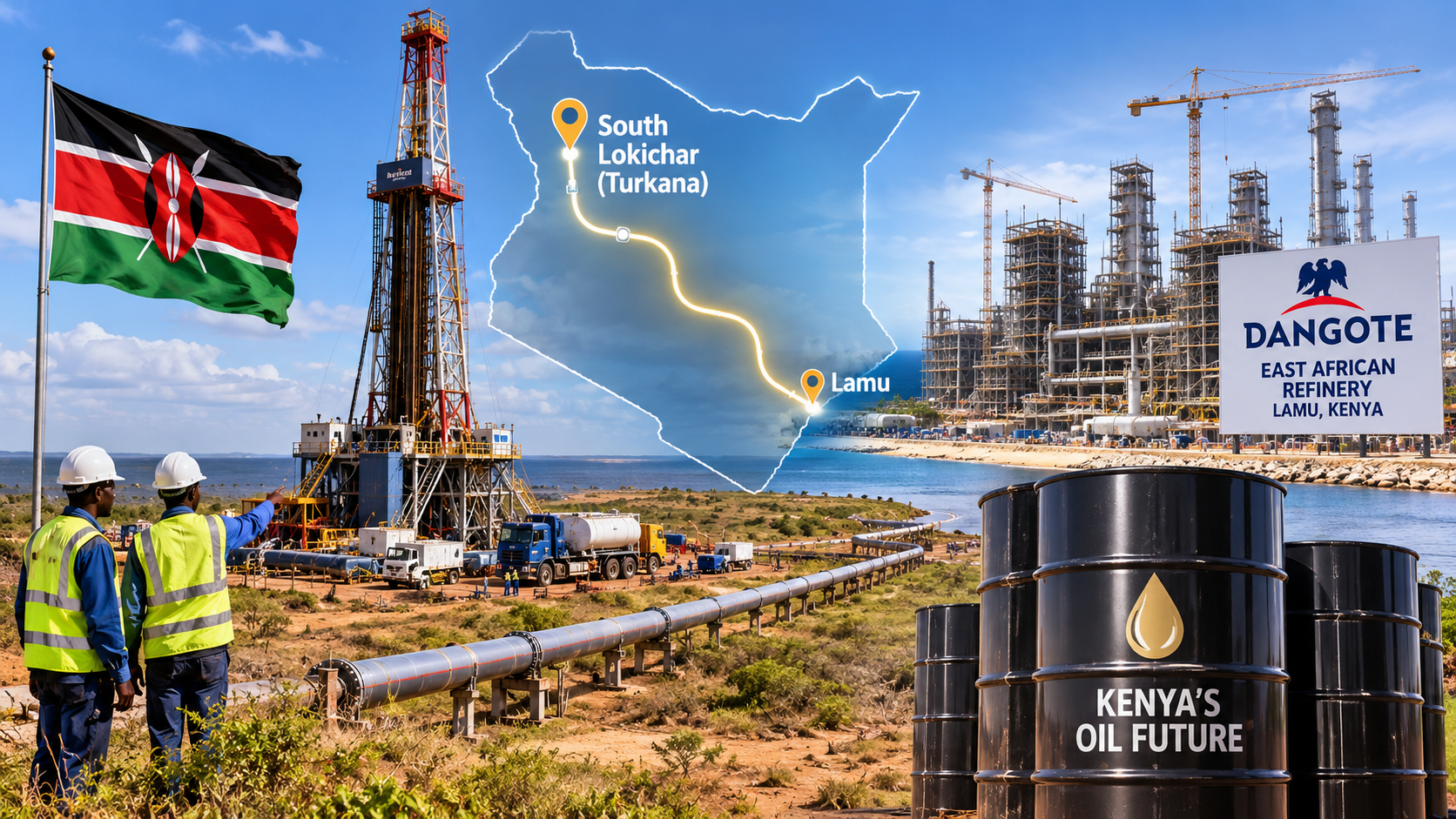
Kenya is approaching a historic milestone in its energy sector. On November 20, 2026, drilling operations at the South Lokichar oilfields in Turkana County are scheduled to commence, marking another significant step towards the country’s first commercial crude oil production.
Energy and Petroleum Cabinet Secretary Opiyo Wandayi confirmed the commencement date, maintaining that the project remains on course to achieve first oil on December 1, 2026. President William Ruto is expected to preside over the launch of the first oil consignment.
The development is being undertaken by Gulf Energy E&P BV SEZ, which is targeting initial production of approximately 20,000 barrels per day before increasing output to 50,000 barrels per day in subsequent development phases.
For Kenya, this represents the culmination of more than a decade of exploration, appraisal, negotiations and infrastructure planning. It also introduces a new dimension to the country’s energy industry, with opportunities to develop petroleum production, transportation, storage, refining and associated industrial services.
The timing is particularly significant. As Kenya prepares to become an oil-producing country, a major investment in refining infrastructure is also taking shape at Lamu, where the Dangote Group has commenced development of a proposed 700,000-barrel-per-day refinery.
The two developments could eventually form the foundation of a more integrated petroleum industry, connecting domestic oil production with refining capacity and regional petroleum markets.
However, substantial engineering, commercial and logistical challenges remain before that ambition can be realised.
From discovery to commercial production
Kenya’s journey towards becoming an oil producer began in March 2012, when Tullow Oil announced the discovery of commercially viable oil at the Ngamia-1 exploration well in the South Lokichar Basin.
The discovery followed years of petroleum exploration in northern Kenya and established Turkana as a significant oil exploration region. Subsequent appraisal activities identified additional discoveries, including Amosing, Twiga, Ekales, Agete and Etom.
The discoveries generated considerable expectations that Kenya could become an important crude oil exporter. Initial development concepts envisaged a large-scale petroleum operation supported by a dedicated pipeline connecting Turkana to the proposed Lamu Port.
Commercial development, however, proved more difficult than establishing the existence of oil.
The project required substantial capital investment, extensive supporting infrastructure and agreements covering production sharing, taxation, environmental protection and community interests. Negotiations between the government and project partners, together with changes in the international investment environment, contributed to repeated delays.
An Early Oil Pilot Scheme was subsequently implemented, allowing limited quantities of crude from Turkana to be transported by road to Mombasa for export between 2018 and 2020. The pilot demonstrated that oil could be produced and transported from the region, although it was not a substitute for the full commercial development of the fields.
The ownership structure also changed, with Gulf Energy eventually taking over the development interests previously held by Tullow Oil and its partners.
A revised Field Development Plan submitted by Gulf Energy in September 2025 subsequently provided the framework for the current phased development approach.
The transition from discovery in 2012 to anticipated commercial production in December 2026 illustrates the considerable time, investment and coordination required to move a petroleum resource from exploration into production.
The engineering behind first oil
The South Lokichar development is being implemented in phases, beginning with the Ngamia and Amosing fields, which have been identified as the most technically mature reservoirs for initial production.
According to the Field Development Plan, the first phase will use 48 wells, comprising five existing wells and 43 additional wells, to achieve an initial production plateau of approximately 20,000 barrels per day.
Two Early Production Facilities, each designed to handle approximately 10,000 barrels of oil per day, will process the crude from the two fields.
The facilities will undertake several essential operations, including the separation of oil, gas and water, crude dehydration, water treatment, storage and transfer. These processes are necessary to ensure that the crude meets the required specifications before transportation.
The second phase will expand production towards approximately 50,000 barrels per day. It will involve further development of Ngamia and Amosing, alongside production from additional fields, including Twiga, Ekales, Agete and Etom.
A Central Processing Facility is planned to support the increased production volumes.
The phased strategy allows engineers to collect additional information about reservoir behaviour and use actual production data to optimise subsequent development.
This is particularly important in petroleum engineering because reservoir performance can differ from initial geological models. Engineers must continually monitor pressure, fluid movement, water production and well performance to determine how extraction should be managed.
The drilling programme will involve well construction, casing and cementing, formation evaluation, well completion and pressure testing. These activities require specialised equipment and stringent safety procedures because drilling operations involve high-pressure systems, combustible materials and potentially hazardous formation fluids.
The project has mobilised a GW70 onshore drilling rig rated at 1,500 horsepower. The equipment was transported from Oman and received at the Port of Mombasa in September 2026 before preparations for deployment to Turkana.
Gulf Energy has also engaged international specialist service providers, including Baker Hughes for integrated well services and SLB for the Early Production Facility.
The involvement of these companies illustrates the technical complexity of the undertaking and the importance of specialised expertise in developing petroleum resources.
Water supply: A critical engineering consideration
Water availability is among the most important challenges facing the South Lokichar development.
Turkana is an arid region where water is essential for households, livestock keeping and other economic activities. Petroleum operations also require substantial water volumes, particularly for drilling, processing and reservoir pressure maintenance.
The Field Development Plan identifies the Turkwel Gorge Reservoir as the preferred source of supplementary water for the project.
A pipeline of approximately 90 kilometres is planned to convey water from the Turkwel area towards the oilfields around Ngamia. The infrastructure will require hydraulic design, pumping systems, pipeline installation, control equipment and long-term maintenance.
At peak Phase One production, the project’s estimated operational water requirement is approximately 26,000 barrels per day.
Water management will also involve treating and reusing produced water. As oil is brought to the surface, it is accompanied by water and other fluids. Processing facilities must separate these components, after which appropriately treated water can be reinjected into the reservoir to support pressure maintenance.
The project therefore requires an integrated water management system that balances operational requirements with environmental protection.
The proposed water infrastructure also includes community offtakes along the pipeline route, creating an opportunity to improve water access for surrounding settlements and support irrigation.
However, the availability of water for petroleum operations must be balanced against domestic consumption, livestock and agricultural requirements. Effective monitoring, transparent allocation arrangements and community participation will be essential.
The transportation challenge: Moving oil from Turkana to the coast
Producing crude oil is only one part of the petroleum value chain. Getting it to storage and export facilities presents another major engineering and logistical undertaking.
During the first development phase, crude will be transported by road from Lokichar to the Kenya Petroleum Refineries Limited facility in Changamwe, Mombasa, a distance of approximately 1,100 kilometres.
This arrangement is necessary because the project does not yet have a dedicated crude oil pipeline connecting Turkana to the coast.
However, Turkana crude presents a particular transportation challenge because of its high wax content. The crude has a wax appearance temperature of approximately 62–67°C and a pour point of approximately 42–48°C, depending on the field.
These characteristics mean that the oil can develop wax deposits and eventually become difficult to transport if its temperature falls too low.
The Field Development Plan consequently provides for crude to be loaded at approximately 80°C into insulated road tankers. The insulation is intended to minimise heat loss and maintain the oil in a sufficiently fluid state throughout the journey.
At the planned production rate of 20,000 barrels per day, approximately 100 tanker loads will need to be dispatched daily. The development plan estimates that a fleet of around 600 trucks will be required, based on a six-day round trip.
This creates significant demands on road infrastructure, vehicle maintenance, driver management, loading facilities and road safety.
The project also identifies the need to upgrade sections of the C46 road, maintain the A1 corridor between Lokichar and Sebit, complete road construction between Sebit and Kitale, and improve access to the receiving facilities in Mombasa.
At KPRL Changamwe, approximately 143,000 cubic metres of insulated storage capacity, equivalent to around 900,000 barrels, is envisaged to accommodate the crude before export.
The storage facilities will require heating arrangements, insulated tanks and appropriate transfer systems. A heated and insulated pipeline connection to the Kipevu Oil Terminal 2 is also envisaged.
From the second development phase, when production is expected to reach 50,000 barrels per day, the transportation model is planned to incorporate rail. The development plan envisages transporting crude from the Eldoret area to Mombasa using dedicated rail wagons.
The initial road-based approach will allow production to begin without waiting for a dedicated pipeline. However, its long-term commercial viability will depend on transportation costs, road conditions, operational efficiency and the reliability of export infrastructure.
Finding a market for Kenyan crude
Kenya’s entry into the international crude oil market will require more than establishing production capacity. The country must also secure buyers willing to purchase its oil at prices that justify the costs of extraction, handling and transportation.
The government describes Turkana crude as light and sweet, referring to its relatively low density and low sulphur content. These characteristics are generally attractive to refiners because they can make crude easier to process into products such as petrol, diesel and aviation fuel.
However, crude oil is not valued on these two characteristics alone. Refinery compatibility also depends on its detailed chemical composition, wax content, acidity, contaminants and other physical properties.
The government has narrowed the proposed trading name for Kenyan crude to four options: Great Rift Light, Great Rift Intermediate, Great Rift Blend and Great Rift Sweet. The final name is expected to be announced alongside the first oil consignment.
A recognised trading name will help distinguish Kenyan crude in international markets, where established grades such as Brent, West Texas Intermediate, Murban and Nigeria’s Bonny Light already have significant market recognition.
For Kenya, the commercial challenge will be securing buyers and establishing pricing arrangements that account for the quality of its crude, the cost of transportation and the prevailing international market conditions.
The first phase will rely on exporting crude through Mombasa, with the first exports expected in the first quarter of 2027. This means that achieving first oil in December 2026 and commencing regular exports are separate milestones.
An important question is whether Kenya can eventually develop a dependable regional market that reduces its reliance on distant international buyers.
This is where the proposed Dangote refinery in Lamu becomes particularly significant.
Dangote’s Lamu refinery: A timely opportunity for Kenyan crude
Kenya’s preparations to begin oil production are coinciding with one of Africa’s most ambitious downstream petroleum investments.
On September 30, 2026, the Dangote Group broke ground on a proposed 700,000-barrel-per-day refinery at Lamu Port. The project, estimated at approximately US$16 billion, is intended to serve Kenya and the wider East African petroleum market.
The development is expected to take approximately 40 months to construct, according to announcements made at its groundbreaking. If implemented within the proposed schedule, it could become a major regional refining centre early in the next decade.
The timing is strategically important. As South Lokichar moves towards commercial production, Kenya is also preparing to develop substantial domestic refining capacity.
The two projects could eventually establish a connection between the country’s upstream petroleum resources and its downstream industrial sector.
The proposed Lamu refinery could provide a potential regional market for Turkana crude, reducing the need to depend entirely on buyers in Europe, Asia and other distant markets. It could also strengthen the commercial case for developing transportation infrastructure linking the oilfields to the coast.
The experience of the operating Dangote Petroleum Refinery in Lekki, Nigeria, provides an indication of the potential of such an arrangement.
The Nigerian facility, with a reported capacity of approximately 650,000 barrels per day, has demonstrated the ability of a large African refinery to source crude from different producing countries. Its published disclosures indicate that it had processed 36 different crude grades from Africa, South America, the United States and the Middle East by June 2026.
The refinery has also relied on both domestic and international crude supplies, demonstrating the importance of feedstock diversification in operating a large processing facility.
This experience is relevant to Kenya because the proposed Lamu refinery will require substantial quantities of crude from different sources.
However, the scale of the refinery must be considered alongside Kenya’s production potential.
At an initial output of 20,000 barrels per day, South Lokichar would supply approximately 2.9 per cent of the Lamu refinery’s designed capacity. Even when production increases to 50,000 barrels per day, Kenyan crude would account for only about 7.1 per cent of its requirements.
The refinery will therefore depend overwhelmingly on crude sourced from other producing countries.
This does not diminish the opportunity for Kenya. Rather, it suggests that Turkana crude could become one component of a wider regional and international feedstock supply arrangement.
There are also technical considerations to resolve. Although Kenyan crude is described as light and sweet, its high wax content presents specialised handling requirements. The refinery’s engineers will need to assess its compatibility with the processing configuration, including blending requirements, heating, transportation and the effect on refining margins.
A refinery’s ability to process different crude grades does not automatically guarantee that every available grade will be commercially suitable.
No confirmed long-term crude supply agreement between Gulf Energy and the proposed Lamu refinery has been announced. Such an arrangement would require technical evaluation, commercial negotiations, pricing agreements and dependable delivery infrastructure.
Nevertheless, the possibility of supplying a major domestic refinery gives Kenya another potential route to commercialising its petroleum resources.
The Turkana–Lamu pipeline: Connecting production to refining
Perhaps the most significant infrastructure opportunity arising from the proposed Lamu refinery is the possibility of reviving the long-discussed crude oil pipeline linking South Lokichar to the coast.
The original development concept envisaged a dedicated pipeline connecting Turkana’s oilfields to Lamu, where crude could be stored and exported through the port.
The project faced commercial and financing difficulties, partly because the expected production volumes and transportation economics did not initially justify the required investment.
The proposed Lamu refinery introduces a different consideration. Instead of transporting all the crude to the coast for export, a pipeline could potentially supply part of the production directly to a domestic refining facility.
This could improve the commercial case for the infrastructure by creating a potential local destination for some of the oil.
The engineering requirements would, however, be substantial.
Because Turkana crude has a high wax content, a conventional pipeline operating at ambient temperatures may not be suitable. The system would require appropriate flow assurance measures, potentially including heating, insulation, temperature monitoring and specialised pumping arrangements.
Pipeline design would also need to account for terrain, hydraulic pressure, changes in elevation, corrosion protection, leak detection, emergency shutdown systems and environmental safeguards.
The route would require extensive surveying, geotechnical investigations, land acquisition, environmental assessments and community consultations.
Construction would involve civil engineering works, pipe laying, welding, inspection, testing, pumping stations and control systems. Once operational, the pipeline would require continuous monitoring and a planned maintenance programme.
A pipeline could offer advantages over transporting all the crude by road, particularly as production increases. It could reduce the number of heavy vehicles required along the evacuation corridor and provide a more predictable transportation system.
However, its economic justification would depend on confirmed production volumes, refinery demand, export arrangements, financing costs and the expected operating life of the oilfields.
The pipeline should therefore be assessed as part of an integrated petroleum infrastructure strategy rather than as an isolated construction project.
Environmental protection and community responsibility
The transition to commercial oil production also introduces environmental responsibilities that will extend throughout the operating life of the fields.
Oil extraction carries risks associated with well integrity, accidental releases, produced water, waste management, air emissions, land disturbance and the handling of hazardous materials.
In Turkana, water management deserves particular attention because of the region’s limited water resources and dependence on pastoralism.
The project will need effective systems for treating and reinjecting produced water, monitoring groundwater resources and managing waste generated during drilling and production.
Well integrity will be essential. Proper casing, cementing, pressure monitoring and well-control systems are necessary to prevent uncontrolled releases and protect underground water formations.
At the production facilities, containment systems, emergency shutdown arrangements, fire protection, gas detection and spill-response procedures must be incorporated into the design and operation.
The transportation of heated crude by road also introduces safety considerations involving tanker integrity, driver training, vehicle maintenance, temperature control and emergency response.
The environmental and social impact of the proposed Lamu refinery will require equally careful attention. The scale of the investment and its coastal location raise questions about land use, marine ecosystems, emissions, water requirements and the livelihoods of surrounding communities.
The Lamu development has already attracted public attention over land rights, compensation and environmental concerns. These issues will require transparent engagement and effective regulatory oversight as construction progresses.
For both projects, environmental protection should be treated as an integral engineering requirement rather than an obligation addressed after construction.
Opportunities for Kenya’s engineering industry
The development of South Lokichar and the proposed Lamu refinery presents opportunities across a wide range of engineering disciplines.
Civil and structural engineering firms will be required for access roads, drainage, foundations, earthworks, industrial buildings, storage facilities and supporting infrastructure.
Mechanical engineering specialists will be needed for pumps, compressors, pressure vessels, storage tanks, pipelines and fluid-handling systems.
Electrical and instrumentation engineers will be involved in power distribution, control systems, automation, monitoring equipment and industrial safety systems.
Other opportunities exist in chemical and process engineering, materials engineering, surveying, geotechnical investigations, environmental consultancy, inspection, testing, fabrication and equipment maintenance.
The refinery project also presents substantial opportunities for engineering, procurement and construction contractors. Business Daily reported that Indian state-owned Engineers India Limited had secured a contract valued at more than US$450 million, while Honeywell Technologies had been selected for work expected to be worth approximately US$300 million.
These commitments demonstrate the scale of specialist engineering services required to deliver a modern refining facility.
However, opportunities for Kenyan companies will not arise automatically. Many petroleum and refinery operations require specialised certifications, quality assurance systems, technical experience and compliance with demanding international safety standards.
Local engineering firms will need to strengthen their technical capabilities, establish partnerships with experienced international contractors and prepare for procurement requirements within the petroleum industry.
The South Lokichar Field Development Plan identifies opportunities for Kenyan participation in transportation, construction, logistics, mechanical and electrical services, waste management, professional services and other support activities.
Its proposed Phase One transportation arrangement alone requires approximately 600 trucks, with at least 200 envisaged to come from county-based suppliers.
Universities and technical training institutions also have an opportunity to strengthen programmes in petroleum engineering, process engineering, industrial maintenance, instrumentation, automation and related technical fields.
The long-term value of these developments should be measured partly by how much technical expertise, industrial capability and enterprise development they leave within Kenya.
Beyond the first barrel: Building a sustainable petroleum industry
The commencement of drilling in South Lokichar is an important achievement, but it should not be confused with the completion of Kenya’s petroleum development ambitions.
The December 2026 first-oil target marks the beginning of a longer process involving well development, reservoir management, production optimisation, transportation, marketing and infrastructure expansion.
The first phase is intended to establish production at approximately 20,000 barrels per day, with a subsequent increase to 50,000 barrels per day envisaged from the second development phase.
Achieving these targets will require sustained investment and coordination between the government, the operator, regulators, infrastructure agencies, contractors and local communities.
The commercial economics will also require careful management. Road transportation over approximately 1,100 kilometres, specialised heated tankers and extensive storage requirements introduce costs that will influence the competitiveness of Kenyan crude.
The development of more efficient evacuation infrastructure will consequently be important in determining the industry’s long-term viability.
The proposed Lamu refinery offers an additional opportunity to retain more value within the country through domestic refining and the development of associated industries. However, this opportunity depends on the refinery being completed, securing sufficient feedstock, meeting technical and commercial requirements and finding markets for its refined products.
Kenya must also manage its petroleum development alongside its broader energy strategy. The country has invested significantly in geothermal, hydroelectric, wind and solar power. Petroleum development introduces another dimension, particularly in relation to industrialisation, foreign exchange earnings, infrastructure investment and regional trade.
The challenge will be to manage petroleum revenues responsibly while continuing to invest in infrastructure, education, technology and cleaner energy systems.
For the engineering profession, the developments in Turkana and Lamu represent an opportunity to participate in major national industrial projects and demonstrate the importance of engineering expertise in solving complex infrastructure and energy challenges.
After more than a decade of waiting, Kenya is approaching its first commercial oil production milestone. The first barrel will be an important symbol of progress, but the real achievement will be establishing an industry that operates safely, competes commercially, develops local technical capacity and delivers lasting economic benefits.
The opportunity presented by South Lokichar is no longer limited to finding and extracting oil. It is about building the engineering, infrastructure, refining capacity and institutional systems required to turn a natural resource into sustainable national value.
-
Product on sale
 AWEBook Volume 2Original price was: KShs 3,500.00.KShs 3,000.00Current price is: KShs 3,000.00.