Last Updated 13 mins ago by Kenya Engineer
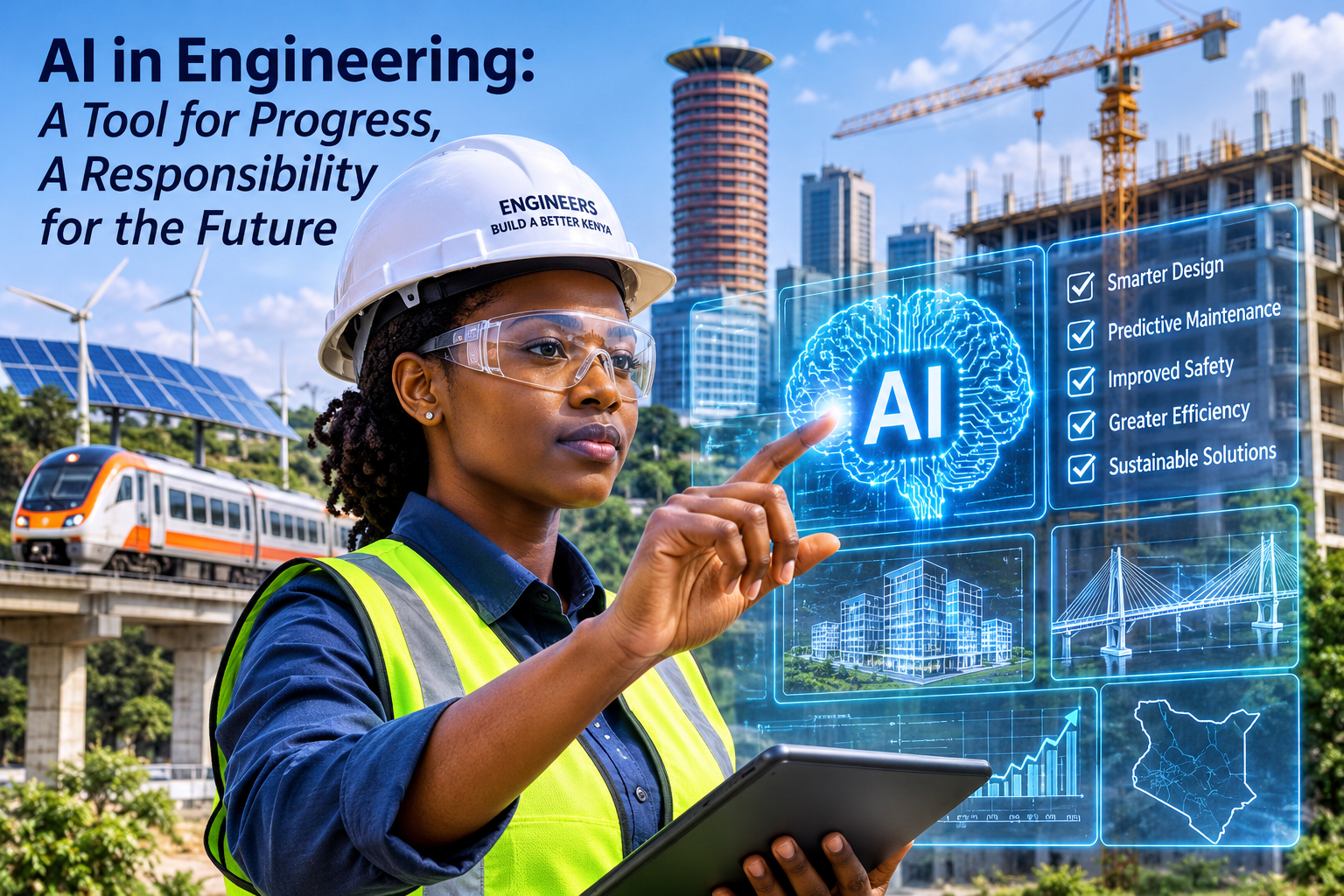
Artificial Intelligence is transforming how engineers design, analyse, build, operate and maintain infrastructure. While the technology promises greater productivity, improved decision-making and new possibilities for innovation, it also raises difficult questions about professional competence, safety, accountability and the future of engineering work. The challenge for engineers is no longer whether to embrace artificial intelligence, but how to use it without surrendering the judgement and responsibility that define their profession.
An engineering profession at a turning point
For generations, engineering practice has evolved alongside advances in technology. The introduction of computer-aided design transformed technical drawing. Numerical modelling changed structural analysis. Building Information Modelling (BIM) brought new levels of coordination to construction projects, while digital instrumentation and automation reshaped industrial production and infrastructure operations.
Each technological shift changed the way engineers worked, the skills they needed and, in some instances, the services they could offer.
Artificial intelligence (AI) represents another such transition, although its potential reach may be considerably broader.
Unlike conventional engineering software, which generally performs calculations and executes operations according to instructions supplied by its users, modern AI systems can identify patterns in large datasets, generate content, interpret images, make predictions, optimise complex processes and, increasingly, execute sequences of tasks with limited human intervention.
This is changing the relationship between engineers and the tools they use. A structural engineer can employ AI-assisted systems to explore design alternatives. A power systems engineer can use machine learning to forecast electricity demand and identify potential equipment failures. A civil engineer can analyse infrastructure inspection images to identify defects, while a project manager can use AI to examine schedules, contracts and construction records.
In manufacturing, predictive algorithms can identify unusual equipment behaviour before a breakdown occurs. In water engineering, data-driven models can support demand forecasting, network management and water quality monitoring.
The implications extend beyond individual tasks. AI is beginning to influence how engineering organisations allocate resources, manage projects, develop designs, interact with clients and compete for work.
The question is whether this transformation will strengthen engineering practice or undermine it.
The answer is unlikely to be entirely one or the other. AI offers significant opportunities to improve engineering outcomes, but its adoption also introduces risks that the profession cannot afford to ignore. The technology is powerful, but it does not possess the professional responsibility, contextual understanding or ethical obligations of a qualified engineer.
From calculating and drawing to predicting and optimising
One of the most important changes AI brings to engineering is the movement from largely reactive processes towards predictive and increasingly adaptive systems.
Traditional engineering practice has relied heavily on established equations, design standards, engineering judgement, simulations and historical performance records. These remain fundamental. However, AI introduces additional ways of analysing information and exploring solutions.
Machine learning, a branch of AI, allows computer systems to learn patterns from data and use those patterns to make predictions or classifications without requiring every possible relationship to be explicitly programmed.
For example, a maintenance engineer traditionally works with inspection schedules, equipment operating manuals, maintenance histories and periodic condition assessments. Although this approach can be effective, it may fail to identify emerging problems between inspections.
A predictive maintenance system can analyse vibration readings, operating temperatures, pressure fluctuations, electrical current patterns and other sensor measurements to identify behaviour associated with developing faults.
Instead of waiting for a scheduled inspection or responding after equipment failure, maintenance teams can investigate potential problems earlier and plan interventions around the actual condition of equipment.
The same principle is increasingly relevant to infrastructure. Bridges, roads, water distribution networks, power transmission systems and industrial facilities generate information that can be analysed to identify deterioration, unusual performance and emerging operational risks.
The quality of such predictions depends on the quality and representativeness of the data, the suitability of the model and the conditions under which it is deployed. Nevertheless, the possibility of moving from reactive maintenance towards condition-based and predictive maintenance represents a significant development for asset owners and engineering organisations.
AI is also changing design processes. Engineers have traditionally developed a design, assessed its performance against technical requirements and adjusted it through successive iterations. Generative design and optimisation systems can explore numerous possible configurations against specified objectives and constraints.
In structural engineering, for instance, an engineer may investigate alternative structural arrangements, material quantities, load paths and spatial configurations. AI-assisted optimisation can help identify promising alternatives for further engineering assessment.
In building services, algorithms can support the optimisation of heating, ventilation, air conditioning and lighting systems, balancing energy consumption, indoor comfort and operating costs.
For power engineers, machine learning can improve load forecasting, renewable energy forecasting and the management of distributed energy resources.
These applications do not eliminate conventional engineering analysis. They expand the range of possibilities that engineers can investigate and potentially reduce the time required to arrive at workable solutions.
Engineering disciplines already experiencing the change
The influence of AI is not confined to computer engineering or information technology. It is spreading across virtually every major engineering discipline, although the applications and level of maturity vary.
Civil and structural engineering
In civil engineering, AI is being applied to infrastructure monitoring, geotechnical analysis, construction planning, structural condition assessment and design optimisation.
Computer vision systems can analyse photographs and inspection footage to identify visible cracks, corrosion, surface deterioration and other defects. Machine learning can help engineers interpret large volumes of monitoring data from bridges, buildings and other infrastructure assets.
In construction, AI-assisted systems can support progress monitoring, schedule forecasting, resource allocation, quantity estimation and the review of project documentation.
The integration of AI with BIM is particularly significant. A BIM environment already provides a structured digital representation of a building or infrastructure project. AI can potentially use the information contained in these models to identify inconsistencies, assess alternatives, flag coordination issues and support lifecycle decision-making.
The longer-term opportunity lies in connecting design information with construction records and operational data, allowing asset owners to make better-informed decisions throughout the life of an infrastructure asset.
Electrical and power engineering
The electricity sector provides some of the clearest examples of why AI could become increasingly important to engineering practice.
Electricity networks are becoming more complex as countries integrate solar, wind, battery storage, electric vehicles and distributed generation into existing systems.
These technologies introduce variability in both electricity supply and demand. Maintaining grid stability requires increasingly sophisticated forecasting, monitoring and control.
AI can support short-term electricity demand forecasting, renewable generation prediction, fault detection, equipment condition monitoring and the optimisation of energy storage.
For utilities, these capabilities could improve network reliability, reduce technical losses and support more efficient allocation of electricity resources.
In Kenya, where renewable energy already plays a substantial role in electricity generation, improved forecasting and grid management could help optimise the integration of variable renewable sources and battery storage.
AI also has potential applications in industrial electrical systems, including motor condition monitoring, power quality analysis, energy management and the early identification of abnormal operating conditions.
Mechanical and manufacturing engineering
Manufacturing has long used automation, but AI introduces a greater capacity for systems to interpret operating conditions and adjust processes based on observed patterns.
Machine vision can inspect manufactured components for defects. Predictive models can identify equipment likely to require maintenance. Production optimisation systems can examine operating conditions, energy consumption, material utilisation and output quality.
In advanced manufacturing environments, AI can work alongside industrial robots and automated production systems to improve accuracy, consistency and throughput.
Mechanical engineers will increasingly need to understand the interaction between conventional mechanical systems, sensors, control systems, robotics and intelligent software.
Water, environmental and agricultural engineering
AI can support the analysis of complex environmental systems where information is collected from numerous locations over extended periods.
In water engineering, applications include water demand forecasting, leak detection, treatment plant optimisation, water quality monitoring and the management of distribution networks.
Environmental engineers can use machine learning to analyse pollution patterns, assess environmental changes and process information from remote sensing systems.
In agricultural engineering, AI-assisted image recognition can help identify crop diseases, monitor plant health and support precision irrigation. Combined with soil sensors and weather information, these systems can help farmers make more informed decisions about water, fertiliser and crop management.
For countries facing water stress, climate variability and pressure to improve agricultural productivity, these applications have considerable development potential.
Industrial, telecommunications and computer engineering
AI is also changing telecommunications network management, cybersecurity, embedded systems, robotics, industrial control and electronic product development.
Network operators can use machine learning to identify unusual traffic patterns, forecast capacity requirements and detect potential service disruptions.
Electronics engineers can use AI-assisted design tools to explore circuit configurations, analyse system behaviour and support fault diagnosis.
In industrial automation, intelligent systems can combine information from sensors, programmable logic controllers and supervisory control systems to improve operational visibility and decision-making.
Across these disciplines, the underlying development is similar: engineering systems are becoming more connected, data-intensive and capable of responding to information in real time.
The evidence: Is the engineering sector ready?
The growing interest in AI should not be mistaken for universal adoption.
The 2025 Royal Institution of Chartered Surveyors (RICS) report, Artificial Intelligence in Construction, provides a useful indication of the gap between expectations and actual implementation.
Based on responses from more than 2,200 professionals globally, the report found that approximately 45 per cent of respondents said their organisations had not implemented AI, while another 34 per cent were still at the early pilot stage.
Only around 12 per cent reported regular use of AI in specific processes, while just 1.5 per cent reported adoption across multiple processes. Less than one per cent described AI as fully embedded across their organisations.
The findings are important because they challenge the impression that AI has already transformed the entire construction industry. Interest is increasing, but widespread operational integration remains limited.
The same report identified significant potential in project scheduling, progress monitoring, resource optimisation, document review and risk management. Looking ahead, 40 per cent of respondents expected AI to have its greatest influence on design optioneering over the following five years.
Design optioneering involves evaluating alternative design solutions against competing requirements such as cost, performance, constructability, sustainability and operational efficiency.
The findings suggest that the next phase of AI adoption could extend beyond automating administrative tasks towards influencing important engineering decisions at the early stages of projects.
The World Economic Forum’s Future of Jobs Report 2025 offers another perspective. It identifies AI and big data among the fastest-growing skill areas expected to increase in importance by 2030. Analytical thinking remains one of the most important core skills identified by employers.
This is an important signal for engineers. The future workplace will require people who can combine technical knowledge, analytical ability and technological literacy rather than rely exclusively on the skills acquired during formal education.
However, adoption also depends on organisational readiness. Firms need reliable data, suitable software, cybersecurity measures, trained personnel and clear procedures for validating AI-generated outputs.
Without these foundations, AI risks becoming another expensive technology that organisations acquire without achieving meaningful improvements in engineering performance.
The positive case: Better engineering, greater productivity and wider possibilities
There are several compelling reasons why the engineering profession should regard AI as an opportunity.
The first is productivity.
Engineering projects involve substantial amounts of information processing, documentation, calculations, drawing reviews, coordination and reporting. Some of these activities are repetitive and time-consuming.
AI can assist with extracting information from technical documents, comparing specifications, preparing preliminary reports, organising inspection records and reviewing large volumes of project information.
This can reduce the time engineers spend on routine administrative work and create more room for technical evaluation, problem-solving and innovation.
The second advantage is improved decision-making.
Engineering decisions frequently involve competing objectives. A road design must consider safety, cost, environmental impact, terrain, drainage and long-term maintenance. An electrical system must balance reliability, efficiency, capacity and cost.
AI-assisted analysis can help engineers evaluate a larger number of alternatives and identify relationships that may not be immediately apparent through conventional approaches.
The final decision, however, must remain grounded in engineering principles, verified information and applicable standards.
The third opportunity is improved asset management.
Many infrastructure owners face a difficult combination of ageing assets, limited maintenance budgets and growing service demands. AI-supported monitoring could help identify where maintenance resources should be directed first.
Rather than allocating maintenance budgets solely according to fixed schedules, asset managers could increasingly use condition information and risk assessments to prioritise interventions.
The fourth benefit is the potential democratisation of technical capabilities.
Smaller engineering firms may not have the financial resources to maintain large specialist teams for every aspect of project analysis, modelling or documentation. Accessible AI tools could help these firms improve their research, preliminary assessments and administrative capacity.
This does not mean that inexpensive AI tools can replace specialist engineering services. It means they could help smaller organisations work more efficiently and compete in areas where access to information and analytical support previously presented significant barriers.
There is also an educational opportunity. AI can help engineering students and young professionals understand complex concepts, explore technical problems and receive explanations tailored to their level of understanding.
Used appropriately, it can become an additional learning resource rather than a substitute for formal engineering education.
The negative side: When efficiency comes at the expense of engineering judgement
Despite these advantages, AI introduces risks that are particularly serious in engineering because the consequences of technical errors can extend beyond financial losses.
A chatbot can produce a convincing explanation that is technically incorrect. An AI-assisted design system can generate an apparently reasonable solution that fails to account for an important loading condition, material property, environmental factor or construction constraint.
A predictive maintenance model can overlook a developing fault if the training data does not adequately represent the operating conditions encountered in practice.
These limitations are especially important when engineers use generative AI systems that produce responses based on statistical patterns rather than independently verifying whether every technical statement is correct.
The danger is not necessarily that AI will consistently produce poor results. It is that it can produce plausible results that are wrong.
An engineer who relies on an unverified AI-generated calculation, specification or design recommendation risks transferring an error into a project without recognising it.
The erosion of technical competence
Another concern is the possibility of overdependence.
Engineering competence develops through years of studying mathematical principles, understanding physical behaviour, performing calculations, investigating failures and solving practical problems.
If students and young engineers increasingly delegate these activities to automated systems without developing the underlying understanding, they may become proficient at operating software without being able to assess whether its outputs are correct.
This creates a particularly difficult professional challenge. Engineers need to learn how to use AI, but they must also retain the technical competence required to challenge it.
An engineer who cannot independently assess a structural calculation, interpret a circuit response or evaluate a hydraulic model will struggle to identify errors in AI-assisted work.
Accountability and professional liability
AI systems cannot assume professional responsibility for a failed bridge, an unsafe electrical installation, a defective industrial plant or an inadequately designed water treatment facility.
When an engineer signs off on a design, inspection report or technical recommendation, the professional obligations associated with that work do not disappear because AI was involved.
The American Society of Civil Engineers addressed this question in Policy Statement 573, adopted in July 2024. The organisation recognises the potential of AI to improve efficiency, innovation and sustainability but maintains that the professional engineer must retain responsibility for engineering work and the protection of public health, safety and welfare.
This principle is equally relevant to engineering practice in Kenya.
The Engineers Board of Kenya’s Code of Conduct and Ethics requires engineers to place public safety, health and welfare at the forefront of their professional duties, work within their areas of competence and maintain their professional development.
These obligations remain applicable regardless of whether work is undertaken manually, using conventional engineering software or with AI assistance.
Data security and intellectual property
AI adoption also raises questions about the information engineers share with external platforms.
Engineering firms routinely handle sensitive information, including client drawings, infrastructure layouts, equipment specifications, commercial proposals, project budgets and operational records.
Uploading such information to an AI platform without understanding its data-handling arrangements can expose clients and organisations to confidentiality, intellectual property and cybersecurity risks.
There are also concerns about the accuracy and ownership of AI-generated technical content, particularly where systems draw on third-party information or produce outputs whose origins cannot easily be established.
Engineering organisations need clear policies governing what information can be shared, which platforms may be used and how AI-assisted outputs should be reviewed and documented.
The displacement of certain roles
The effect of AI on engineering employment also deserves serious attention.
It would be premature to conclude that AI will eliminate engineering as a profession. Engineering involves far more than producing calculations, drawings or reports. It requires understanding physical environments, interpreting standards, making decisions under uncertainty, coordinating people and resources, managing construction and accepting professional responsibility.
However, some tasks traditionally performed by engineers and technical personnel will become increasingly automated.
Routine drafting, document classification, preliminary calculations, data processing, basic reporting and certain forms of inspection analysis are among the activities that could require fewer working hours as AI capabilities improve.
This may change staffing requirements, the structure of engineering firms and the traditional pathways through which young engineers gain experience.
The risk is that automation of junior-level tasks could reduce opportunities for graduates to develop practical competence if firms fail to redesign their training and mentorship arrangements.
The profession must recognise that producing an engineer involves more than teaching someone to use increasingly sophisticated software. It requires developing the judgement that comes from understanding why engineering decisions are made and what can go wrong when they are not properly evaluated.

-
Product on sale
 AWEBook Volume 2Original price was: KShs 3,500.00.KShs 3,000.00Current price is: KShs 3,000.00.