
Last Updated 10 months ago by Kenya Engineer
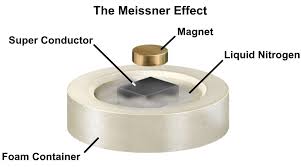
Superconductivity has two unique properties that have elicited commercial interest: namely, zero electrical resistance and the ability to expel all magnetic flux from their interior such that they are forced out of a magnetic field [1].
Kamerlingh Onnes succeeded in liquefying helium in 1908 at 4.2 K ≡ -268.95º C and paved the way for many new experiments to be performed on the behavior of materials at low temperatures [2]. The researcher experimented with mercury (Hg) and liquid helium and established that at about 4 K ≡ -269.15ºC, resistivity drops to zero (0) [2].
More experiments revealed superconducting elements are found in the left portion of the transition elements, including elements in group II, III and IV to the right of the transition elements. Some lanthanides and actinides were also found to be superconducting, summing to twenty-seven (27) elemental superconductors.
The temperature at which materials shift from normal conduction with resistance to superconductivity is referred to as the transition temperature (TC). It was established that all elemental superconductors have a TC close to zero (0) K to have engineering application [2].
The search for superconducting materials with higher TC has led researchers to explore alloys with varied degrees of success. Group VB and IVA alloys viz. Niobium Stannide (Nb₃Sn), Niobium Germanium (Nb₃Ge) and Niobium Silicon (Nb₃Si) have had the highest TC until the recent discovery of high TC ceramic systems. Nb₃Ge has a TC at 23 K ≡ -250.15º C [2].
The ceramic systems are metastable systems and can only be produced by a non-equilibrium solidification process such as rapid quenching, which results in a brittle material that cannot be drawn into wire [1]. The most commonly used superconducting alloy for commercial application, especially in large superconducting magnets for Magnetic Resonance Imaging (MRI) systems, is Niobium Titanium alloy (Nb 46.5 w% Ti) [2].
Niobium-Titanium alloy has TC = 9 K ≡ -264.15ºC at magnetic flux density B = 0, and Critical field HC₂ = 11 tesla (T) at 4.2 K ≡ -268.95º C [2]. Superconductors are strongly correlated with perovskite structure ABO₃.
Kenya is home to the sixth largest deposit of niobium and other rare earth materials worth Ksh 250 billion that was discovered in the year 1919 in Mrima Hill, Kwale County [3]. A mining license was issued to a Canadian company, Cortex Mining Kenya Limited, in March 2013 but was later cancelled, implying that this resource has never been exploited.
Base Titanium, an Australian company, has been mining titanium in the same county with deposits depletion predicted by the end of 2024, which will mark the closure of the mine. Most of the mined titanium ore has been exported as raw ore for further value addition. The presence of the two minerals in Kwale County can be seen as a lost opportunity in which Kenya would have developed its superconductivity industry by local value addition after the extraction process.
Kenya could have negotiated for the manufacture of MRI machines locally, which would have brought down the cost of disease diagnosis. Tanzania has a large deposit of helium gas—a resource under danger of depletion from Earth owing to its small atomic mass that makes it rise from Earth’s atmosphere to space. The East African region has the capacity to develop an industry on superconductivity technology.
There is need to add value locally to the critical materials niobium, titanium and helium. There is also need to enter into agreements with countries that have invested in research and development and are holding patents on superconductivity technology, to transfer the technology for the betterment of humanity.
The largest application of superconductors is in superconducting magnets using Nb 46.5 W% Ti, though Nd₃Sn (Neodymium tin) is finding its way into the same application because of its higher critical current at liquid helium temperature (LHe). Application of high-temperature superconducting ceramic systems has been slow to peak because of their brittleness and difficulties in forming them into cables with high current-carrying capability.
There are some rather exotic applications of superconductors based on their tunneling properties (Josephson effect). The DC Josephson effect is applicable in very sensitive galvanometers and magnetometers, the AC Josephson effect in voltage metrology, and Superconducting Quantum Interference Detectors (SQUID) in oil prospection, mineral exploration, geothermal energy surveying and earthquake prediction [2].
The working mechanism of superconductivity was explained through the BCS theory postulated by Bardeen, Cooper, and Schrieffer in 1957. Bardeen was a two-time Nobel prize winner—in 1956 for co-invention of the transistor and in 1972 for the explanation of superconductivity.
The BCS theory predicts that under certain conditions, the attraction between two conducting electrons due to succession of phonon interaction can slightly exceed the repulsion that they exert on each other directly due to coulomb interaction of their similar charges. The pair of electrons is thus weakly bound together, forming what is known as a Cooper pair [1].
The Cooper pairs are responsible for superconductivity. The electron pair is such that their spin and orbital angular momenta cancel in conventional superconductors. The Cooper pairs are described by the order parameter’s wave function, which has a symmetry similar to that of the wave function of s-orbital electrons and represents a singlet state [2].
References
- Lesley E. Smart and Elaine A. Moore, Solid State Chemistry: An Introduction, CRC Press, Taylor and Francis Group (USA, 2012). ISBN 987-4398-4790-9.
- Introduction to the Physics and Chemistry of Materials, CRC Press, Taylor and Francis Group (USA, 2009). ISBN 987-1-42006133-8.
- Daily Nation newspaper, Why KSh 250 billion Niobium find lies untapped 93 years later (Kenya, 14th October 2012).

-
Product on sale
 AWEBook Volume 2Original price was: KShs 3,500.00.KShs 3,000.00Current price is: KShs 3,000.00.