
Last Updated 1 hour ago by Kenya Engineer
Water that leaves a home, factory or commercial building is usually treated as waste. Yet much of it can be recovered, treated to a suitable standard and returned to productive use. As cities expand and competition for freshwater intensifies, wastewater is gaining recognition as a resource that water engineers can no longer afford to overlook.
The opportunity extends well beyond installing more treatment plants. It involves designing systems that collect wastewater reliably, remove contaminants, recover useful materials and deliver treated water to places where it can replace freshwater. Distribution infrastructure, energy consumption, digital monitoring and the economics of long-term operation all influence whether a reuse scheme succeeds.
For Kenya, these questions have immediate relevance. Water utilities face pressure to extend supply, maintain ageing networks, improve sanitation and contain operating costs. The country also has industries, farms and urban developments that require dependable water supplies. Properly planned reuse schemes could help meet some of this demand while reducing the volume of untreated wastewater entering rivers and other receiving environments.
The challenge is global. UN-Water reported that 42 per cent of household wastewater was not safely treated in 2022, equivalent to an estimated 113 billion cubic metres released into the environment with inadequate or no treatment. Data gaps remain substantial, particularly for industrial wastewater. The available evidence nevertheless points to a large engineering task involving treatment capacity, environmental protection and the recovery of usable water.
Wastewater treatment is the starting point
Wastewater reuse begins with an understanding of what the water contains and what it will be used for. Domestic sewage, industrial effluent and agricultural drainage have different characteristics. Their treatment requirements depend on the concentration of pollutants, the intended application and the risks posed to people and the environment.
Conventional treatment commonly involves several stages. Preliminary treatment removes large debris, grit and other materials that could damage equipment. Primary treatment allows suspended solids to settle. Secondary treatment uses biological processes to break down organic matter. Further treatment may be required to remove nutrients, fine particles, dissolved contaminants and pathogens.
The engineering design must account for variations in incoming wastewater. Flow rates can rise sharply during rainfall in systems affected by stormwater infiltration. Industrial discharges may introduce chemicals that disrupt biological treatment. Inadequate sewer maintenance can also affect the quality and quantity of wastewater reaching a plant.
For water intended for irrigation, industrial processes or landscape maintenance, treatment requirements depend on the exposure pathways and applicable standards. Water used in cooling systems may require careful control of scaling, corrosion and microbial growth. Irrigation schemes need to consider salinity, soil conditions and the types of crops grown.
Potable reuse involves a higher level of control. Advanced treatment can combine membrane filtration, reverse osmosis, activated carbon, oxidation and disinfection, depending on the source water and the quality objectives. Independent monitoring and appropriate regulatory safeguards are essential wherever reclaimed water could enter a drinking-water supply.
The design principle is straightforward: treatment should match the intended use, with safeguards proportionate to the health and environmental risks. Applying the most expensive treatment process to every reuse application can waste energy and capital. Applying inadequate treatment can expose users to serious risks.
Kenya’s water losses strengthen the case for better engineering
Wastewater reuse forms part of a wider challenge in water management. Producing more water will not solve every supply problem if large quantities are lost before reaching consumers.
Kenya’s Ministry of Water and Sanitation reported in May 2026 that non-revenue water stood at approximately 44 per cent, representing more than KSh10 billion in annual losses. Non-revenue water includes physical leakage as well as water that is supplied but not properly measured or billed. The figure highlights the scale of the operational and financial pressure facing the sector.
The problem calls for coordinated investment in pipeline rehabilitation, pressure management, accurate metering, network mapping and leak detection. Engineers also need reliable information on where water enters the network, how it moves through the system and where losses occur.
Digital monitoring can improve that picture. Sensors measuring flow and pressure can help utilities identify unusual changes in network behaviour. Acoustic equipment can detect some underground leaks before they become visible. Geographic information systems can link pipelines, valves, customer connections and maintenance records. Hydraulic models can help engineers test how repairs, new connections or changes in demand might affect performance.
Artificial intelligence can assist with identifying patterns across large volumes of operational data. Its usefulness depends on the quality of that data, the design of the monitoring system and the ability of utility teams to act on the results. An algorithm may flag a likely leak, but a repair crew still needs accurate location information, suitable equipment and access to the affected pipeline.
These technologies are relevant to wastewater systems as well. Flow monitoring can reveal abnormal inflows, pumping problems or potential blockages. Plant operators can track equipment performance and identify changes in treatment efficiency. Predictive maintenance can help schedule servicing before a critical pump or blower fails.
The objective is to improve the performance of the entire water cycle. Reducing losses in drinking-water networks, improving wastewater collection and recovering treated effluent can work together to reduce pressure on freshwater sources.
Reclaimed water needs a route to its users
A treatment plant can produce water that meets the required quality standards and still fail to deliver an economically viable reuse scheme. The missing link may be infrastructure between the plant and potential users.
Freshwater networks are generally designed to deliver water to customers. Reuse schemes may need a separate distribution system connecting wastewater treatment facilities to industrial estates, irrigation areas, construction sites or large commercial developments. Depending on the application, this could involve dedicated pipelines, storage reservoirs, pumping stations, metering and additional treatment at the point of use.
Location is critical. A large wastewater treatment plant may discharge millions of litres a day into a river while a potential industrial customer nearby draws freshwater from a stressed supply system. If the customer is close enough, a reclaimed-water pipeline may offer an attractive alternative to developing a new source. Long transmission distances, difficult terrain or the need for extensive pumping can weaken the business case.
Water quality must also remain suitable throughout distribution. Storage conditions, pipe materials, residual disinfection requirements and the possibility of cross-connections with potable networks all require careful design. Reclaimed-water systems should be clearly identified, with safeguards to prevent accidental use as drinking water.
Industrial users can provide an early market for treated wastewater. Some manufacturing processes, cooling applications and cleaning operations can use reclaimed water once quality requirements have been established. Construction projects may use suitable treated water for dust suppression and selected site activities, subject to environmental and public-health controls.
Agriculture presents another opportunity, particularly where irrigation demand coincides with the availability of treated effluent. Such projects require assessment of salinity, nutrients, pathogens and possible accumulation of contaminants in soils. Crop selection and irrigation methods also influence the acceptable water quality.
The strongest reuse projects begin by identifying a dependable user. Engineers can then establish the required water quality, expected demand, delivery pressure and seasonal variation before selecting the treatment process and sizing the distribution system.
The circular economy extends beyond water
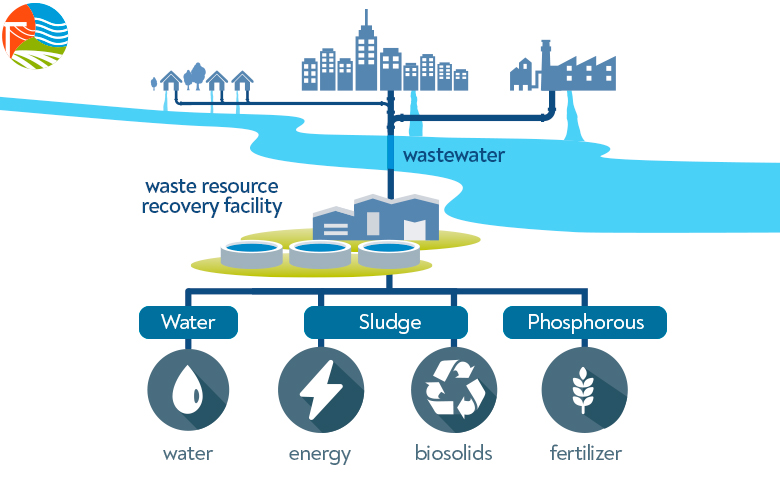
Wastewater treatment produces more than reclaimed water. It also generates sludge containing organic matter, nutrients and, in some cases, contaminants that require careful management.
Anaerobic digestion can break down organic material in sludge and produce biogas. Where the quantity and quality of gas justify the investment, it can support heat generation or electricity production at a treatment plant. Recoverable nutrients, particularly phosphorus and nitrogen, may also offer value for agriculture when processing methods and safety standards permit their use.
These approaches can reduce the volume of material requiring disposal and improve the resource efficiency of wastewater facilities. Their viability depends on plant size, energy demand, sludge characteristics, local markets and the cost of handling recovered products.
Energy consumption deserves particular attention. Pumps move wastewater through collection networks, aeration systems supply oxygen for biological treatment, and advanced processes may require substantial pressure or additional treatment stages. Electricity costs can place considerable pressure on utility budgets, especially where equipment is inefficient or plants operate below their intended capacity.
Engineers can reduce that burden through efficient pumps and motors, improved aeration control, energy recovery, appropriate process selection and better maintenance. Solar power may contribute where site conditions and operating requirements support it. Any energy strategy must account for the need to maintain treatment performance during periods of variable supply.
Resource recovery can improve the economics of a treatment plant, but expected revenue should be based on credible demand and realistic operating costs. Biogas, fertiliser products and reclaimed water all require suitable infrastructure and dependable markets. Their value is strongest when these requirements are considered during project design rather than added after construction.
Digital systems give operators better control
Modern wastewater facilities generate substantial operational data. Flow meters, water-quality instruments, pump controls and laboratory results can help operators understand how a plant responds to changes in wastewater composition and demand.
Supervisory control and data acquisition systems allow operators to monitor equipment and adjust processes from a central control room. More advanced analytics can combine historical data with real-time measurements to forecast inflows, identify unusual operating conditions and improve maintenance planning.
Digital twins can take this further by creating a computer-based representation of a treatment plant or distribution network. When supported by reliable data and calibrated engineering models, they can help operators assess proposed changes, investigate faults and test operating scenarios before implementing them.
These systems are particularly valuable when water utilities manage extensive networks with limited maintenance resources. Yet technology cannot compensate for missing asset records, poorly maintained instruments or a shortage of trained personnel. Digital infrastructure also introduces cybersecurity risks. Operational technology controlling pumps, treatment processes and valves must be protected against unauthorised access and disruptions.
For utilities in Kenya and other developing economies, implementation can begin with targeted applications. Monitoring energy consumption at a major pumping station, installing flow meters at key points or improving maintenance records may deliver practical benefits before a utility invests in a complex, integrated digital platform.
Financing determines whether projects reach operation
Wastewater reuse competes for funding with drinking-water supply, sewer expansion, flood control and other essential infrastructure. Treatment plants also require continuing expenditure on electricity, chemicals, laboratory testing, skilled staff, equipment replacement and sludge management.
The financial case is strongest when a project can demonstrate a dependable source of wastewater, a clear market for the treated product and a credible comparison with alternative water supplies. The costs of collection, treatment, storage, distribution and maintenance must be assessed together.
The World Bank’s 2025 analysis of water reuse economics found that reclaimed water can be competitive with alternative supplies, particularly where wastewater collection infrastructure already exists and treatment facilities are close to users. The economics vary considerably by location and treatment standard. Potable reuse generally requires more extensive treatment and safeguards than non-potable applications.
Industrial customers may be able to support projects through long-term water-purchase agreements. Municipal utilities can explore partnerships with private operators, industrial parks and agricultural users. Public investment may be necessary where the principal benefits include pollution reduction, improved sanitation or protection of ecosystems that cannot be fully recovered through water sales.
Performance-based contracts can also help align payments with plant availability, treatment quality and energy efficiency. Any arrangement requires clear allocation of responsibility for compliance, maintenance, equipment replacement and service interruptions.
Kenya’s water-sector investment plans recognise the need to expand sewerage and sanitation infrastructure while reducing losses in distribution networks. The Nairobi City Water and Sewerage Company strategic plan for 2024/25–2028/29 also identifies wastewater recycling as a potential avenue for diversifying revenue. Turning that ambition into operating projects will require sound technical design, dependable customers and sustained institutional support.
A global challenge with local engineering solutions
Water scarcity is not confined to arid countries. Growing cities, industrial expansion, agricultural demand and changing rainfall patterns place pressure on water systems across different climates and income levels. Even regions with substantial rainfall can face local shortages when storage, treatment, distribution and wastewater infrastructure fail to keep pace with demand.
The solutions will differ by location. Coastal cities may consider desalination alongside wastewater reuse. Industrial centres can develop systems that recover water from process effluent. Water-stressed cities may prioritise leakage reduction, wastewater recycling and demand management. Smaller communities may benefit from decentralised treatment systems where large sewer networks are impractical, provided operators can maintain them and manage the resulting sludge safely.
The Innovation Driven Water Sustainability Conference scheduled for Jeddah from 14 to 16 December 2026 is among the international forums bringing engineers, utilities, investors and technology developers together to discuss the deployment of water solutions. Its focus reflects a wider shift towards connecting technical innovation with operational needs.
For engineers, the task is to turn these possibilities into infrastructure that works under real conditions. That means selecting treatment processes suited to local wastewater, designing networks around actual demand, protecting public health, controlling energy use and planning for decades of operation.
Wastewater reuse will not replace the need for new water sources, effective conservation or better distribution networks. It can, however, reduce demand for freshwater and recover value from a resource that cities already produce every day.
The measure of success will be visible in the performance of treatment plants, the reliability of reclaimed-water supplies, the quality of receiving rivers and the cost of delivering essential services. When these systems are designed as connected parts of the same water cycle, wastewater can become a dependable component of water security.

-
Product on sale
 AWEBook Volume 2Original price was: KShs 3,500.00.KShs 3,000.00Current price is: KShs 3,000.00.