Last Updated 1 month ago by Kenya Engineer
When Kenya Engineer reported on the construction of Talanta Sports Stadium in August 2024, the project was still largely a construction story: a new national arena rising at Jamhuri Grounds as Kenya prepared to co-host the 2027 Africa Cup of Nations.
Two years later, the project has moved into its final and arguably more demanding phase.
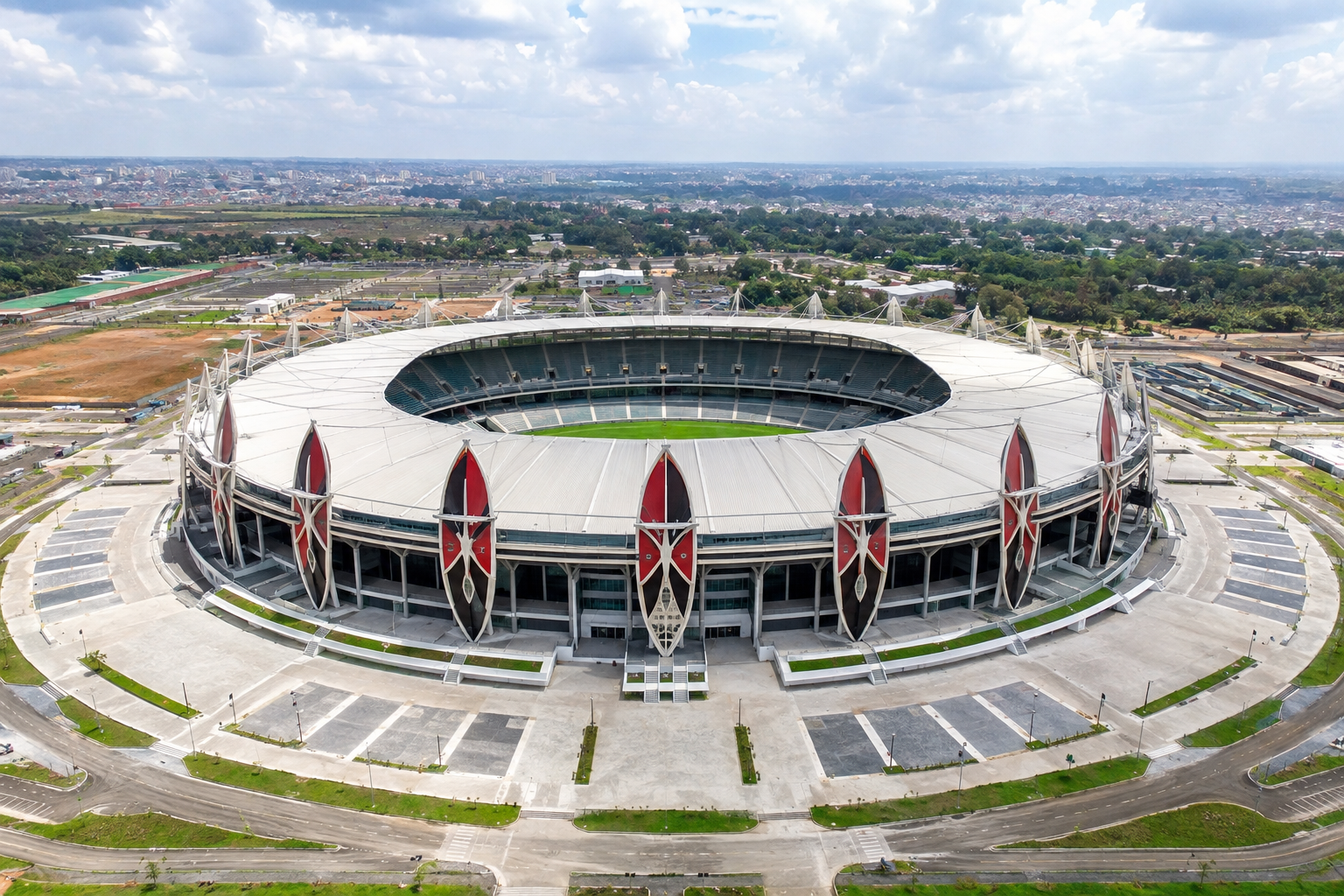
As of 19 August 2026, Sports Cabinet Secretary Salim Mvurya put overall completion of the Talanta Sports Complex at more than 92 per cent. The centrepiece is the 60,000-seat Raila Odinga International Stadium, supported by three additional sporting pitches, media and hospitality facilities, transport infrastructure and utility systems.
Construction progress, however, tells only part of the story.
The project is simultaneously an architectural landmark, a structural-engineering exercise, a transport-planning challenge, a substantial financing commitment and a test of Kenya’s ability to manage large public assets once the contractors leave.
There is also a new complication outside the stadium gates. One of the proposed access corridors linking Talanta towards Bomas has been stopped temporarily by the Environment and Land Court because of a dispute over construction through Ngong Road Forest. The ruling means the conversation about Talanta can no longer be limited to whether the stadium itself will be completed. It must also consider how supporting infrastructure is delivered, at what environmental cost and under what legal safeguards.
The ultimate test will therefore not be whether Kenya can build Talanta.
It will be whether Kenya can make it work.
A stadium designed primarily around football
One of Talanta’s most consequential design decisions is immediately visible from inside the bowl: there is no athletics track between the spectator stands and the football pitch.
Unlike many of Kenya’s older multipurpose stadiums, the main arena has been conceived as a purpose-built football venue, although it can also accommodate rugby and other suitable events. Bringing spectators closer to the playing field improves sightlines and the intimacy of the stadium experience.
Athletics has not disappeared from the complex. Instead, the latest project configuration provides three additional pitches, two associated with athletics tracks and another configured for football and rugby. This separates the requirements of the main stadium from training and athletics functions elsewhere in the complex.
It is a sensible approach from both an engineering and operational perspective.
A stadium designed to do everything often compromises the experience of individual sports. Separating functions allows the main bowl to optimise spectator geometry for football while the wider sports city accommodates athletics, training and athlete development.
Talanta is being designed towards CAF Category 4 requirements, the level required for major continental football events. The latest specifications include dedicated press-conference facilities, media working areas and a media tribune, together with 52 luxury skyboxes and modern spectator infrastructure.
These features matter commercially as much as technically.
A stadium capable of hosting high-level international football must accommodate broadcasters, journalists, sponsors, hospitality clients, teams, officials, security personnel and tens of thousands of spectators simultaneously without their operational flows conflicting unnecessarily.
At this scale, circulation itself becomes an engineering problem.
The roof: where Talanta becomes structurally interesting
Among Talanta’s most technically distinctive components is the roof.
According to Ministry of Defence project architect and project manager Major Victor King’e, the stadium uses a lightweight canopy supported through hydraulically tensioned steel cables. The system allows large roof spans over the spectator areas without requiring a dense arrangement of columns that would interfere with sightlines.
This is the logic behind many modern long-span stadium structures.
Steel is extremely efficient in tension. By transferring roof loads through cable systems and appropriately designed anchorages and compression elements, designers can create large covered spaces using less structural mass than would be required by conventional beam-and-column solutions across equivalent spans.
The roof is fixed rather than retractable, covering spectator areas while leaving the playing field substantially open to natural light and ventilation.
Structurally elegant does not, however, mean maintenance-free.
Cable forces, anchorages, roof membranes, steel connections, corrosion protection, drainage and wind-induced movement will have to be monitored throughout the stadium’s life. The engineering challenge therefore moves, after commissioning, from erection to inspection.
A stadium roof of this complexity should eventually have a formal structural-health and inspection programme rather than waiting for visible deterioration before intervention.
That principle applies to the entire building.
Architecture that also performs a crowd-management function
Talanta’s architecture has deliberately incorporated Kenyan national imagery.
The external form uses eight shield-and-spear elements associated with the national emblem. Importantly, project architect Major King’e has explained that the shields correspond with entrances around the stadium and are intended to assist spectators with wayfinding.
That transforms an architectural motif into part of the building’s circulation system.
In a 60,000-person arena, wayfinding is not merely a graphic-design issue. Poor orientation can produce counterflows, congestion around gates, delays at security checkpoints and potentially dangerous crowd concentrations.
Effective stadium design therefore brings together structural engineering, architecture, security, fire and life-safety systems, pedestrian circulation and human behaviour.
Visitors may remember Talanta’s shields as decoration.
Engineers should also see them as landmarks in a much larger crowd-management system.
Who designed and who is building Talanta?
The project has evolved through several institutional layers.
The original concept design was developed through University of Nairobi Enterprises and Services Limited, with Professor Erastus Abonyo identified as lead consultant. The early design established, among other things, the three-tier stadium concept and Kenyan shield-and-spears architectural language.
The main construction contractor is China Road and Bridge Corporation (CRBC).
Supervision is being undertaken by the Kenya Defence Forces Engineering Department, with Major Victor King’e serving publicly as Ministry of Defence project architect and project manager.
The arrangement is notable.
Rather than relying entirely on the conventional public-client, consultant and contractor structure familiar in many government works, the Ministry of Defence has taken an unusually prominent technical-supervision role.
Government has argued that KDF involvement provides the discipline, speed and execution capability required by a project with a fixed international sporting deadline.
The project has nonetheless attracted scrutiny over procurement, cost establishment and transparency.
Both issues can be true at once: fast project delivery can be a legitimate engineering priority, while procurement and value-for-money scrutiny remain legitimate public interests.
From concrete shell to intelligent stadium
The latest project update provides a better picture of what will sit inside the structural shell.
At the centre will be a hybrid playing surface combining Monaco-variety Bermuda grass with stitched synthetic fibres. Hybrid turf attempts to retain the playing characteristics of natural grass while using artificial reinforcement to improve durability and resistance to wear.
This matters if Talanta is to become a heavily used stadium rather than an occasional ceremonial venue.
The complex is also receiving dedicated media infrastructure, LED façade lighting and integrated digital-advertising systems. A musical dancing fountain forms part of the external public realm, while dedicated power and utility infrastructure is being installed to support the electrical and digital demands of a modern international venue.
These systems could eventually become important revenue infrastructure.
Digital advertising, premium hospitality, broadcasting facilities and skyboxes are not merely embellishments. Properly commercialised, they are among the assets capable of generating recurring income independently of ordinary ticket sales.
The question for the eventual stadium operator is whether these facilities will be treated as active commercial assets or simply opened when the national team plays.
More than 92 per cent complete — but the dates tell an important story
Talanta illustrates why completion percentages on major infrastructure projects should be interpreted carefully.
In May 2026, the Sports Ministry told Parliament that the project was around 87 per cent complete and said the stadium would be launched in August. Earlier deadlines had already shifted as construction progressed.
On 19 August, the government’s latest position was that the complex had moved beyond 92 per cent completion.
At the time of writing, the latest update does not establish a new firm public handover or opening date.
That is not necessarily surprising.
The last few percentage points of a stadium project can be disproportionately complex.
Completing the concrete bowl or roof does not produce an operational international stadium. Mechanical and electrical installations, access-control systems, fire detection and suppression, lifts, CCTV, broadcasting systems, lighting, public-address equipment, communications, plumbing, drainage, pitch systems, kitchens, hospitality spaces, security systems and emergency procedures all have to be commissioned and integrated.
A stadium can therefore appear physically complete while remaining operationally incomplete.
Before its first full-capacity international fixture, Talanta should ideally undergo progressive test events, increasing attendance in stages so engineers and operators can observe entry rates, turnstile performance, public transport loading, emergency systems, washroom demand, telecommunications capacity, concession operations and post-event evacuation.
Commissioning people through a stadium is as important as commissioning its electrical equipment.
The stadium outside the stadium
The engineering challenge becomes even more interesting beyond the perimeter fence.
A 60,000-seat venue can release tens of thousands of people into the surrounding transport system over a relatively short period. If access planning is weak, a technically excellent stadium can still deliver a poor spectator experience.
Talanta therefore requires its own supporting mobility ecosystem.
In February 2026, the Kenya Urban Roads Authority selected China Road and Bridge Corporation, China Wu Yi and Kenya’s Gaps Construction and Engineering for approximately KSh3.9 billion of road and pedestrian infrastructure around Talanta.
The planned works include walkways along Ngong Road, road connections towards Cemetery Road, a bridge associated with the Southern Bypass interchange, another bridge across Ngong Road and additional carriageway and pedestrian links around the complex. The packages were procured using the Specially Permitted Procurement Procedure and were given a 12-month construction period.
Road capacity, however, is only part of the answer.
The Sports Ministry confirmed on 19 August that an adjacent railway station is under construction, while additional road works are taking place within and around the stadium complex.
That multimodal approach is essential.
The objective should not be to create enough private-car parking for everyone attending a major fixture. Such a strategy would require enormous land areas and would simply shift congestion to surrounding junctions.
A better stadium-access model combines commuter rail, high-capacity buses, walking, controlled drop-off areas, cycling where feasible and carefully managed private-vehicle access.
If Nairobi can make public transport the easiest way to attend Talanta, the investment could provide a model for event mobility elsewhere in the city.
But one access route has run into the forest
There is now a significant legal and environmental qualification to the transport programme.
The Environment and Land Court has issued conservatory orders temporarily halting construction of a proposed road through Ngong Road Forest linking Talanta Stadium towards the Bomas International Conference Centre.
The orders restrain further excavation, tree-felling, land clearance and construction within the disputed forest section while the court considers an application filed by the Law Society of Kenya, Green Belt Movement and JustAct challenging the proposed development.
The application is scheduled for ruling on 16 September 2026.
The dispute should not be treated as an argument between people who support infrastructure and people who oppose it.
It raises a genuine engineering-planning question: must a critical stadium-access route use that particular alignment, and if so, has the environmental trade-off been adequately demonstrated and lawfully approved?
Urban infrastructure necessarily creates competing demands for land. Roads need corridors. Rail needs right-of-way. Cities need mobility.
But urban forests also perform infrastructure functions of their own: stormwater regulation, temperature moderation, air-quality improvement, biodiversity protection, carbon storage and recreation.
Good engineering therefore does not begin with the assumption that one must automatically defeat the other.
Alternative alignments, transport demand management, additional public-transport capacity and different access strategies should form part of any defensible solution if the existing route cannot satisfy environmental and legal requirements.
Importantly, the court order concerns the disputed forest corridor; it does not mean that all Talanta access-road construction has stopped.
But the case introduces both schedule risk and an important environmental dimension into the supporting-infrastructure programme.
How much does Talanta actually cost?
This seemingly simple question has produced several different answers.
Part of the problem is that different figures refer to different components.
The University of Nairobi consultants’ early estimate was approximately KSh34.6 billion.
Parliament has subsequently discussed a signed stadium contract of approximately KSh45.8 billion. The Ministry maintains that the difference should not be described as a variation to the contract because, according to Sports CS Salim Mvurya, the contract itself was signed at about KSh45 billion. The government says taxes, levies and import-related charges not included in the original consultant estimate account for the movement from the early figure.
That explanation has not ended the debate.
The Auditor-General’s findings prompted senators to question documentation supporting the difference, the use of direct procurement and the approvals surrounding the project. The Senate committee has continued to seek a clearer reconciliation between the original estimate and the amount eventually contracted.
For engineers, the distinction is important.
A concept estimate and an executed contract price are not the same thing. Design development can add scope. Taxes, imported specialist equipment, contingency, logistics, inflation, programme compression and contractor risk can all alter the final price.
But a technically valid reason for differences does not eliminate the need to document them.
On a project of this size, the public should eventually be able to see a clear cost bridge:
concept estimate → detailed scope → taxes and statutory charges → specialist systems → risk allowances → contractor price → final account.
That would be more useful than arguing endlessly over whether the difference should be called an escalation, adjustment or variation.
The financing number is different again
The project is also associated with a KSh44.79 billion infrastructure asset-backed bond issued through Linzi FinCo and listed on the Nairobi Securities Exchange.
The 15-year instrument carries a 15.04 per cent rate of return. The issue was fully subscribed, with investors offering approximately KSh44.875 billion against the KSh44.791 billion target.
This creates another number that requires careful interpretation.
According to the bond documents reported by Business Daily, investors are expected to receive approximately KSh102.42 billion over the life of the instrument, including about KSh57.6 billion in interest. Interest income from the bond is tax-exempt.
That does not mean the stadium cost KSh102.42 billion to construct.
It means that raising long-term capital has a cost.
Confusing construction cost with cumulative principal-and-interest payments would exaggerate the physical cost of the stadium. Ignoring the financing cost altogether would underestimate the long-term financial commitment.
Both numbers matter; they answer different questions.
The first asks: what did the asset cost to build?
The second asks: what will the financing ultimately cost over time?
And the roads are another bill
The distinction becomes even more important when supporting infrastructure is included.
The approximately KSh3.9 billion KURA road programme around Talanta is separate from the principal stadium construction contract.
The railway connection, utilities and other agency-led supporting works also need to be understood in their own right.
That suggests the final public accounting for Talanta should ideally be presented in layers:
- Main stadium and sports-complex construction;
- External and auxiliary works;
- Road infrastructure;
- Rail and public-transport infrastructure;
- Utility upgrades;
- Financing and transaction costs; and
- AFCON-specific temporary operational expenditure.
Without that separation, almost any headline figure can be made to look either alarmingly high or reassuringly low depending on what the writer chooses to include.
For a national project of this scale, a consolidated final cost report would be valuable.
Procurement remains part of the engineering story
The Senate’s scrutiny has also focused on the decision to award the stadium contract through direct procurement.
The Ministry has defended the approach on the basis of project complexity and the strict programme created by Kenya’s AFCON commitments, while stating that the required approvals were obtained. Senators and the Auditor-General have questioned aspects of that process and the available supporting documentation.
The road packages similarly used a Specially Permitted Procurement Procedure rather than an ordinary open tender.
There is a real tension here.
Major sporting events create deadlines that cannot easily move. Conventional procurement can consume significant time, and fast-tracking design, procurement and construction may genuinely be necessary.
But reduced competition can weaken price discovery.
That is precisely why accelerated procurement requires particularly strong documentation, cost benchmarking, scope control and post-project audit.
Speed and accountability are not competing engineering objectives.
A well-managed project should aim for both.
So what economic return should Kenya expect?
The political justification for stadium investment is often expressed in terms of tourism, jobs, international exposure and national pride.
Some of those benefits are real.
Construction itself creates temporary employment and supplier demand. AFCON will bring teams, officials, media and supporters who purchase accommodation, food, transport and entertainment. A high-quality national stadium can improve Kenya’s ability to host other continental and global sporting events.
But international evidence provides a useful warning.
Research on stadium-driven development has repeatedly found that large venues do not automatically generate economic benefits sufficient to justify their public cost. One reason is substitution: money spent at a stadium may simply replace spending that residents would otherwise have made elsewhere in the same economy.
That does not prove Talanta is economically unjustified.
It means its economic case cannot simply be: we built a stadium, therefore growth will follow.
The economic value has to be engineered almost as deliberately as the structure itself.
AFCON cannot be the business plan
AFCON 2027 is the deadline that accelerated Talanta’s construction.
It should not be the stadium’s economic justification.
A stadium of this quality should have an operating life measured in decades. A tournament lasting a few weeks therefore accounts for only a tiny fraction of its useful life.
The more important question is what happens on an ordinary Saturday in 2032.
Does Talanta host domestic football?
Does it attract continental club finals?
Can Kenya secure international rugby, women’s football and youth competitions?
Can concerts be staged without repeatedly destroying the pitch?
Are the conference, hospitality and media spaces operating on non-match days?
Are the training facilities used by academies, national teams and high-performance programmes?
Are the 52 skyboxes commercially leased?
Are digital advertising systems generating revenue?
Are restaurants and surrounding businesses benefiting from event traffic?
Those questions will ultimately tell us more about Talanta’s value than the opening ceremony.
The stadium needs an events business, not simply a caretaker
Public sporting facilities often struggle because their management structure is based principally around preserving the asset.
Talanta needs to go further.
It requires a commercially competent operating model capable of selling the asset hundreds of days a year, even when no football match is taking place.
That means active event acquisition.
Concert promoters should be approached.
Regional sports federations should know what Talanta can offer.
Corporate hospitality packages should be marketed.
Conference and exhibition spaces should have commercial targets.
Media production facilities should be usable independently.
Training grounds should have structured booking systems.
Naming, advertising and sponsorship rights should be managed professionally.
The operator should know the revenue generated per event, per spectator and per square metre of commercial space.
The objective is not necessarily to recover the entire construction cost through gate receipts. Few public national stadiums operate that way.
The objective is to reduce the recurring burden on taxpayers while maximising the sporting, social and commercial return from an asset that has already been built.
Concerts could be important — but they require engineering discipline
Large concerts are an obvious opportunity.
Nairobi has a sizeable entertainment market, and a 60,000-capacity modern venue could attract events that currently struggle to find infrastructure of the necessary scale.
But concerts cannot simply be dropped onto a football pitch.
Successful multi-event operation requires engineered pitch-protection systems, defined loading limits, temporary power strategies, stage-access routes, rigging procedures, crowd layouts, emergency plans, acoustic management and rapid stadium-conversion processes.
The new hybrid pitch may improve durability, but even reinforced turf can be damaged by heavy equipment, concentrated loads and prolonged surface covering.
The operations manual should therefore be as detailed as the structural drawings.
Transport can multiply the return
The road and rail investments around Talanta also create an opportunity to improve the economic argument.
If new pedestrian routes, railway facilities, road connections and public-transport capacity serve Nairobi residents even when the stadium is empty, their benefits extend beyond sporting events.
This is important because supporting infrastructure should not become stranded “event infrastructure” used intensively only a few days each year.
The railway station should form part of Nairobi’s daily passenger network.
Pedestrian infrastructure should serve nearby communities.
Road improvements should address ordinary mobility bottlenecks.
Where practical, cycling access should be incorporated.
The strongest economic case is therefore not that billions were spent for a stadium.
It is that the stadium became the catalyst for infrastructure that improved the wider district.
The current Ngong Road Forest dispute reinforces why those wider benefits must also be weighed against wider environmental costs.
Local businesses need a deliberate place in the model
Another economic-impact question is where spectator money ends up.
A stadium can generate substantial transaction volumes without necessarily creating broad local benefit.
If catering, merchandising, transport and hospitality opportunities are concentrated in a handful of large operators, much of the spending may bypass surrounding communities.
Talanta could adopt structured opportunities for qualified small and medium-sized businesses in catering, merchandising, cleaning, logistics, temporary staffing and other event services.
The approach must still meet food-safety, security, quality and procurement standards.
But local economic participation should be designed rather than assumed.
A successful AFCON should leave behind suppliers that are stronger after the tournament than before it.
Maintenance may determine whether today’s KSh45 billion becomes tomorrow’s bargain or burden
Kenya has considerable experience constructing impressive public facilities.
The harder test has often been maintaining them.
Talanta’s technical sophistication makes neglect particularly expensive.
Roof cables and anchorages will require inspection.
Steelwork requires corrosion protection.
Waterproofing and joints deteriorate.
Lifts need preventive maintenance.
Fire systems require testing.
Turnstiles and CCTV systems become obsolete.
LED displays fail.
Network equipment requires replacement.
Hybrid turf needs specialised agronomy.
Drainage systems must remain clear.
Mechanical and electrical equipment has finite service lives.
The question is therefore not simply how much money is available for repairs.
It is whether Talanta begins life with a formal lifecycle asset-management programme.
Every major component should have an asset ID, expected service life, inspection interval, maintenance procedure and replacement-cost forecast.
Maintenance funding should be ring-fenced before failure rather than sought afterwards.
For a national asset costing tens of billions of shillings, reactive maintenance would be false economy.
Measure the stadium after the cameras leave
Talanta’s success should ultimately be measured using operational data rather than political speeches.
Useful indicators would include:
- Number of major event days per year;
- Total annual spectators;
- Average stadium utilisation;
- Revenue from ticketing;
- Hospitality and skybox income;
- Sponsorship and advertising revenue;
- Non-match-day revenue;
- Cost of operations and maintenance;
- Preventive-maintenance compliance;
- Public-transport share among event attendees;
- Average stadium-entry and evacuation times;
- Number and value of opportunities awarded to local businesses;
- Training-facility utilisation;
- International events attracted to Kenya; and
- Economic activity generated in the surrounding district.
Those figures should ideally be published.
Transparency after construction is just as important as transparency during procurement.
If Talanta requires an annual public subsidy, there is nothing inherently wrong with saying so. National cultural and sporting infrastructure can provide benefits that are not captured entirely through cash revenue.
But policymakers should know what that subsidy buys.
A stadium does not have to make a profit to have value
There is a danger in evaluating every public asset only by whether it directly repays its construction cost.
Public roads do not need toll booths at every junction to demonstrate value.
Parks do not need admission tickets to justify every acre.
National museums, libraries and sports facilities can create cultural, social and developmental benefits beyond their balance sheets.
Talanta may help develop athletes.
It may create unforgettable national sporting moments.
It may support Kenya’s diplomatic and tourism profile.
It may encourage participation in sport.
It may give young footballers a stage equal to facilities they see elsewhere in the world.
Those are legitimate benefits.
But acknowledging them does not make cost irrelevant.
The larger the public investment, the stronger the obligation to extract every reasonable economic, social and sporting return from it.
The engineering challenge begins at handover
There is little doubt that Talanta Sports Complex represents an important step in Kenya’s sporting infrastructure.
Its 60,000-seat football-focused bowl, hydraulically tensioned cable-supported canopy, hybrid playing surface, training facilities, 52 skyboxes, digital systems, media infrastructure and distinctive architectural language make it unlike any stadium previously constructed in the country.
Its delivery has also raised difficult but necessary questions.
The public deserves a clear final reconciliation of the project cost.
Procurement decisions deserve scrutiny.
The long-term cost of the financing should remain visible.
Supporting infrastructure must be completed.
The dispute over the Ngong Road Forest corridor must be resolved lawfully and on a technically defensible basis.
And the stadium must enter service with a credible maintenance and commercial strategy.
The strongest justification for Talanta will not ultimately be made by comparing its roof with Wembley, its façade with another African stadium or its capacity with Kasarani.
It will be made by what happens there over the next thirty years.
If trains arrive full on event days; if people can enter and leave safely; if the stadium hosts football, rugby, concerts and international events throughout the year; if its training grounds develop athletes; if businesses earn from its visitors; if its commercial infrastructure generates revenue; if surrounding transport investments serve Nairobi beyond match days; and if preventive maintenance preserves the structure for decades, the investment will increasingly make sense.
If instead Talanta becomes spectacular for AFCON and quiet thereafter, while financing costs continue and maintenance is deferred until another expensive rehabilitation is required, its engineering achievement will be overshadowed by an operating failure.
Kenya is now close to completing the building.
The more difficult project is about to begin:
turning a KSh45.8 billion-class national asset into infrastructure that works, earns, serves and lasts.

-
Product on sale
 AWEBook Volume 2Original price was: KShs 3,500.00.KShs 3,000.00Current price is: KShs 3,000.00.