

Last Updated 2 hours ago by Kenya Engineer
Nvidia’s agreement to support SB Energy’s proposed PORTS-Pike AI campus in Ohio with a guarantee of up to US$105 billion has produced an arresting headline. The first analytical task is to define what that number is—and what it is not.
It is not a disclosed construction budget and it is not an immediate cash transfer. Reuters reported that the guarantee would support a portion of lease and power-payment obligations and a minimum site value under defined conditions. The financing structure is still being developed, with sponsor equity expected to be followed by project debt and bonds.
Nvidia is also investing US$1.5 billion in SB Energy and is expected to be the exclusive supplier of chips to the campus. OpenAI has agreed to secure approximately 8 GW of IT capacity through a 20-year lease. The first 800 MW is expected around 2028 under the announced development schedule.
Together, those terms look less like an ordinary property lease and more like project finance: a special-purpose development backed by a long-term customer commitment, supplier support, asset value and contracted revenue that can be used to raise capital.
Four parties, four different risks
The structure aligns four major commercial roles.
SB Energy is the developer and asset owner. It must secure land, permits, construction, energy supply, grid infrastructure, operations and financing. OpenAI is the anchor tenant whose 20-year demand commitment makes the campus financeable. Nvidia is both an equity investor and strategic supplier, with a guarantee that reduces selected downside risks for lenders or the project. AEP Ohio is the regulated utility coordinating major transmission works.
Each party carries a different exposure. The developer faces construction cost, schedule and operating risk. The tenant faces long-term demand, technology and payment commitments. Nvidia faces guarantee and investment risk, but also gains potential chip revenue. The utility and regulators face system-planning and interconnection risk. Communities face land, water, environmental and public-infrastructure impacts.
The value of a project-finance structure is not that risk disappears. It is that contracts assign specific risks to parties that are expected to manage or bear them.
Power infrastructure is part of the campus, not an externality
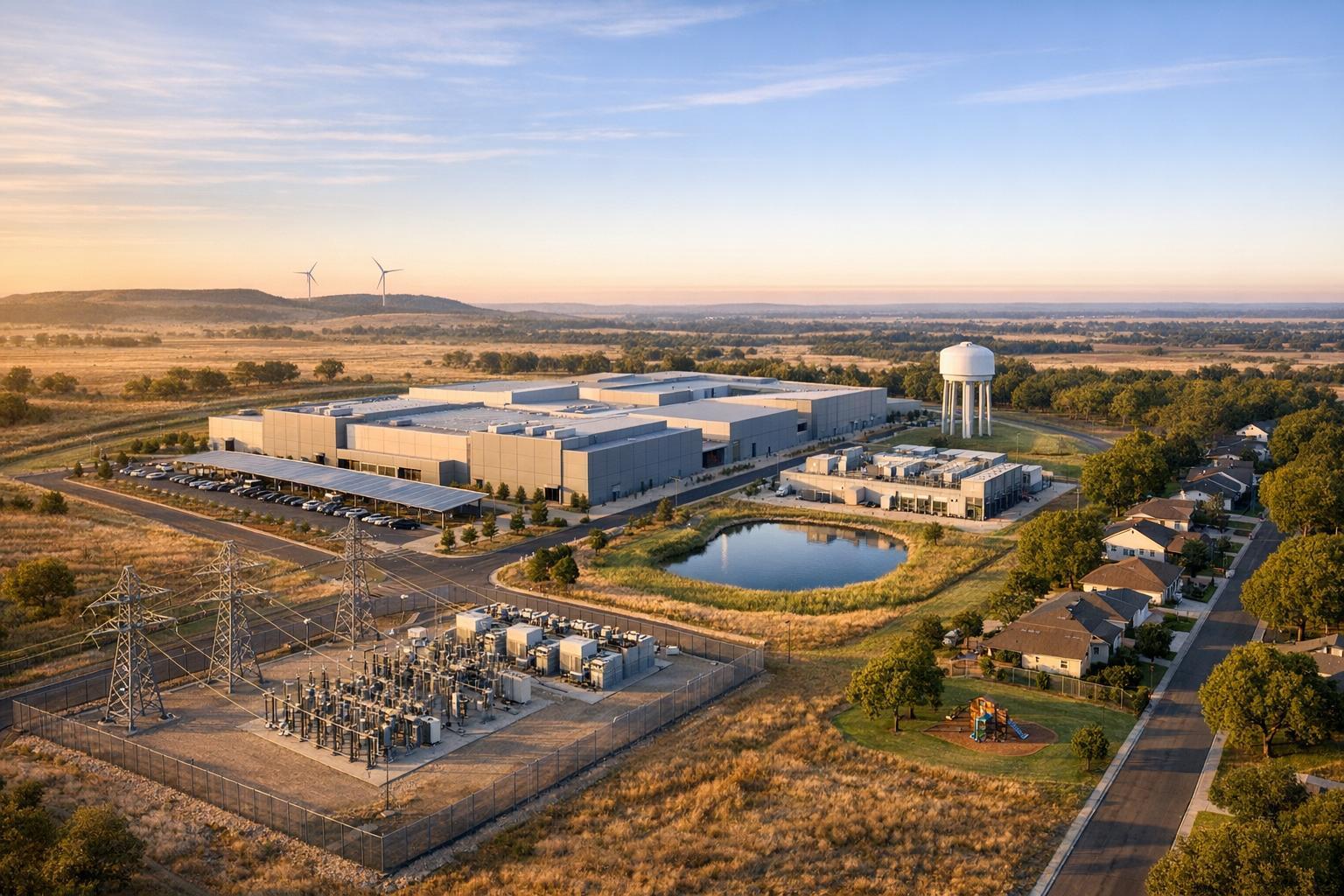
OpenAI says the campus will secure about 8 GW of IT capacity. SB Energy’s broader energy plan is reported to require at least 10 GW of new generation. AEP Ohio has described a US$4.2 billion, 765 kV transmission programme that SB Energy would fund so ordinary customers are not charged for infrastructure dedicated to the development.
That cost-allocation principle may become as important as the computing technology. Large AI loads can require new lines, substations, generation and reserves. If those assets are built ahead of the customer and the customer later scales down, other electricity users can be left with underused infrastructure. Requiring the project sponsor to fund dedicated works reduces that risk.
The timelines also need careful reading. Reuters and OpenAI refer to the first 800 MW becoming available around 2028, while AEP Ohio has said it expects to power the campus in 2029. Those statements may refer to different milestones, sources of initial power or scopes of utility work. Until a detailed energisation schedule is published, they should be presented as a timing difference to be reconciled—not silently combined into one date.
The guarantee creates both confidence and correlation
Nvidia’s involvement can strengthen financing. It signals supplier commitment, offers some value protection and gives lenders confidence that the hardware ecosystem will support the campus. The long-term OpenAI lease supplies demand visibility.
But the structure also creates correlated risk. Nvidia’s future chip sales benefit from the data-centre build-out; the project’s asset value depends partly on demand for those chips and related AI services; and the guarantee may be tested precisely when technology demand or equipment values weaken. OpenAI’s ability to honour a long lease depends on its own commercial growth and access to capital.
This circularity is not by itself evidence of an improper transaction. Vendor finance, customer guarantees and take-or-pay agreements are common methods of making infrastructure bankable. The correct questions concern limits and stress cases: What events trigger the guarantee? Who can claim? What is excluded? How is minimum site value calculated? What happens if chips are obsolete, the tenant needs less capacity or the power system is delayed?
Lenders will also need to distinguish the residual value of general infrastructure—land, substations, cooling and buildings—from specialised computing equipment whose performance and market value can decline rapidly.
“Eight gigawatts” needs a capacity dictionary
AI infrastructure announcements routinely compress several different capacity states into one number. An 8 GW agreement may refer to contracted IT capacity planned across years. It is not the same as 8 GW of substations energised, servers installed, computing sold to customers or load operating continuously.
Kenya Engineer’s analysis “Beyond the GPU Count” proposed a more disciplined capacity language: announced, contracted, under construction, connected, energised and operational. That framework is exactly what the PORTS-Pike project needs.
For every phase, reporting should separate site power from IT load, firm power from nameplate generation, installed hardware from utilised computing and maximum demand from annual electricity consumption. It should also state power-usage effectiveness, water demand, backup strategy and network capacity.
Without that dictionary, very large numbers can imply progress that has not yet occurred.
The cost-recovery principle travels to Kenya
The Ohio structure has direct relevance to Kenya’s emerging data-centre and industrial-campus proposals. Kenya Engineer’s review of New South Wales data-centre rules highlighted the same policy bargain: faster approvals can be paired with full recovery of dedicated power and water infrastructure costs from the developer.
Kenya should adopt that principle transparently. If a large data centre requires a new transmission bay, line, substation, generation reserve, water main or treatment facility, the project appraisal should distinguish shared system upgrades from dedicated assets. The responsible party, payment security and treatment of stranded assets should be explicit before approval.
This does not mean every network improvement must be privately funded. Some upgrades benefit the wider system. It means the public case for cost sharing must be demonstrated rather than assumed.
A bankability checklist for Kenyan proposals
The Ohio transaction suggests a practical disclosure template for large digital projects in Kenya:
- Project company, ultimate owners and sponsor equity committed at risk;
- Anchor customer, contract term, termination rights and credit support;
- Meaning and limit of any guarantee, including trigger events and beneficiaries;
- Phased IT load, construction milestones and contracted, connected and operational capacity;
- Generation source, firm capacity, fuel or resource risk and emissions;
- Transmission and distribution scope, cost payer and security for dedicated works;
- Cooling technology, water balance, wastewater and heat-rejection plan;
- Residual asset value and reuse plan if the tenant or technology changes;
- Public incentives, land commitments, tax treatment and contingent liabilities; and
- Local construction, operations, supplier-development and skills obligations.
These are not barriers to investment. They are the information that converts a promotional announcement into an investable, regulatable project.
AI infrastructure is becoming infrastructure finance
The most important lesson from PORTS-Pike is not that every AI developer needs a US$105 billion guarantee. It is that the next generation of computing campuses is too power-intensive and capital-heavy to be analysed as a collection of servers.
Its real architecture includes long-term demand contracts, chip-supply agreements, special-purpose financing, utility interconnections, new generation, water systems and public approvals. The computing layer will evolve rapidly; the energy and civil assets may remain for decades.
Kenya Engineer’s continuing coverage of power, cooling and grid capacity has anticipated this shift. The editorial question should now follow the money and the risk: who is committing equity, who is guaranteeing revenue, who pays for the line, who absorbs delay and what the public inherits if the forecast is wrong?
The guarantee headline is useful only when it opens that deeper examination.
-
Product on sale
 AWEBook Volume 2Original price was: KShs 3,500.00.KShs 3,000.00Current price is: KShs 3,000.00.