

Last Updated 2 hours ago by Kenya Engineer
Schneider Electric has positioned energy intelligence as a defining feature of the next phase of the energy transition, arguing that the rapid growth of artificial intelligence, electrification and industrial activity will require energy infrastructure that is not only more efficient, but also connected, resilient and increasingly software-driven.
The company made the case at its Innovation Summit Middle East & Africa, held at the Abu Dhabi National Exhibition Centre (ADNEC), where more than 2,500 government representatives, industry leaders, customers, partners, students and media attended the two-day event.
Held under the theme “Advancing Energy Tech to Power Intelligence and Resilience”, the summit examined the relationship between the region’s expanding digital infrastructure and the physical energy systems required to support it.
The connection is becoming increasingly important as data centres, industrial facilities and digitally enabled businesses place new demands on electricity infrastructure. Artificial intelligence is adding another dimension to that demand, with AI workloads requiring significant computing capacity and, consequently, reliable electricity and cooling.
Schneider Electric CEO Olivier Blum described this emerging environment as an “Era of Intelligence”, arguing that although AI is fundamentally digital, its operation depends on physical infrastructure.
“We’re entering an Era of Intelligence in which AI is becoming embedded in the physical economy,” Blum said. “AI may be digital, but it runs on electricity and depends on the physical systems beneath it.”
The observation reflects a broader challenge facing energy planners. Digital technologies can make electricity systems more observable and controllable, but they also introduce new loads and operational requirements. Data centres, for example, require continuous power and increasingly sophisticated electrical and cooling systems. Industrial users adopting automation and AI similarly need reliable power and communications infrastructure.
This makes the ability to monitor, analyse and manage energy infrastructure increasingly important.
At the summit, Schneider Electric presented energy intelligence as an approach that brings together energy data, software, artificial intelligence and automation with electrical and industrial systems. The objective is to allow operators to identify inefficiencies, respond to changing conditions and make decisions using information gathered from increasingly connected infrastructure.
For the Middle East and Africa, the issue has particular relevance as countries invest simultaneously in energy infrastructure, industrial capacity and digitalisation.
The summit also highlighted the growing intersection between AI adoption and industrial operations. Schneider Electric released its 2026 Industrial AI in Consumer Packaged Goods study for the UAE, which found that 59 per cent of UAE manufacturers surveyed expect transformational adoption of AI by 2030, compared with 42.2 per cent globally.
Walid Sheta, President of Schneider Electric’s Middle East and Africa Zone, said the pace of industrial AI adoption made it important for businesses to address cybersecurity, resilience and the return on their investments.
These considerations are particularly significant as AI moves from experimental applications into production environments. An industrial facility that uses AI to optimise production, maintenance or energy consumption ultimately depends on the reliability of the sensors, communications networks, control systems and electrical infrastructure underneath those applications.
Cybersecurity therefore becomes part of the energy and industrial infrastructure equation. Greater connectivity creates opportunities to monitor and optimise assets, but it also creates additional points at which systems can potentially be disrupted.
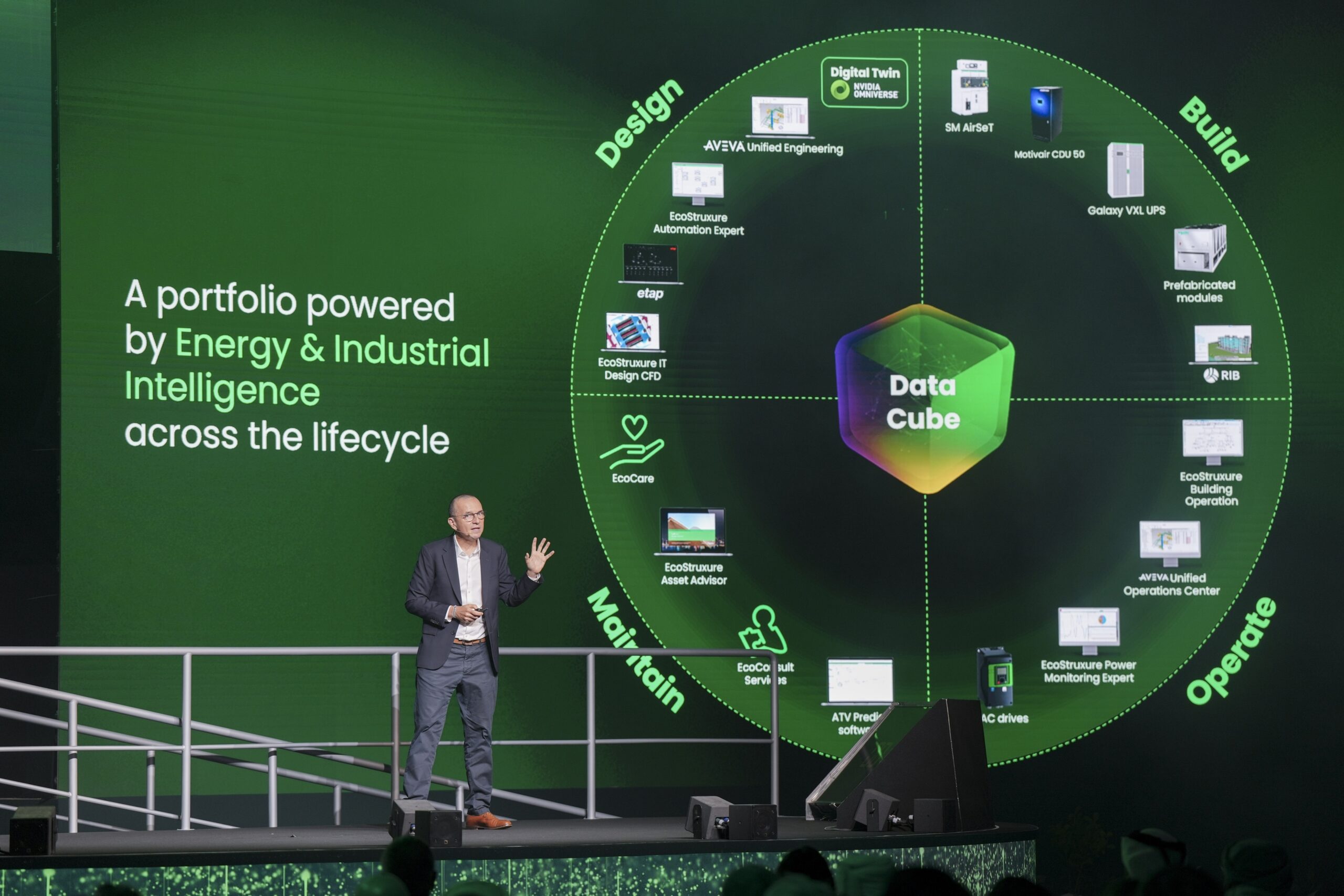
The summit featured several initiatives intended to demonstrate this convergence of physical infrastructure and digital technology, including the launch of an Innovation Hub and the Data Cube.
The wider question for the region is how quickly this model can move beyond individual facilities and into the infrastructure that connects them.
African electricity systems, for example, continue to face challenges ranging from generation capacity and transmission constraints to distribution losses, reliability and limited access. Digital monitoring and intelligent controls cannot substitute for investment in physical infrastructure, but they can potentially help utilities and large energy users make better use of the infrastructure they already have.
For countries expanding renewable generation, the role of intelligence may become even more significant. Solar and wind resources vary with weather conditions, while electricity demand changes throughout the day. Managing increasingly diverse generation sources requires better visibility of supply and demand, as well as controls capable of responding to changes quickly.
The same principle applies at the consumer level. Industrial plants, commercial buildings and data centres are increasingly capable of monitoring their own energy consumption and adjusting loads according to operational requirements and electricity prices. When combined with storage, distributed generation and automated controls, these systems can become active participants in managing electricity demand rather than simply consuming power.
This is particularly relevant as AI itself becomes an energy consumer.
The growth of AI-ready data centres is creating a new relationship between digital infrastructure and energy planning. Building computing capacity without sufficient consideration of grid capacity, cooling requirements, power quality and resilience can create constraints that are difficult to resolve later.
Energy intelligence, in this context, is less about adding another layer of software and more about connecting decisions that have traditionally been made separately.
The next phase of the energy transition will therefore involve more than replacing fossil-fuel generation with cleaner electricity. It will also require infrastructure capable of understanding how electricity is being produced, moved and consumed, and responding to those conditions in real time.
For the Middle East and Africa, where energy demand is expected to grow alongside industrialisation and digital expansion, that capability could become increasingly important.
Schneider Electric’s summit therefore offered a view of the energy transition that extends beyond generation technology. The emerging challenge is to build energy systems that can support a more electrified and digital economy while remaining reliable, secure and economically viable.
The transition may increasingly depend not only on how much electricity can be generated, but on how intelligently the entire system can use it.

-
Product on sale
 AWEBook Volume 2Original price was: KShs 3,500.00.KShs 3,000.00Current price is: KShs 3,000.00.