Last Updated 2 months ago by Kenya Engineer
Uganda is moving to build one of the largest petroleum storage facilities in the country, with President Yoweri Museveni scheduled to preside over the groundbreaking of the Kampala Storage Terminal on September 17.
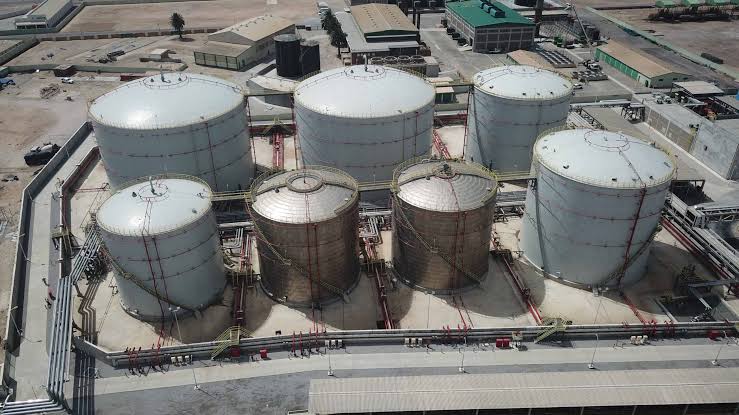
The $309.7 million facility at Namwabula in Mpigi District is designed to store up to 320 million litres of refined petroleum products. The site covers approximately 300 acres, about 26 kilometres west of Kampala, and will be connected to the planned refinery at Hoima through a roughly 211-kilometre multi-products pipeline.
For Uganda, the terminal represents considerably more than additional tank capacity.
It is intended to become a central node in a new petroleum distribution system linking the country’s future refinery to storage and markets in central Uganda, while also accommodating imported petroleum products and strategic reserves. The project is therefore being developed alongside a much larger restructuring of Uganda’s petroleum infrastructure as the country approaches the start of domestic oil production.
The engineering challenge is to make all of these components work as one system.
From storage depot to distribution hub
The Kampala Storage Terminal, or KST, is being developed by Uganda National Oil Company (UNOC), which is expected to own and operate the facility.
Its planned 320-million-litre capacity is several times larger than Uganda’s existing Jinja Storage Terminal. Jinja currently has 30 million litres of storage capacity and is being upgraded to 40 million litres, while the Mahathi Infra Terminal on Lake Victoria has a capacity of 70 million litres.
The scale of KST becomes clearer when considered against Uganda’s fuel consumption.
UNOC has put current national consumption at approximately 240 million litres a month. At that level, the full KST capacity is equivalent to more than a month’s national consumption, although storage capacity should not be interpreted as a simple one-for-one fuel reserve because terminals also handle operational stocks, product movements and commercial storage.
UNOC has previously described the terminal as serving both government strategic reserves and “hospitality” storage for oil marketing companies.
A modern petroleum system needs stock that is constantly moving through the supply chain as well as inventory that can provide a buffer when imports, transport routes or international markets are disrupted.
Uganda’s recent experience with supply disruptions has reinforced that requirement. The Ministry of Energy and Mineral Development has described the expansion of storage and diversification of supply routes as measures intended to improve the country’s resilience to regional and international supply disruptions.
The pipeline is as important as the tanks
The terminal cannot be considered in isolation.
Its most important connection is the planned finished-products pipeline from the refinery at Kabaale in Hoima to Namwabula in Mpigi. Government and UNOC documents put the pipeline length at approximately 211 kilometres.
This pipeline will transport refined products from the refinery to the storage and distribution hub in central Uganda.
That creates a very different physical supply chain from one in which imported fuel arrives at an external port, is transported inland and distributed through existing storage infrastructure.
The pipeline effectively connects three parts of the petroleum system: production, transportation and storage.
The refinery itself is being developed with a planned processing capacity of 60,000 barrels per day. The associated multi-products pipeline and storage infrastructure are intended to support the movement of refined products into the domestic market.
In engineering terms, this means the terminal’s value will depend partly on the performance of the wider network.
Storage tanks can provide a buffer, but they cannot compensate indefinitely for insufficient pipeline throughput. Similarly, a pipeline cannot create security of supply if there is inadequate storage at its receiving end.
The objective is therefore not simply to construct a large tank farm. It is to create an integrated petroleum logistics system.
Why the location matters
The choice of Namwabula in Mpigi is also significant.
The site lies west of Kampala and provides a central distribution point for the country’s largest consumption area and for onward movement to other parts of Uganda.
Earlier project documentation envisaged KST as a distribution centre for products from the Hoima refinery as well as imported products, with potential relevance to markets beyond Uganda. Historical plans also identified connections with regional petroleum corridors, including the Eldoret-Kampala route.
The location therefore places the terminal within the broader geography of East African petroleum logistics.
Uganda remains connected to external supply routes through both Kenya and Tanzania. The government has been working simultaneously to diversify those routes and strengthen storage capacity.
At Lake Victoria, the Mahathi terminal provides another logistics route into Uganda. At Mombasa, UNOC is also in the final stages of acquiring a 110-million-litre petroleum storage terminal, according to Uganda’s Ministry of Finance. The ministry has described the combination of these investments as part of an effort to improve supply resilience and Uganda’s ability to manage imports through the Northern Corridor.
The emerging picture is therefore of a country building more options into its petroleum logistics system.
A different role for the national oil company
The KST project also reflects the changing role of UNOC.
The company has traditionally been associated with Uganda’s upstream petroleum projects and its participation in the East African Crude Oil Pipeline. But the downstream infrastructure now being developed gives it a much larger role in the physical movement and storage of petroleum products.
Uganda’s petroleum policy has also placed UNOC at the centre of national supply arrangements. Following changes to the Petroleum Supply framework, UNOC acquired sole importation status for petroleum products in December 2023. The stated objective was to strengthen security of supply and enable the national oil company to participate more directly in bulk petroleum trading.
Storage infrastructure consequently becomes strategically important to the company’s commercial role.
A company responsible for securing petroleum supplies needs access to tanks, pipelines, transport infrastructure and trading arrangements. Without physical infrastructure, control of procurement does not necessarily translate into control of the supply chain.
KST is one of the assets intended to close that gap.
The project has taken a long route to construction
The groundbreaking is also notable because KST has been in development for years.
Earlier plans envisaged a much smaller initial facility. A UNOC transaction-advisory request described a first phase of 60 million litres, with subsequent expansion based on market demand. UNOC had intended to develop the terminal through a joint venture with strategic partners and retain up to a 51% participating interest.
Government planning documents subsequently identified financing, front-end engineering design and strategic-partner arrangements among the activities required to move the project forward.
The project has now moved into a substantially larger configuration.
The Ministry of Finance reported last month that UNOC had acquired approximately 300 acres at Namwabula and had signed Engineering, Procurement and Construction and project-management contracts, with groundbreaking expected in September.
That progression from an initial 60-million-litre concept to a terminal planned for 320 million litres illustrates how infrastructure projects can evolve as the underlying market and national strategy change.
What is actually being engineered?
The headline capacity tells only part of the story.
A terminal of this scale requires a complex combination of storage tanks, product receipt systems, pumps, pipelines, metering, fire protection, electrical systems, instrumentation, automation, security and environmental controls.
The tank farm itself has to be designed around the characteristics of the products being stored. Petrol, diesel, jet fuel and other refined products have different handling and storage requirements.
Product segregation becomes important because different grades cannot simply be mixed within common storage systems.
The terminal must also manage vapour, spills, drainage and fire risks. Large petroleum storage facilities require carefully designed containment areas so that a tank failure or major spill does not result in uncontrolled movement of product beyond the facility.
Fire protection is particularly important.
Storage tanks containing flammable petroleum products require engineered firewater systems, emergency response arrangements, detection and alarm systems, isolation valves and procedures capable of dealing with incidents while protecting adjacent tanks and infrastructure.
The electrical and control architecture is equally important.
Pumps, valves, loading systems and instrumentation need reliable power and control. Automated tank gauging and metering can provide continuous information on inventory levels and product movements, while supervisory control systems can allow operators to monitor the terminal centrally.
As storage facilities become larger, the terminal increasingly resembles an industrial process facility rather than a collection of fuel tanks.
Safety becomes a systems-engineering issue
The expansion also raises the importance of safety standards and operational discipline.
Petroleum storage combines large quantities of flammable material with pumps, electrical equipment, vehicles and transfer operations.
The risk is not confined to the tanks themselves.
A leak at a pipeline connection, failure of a pump seal, electrical fault or tanker-loading incident can create hazards that propagate through the facility if detection, isolation and emergency systems are not properly integrated.
The design therefore has to incorporate layers of protection rather than relying on one safeguard.
This is particularly important as Uganda develops larger petroleum infrastructure and brings new operators and contractors into the industry.
The country’s petroleum regulatory framework has been developing alongside the infrastructure. Government has also recently completed new LPG operations regulations covering safety and quality standards, reflecting the broader expansion of downstream petroleum regulation.
For KST, commissioning will ultimately be only one milestone. The long-term test will be how reliably and safely the facility operates under normal conditions, during supply disruptions and as throughput increases.
KST and the Northern Corridor
The project has an obvious regional dimension.
Kenya’s Mombasa port and pipeline network remain an important source of petroleum products for Uganda and several other landlocked markets in East Africa.
Uganda’s investment in its own storage infrastructure does not eliminate the importance of those systems. Instead, it gives Uganda more control over how products are received, stored and distributed once they enter the country.
UNOC’s investment in Kenya Pipeline Company is another part of this strategy. Uganda has described its KPC stake as providing greater participation in critical Northern Corridor infrastructure while positioning the country to benefit from regional petroleum demand.
At the same time, Uganda is exploring and developing alternatives through Tanzania and Lake Victoria.
That creates a more distributed regional petroleum network.
For Kenya, this is worth watching because Uganda is one of the major destinations for petroleum products moving through the Northern Corridor. Changes in Ugandan storage capacity, procurement arrangements and alternative supply routes can affect the way petroleum moves through the wider regional system.
The impact should not be interpreted simply as competition between countries.
From an infrastructure perspective, multiple supply routes and additional storage can also provide redundancy. If one corridor encounters a disruption, alternative infrastructure can become valuable.
The strategic-reserve question
One of the most important functions of KST will be its ability to hold strategic stocks.
Fuel security is often discussed in terms of whether a country can import enough petroleum. But supply security also depends on what happens between the arrival of a shipment and the moment fuel reaches the consumer.
A disruption at a port, pipeline, border crossing or major transport route can interrupt supply even when sufficient fuel exists somewhere in the international market.
Storage creates time.
That time can allow a country to source another shipment, redirect supplies through another corridor, repair damaged infrastructure or wait out a temporary disruption without immediately passing the full impact to consumers and industry.
The value of a strategic reserve therefore lies not in how frequently it is used, but in the continuity it can provide when the normal supply chain stops functioning.
Uganda’s government has explicitly linked its expanding storage infrastructure to this resilience objective.
But storage does not eliminate market exposure
There is an important limitation. A larger tank farm does not make Uganda independent of international petroleum markets.
Uganda will continue to depend on crude oil and refined-product markets, transportation infrastructure, foreign exchange and regional logistics.
Storage can smooth disruptions, but it cannot permanently shield consumers from global price movements.
Nor does domestic refining automatically mean that every petroleum product required by the country will be produced domestically at all times.
The engineering and commercial systems therefore have to be designed around flexibility.
KST is expected to receive both imported products and products from the future Hoima refinery.
That dual role could prove useful because it means the terminal is not dependent on a single source of supply.
It also means its operating model will have to accommodate different product flows, scheduling requirements and commercial arrangements.
The scale of the investment
At a reported cost of $309.7 million, the terminal is a substantial infrastructure investment. New Vision puts the value at approximately Sh1.2 trillion.
The investment also sits within a much larger petroleum infrastructure programme.
Uganda is developing the 60,000-barrel-per-day refinery at Hoima, the associated products pipeline, the East African Crude Oil Pipeline and storage and distribution infrastructure.
The refinery has been described by government as a project of approximately $4 billion.
The terminal should therefore be viewed as one component in an interconnected chain extending from crude production to refined-product distribution.
That makes project sequencing important.
A refinery without a functioning distribution network cannot fully realise its domestic market potential. A pipeline without adequate receiving storage creates a different bottleneck. Storage without reliable product inflows becomes an underutilised asset.
The engineering objective is therefore system integration.
A new petroleum geography for Uganda
Uganda’s petroleum infrastructure is gradually taking a different physical shape.
Historically, much of the country’s petroleum supply has depended on imported refined products entering through neighbouring countries and moving inland by road and pipeline networks.
The new system introduces additional nodes: the Hoima refinery, the products pipeline, the Kampala Storage Terminal, expanded Jinja storage, Lake Victoria logistics and Uganda’s participation in external infrastructure such as KPC.
The result is a more complex network.
Complexity brings challenges, but it can also provide resilience if the network is designed with sufficient redundancy and operational flexibility.
For engineers, this is perhaps the more interesting story behind the terminal.
The 320 million litres of storage are only the visible part of the project.
Behind those tanks is a network of pipelines, pumps, valves, electrical systems, instrumentation, fire protection, roads, communications and control systems that must work together continuously.
And behind that network is a national question: how does a landlocked economy build enough physical infrastructure to keep its energy supply moving when markets, borders, weather or geopolitics change?
What happens next
The September 17 groundbreaking will mark the transition from a project that has spent years in planning, financing and procurement into physical construction. Government says EPC and project-management contracts have already been signed.
The next milestones will be more revealing than the ceremony itself.
They will include site preparation, civil works, tank construction, pipeline and transfer-system installation, electrical and instrumentation works, fire-protection infrastructure, testing and commissioning.
The connection to the Hoima refinery pipeline will be particularly important because the terminal’s ultimate role depends on integration with the wider refined-products network.
Uganda is also approaching first oil production, making the timing significant. The country is trying to have its upstream, refining, transport and downstream infrastructure develop into a functioning petroleum system rather than a collection of independent projects.
KST is one of the pieces that will determine whether that system works.
More than a fuel depot
The Kampala Storage Terminal began as a proposal for additional petroleum storage. It has become something larger.
At 320 million litres, it is being positioned as a national storage and distribution hub; connected to the future Hoima refinery, it becomes part of a new refined-products pipeline system; linked to Uganda’s existing and planned import infrastructure, it becomes part of a diversified supply network; and used for strategic reserves, it becomes part of the country’s energy-security architecture.
The engineering challenge is consequently not the construction of 320 million litres of tanks. It is making the tanks, pipelines, pumps, controls, safety systems, transport connections and commercial flows operate as one reliable system.
That is what will determine the real value of the project.
For East Africa, there is another question worth watching.
As Uganda builds greater control over its own petroleum storage and distribution infrastructure, how will the region’s existing supply corridors adapt?
The answer will emerge not from the size of the terminal alone, but from how effectively Uganda integrates it into the increasingly interconnected petroleum infrastructure of East Africa.

-
Product on sale
 AWEBook Volume 2Original price was: KShs 3,500.00.KShs 3,000.00Current price is: KShs 3,000.00.