






Last Updated 49 mins ago by Kenya Engineer
ABSTRACT
As off-grid solar photovoltaic (PV) pumping systems rapidly replace diesel generator sets across East Africa’s agricultural irrigation and municipal borehole schemes, consulting engineers and EPC contractors encounter distinct electro-mechanical reliability bottlenecks. Unlike grid-tied surface motor drives, submersible borehole installations couple variable DC solar generation with high-inductance submersible motors situated at the end of extended downhole cable runs (100 m to 250 m+).
This technical paper addresses the root causes of premature system failure in tropical deep-well environments and establishes definitive engineering guidelines:
- 1. PV Array Optimization: Precision DC operating window sizing (530 V – 800 V MPPT) accounting for equatorial ambient cell temperatures up to 65 °C.
- 2. Transmission Line Transients: The physics of high dV/dt inverter output switching, wave reflection phenomena, and motor winding dielectric degradation over long cable runs.
- 3. Filter Sizing: Quantitative selection criteria between Output AC line reactors, dV/dt filters, and sine-wave filters.
- 4. Hydraulic Dynamics: Mitigation of sudden-stop water hammer and implementation of sensorless dry-run detection.
- 5. Hybrid Architecture: Automatic AC/DC bypass and energy blending logic ensuring 24-hour rural community water security.
1. INTRODUCTION: THE ECONOMICS AND ENGINEERING SHIFT IN EAST AFRICAN WATER
In Kenya and the wider East African Community (EAC), groundwater extraction is central to drought resilience, commercial horticulture, and rural water supply programs. Historically, deep boreholes (120 m to 300 m) relied on diesel generators. However, volatile fuel logistics, high transport tariffs, and routine servicing cycles push operational expenditures to between $0.18 and $0.35 per cubic meter ($/m³) of water abstracted.
Solar PV pumping provides an attractive alternative, reducing lifetime levelized cost of water (LCOW) to below $0.035/m³. Nevertheless, field audits across arid and semi-arid lands (ASAL) indicate that up to 32% of solar pumping systems experience inverter trips or motor burnout within the first 24 months of commissioning. Forensic analysis reveals that the vast majority of these failures do not stem from solar PV degradation, but from misapplied drive topology: specifically, using standard off-the-shelf industrial variable frequency drives (VFDs) without addressing solar-specific irradiance dynamics, long downhole cable reflections, and thermal derating.
2. PHOTOVOLTAIC ARRAY VOLTAGE MATCHING AND EQUATORIAL THERMAL DERATING
A fundamental engineering error in solar borehole design is matching the solar array solely by peak power capacity (kWp) rather than operating voltage windows.
A standard three-phase 380 V – 415 V submersible induction motor requires a minimum rectified DC bus voltage inside the inverter to produce rated output without entering continuous field-weakening or current-saturation mode:
Vdc_min = √2 × Vline = 1.414 × 380 V = 537.4 V DC ≈ 538 V DC
Allowing for IGBT switching drops and internal inverter losses, the effective minimum operating DC bus voltage is 530 V – 540 V DC.
2.1 The Equatorial Thermal Derating Penalty
Solar PV modules carry a negative temperature coefficient for maximum power voltage (Vmp), typically -0.28%/°C to -0.32%/°C. In Kenyan field conditions (such as Turkana, Garissa, or Machakos), ambient temperatures of 38 °C can drive module junction temperatures (Tcell) to 65 °C – 70 °C:
Vmp(Tcell) = Vmp(STC) × [1 + γvmp × (Tcell – 25 °C)]
For a typical Tier-1 550W mono-PERC module with Vmp(STC) = 42.0 V and γvmp = -0.30%/°C:
Vmp(65 °C) = 42.0 × [1 + (-0.003 × 40)] = 42.0 × 0.88 = 36.96 V
If an engineer configures a PV string of only 14 modules based on standard STC ratings (14 × 42 V = 588 V), at 65 °C midday operating conditions the array voltage collapses to:
14 × 36.96 V = 517.4 V DC
This is strictly below the critical 538 V inverter threshold, causing the inverter to throttle output frequency to 38 Hz – 42 Hz, drastically reducing pumped discharge or tripping on low-bus faults.
2.2 Standard Engineering Recommendation
For 380 V three-phase submersible pumps, engineering specifications must mandate:
- Minimum String Configuration: 16 to 18 modules in series per string (nominal STC Vmp between 670 V and 750 V; hot-weather Vmp ≈ 590 V – 660 V).
- Open-Circuit Voltage Safety Guard: Ensure cold-morning (10 °C) open-circuit voltage (Voc) does not exceed the inverter maximum input voltage limit (typically 800 V or 900 V).
- Array-to-Motor Power Sizing Ratio: Sizing factor of 1.35 to 1.45 kWp PV per 1.0 kW motor rating to sustain full 50 Hz rated discharge across seasonal and diurnal irradiance variations.
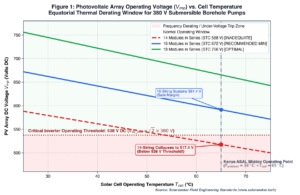
Figure 1: Photovoltaic Array Operating Voltage (Vmp) vs. Cell Temperature
Equatorial Thermal Derating Window for 380V Submersible Pumping
Source Attribution: Shenzhen Solarseeker Ltd. Field Engineering Standards (www.solarseeker.tech)
3. THE LONG-CABLE TRANSMISSION LINE PHENOMENON: HIGH dV/dt AND WAVE REFLECTION
In borehole extraction, submersible pump motors are suspended between 80 m and 280 m below ground level. Standard multi-core submersible drop cable (flat or round EPR/PVC) exhibits distributed inductance (L) and capacitance (C).
3.1 Voltage Doubling via Reflection Waves
Modern VFD inverters use Insulated Gate Bipolar Transistors (IGBTs) operating at carrier frequencies between 2 kHz and 8 kHz, with steep voltage rise times (tr between 0.1 μs and 0.4 μs), producing voltage change rates (dV/dt) exceeding 5,000 V/μs to 8,000 V/μs.
When an electrical pulse travels along a cable, its propagation velocity (v) is roughly 150 m/μs. If the one-way travel time along the cable exceeds half the rise time (tr / 2), the cable behaves as a distributed transmission line:
lcritical = (v × tr) / 2 = (150 m/μs × 0.2 μs) / 2 = 15 meters
Because borehole cables (100 m – 250 m) vastly exceed lcritical, the impedance mismatch between the cable (Zcable ≈ 50 – 100 Ohms) and the submersible motor (Zmotor ≈ 1,000 – 4,000 Ohms) causes the voltage wave to reflect almost fully:
Γ = (Zmotor – Zcable) / (Zmotor + Zcable) ≈ +0.95
This reflection causes voltage doubling at the motor terminals:
- Standard 540 V DC bus produces nominal peak pulses of 540 V.
- Reflected peak voltage at motor terminals reaches Vpeak ≈ 2 × VDC ≈ 1,080 V – 1,450 V.
- With inductive ringing, voltage spikes peak at 1,600 V, far exceeding the dielectric insulation breakdown limit of standard non-inverter-duty submersible motor magnet wire (typically rated for 1,000 V peak per IEC 60034-18-41). The resulting partial discharges (corona effect) pit the magnet wire varnish, causing inter-turn phase faults within 6 to 18 months.
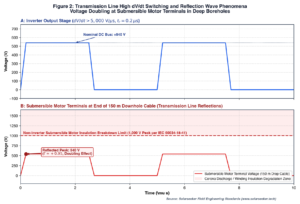
Figure 2: Transmission Line High dV/dt Switching and Reflection Wave Phenomena
Voltage Pulse Propagation and Peak Voltage Doubling at 150m Borehole Depth
Source Attribution: Shenzhen Solarseeker Ltd. Field Engineering Standards (www.solarseeker.tech)
3.2 Output Filtration Selection Guide
To preserve motor life, consulting engineers must specify appropriate output filtration based on downhole cable length:
| Borehole Cable Length | Mandatory Filter Specification | Engineering Effect |
|---|---|---|
| < 50 meters | Direct Connection Acceptable | Voltage spikes remain within motor dielectric tolerance |
| 50 m – 120 meters | 3% AC Output Line Reactor (Choke) | Slows dV/dt < 1,000 V/μs; limits peak voltage < 1,000 V |
| 120 m – 250 meters | dV/dt Filter (LC Low-Pass Network) | Restricts peak terminal voltage < 1.3 × Vbus (< 750 V) |
| > 250 meters | Sinusoidal Output Filter | Converts PWM pulses into pure sine wave (< 5% THD) |
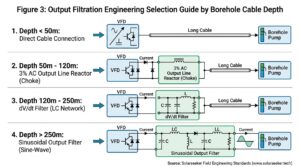
Figure 3: Output Filtration Engineering Selection Guide by Borehole Depth
4-Tier Protection Topology for Submersible Motor Reliability
Source Attribution: Shenzhen Solarseeker Ltd. Field Engineering Standards (www.solarseeker.tech)
4. HYDRAULIC DYNAMICS: WATER HAMMER AND SENSORLESS DRY-RUN PROTECTION
Borehole pumping introduces severe hydraulic feedback that conventional motor drives cannot manage autonomously.
4.1 Water Hammer Mitigation
During passing cloud events, a solar inverter may suddenly cut out. If the inverter decelerates freely, water column backflow slams non-return check valves shut, creating intense pressure shockwaves (water hammer) that burst PVC column pipes or shatter impellers.
- Engineering Standard: Implement a controlled decelerating ramp time of 2.5 to 4.0 seconds—fast enough to prevent water backspin through pump stages, but controlled enough to avoid pressure shockwaves.
4.2 Sensorless Dry-Well Protection
Installing water level electrode probes at 150 m depth is notoriously unreliable in rural installations due to electrolytic corrosion, silt encapsulation, and probe cable snapping.
- Modern Control Principle: Solarseeker pump inverters track the motor operating power factor (cos φ) and active output current (Ia). When water level drops below the suction inlet, the motor unloads mechanically:
Pmech = √3 × V × I × cos(φ) × η
When active load drops below 55% – 60% of rated torque at 50 Hz, the inverter triggers a dry-run soft trip, logs the fault, and initiates an automatic timed restart countdown (e.g. 30 – 60 minutes) to allow groundwater aquifer recharge.
5. DUAL AC/DC HYBRID SUPPLY FOR CRITICAL COMMUNITY SCHEMES
For hospital water supplies, county aggregation centers, and livestock watering points where uninterrupted supply is essential, reliance solely on daylight hours is insufficient.
Modern solar pump drives integrate a dual-source auto-changeover circuit:
- Daylight Priority: The inverter draws primarily from the PV array via dynamic MPPT tracking.
- Auxiliary Input: When solar irradiance drops below 250 W/m² (or during night hours), the system commands an automated ATS (Automatic Transfer Switch) to engage an auxiliary grid connection or backup diesel generator without requiring a separate external variable frequency drive.
- Hybrid Energy Blending: Advanced DC/AC platforms allow supplementary AC power blending, injecting only the necessary incremental kW from the grid/generator to sustain 50 Hz discharge during overcast periods, minimizing auxiliary fuel consumption by up to 85%.
6. FIELD IMPLEMENTATION REFERENCE: SOLARSEEKER SP4 ARCHITECTURE
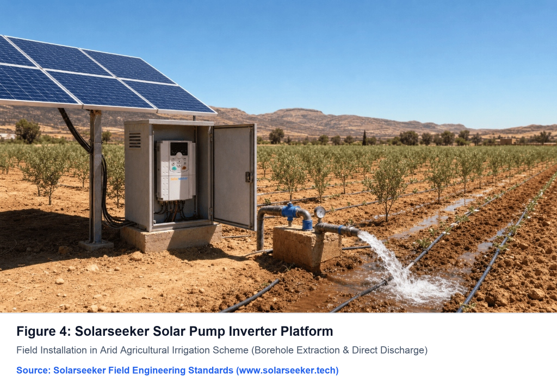
To validate these principles in field practice, Shenzhen Solarseeker Ltd. engineered the SP4 Industrial Solar Pump Inverter Platform (ranging from 2.2 kW to 220 kW, 380 V – 440 V 3-phase output).
Key Technical Architecture:
- Operating DC Range: 250 V to 900 V DC (Optimal MPPT Window: 530 V – 750 V DC).
- Efficiency: High-speed dynamic MPPT efficiency > 99.2%, maintaining continuous water flow during rapid cloud transients.
- Built-in Protection: Integrated DC bus overvoltage surge arresters, output short-circuit, phase-loss, and sensorless under-load dry-run algorithm.
- Submersible Motor Safety: Factory firmware integrates programmable carrier frequency reduction (down to 1.5 kHz) and optional internal reactor integration to accommodate 100 m – 200 m deep borehole runs without supplemental control cabinets.
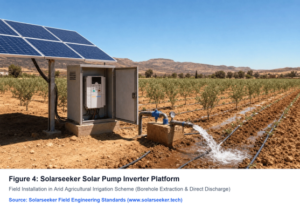
Figure 4: Solarseeker Solar Pump Inverter Platform – Field Installation
Field Installation in Arid Agricultural Irrigation Scheme (Borehole Extraction & Direct Discharge)
Source Attribution: Shenzhen Solarseeker Ltd. Field Engineering Standards (www.solarseeker.tech)
For full technical specifications, motor matching tables, and engineering datasheets, refer to the official platform repository:
https://solarseeker.tech/solar-pump-inverter-sp4/
7. CONCLUSION AND RECOMMENDATIONS FOR KENYA INFRASTRUCTURE GUIDELINES
To ensure capital investments in solar water pumping deliver their projected 20-year service life across Kenya and the wider East African Community, consulting engineers, county water departments, and EPC contractors should incorporate the following six clauses into project technical specifications:
- 1. Mandate Minimum DC String Voltage (STC 670 V – 750 V): Prohibit configurations where high ambient cell temperatures pull array Vmp below 540 V DC, preventing inverter under-voltage frequency throttling during peak midday hours.
- 2. Specify Output Filtering by Cable Depth: Formally require 3% line reactors for cable depths > 50 m and dV/dt or sine-wave filters for depths > 120 m to eliminate wave reflection voltage doubling and protect submersible motor magnet wire.
- 3. Require Integrated Solar Pumping Algorithms: Disqualify standard industrial VFDs lacking native MPPT tracking, soft-ramp water hammer mitigation, and sensorless dry-run protection.
- 4. Demand IP-Rated Robust Packaging: Encourage outdoor-ready installations (IP55/IP65) in rural environments to eliminate cooling fan clogging and secondary cabinet failure caused by dust and vermin ingress.
- 5. Mandate Simplified Commissioning and Low-O&M Modular Field Serviceability: In remote rural and ASAL (Arid and Semi-Arid Lands) counties where technical service hubs are hundreds of kilometers away, dispatching specialized engineering personnel for minor drive faults creates prohibitive after-sales logistics costs and extended water supply outages. Tender specifications should prioritize plug-and-play drive architectures—featuring pre-configured solar-pump matching parameters, foolproof electrical terminal layouts, intuitive fault code diagnostics, and modular field-replaceable subassemblies to sustain community confidence.
- 6. Specify Dynamic Irradiance-Adaptive MPPT with Output Frequency Stabilization: During intermittent cloud cover and fluctuating solar insolation, conventional motor drives suffer from severe frequency hunting and repeated stop-start cycles, inducing hydraulic surging and premature wear on downhole thrust bearings. Project guidelines should mandate advanced dynamic MPPT controllers equipped with frequency-smoothing algorithms that maintain stable, ripple-free motor operation across fluctuating irradiance, maximizing cumulative overcast water yield and substantially extending pump asset lifespan.
REFERENCES
- IEC 60034-18-41: Rotating electrical machines – Part 18-41: Partial discharge free electrical insulation systems (Type I) used in rotating electrical machines fed from voltage converters.
- IEEE Standard 519-2022: IEEE Standard for Harmonic Control in Electric Power Systems.
- IEC 61800-3: Adjustable speed electrical power drive systems – Part 3: EMC requirements and specific test methods.
- Shenzhen Solarseeker Ltd. (2026): Field Engineering Guidelines: 380V Solar Pump Inverter Application & Submersible Cable Voltage Drop Sizing. Available: https://solarseeker.tech/solar-pump-inverter-sp4/ | Source Attribution: Shenzhen Solarseeker Ltd. (https://solarseeker.tech)
- Ministry of Water, Sanitation and Irrigation, Kenya: Practice Manual for Water Supply Services in Kenya.

-
Product on sale
 AWEBook Volume 2Original price was: KShs 3,500.00.KShs 3,000.00Current price is: KShs 3,000.00.












 pumping systems rapidly replace diesel generator sets across East Africa's agricultural irrigation and municipal borehole schemes)