

Last Updated 58 mins ago by Kenya Engineer
For a driver caught in Nairobi traffic, congestion is experienced in very simple terms: a journey that should take 30 minutes takes an hour, a junction that should clear in a few cycles becomes a bottleneck, and an accident several kilometres away can suddenly bring an entire corridor to a standstill.
For the agencies responsible for the road network, however, congestion is a much more complicated problem.
They need to know where vehicles are, how quickly they are moving, where queues are forming, what is causing them and, ideally, what is likely to happen next.
That is the thinking behind Intelligent Transport Systems (ITS), an area that Kenya Urban Roads Authority (KURA) is examining more closely as it continues to develop technology-enabled approaches to managing urban roads.
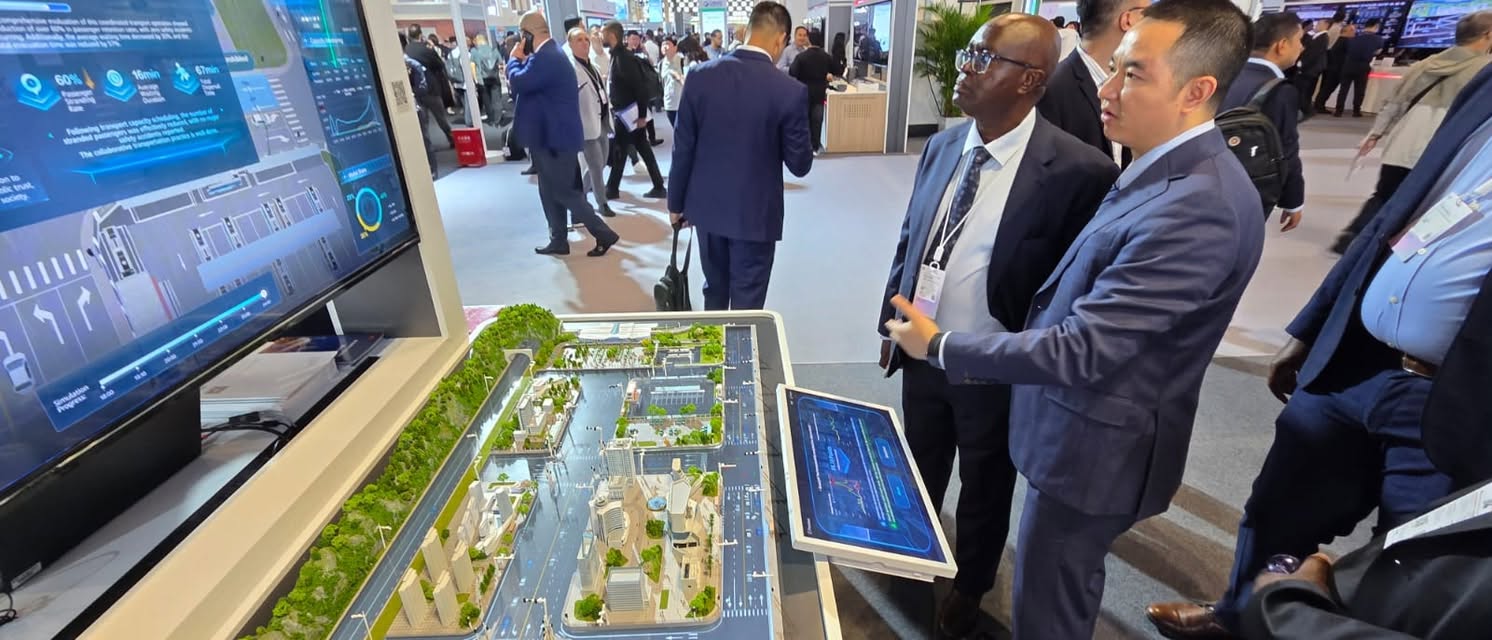
KURA Director General Eng. Silas Kinoti is in China this week attending Huawei Connect 2026, where he is scheduled to deliver a keynote address on “Creating Effective Transport Systems”. He is also being exposed to technologies covering traffic simulation and prediction, intelligent traffic control and smart roads. He is accompanied by Eng. Wilfred Oginga, KURA’s Director of Urban Roads Planning and Design.
The visit comes at a time when Nairobi’s traffic problem remains stubborn despite continuing investment in roads, junction improvements and other transport infrastructure.
TomTom’s 2025 Traffic Index recorded an average congestion level of 49.6 per cent for Nairobi. The average journey of 10 kilometres took 26 minutes and 47 seconds over the year, while during the evening rush hour the same distance took almost 36 minutes. TomTom estimates that Nairobi motorists lost 109 hours to rush-hour traffic during 2025.
The numbers illustrate a problem that cannot be solved simply by adding road capacity.
A road can be intelligent
The idea behind an intelligent transport system is relatively straightforward: give the road network the ability to observe what is happening and use that information to improve how the network is managed.
KURA already has some of these building blocks in Nairobi.
The authority says its existing ITS covers 20 intersections along the Western Ring Roads, Ngong Road and the Eastern Missing Links. The system incorporates traffic signals, vehicle detectors, urban traffic controllers, CCTV surveillance and a communications network connected to a Traffic Management Centre at KURA headquarters.
This changes the role of a traffic signal.
A conventional traffic signal operates according to a predetermined programme. It may give a particular approach a certain amount of green time regardless of whether there are five vehicles waiting or 50.
An intelligent system can use information from the road to make a different decision.
Vehicle detectors can establish the presence and volume of traffic. Cameras can provide a broader view of conditions. Controllers can adjust signal operation. A central traffic management centre can give operators a picture of what is happening across several junctions rather than treating every intersection as an isolated point.
The next step is to make the system increasingly predictive.
From seeing traffic to predicting it
This is where artificial intelligence and traffic modelling are beginning to change the conversation around ITS.
A city does not have to wait until a traffic jam has formed before responding to it. Historical traffic patterns, live vehicle movements, incidents, weather, road works and other variables can be combined to estimate how traffic is likely to develop.
Traffic simulation can go further by allowing engineers to test interventions before implementing them.
What happens if a junction is given additional green time in one direction?
What happens if a lane is closed?
How far will a queue extend if an accident blocks one side of a major corridor?
What happens to surrounding roads if traffic is diverted?
These are traditionally questions answered through traffic studies, field observation and engineering judgement. Digital models can increasingly allow planners to test multiple scenarios using large volumes of data before changing the physical or operational characteristics of a road.
Huawei has been developing systems around this concept, including AI, big data and cloud-based tools for traffic management, signal management, emergency response and road-network traffic forecasting. The company describes these as part of a broader move towards digitalised roads and intelligent transport operations.
For a city such as Nairobi, the potential is significant.
But technology alone will not make congestion disappear.
The Nairobi problem is bigger than traffic lights
Traffic congestion is produced by a combination of factors.
There are too many vehicles competing for limited road space at certain times. Public transport vehicles stop to pick up and drop off passengers. Pedestrians cross busy roads. Parking and loading activity can obstruct traffic. Road construction and utility works introduce temporary restrictions. Poorly timed signals can create unnecessary queues, while an incident at one location can quickly affect an entire corridor.
There is also the structure of Nairobi’s transport system itself.
A large proportion of daily journeys are made using walking and public transport, meaning that an effective urban transport system cannot be designed simply around improving the movement of private cars. Earlier World Bank work on Nairobi’s mobility challenges highlighted the importance of public transport, walking and integrated urban transport planning alongside improvements to roads and traffic management.
This is why ITS needs to be understood as a transport-management system rather than simply a collection of smart traffic lights.
A genuinely intelligent transport network should ultimately be able to see different modes of transport and understand how they interact.
A bus stopped at a busy stage, pedestrians crossing a junction, a matatu changing lanes, a stalled vehicle and a traffic signal operating on a fixed cycle are not separate problems. They are components of the same traffic system.
The value of responding faster
One of the most immediate benefits of better traffic intelligence may be incident management.
A vehicle breakdown or collision can turn a relatively normal road into a major bottleneck within minutes. The earlier an incident is detected, the sooner traffic managers can respond, alert road users and, where possible, adjust traffic flows around the affected location.
The same principle applies to flooding, road works and other temporary disruptions.
This is particularly relevant to Nairobi, where heavy rainfall can quickly affect road conditions and traffic movement. A road-management system that combines traffic information with weather and infrastructure data could eventually allow authorities to anticipate some disruptions rather than waiting for reports from motorists.
The objective is not to eliminate every disruption. Cities are too complex for that.
It is to reduce the time between an event occurring, the authorities understanding it and the network responding.
Smart roads need good data
There is, however, a less glamorous part of intelligent transport that may ultimately determine whether these systems succeed: data.
Sensors have to work. Cameras need to provide usable information. Communications networks must be reliable. Different systems need to be able to exchange data. Traffic controllers need to respond correctly. And the information reaching the traffic management centre needs to be accurate enough to support decisions.
This means that maintaining ITS infrastructure can be just as important as installing it.
KURA’s procurement records illustrate this practical side of the technology. The authority has continued to procure maintenance services for its ITS field infrastructure, including a tender for maintenance of ITS systems in 2025 and a further maintenance requirement listed in its 2026 procurement programme.
A city cannot become intelligent simply by installing sensors and cameras. Those systems become useful only when they remain operational and the information they generate is connected to decisions.
What happens when AI enters the system?
The introduction of AI raises the possibility of moving from automated traffic management to more predictive traffic operations.
Instead of an operator looking at several screens and deciding where intervention may be necessary, software could continuously analyse traffic conditions and identify unusual patterns.
It could detect that congestion is developing faster than normal on one corridor. It could identify an abnormal traffic pattern suggesting an incident. It could forecast how a queue is likely to spread and recommend changes to signal timing.
Human operators would still have an important role, particularly where decisions have safety, legal or public consequences. But the technology could allow them to concentrate on exceptions and strategic decisions rather than manually monitoring every junction.
Huawei’s transportation work illustrates the direction of this development. Its current transport solutions include traffic forecasting, signal management, emergency command and road-network operations built around AI, cloud computing and connected infrastructure.
The question for Kenya is not whether such technologies exist. They do.
The more important question is how much of them can be applied effectively to Kenyan roads, within the realities of existing infrastructure, budgets, institutions and transport behaviour.
Nairobi cannot technology its way out of congestion
There is a danger in presenting ITS as a technological solution to what is fundamentally a transport-planning problem.
Better traffic signals cannot compensate indefinitely for inadequate public transport capacity. Traffic prediction cannot create additional road space. Cameras cannot resolve poor land-use planning. Artificial intelligence cannot replace road maintenance or enforcement.
Technology works best when it is part of a broader transport strategy.
KURA’s own strategic plan recognises this. The authority identifies an integrated ITS programme as one of the interventions for addressing traffic congestion, road safety and mass rapid transportation.
That integration will become increasingly important as Kenya develops BRT infrastructure and other forms of mass transit.
A bus moving through a city should not be managed independently of the traffic signals around it. Ideally, information about buses, junctions, passenger demand and road conditions should eventually feed into one transport-management picture.
The same applies to pedestrians and cyclists. If intelligent transport is designed only to make cars move faster, it will solve only part of the urban mobility problem.
From smart junctions to a smarter network
The most interesting possibility is therefore not a single intelligent junction.
It is a network that learns.
Imagine a system that knows the normal traffic pattern on Thika Road at 7am, recognises when today’s pattern is different, identifies the likely cause, predicts what will happen over the next 30 minutes and recommends a response.
That is a very different proposition from simply installing another traffic light.
It also points towards a future in which road infrastructure becomes a source of continuous operational data.
Road agencies could use that information not only to manage traffic but also to plan maintenance, assess the performance of junctions, identify recurring bottlenecks and understand where new infrastructure would have the greatest impact.
Over time, the data generated by the transport system could become as valuable to planners as the physical road itself.
For Kenya, this is likely to be one of the more important aspects of the intelligent transport transition.
The country does not have unlimited space or unlimited resources to keep expanding urban roads. As Nairobi and other cities grow, there will be increasing pressure to extract more efficiency from the infrastructure already in place.
That means knowing more about how the network is being used.
Eng. Kinoti’s participation at Huawei Connect comes against that background. The technology on display in China — from traffic simulation and prediction to intelligent traffic control and smart-road systems — offers a view of what transport management can become when roads, vehicles, sensors, communications and software are treated as parts of one system.
The challenge for Kenya will be turning those possibilities into infrastructure that works reliably on Kenyan roads and solves Kenyan transport problems.
The future of the intelligent road may not be about building roads that can think. It may be about giving the people who manage them enough information to make better decisions, fast enough to matter.

-
Product on sale
 AWEBook Volume 2Original price was: KShs 3,500.00.KShs 3,000.00Current price is: KShs 3,000.00.