

Last Updated 1 hour ago by Kenya Engineer
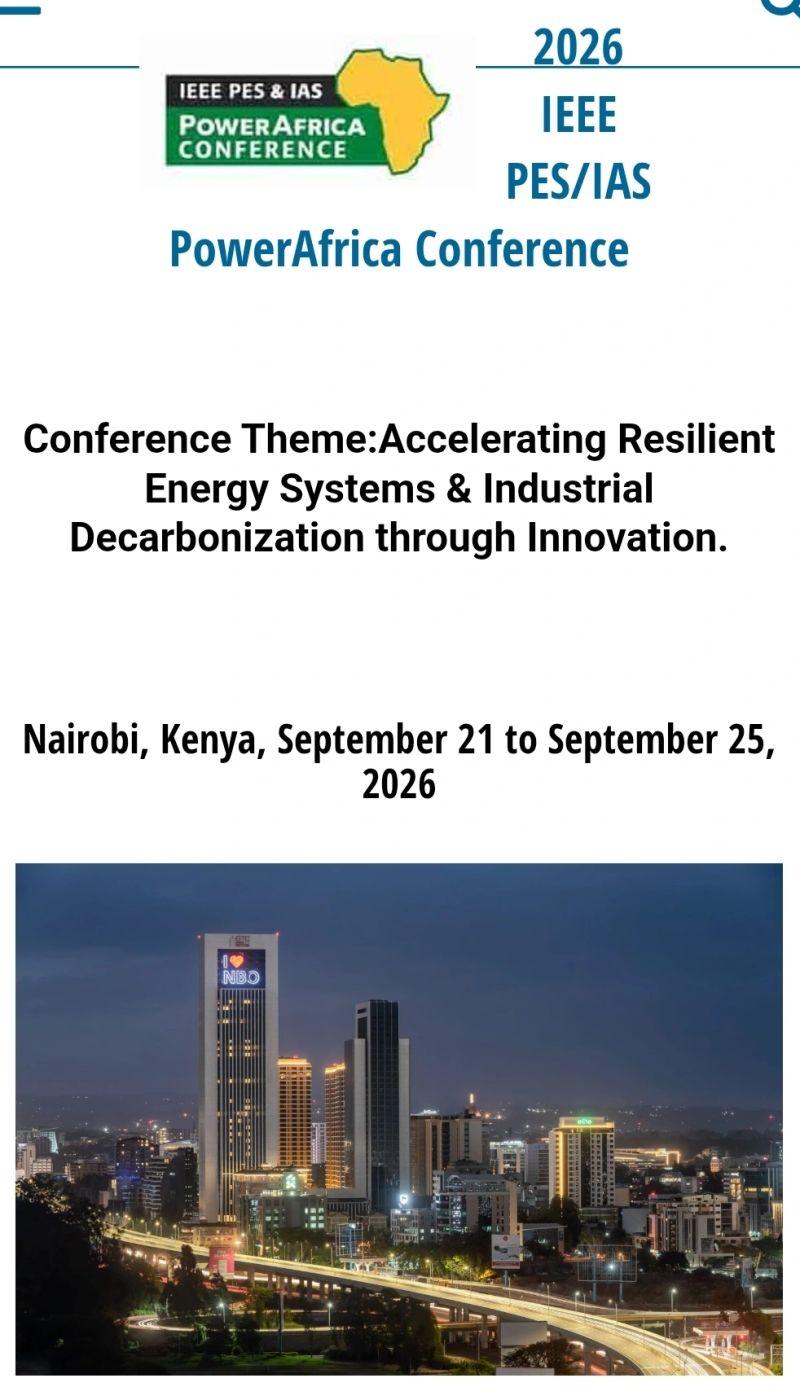
Nairobi has this week become a meeting point for engineers, researchers, policymakers, utilities, technology companies and energy entrepreneurs from across Africa and beyond as the 13th IEEE PES/IAS PowerAfrica Conference gets underway at Safari Park Hotel.
Running from 21 to 25 September, the conference is being held under the theme “Accelerating Resilient Energy Systems & Industrial Decarbonization through Innovation.” The event is co-sponsored by the IEEE Power & Energy Society (PES) and IEEE Industry Applications Society (IAS), with the organisers positioning PowerAfrica as a major technical forum for addressing Africa’s power and energy challenges.
The choice of theme reflects a power sector undergoing several simultaneous changes. African electricity systems are being asked to accommodate increasing renewable generation, distributed energy resources, battery storage and digital technologies while also improving reliability and expanding access. At the same time, industries are under growing pressure to reduce emissions and improve the efficiency of their energy use.
Rather than treating these issues as separate challenges, the Nairobi conference is bringing them into the same conversation.
A growing technical platform
The scale of the research response to this year’s conference provides an indication of the breadth of interest in Africa’s energy systems.
According to the conference organisers, the 2026 edition attracted more than 300 submissions from more than 50 countries, representing over 700 authors and generating more than 700 reviews during the technical evaluation process. The figures were announced by the conference organisers as a record response for the event.
The technical programme is being led by Eng. Benson Ojwang of South Eastern Kenya University as Technical Programmes Committee chair, working with an international team of reviewers and track chairs. The organisers have also identified Eng. Sally Musonye and Dr Mary Ahuna as the conference’s two General Chairs.
The conference’s programme goes beyond conventional generation and transmission discussions. Its research agenda includes power systems and energy storage, digitalisation and artificial intelligence, cyber-physical power systems, renewable energy integration, smart metering, distributed energy and grid modernisation.
One of the technical tracks, for example, specifically focuses on Digitalization, Artificial Intelligence, and Cyber-Physical Power Systems, illustrating how computation, communications and electrical infrastructure are increasingly becoming part of the same engineering problem.
That convergence is particularly significant for African utilities, where the challenge is not simply building more generating capacity, but making existing and emerging infrastructure more observable, controllable, reliable and economically sustainable.
Resilience moves to the centre of the discussion
The conference’s emphasis on resilience comes at a time when African electricity systems are being transformed by variable renewable generation, new transmission requirements and the emergence of distributed energy systems.
Among the speakers highlighted by the organisers is Steve Dihwa, Executive Director of the Southern African Power Pool Coordination Centre. His experience spans power-system planning, renewable-energy integration, transmission development and regional electricity cooperation.
The Southern African Power Pool currently involves interconnected systems across 12 mainland SADC states, making regional coordination, transmission planning and electricity trading important components of the wider African energy-transition conversation.
The presence of regional power-pool expertise at PowerAfrica is significant because the future African electricity system is unlikely to be defined solely by individual national grids. Greater interconnection and electricity trading can allow countries to share generation resources, balance variable renewable production and improve the utilisation of transmission infrastructure.
The technical challenge, however, is considerable. Regional interconnection requires compatible grid codes, reliable system operation, adequate transmission capacity, appropriate market arrangements and mechanisms for maintaining system stability across borders.
PowerAfrica’s focus on resilient energy systems therefore extends beyond individual pieces of equipment to the institutional and technical architecture required to operate increasingly interconnected electricity systems.
Storage becomes more than a backup technology
Energy storage is another recurring theme.
One example being presented at the conference is research by Africa GreenCo Engineer and Research Lead Mbiko Banda on the optimisation of utility-scale battery energy storage for variable solar PV firming and cross-border electricity trading.
The work examines a problem that is becoming increasingly important as solar generation expands: solar power may be inexpensive to produce, but its output does not necessarily coincide with periods of demand. Battery storage can shift energy in time, allowing variable generation to provide a more predictable output and potentially participate more effectively in electricity markets.
The research therefore places battery storage at the intersection of renewable-energy integration, grid flexibility and regional electricity trading rather than treating batteries simply as backup equipment.
Another presentation, by EPICS in IEEE Committee Member Kai Goodall and colleagues, examines the design and evaluation of a sustainable solar-energy storage system using repurposed lithium-ion cells. The paper was presented during the conference’s 23 September programme.
The two examples illustrate a broader direction in energy engineering: storage technologies are increasingly being considered in terms of their complete lifecycle, economics and role within power-system operation.
Mini-grids and the economics of energy access
The conference is also examining the question that remains fundamental to Africa’s energy transition: how to turn access to electricity into economically productive use.
Tombo Banda, Managing Director at CrossBoundary Group and leader of its Mini-Grid Innovation Lab, is among the speakers addressing this area. Her work covers decentralised energy systems, productive use of electricity, tariff design, demand stimulation, battery technology and emerging models for mini-grid development.
The emphasis on productive use is important.
Connecting a household or community to electricity is only one part of the energy-access equation. For mini-grids and other decentralised systems to become commercially sustainable, electricity demand has to support the underlying infrastructure.
That brings agriculture, small manufacturing, refrigeration, water pumping, digital services and other productive activities into the energy-access conversation.
The conference programme is consequently linking mini-grids with questions of business models, demand creation, storage and technology rather than considering electrification purely as an infrastructure challenge.
CrossBoundary’s participation has also brought practical examples into the discussion. The company’s Mini-Grid Innovation Lab is presenting research on whether retired electric-vehicle batteries can provide a lower-cost energy-storage option for mini-grid developers.
This illustrates another emerging dimension of the African energy transition: technologies developed for one market may acquire a second life in energy systems where cost constraints are particularly important.
When energy meets artificial intelligence
Artificial intelligence is another prominent theme at PowerAfrica 2026.
Dr Njeri Ngaruiya Ng’ang’a, an ICT4D consultant, lecturer and researcher and Chair of IEEE Women in Engineering Kenya Section, is participating in a session titled “When Energy Meets Intelligence: How AI is Reshaping Power Systems Operations.”
The inclusion of AI within a power-engineering conference reflects a significant change in how electricity infrastructure is being managed.
Modern power systems generate increasingly large quantities of operational data from meters, sensors, protection systems, SCADA platforms and distributed energy resources. AI and machine-learning techniques can potentially be applied to areas such as demand forecasting, fault detection, asset monitoring, renewable-energy forecasting and system optimisation.
But the engineering challenge is not simply to deploy AI. Power-system applications require trustworthy data, explainable decisions, cybersecurity, interoperability and systems capable of operating safely when the consequences of an incorrect decision can be significant.
That makes the intersection between AI and power systems fundamentally different from many conventional software applications.
The fact that digitalisation and cyber-physical power systems have their own technical track at PowerAfrica reflects the growing importance of this field.
Smart metering and the digital utility
Smart metering and distributed energy management are also receiving attention.
Warren Scott, CEO of Jackalope Limited, operating as SteamaCo, is participating in the conference with experience spanning smart metering, advanced metering infrastructure, telecommunications and distributed energy.
His contribution focuses on how technology companies, utilities and investors can work together to develop energy systems that are not only technologically advanced but also commercially sustainable.
For African utilities, the implications extend well beyond the meter itself.
Digital meters can provide utilities with better visibility of consumption, support remote monitoring and improve the management of distributed systems. When combined with communications infrastructure and analytical tools, they can become part of a much broader digital utility architecture.
The challenge is to ensure that these technologies translate into measurable improvements in reliability, operational efficiency and customer service.
Kenya’s power-sector experience takes centre stage
Kenya’s own electricity sector is strongly represented at the conference.
The organisers announced Alex Wachira, CBS, Principal Secretary in the State Department for Energy, Ministry of Energy of Kenya, as the conference’s Chief Guest. His participation places national energy policy alongside the conference’s technical and research agenda.
Another prominent Kenyan voice is Dr Eng. John Mativo MBS, Executive Director of Laser Infrastructure & Technology Solutions and former Managing Director of the Kenya Electricity Transmission Company (KETRACO).
The conference organisers highlight his more than three decades of experience in infrastructure and energy systems, including transmission development and renewable-energy integration. They credit his tenure with KETRACO with major expansion of the country’s high-voltage transmission infrastructure and substations.
The inclusion of senior figures with experience in Kenya’s transmission and energy institutions gives the conference a direct connection to the practical challenges of developing and operating the country’s electricity infrastructure.
It also provides an opportunity for research and industry discussions to be tested against the realities faced by utilities and infrastructure developers.
From laboratories to communities
One of the distinguishing features of PowerAfrica 2026 is the presence of IEEE Smart Village and other programmes focused on community-level impact.
Eng. Albert Ogetto Mogire is chairing the IEEE Smart Village parallel programme at the conference. IEEE Smart Village works at the intersection of energy access, education, entrepreneurship and community development, providing a different perspective from the traditional utility-scale power-system conversation.
The programme has also included a student paper competition, with the organisers announcing recognition of the top three papers in each category.
EPICS in IEEE is similarly represented, including sessions on engineering for impact and service-learning opportunities as well as technical research on solar-energy storage.
These programmes broaden the definition of energy innovation. The question is no longer simply whether an engineering solution works technically, but whether it can reach communities, support livelihoods and remain viable after the initial project or grant ends.
Developing the people behind the energy transition
The conference is also giving attention to professional development and the next generation of engineers.
IEEE Young Professionals Kenya is represented through speakers including Daphny Peres Danga, Chairperson of IEEE Young Professionals Kenya, and Patrick Murimi, Secretary of the organisation and a Software QA Engineer at Harvard Business Publishing.
Their participation brings issues of career readiness, professional development, digital skills and the transition from university into the workplace into a conference otherwise dominated by highly technical energy-system discussions.
This is increasingly relevant as the energy industry itself becomes more multidisciplinary.
Tomorrow’s power engineer may need to understand not only electrical machines, protection systems and transmission networks, but also data science, cybersecurity, communications, automation, energy markets and software systems.
A platform connecting research and implementation
PowerAfrica’s organisers say the 2026 conference is designed to connect researchers, engineers, policymakers, industry professionals, academics and innovators.
The programme appears to be doing exactly that across several levels: high-voltage transmission and regional electricity markets sit alongside mini-grids and energy access; battery storage sits alongside renewable integration; and artificial intelligence sits alongside conventional power-system operation.
That breadth is perhaps the most important feature of the Nairobi meeting.
Africa’s electricity challenge cannot be addressed through generation capacity alone. More generation must be accompanied by transmission, distribution, storage, digital monitoring, appropriate market structures, skilled personnel and business models capable of supporting investment.
The conference theme of resilient energy systems and industrial decarbonisation therefore extends well beyond the conference rooms at Safari Park.
It speaks to a continent attempting to expand electricity access while simultaneously modernising its existing infrastructure and responding to the global shift towards lower-carbon energy systems.
Nairobi as a meeting point for Africa’s energy future
The organisers have reported participation from authors in more than 50 countries and more than 300 research submissions, underlining the international dimension of the conference.
At the same time, the event has a distinctly African focus.
The participation of the Ministry of Energy, KETRACO, KenGen, Kenya Power, Engineers Board of Kenya, IEEE Kenya Section and universities across the country places Kenyan institutions at the centre of the technical programme. The conference has also attracted participation from organisations and experts working across East, Southern and West Africa.
For Kenya, hosting PowerAfrica provides more than an opportunity to showcase its energy sector. It places the country’s engineers, researchers and institutions within a wider continental conversation about how African electricity systems should evolve.
The central question emerging from the conference is therefore broader than how Africa can generate more electricity.
It is how the continent can build electricity systems that are resilient enough to withstand disruption, intelligent enough to respond to increasingly complex operating conditions, flexible enough to accommodate renewable energy, and commercially viable enough to expand access.
PowerAfrica 2026 is bringing those questions together in Nairobi.
And with the conference continuing through 25 September, the technical discussions, research presentations and conversations taking place at Safari Park could provide an important indication of where Africa’s power and energy sector is heading next.

-
Product on sale
 AWEBook Volume 2Original price was: KShs 3,500.00.KShs 3,000.00Current price is: KShs 3,000.00.