Last Updated 18 mins ago by Kenya Engineer
The development of autonomous underwater vehicles is opening new possibilities for how engineers explore, monitor and maintain the ocean environment. Recent cooperation between French naval engineering company Naval Group and Abu Dhabi’s Technology Innovation Institute (TII) highlights the growing investment in systems capable of conducting extended underwater operations with limited human intervention.
The two organisations signed an agreement on 3 November 2026, announced during EURONAVAL 2026 in Paris, to explore the joint development and commercialisation of uncrewed underwater vehicles (UUVs).
The partnership combines TII’s research capabilities in autonomous systems with Naval Group’s experience in naval systems design, development and integration. Its ambitions include persistent maritime surveillance and underwater reconnaissance, as well as the development of combat-capable underwater platforms.
A central element of the collaboration is TII’s extra-large unmanned underwater vehicle (XLUUV), which will be considered alongside Naval Group’s experience in unmanned underwater combat systems. The agreement establishes a framework for cooperation; it does not yet represent a confirmed production contract or commercial deployment programme.
Engineering an underwater autonomous system
An autonomous underwater vehicle is a robotic platform designed to operate beneath the water without continuous direct control from a human operator. Unlike a remotely operated vehicle (ROV), which is typically connected to a surface vessel through a communications cable, an AUV follows programmed missions and uses onboard sensors, computers and navigation systems to make operational decisions.
These vehicles integrate several engineering disciplines, including mechanical engineering, electrical and electronic systems, software development, control engineering, robotics, hydrodynamics and materials science.
Their design must account for the demanding underwater environment. Increasing water pressure with depth places substantial demands on the vehicle’s pressure-resistant structures and sealed electronic enclosures. Corrosion, temperature variations and water ingress also influence material selection, component protection and maintenance requirements.
Propulsion and energy management are equally important. Unlike surface vessels, underwater vehicles cannot rely on conventional satellite navigation or maintain continuous radio communications with operators. They must manage their energy consumption carefully while maintaining accurate estimates of their position and orientation.
Navigation systems commonly combine inertial measurement units, depth sensors, acoustic positioning and other environmental measurements. Depending on the mission, sonar and optical imaging systems can provide information about the seabed, underwater structures and surrounding objects.
The combination of these technologies enables a vehicle to undertake survey, inspection and monitoring missions over extended periods without requiring a crew to remain directly above it.
TII’s extra-large underwater vehicle
TII has provided further technical information about its autonomous underwater programme through its Autonomous Robotics Research Center.
Its XLUUV is a modular, 5.5-metre underwater platform designed to accommodate different mission payloads. According to TII, the vehicle is designed to fit inside a standard 20-foot shipping container and can be deployed from slipways, suitable vessels or a purpose-built unmanned surface vehicle.
The modular design allows the central section of the vehicle to be reconfigured for different operational requirements. Potential applications include underwater surveillance, hydrographic sensing and the deployment of seabed monitoring equipment.
TII states that the vehicle is targeting a range of approximately 450 kilometres on a single charge when equipped with its full battery configuration.
The underwater vehicle is also being developed as part of a wider autonomous marine system rather than as an independent platform. This includes a 17-metre aluminium catamaran unmanned surface vehicle (USV), designed to provide charging, communications and operational support.
The surface platform is intended to operate for approximately a week and act as a communications relay between the underwater vehicle and shore-based operators. A launch and recovery system will support the deployment and retrieval of the underwater platform.
TII reported in September 2026 that the XLUUV was approaching final assembly, with initial sea trials planned for December 2026 and full operational readiness targeted for 2027. These are the institute’s stated development targets rather than independently confirmed operational milestones.
The communications challenge beneath the sea
One of the most difficult engineering problems in autonomous underwater operations is maintaining communication with a vehicle while it is submerged.
Radio-frequency signals, which are widely used in terrestrial and airborne communication systems, experience severe attenuation in seawater. This makes conventional wireless communication unsuitable for maintaining continuous high-bandwidth links with deeply submerged vehicles.
Acoustic communication is more practical over longer underwater distances, but it has limitations. Data transmission rates are relatively low, propagation delays can be significant, and performance is influenced by water depth, temperature, salinity and seabed conditions.
Optical communication can support higher data rates, but generally requires short distances, suitable water clarity and accurate alignment between communicating devices.
These constraints affect how autonomous systems are designed. A vehicle may have sufficient battery capacity to remain underwater for several days, but its operational usefulness also depends on its ability to communicate information, receive instructions and transfer collected data.
TII is addressing this challenge through its UniSDM multimode software-defined underwater modem. The technology combines acoustic, optical, magnetic induction and radio-frequency communication methods in one platform, allowing the system to select or combine communication approaches depending on operating conditions.
The institute is also developing a water-air communication system intended to establish optical communication links between aerial drones and underwater assets.
Such developments could reduce reliance on continuously deployed crewed support vessels and improve the efficiency of underwater data collection.
Applications beyond naval defence
Although the Naval Group–TII partnership has a strong defence and maritime security dimension, the underlying technologies have applications across the wider marine engineering industry.
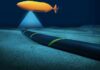
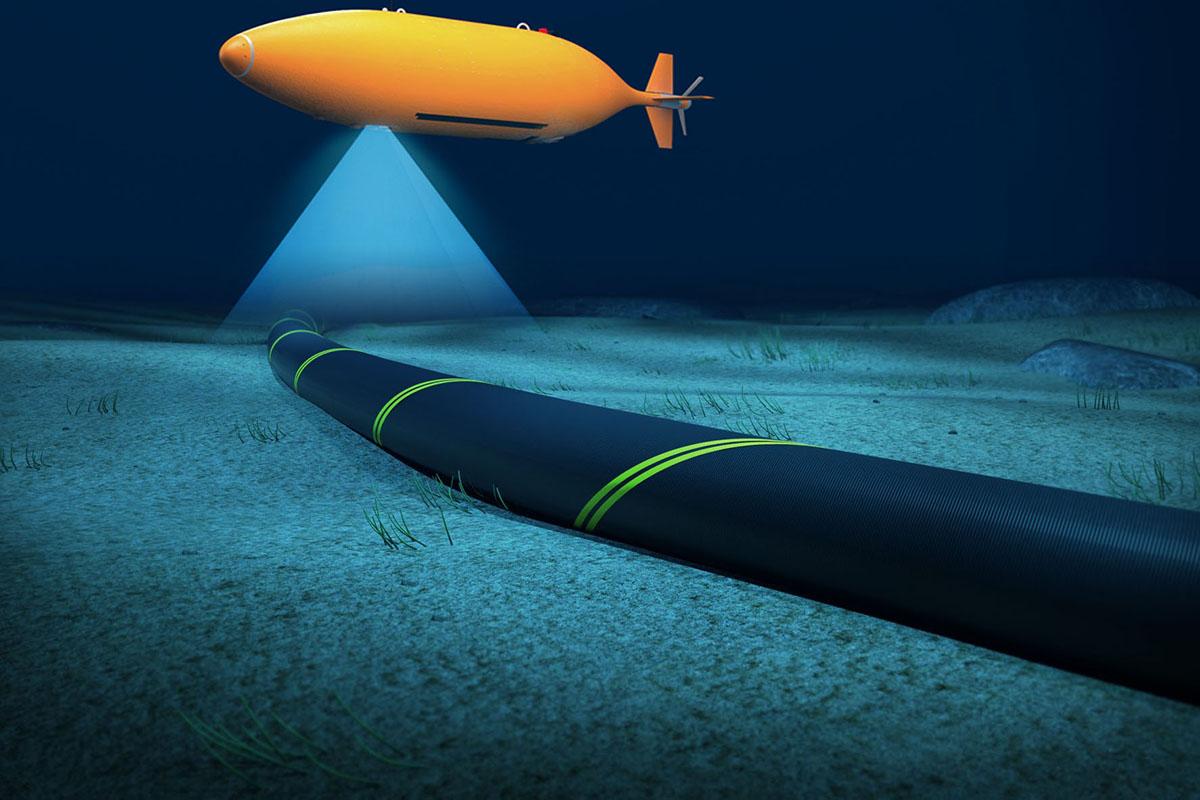
One important area is subsea infrastructure inspection. Underwater vehicles equipped with sonar, cameras and other sensors can be used to survey pipelines, offshore installations, seabed structures and submarine telecommunications cables.
These inspections are particularly relevant where infrastructure extends across large distances or operates in locations that are difficult and expensive for divers and conventional inspection vessels to access.
Autonomous systems can also support hydrographic surveys, seabed mapping and environmental monitoring. Repeated surveys can help engineers identify changes in seabed conditions, monitor sediment movement and assess the condition of underwater structures.
In offshore energy, similar platforms could support inspections around offshore wind installations, subsea power cables and oil and gas infrastructure.
Marine scientists can also use autonomous vehicles to collect information on water conditions, marine habitats and oceanographic processes. Their ability to conduct repeated measurements over extended periods makes them useful for monitoring environments that would otherwise require frequent vessel deployments.
These applications demonstrate why underwater autonomy is increasingly relevant beyond the defence industry. The same fundamental technologies used for surveillance and reconnaissance can support civilian infrastructure management, scientific research and marine environmental monitoring.
Relevance to Kenya’s maritime infrastructure
For Kenya, developments in autonomous underwater technology are particularly relevant given the country’s position along the Indian Ocean and its growing dependence on maritime infrastructure.
The Port of Mombasa, coastal infrastructure, offshore resources and submarine telecommunications cables all form part of an important network supporting trade, energy and digital connectivity.
Kenya’s submarine cable connections are especially significant. The Communications Authority of Kenya’s 2026 draft market review identifies several international subsea cable systems landing in the country, illustrating the scale of infrastructure that depends on reliable underwater installations.
These cables carry international data traffic and connect Kenya to wider regional and global communications networks. Their protection, inspection and maintenance are therefore important engineering and economic considerations.
Autonomous underwater vehicles could eventually provide additional tools for inspecting cable routes, identifying seabed disturbances and collecting information around marine infrastructure. They could also support port surveys, dredging assessments, coastal mapping and environmental monitoring.
However, deploying such systems locally would require more than acquiring the vehicles. Kenya would need appropriate hydrographic data, trained marine robotics personnel, underwater communications infrastructure, maintenance facilities and suitable regulatory and operational frameworks.
There is also an opportunity for local universities and research institutions to participate in the development of supporting technologies, including underwater sensors, navigation systems, robotics software and data-processing platforms.
The next phase of marine engineering
The Naval Group and TII agreement reflects a wider shift towards autonomous systems capable of operating across the maritime environment with reduced dependence on human crews.
The engineering challenge extends well beyond building a vehicle that can travel underwater. Reliable autonomous operations require integrated propulsion, energy storage, navigation, sensing, communications, control systems and launch and recovery infrastructure.
As these technologies mature, their applications are likely to extend further into offshore infrastructure, subsea telecommunications, marine research and environmental monitoring.
For countries such as Kenya, the significance lies in recognising that the ocean is increasingly becoming an engineering environment in its own right, requiring sophisticated technologies to explore, monitor and maintain the infrastructure beneath its surface.
The development of autonomous underwater systems offers a glimpse of how that work may increasingly be undertaken.

-
Product on sale
 AWEBook Volume 2Original price was: KShs 3,500.00.KShs 3,000.00Current price is: KShs 3,000.00.