
Last Updated 2 hours ago by Kenya Engineer
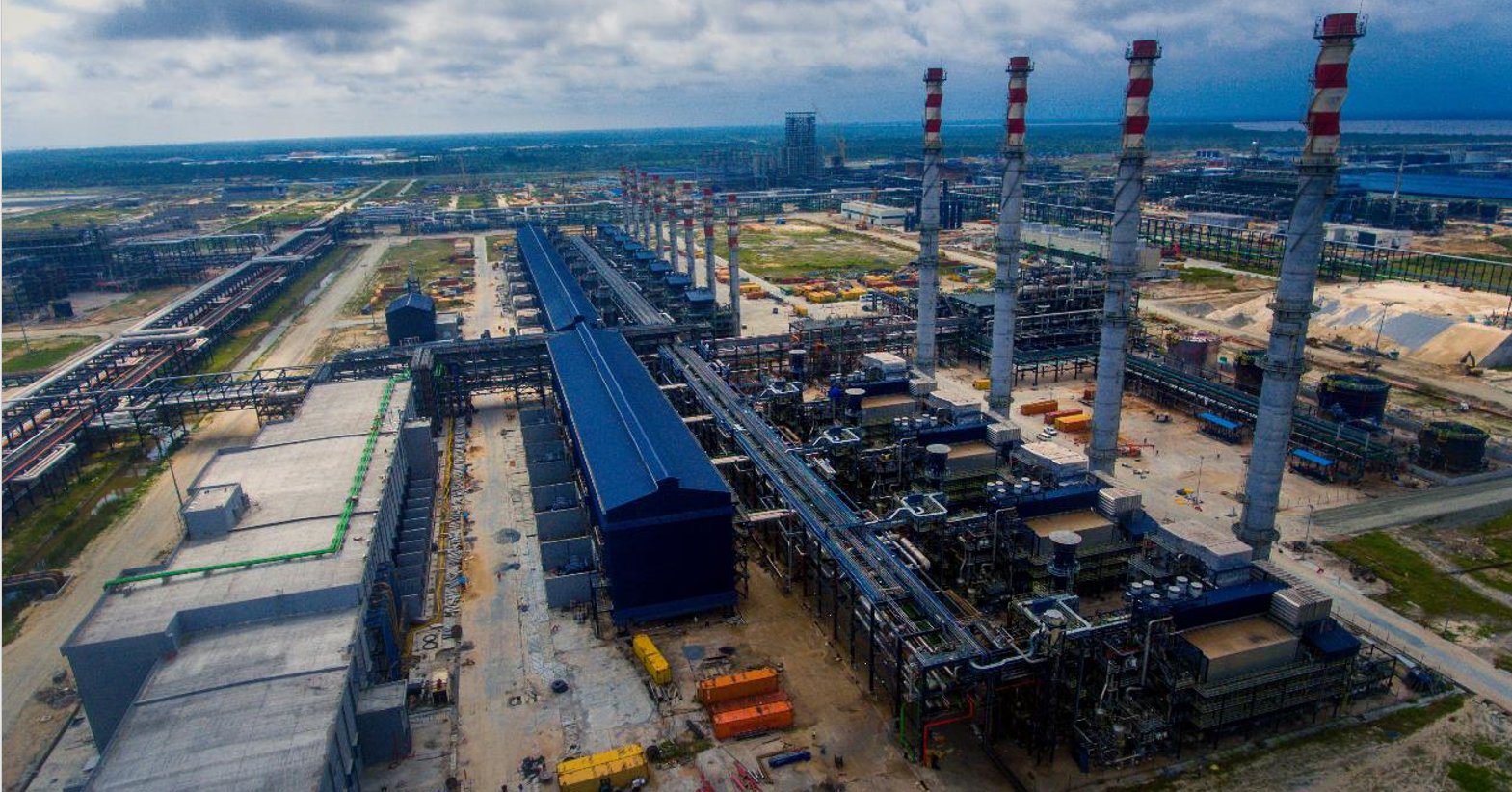
On the edge of Lagos, a refinery has been built on a scale rarely attempted anywhere in the world.
The Dangote Petroleum Refinery and Petrochemicals complex occupies approximately 2,635 hectares in the Lekki Free Zone and was built around a 650,000-barrel-per-day crude processing capacity. The facility is Africa’s largest refinery and the world’s largest single-train refinery. After beginning commercial operations in 2024, it has continued to increase throughput, with the operator reporting performance tests at 700,000 barrels per day in 2026.
The refinery is often discussed in terms of its size and its potential impact on Nigeria’s fuel imports. The more revealing story, however, is the engineering required to build an integrated industrial complex of this scale on reclaimed coastal land and make it operate as a largely self-contained energy and processing system.
Engineering a refinery on reclaimed ground
The first problem was not crude oil. It was the site.
The refinery was built on coastal, swampy terrain at Lekki, requiring enormous quantities of sand filling and ground improvement before heavy industrial structures could be established.
The project developer says about 65 million cubic metres of sand were used to raise the site by approximately 1.5 metres, at a reported cost of about US$300 million. That operation transformed weak coastal ground into a platform capable of supporting the refinery’s process units, storage tanks, pipelines, roads and other heavy infrastructure.
This early work is easy to overlook because it disappears beneath the finished plant. Yet it was fundamental to everything that followed.
A refinery contains equipment weighing thousands of tonnes, large storage vessels, pipe racks, rotating machinery and structures subject to vibration and thermal movement. The ground therefore had to provide predictable bearing conditions across an enormous site.
The scale of the land preparation also illustrates why Dangote cannot be regarded just as a refinery construction project. It was the creation of a new industrial platform.
One train, many processes
The refinery’s defining feature is its 650,000-barrel-per-day single-train configuration.
Rather than spreading processing across several smaller trains, the project concentrates a huge volume of crude processing capacity into an integrated configuration.
The processing system includes crude and vacuum distillation, residue fluid catalytic cracking, mild hydrocracking, alkylation, naphtha hydrotreating and continuous catalytic reforming. Honeywell UOP supplied technology, design services and critical equipment for several of the major process units, including residue fluid catalytic cracking and other conversion processes.
This arrangement allows the refinery to convert heavier fractions of crude into higher-value transportation fuels and petrochemical feedstocks. That conversion capability is important in a country that historically exported crude oil while importing much of its refined petroleum.
The refinery was designed not just to separate crude into products, but to maximise the value extracted from each barrel.
The refinery’s hidden power system
A refinery cannot depend on an unreliable external electricity supply.
Dangote built a 435 MW captive power plant as part of the complex. The refinery also has its own steam and power generation systems and extensive utilities required to maintain continuous process operations.
That self-contained approach extends to water. The complex includes raw-water intake and treatment facilities, reverse-osmosis systems, demineralisation and wastewater-treatment systems. These are not peripheral services. Refining depends on reliable water and steam systems for cooling, processing and equipment protection, while wastewater must be treated before discharge or reuse.
The result is effectively a small industrial city whose central purpose is converting crude oil into fuels and petrochemicals.
A pipeline network within a refinery
The scale of the pipework is another indication of the project’s complexity.
Dangote reports about 1,100 kilometres of pipeline infrastructure associated with the refinery, with the system designed to handle as much as 3 billion standard cubic feet of gas per day.
Inside a refinery, pipes are the arteries connecting the process units.
Crude moves between storage and distillation. Intermediate products are routed through treatment and conversion units. Hydrogen, steam, fuel gas and other utilities have to be distributed to the equipment that needs them. Finished products then move into storage and export systems.
At Dangote’s scale, the pipe network becomes an engineering project in its own right.
The challenge isn’t installing thousands of metres of pipe. Every line has to be correctly sized, supported, insulated where necessary, protected against corrosion and integrated with valves, instrumentation and safety systems.
From crude to petrochemicals
The project also incorporates petrochemical production, making it more than a conventional fuel refinery.
Its integrated configuration allows refinery streams to become feedstocks for petrochemical operations. This is significant because the economic value of the project depends increasingly on what can be produced beyond conventional petrol and diesel.
Dangote has now begun planning a second phase that would raise refining capacity to approximately 1.4 million barrels per day. Engineers India Limited has been appointed project management consultant and EPCM consultant for the expansion under a contract reportedly worth more than US$350 million.
The proposed expansion includes additional polypropylene production and a 750,000-tonne-per-year Oleflex unit to provide propylene feedstock.
The expansion illustrates another important engineering feature of the original project: the site was developed with room for industrial integration rather than being treated as a stand-alone refinery.
Financing an industrial gamble
The refinery’s final cost is generally reported at approximately US$19–20 billion, substantially above earlier estimates.
Reuters reported in 2024 that the project had cost about US$20 billion after years of construction and cost overruns. Financing came through a combination of commercial debt, domestic financial-sector support and equity, with the Nigerian National Petroleum Company also taking an equity position that was subsequently reduced from the originally proposed 20 per cent.
The financing history is important because the refinery was built largely as a private industrial investment rather than a conventional government infrastructure project.
That changed the risk profile.
Construction finance had to support a project with a very long development period, major imported equipment requirements and exposure to foreign-exchange movements. At the same time, the developer had to establish an industrial complex large enough to compete with established refineries elsewhere in the world.
The engineering challenge did not end at commissioning
A refinery this large does not suddenly become a mature operation when the first product leaves the plant. The plant must progressively increase throughput, resolve equipment problems, optimise process units and establish reliable crude supply.
That has been one of Dangote’s most important operational challenges.
The refinery has had to deal with crude availability and the economics of sourcing crude in an environment where Nigeria itself has struggled with production constraints. The ability to process different crude types is commercially significant because it provides a degree of flexibility when domestic supply is insufficient.
At the same time, the refinery has demonstrated the engineering margin built into its systems by reaching performance levels above the original 650,000-barrel-per-day nameplate capacity during testing.
A new industrial model for Africa
The most important engineering lesson from Dangote may ultimately be the integration of systems. The refinery combines land reclamation, process engineering, power generation, water treatment, pipelines, storage, marine logistics and petrochemicals on one enormous site.
Its construction required the coordination of international process-technology companies, engineering firms, equipment manufacturers, financial institutions and thousands of workers.
That complexity is precisely why the project matters beyond Nigeria’s fuel market.
Africa has no shortage of natural resources. Its industrial deficit has often been the inability to convert those resources into finished products at competitive scale. Dangote’s refinery represents an attempt to address that gap through infrastructure.
Whether its full economic promise is realised will depend on crude supply, operational reliability, market regulation and the performance of its expanding petrochemical operations. But as an engineering undertaking, Lekki has already demonstrated that a privately financed African industrial project can be conceived and delivered at a scale previously associated mainly with the world’s largest energy companies and state-backed developments.
-
Product on sale
 AWEBook Volume 2Original price was: KShs 3,500.00.KShs 3,000.00Current price is: KShs 3,000.00.