
Last Updated 1 hour ago by Kenya Engineer
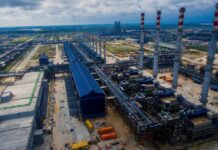
When Tanzania decided to develop the Rufiji River at Stiegler’s Gorge, it was not just building another power station. The Julius Nyerere Hydropower Project required the construction of a large reservoir, a major roller-compacted concrete dam, water diversion works, tunnels, a nine-unit power station, a 400 kV grid connection and a new network of access infrastructure in one of Tanzania’s most remote major project sites.
The result is a 2,115 MW hydropower plant, officially inaugurated on August 22, 2026. The Tanzanian government says the project cost approximately TSh7.452 trillion, equivalent to about US$3.35 billion. Construction began in June 2019 and the project was completed in March 2025 before its formal inauguration.
Its importance to Tanzania’s electricity system is already clear. The plant has become the country’s largest generating facility and accounts for more than half of installed national generation capacity. Tanesco has reported that JNHPP supplied about 43.5 per cent of electricity fed into the national grid during 2025 and roughly half during 2026.
Building across the Rufiji
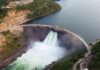
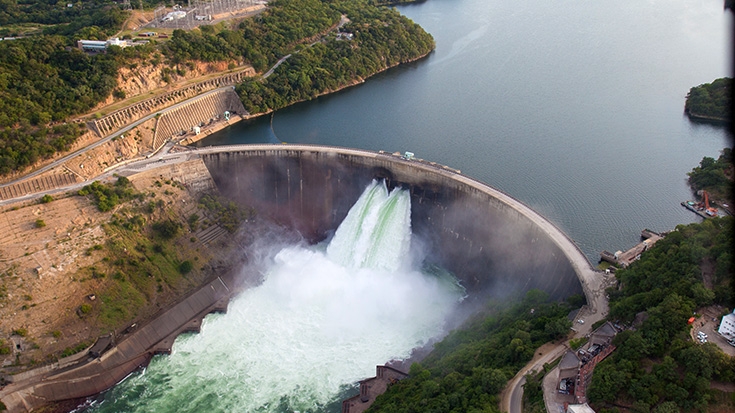
The main dam stretches approximately 1,025 metres along its crest and rises about 131 metres.
It is a roller-compacted concrete, or RCC, dam. Rather than placing conventional concrete in relatively thin individual pours, RCC construction uses concrete with a relatively dry consistency that can be placed and compacted in large horizontal layers.
The approach is particularly suited to large gravity dams because it allows high production rates while retaining the mass and strength required to resist the enormous hydraulic loads imposed by the reservoir.
At Julius Nyerere, the main dam forms only part of the water-retaining system. Four additional saddle dams help close the reservoir around the surrounding topography. Together, the structures are designed to retain approximately 34 billion cubic metres of water.
The scale of the civil works is substantial. The contractor reports about four million cubic metres of excavation, 7.5 million cubic metres of aggregate fill, approximately three million cubic metres of high-performance concrete and around 64,000 tonnes of reinforcement steel.
These quantities illustrate why logistics became a major part of the engineering challenge. Materials had to be excavated, processed, transported and placed continuously while the dam and associated structures were built.
Diverting the river before closing the dam
One of the most critical stages of any major river dam is creating a dry working area in which the main structure can be built. JNHPP used a diversion system that included a 660-metre diversion tunnel and temporary cofferdams.
The diversion tunnel temporarily carried the Rufiji around the construction area, allowing the main dam works to proceed in the river channel. Once the dam and associated structures were sufficiently advanced, the river could be redirected through the permanent hydraulic system and eventually into the reservoir.
The project also includes three tunnels carrying water from the reservoir toward the power station. These waterways are fundamental to the plant’s operation. The reservoir provides the hydraulic head, while the tunnels deliver the water to the turbines at sufficient flow and pressure to generate electricity.
Nine turbines at the powerhouse
Inside the powerhouse are nine vertical Francis turbine-generator units. Each turbine has a capacity of 235 MW, giving the station its total installed capacity of 2,115 MW.
The Francis turbine is particularly suited to large hydropower installations where substantial hydraulic head and flow must be converted into mechanical energy. Water entering the turbine is directed through the runner, causing it to rotate. The turbine shaft drives a generator, which converts the mechanical energy into electricity.
The scale of each unit explains one of the less visible infrastructure requirements of the project.
Large turbine components cannot simply be delivered by ordinary road transport. The project therefore required substantial access infrastructure, including a permanent concrete bridge across the Rufiji and a network of temporary and permanent roads.
The contractor’s scope included about 21 kilometres of permanent access roads and another 59 kilometres of temporary internal roads.
From the powerhouse to the national grid
Generating 2,115 MW is only half the job. The electricity must be moved from the remote power station into Tanzania’s transmission system.
JNHPP thus includes a 400 kV switchyard and transmission connection. The high-voltage system is essential because large amounts of power have to be transmitted over distance while limiting electrical losses.
The project consequently represents an important strengthening of Tanzania’s grid architecture rather than just an increase in generating capacity.
A large power plant can have limited value if the surrounding grid cannot absorb or transmit its output. The associated high-voltage infrastructure allows JNHPP to become a major source of bulk electricity for the national system.
A dam with several jobs
Electricity is the principal purpose of the project, but the reservoir has been designed to serve wider water-management objectives. The large storage volume provides the ability to regulate Rufiji River flows, reduce the impact of flooding and provide water availability through different seasons.
Tanzania also expects the project to support agriculture and fishing while contributing to water management and wildlife conservation in the surrounding area. That makes JNHPP a multipurpose water infrastructure project, although its economic justification rests heavily on electricity generation.
For a country seeking greater industrialisation, additional reliable generation is critical. Hydropower also provides electricity without the direct fuel costs associated with thermal generation, although its output remains dependent on water availability and reservoir management.
A difficult construction history
The project’s delivery was not as straightforward as the final 2,115 MW figure might suggest. The original EPC contract was valued at about TSh6.55 trillion, with the Egyptian joint venture of Arab Contractors and Elsewedy Electric responsible for implementation.
Tanzania’s Controller and Auditor General later identified 13 disputes during implementation. Eleven decisions were issued by the dispute adjudication board, with eight referrals decided in favour of the contractor.
The audit found that additional claims, including price adjustments and disputes connected with project and contract management, resulted in about US$400 million equivalent in additional payments and brought the revised project cost to approximately TSh7.44 trillion.
The Egyptian connection
JNHPP is also significant as an example of African engineering firms executing major infrastructure outside their home market. Arab Contractors and Elsewedy Electric formed the joint venture that delivered the project.
The contract was signed in December 2018 and was originally valued at approximately US$2.9 billion.
For Tanzania, the project has provided a major increase in domestic generation capacity. For Egypt’s construction industry, it has provided a high-profile demonstration of its ability to execute large-scale hydropower infrastructure elsewhere in Africa.
The project employed thousands of workers during construction, with the contractor reporting that most of the approximately 1,961 workers on the project were Tanzanian.
What the project changes
The most consequential feature of Julius Nyerere is the change in scale it introduces to Tanzania’s electricity system.
A single facility now contributes a very large share of national generation. That gives Tanzania additional electricity for households, commercial users and industry, while reducing the system’s dependence on smaller and more variable generating sources.
It also places greater importance on reservoir management, transmission reliability and the ability of the national grid to absorb the plant’s output.
JNHPP marks the point at which Tanzania moves from thinking about hydropower in terms of individual generating stations to managing a major water and electricity system around one of the country’s largest infrastructure assets.
The dam has been completed. The turbines are generating. The project has officially opened.
The next engineering challenge is operational: maintaining the dam, turbines, tunnels and transmission system over decades while managing the Rufiji’s water resource in a way that protects both the power output and the wider functions assigned to the reservoir.
That is ultimately how the success of Julius Nyerere will be measured.

-
Product on sale
 AWEBook Volume 2Original price was: KShs 3,500.00.KShs 3,000.00Current price is: KShs 3,000.00.