Last Updated 1 hour ago by Kenya Engineer
President William Ruto is scheduled to commission the Mwala Cluster Water Supply Project on 24 October 2026, marking a major milestone in efforts to improve water access in parts of Machakos County that have experienced persistent shortages.
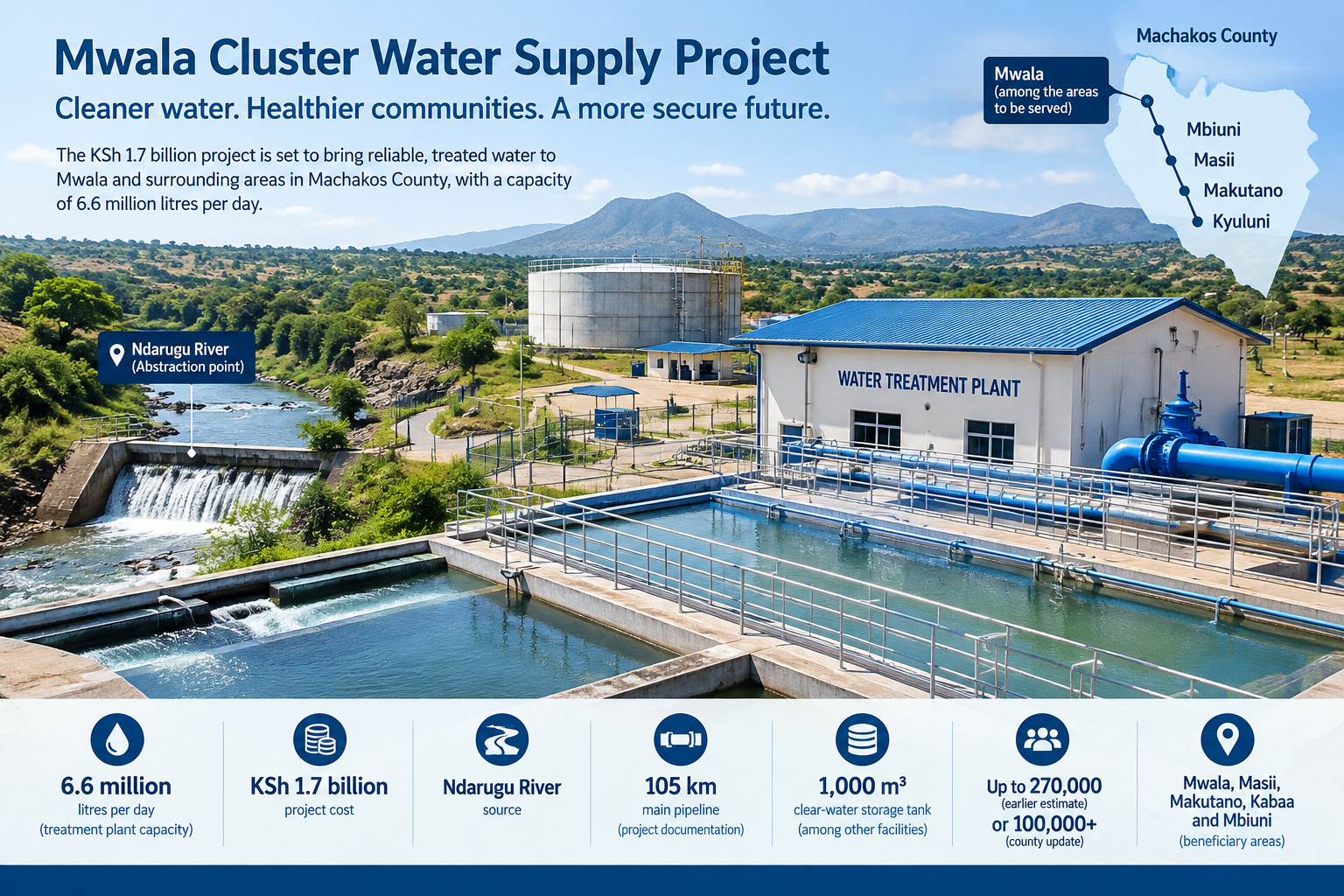
The KSh 1.7 billion project is designed to produce approximately 6.6 million litres of treated water a day, drawing from the Ndarugu River and conveying water through treatment, storage and distribution infrastructure serving Mwala, Masii, Makutano, Kabaa and Mbiuni. It is being implemented under the Kenya Towns Sustainable Water Supply and Sanitation Programme, with funding from the Government of Kenya and the African Development Bank (AfDB).
For the semi-arid communities of Lower Eastern, the significance of the scheme lies in its ability to move water from a river source through a managed supply system to settlements where dependable access has long been a challenge. Its eventual impact will depend on the performance of the complete system, including treatment, pumping, storage, distribution networks and connections to consumers.
From river abstraction to treated water
The scheme begins at the Ndarugu River in the Munyu area, where an intake weir diverts raw water into the supply system. Tanathi Water Works Development Agency’s published project brief specifies a 3.5-metre-high weir and approximately 4.48 kilometres of raw-water gravity mains.
The intake and conveyance works form the first stage of a system designed to transform a river source into a reliable supply of treated water. The raw-water pipeline connects the abstraction infrastructure to the treatment process, where water must be brought to the required quality before it can enter the distribution network.
The treatment plant is designed for a capacity of 6,600 cubic metres per day, equivalent to 6.6 million litres. At continuous operation, this represents a nominal output of 275 cubic metres per hour, or approximately 76.4 litres per second.
These figures describe the plant’s rated capacity rather than a guarantee of the volume that will reach consumers every day. Actual delivery will depend on raw-water availability, treatment performance, plant operating hours, maintenance, pumping requirements, storage levels and losses across the network.
The treatment process is central to the system’s public-health function. Raw water must undergo the appropriate treatment and disinfection processes, with operational monitoring to ensure that the water supplied meets applicable drinking-water quality requirements. Reliable service will require consistent monitoring from the treatment works through to the points of delivery.
Long-distance transmission and storage
The project incorporates a substantial pipeline network intended to carry treated water to settlements across the supply area. Machakos County’s project description identifies a 105-kilometre main pipeline traversing Kayatta, Mbiuni, Mwala, Masii, Makutano and Kyuluni. It also identifies treatment facilities at Kyeleni, a booster station at Syathani and storage infrastructure at Muthei.
The length of the transmission system is significant because delivering water over long distances and across changes in elevation requires careful hydraulic design. Pipeline diameter, friction losses, elevation differences, operating pressure and demand at different supply points all influence how much water can be delivered and how reliably the network operates.
Where gravity alone cannot provide the required pressure, pumping facilities help maintain flow through the system. The Syathani booster station is therefore an important component of the infrastructure described by the county government.
Storage tanks provide another layer of operational control. They allow water to accumulate when production exceeds immediate demand and help meet peak consumption periods. Storage can also provide a buffer during short interruptions to treatment or pumping, although the duration of that protection depends on tank capacity and actual demand.
Tanathi’s published project brief specifies a 1,000-cubic-metre clear-water storage tank, alongside additional storage facilities. At the plant’s full rated output of 6,600 cubic metres per day, 1,000 cubic metres is equivalent to about 3.6 hours of production. This is a simple comparison of nominal volumes, not an estimate of the storage system’s actual operating reserve, since the tank is only one component of the wider network.
A system designed around water security
The scheme is intended to improve water access for households, businesses and institutions across the project area. Earlier Tanathi project documentation estimated a potential beneficiary population of approximately 270,000 people, while a Machakos County update described the project as serving more than 100,000 residents. The different figures should be read in the context of the respective project descriptions and beneficiary estimates rather than treated as identical measures of the population already receiving water.
For communities that depend on distant water sources, seasonal supplies or water of uncertain quality, a piped system can reduce the time and effort required to obtain water while improving the prospects for more reliable domestic supply. Schools, health facilities, shops and other institutions may also benefit where the network provides adequate coverage and connections.
Improved access can support economic activity, but the effect will depend on the reliability and affordability of the service. Water availability alone does not guarantee agricultural expansion or commercial growth; these outcomes also depend on distribution arrangements, tariffs, household connections and the availability of water for different uses.
The system’s long-term performance will also depend on the sustainability of its source. River abstraction must be managed alongside seasonal changes in river flow, competing water uses and environmental requirements. The capacity of the treatment plant should not be confused with the volume of water that the river can sustainably supply throughout the year.
Project delivery and the test of operation
The Mwala project has taken longer to deliver than originally anticipated. Tanathi’s published project brief recorded delays associated with the non-performance of a previous contractor, whose contract was terminated before the remaining works were re-advertised. The same brief, dated November 2024, reported completion at 33 per cent and anticipated completion by December 2025. Subsequent government updates in 2026 reported that construction had advanced substantially ahead of the planned commissioning.
The commissioning marks an important milestone, but the ultimate measure of the project’s success will be the water delivered to consumers and the continuity of that service. Completion of major infrastructure must be followed by effective operational management, routine maintenance, water-quality testing, monitoring of pressure and leakage, and a sustainable system for collecting revenue to fund operations.
The responsible water-service provider will need to manage customer connections, repair faults promptly, monitor non-revenue water and maintain the treatment and pumping facilities. These functions determine whether the infrastructure can continue delivering its designed service over its operating life.
The project also illustrates the relationship between capital investment and service delivery. The initial expenditure creates the physical capacity to abstract, treat, store and convey water, but sustained benefits depend on competent operation and maintenance after construction.
For Lower Eastern, the Mwala Cluster Water Supply Project represents a substantial addition to regional water infrastructure. Its rated production capacity provides a basis for improving access across the designated service area. The next measure of progress will be whether that capacity translates into a dependable supply for the households and institutions the project was designed to serve.

-
Product on sale
 AWEBook Volume 2Original price was: KShs 3,500.00.KShs 3,000.00Current price is: KShs 3,000.00.