Last Updated 2 hours ago by Kenya Engineer
On 24 October 2026, President William Ruto commissioned Phase Two of the Mwala Cluster Last Mile Water Supply Project in Mbiuni, Machakos County. Kenya Broadcasting Corporation reported that the phase is intended to serve approximately 120,000 residents across eleven communities. That is an announced service target, not a count of connected households or a measure of water delivered.
The distinction matters because a water scheme is a connected set of assets. A functioning intake and treatment plant cannot by themselves establish that consumers at the far end of the network receive a reliable supply. The condition of transmission and local pipes, available pressure, storage, operating arrangements and individual connections all matter.
The wider system behind the last mile
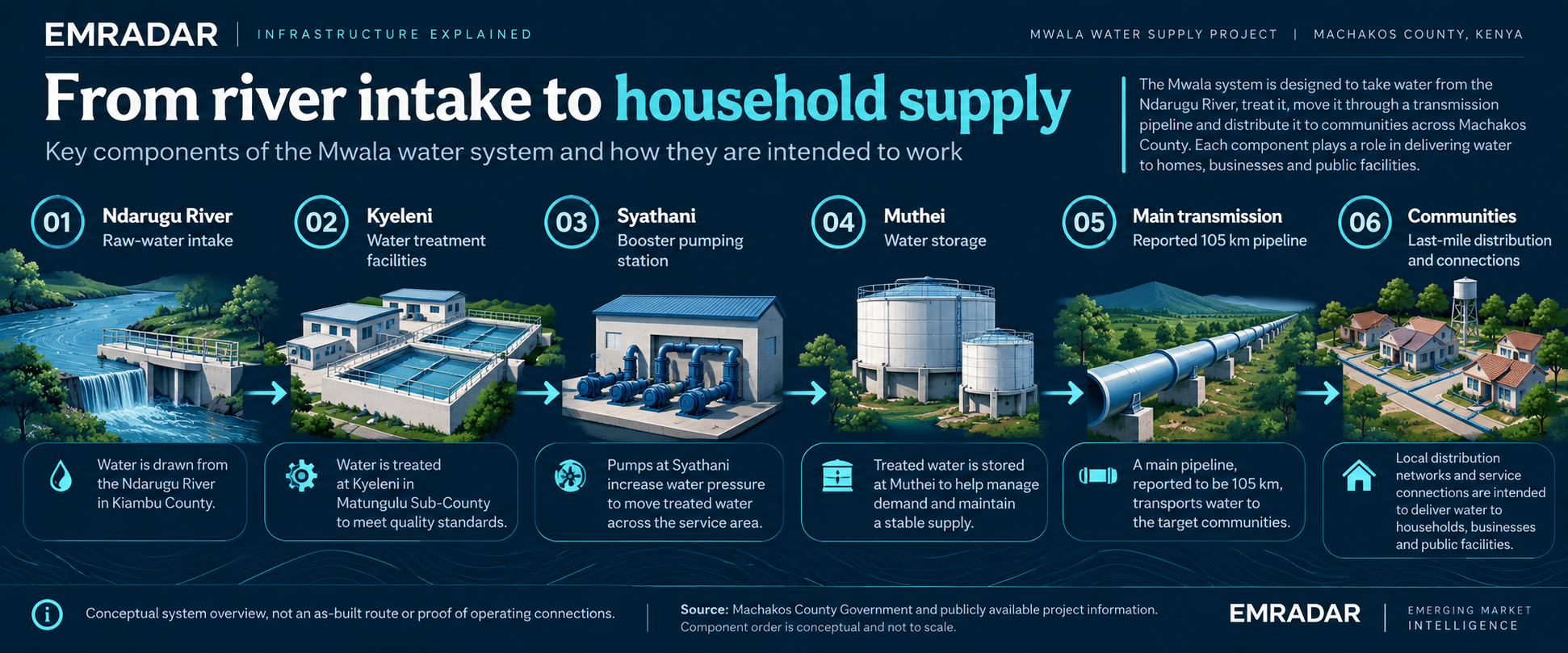
Machakos County describes the wider Mwala Cluster scheme as including an intake on the Ndarugu River, treatment facilities at Kyeleni, a booster station at Syathani, storage tanks at Muthei and a reported 105-kilometre main pipeline. These components should not be presented as works all newly constructed under the October Phase Two commissioning.
The published technical specifications describe a conventional treatment system with a projected capacity of approximately 6,600 cubic metres per day, alongside gravity conveyance, storage, booster pumping and pumping mains. This is a design specification, not a verified figure for actual daily output after commissioning.
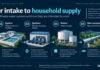
Published documents also describe differing pipeline lengths and project scopes. Without a reconciled as-built schedule, it would be misleading to add them together or state that any one figure represents the full completed network. The accompanying graphic is therefore a conceptual explanation of the wider system, not a surveyed route.
Where the last-mile test begins
KBC identifies the intended service areas as Mwala, Makutano, Masii, Kivandini, Wamunyu, Kathama, Oldonyo Sabuk, Mbiuni, Mbaani, Kilembwa and Kyawango. This establishes the published coverage target. It does not show which streets have distribution mains, how many service connections are active or whether households receive water every day.
A useful first post-commissioning account would distinguish three numbers: connections installed, connections actually receiving water, and the number of people expected to benefit. They are different measures and should not be substituted for one another.
Reliability is an operating question
For an engineer or utility operator, reliability is best tested through records rather than commissioning photographs. Treatment-plant production logs would show volumes produced; bulk and local meters would show volumes entering distribution zones; pressure and interruption logs would reveal how consistently supply reaches different areas. Water-quality tests would establish whether delivered water meets the relevant standards.
Pump availability, electricity supply, maintenance arrangements and leakage control can affect performance. These are factors to investigate, not documented failures of the Mwala scheme. The public material reviewed for this article does not establish post-commissioning operating performance for Phase Two.
What evidence would show that the project is working?
A useful public performance report would record, by service area, active connections, average hours of supply, delivered water volumes, interruptions, water-quality compliance and repair times. It would also identify the responsible operator and how maintenance is funded. Over time, this would allow residents and engineers to compare intended coverage with observed service.
The social benefits should be assessed with the same care. A more dependable supply could reduce time spent collecting water and support schools, health facilities and local businesses. Those are plausible outcomes, but evidence of actual changes in household access, affordability and service quality is needed before describing them as achieved.
The milestone after commissioning
The Mbiuni ceremony establishes a formal project milestone. The county’s infrastructure descriptions explain the intended technical pathway from water source to communities. Neither, on its own, proves sustained service at individual connections.
For Mwala, the next meaningful milestone will be a transparent account of how much treated water reaches the eleven intended communities, how many consumers are connected and how reliably the system performs. That is the difference between infrastructure commissioned and water service demonstrated.

-
Product on sale
 AWEBook Volume 2Original price was: KShs 3,500.00.KShs 3,000.00Current price is: KShs 3,000.00.