Last Updated 48 mins ago by Kenya Engineer
Vertiv and NVIDIA have introduced an approach to designing and deploying AI data centres that could reduce infrastructure delivery time and increase computing output during the first year of operation.
Announced at NVIDIA GTC Berlin on 26 October 2026, the approach combines pre-engineered reference designs, virtual simulation and validation, and factory-built infrastructure to shorten the time required to move from project planning to operational capacity. Polar Data Centers is applying the deployment model to the first 41 MW phase of its AI data centre project at Herøya, Norway.
The development addresses a growing challenge in AI infrastructure. As demand for computing capacity increases, developers must coordinate power supply, cooling, networking and facility systems to support increasingly dense computing equipment. Designing and integrating these systems through separate processes can introduce delays, particularly where complex infrastructure must be assembled and tested on site.
Vertiv and NVIDIA’s approach seeks to address these challenges by treating the AI facility as an integrated system from the design stage through to physical deployment.
Virtual validation to shorten design time
The design process combines the NVIDIA Vera Rubin DSX AI Factory reference design and NVIDIA Omniverse DSX Blueprint with Vertiv’s digital representations of power and cooling equipment, integrated through Dassault Systèmes’ 3DEXPERIENCE platform.
Engineers can use the shared virtual environment to configure infrastructure around specific computing, power, cooling and facility requirements, then test the proposed arrangement before construction and installation begin. This allows potential integration issues and equipment conflicts to be identified earlier, reducing the need to develop and validate each system independently.
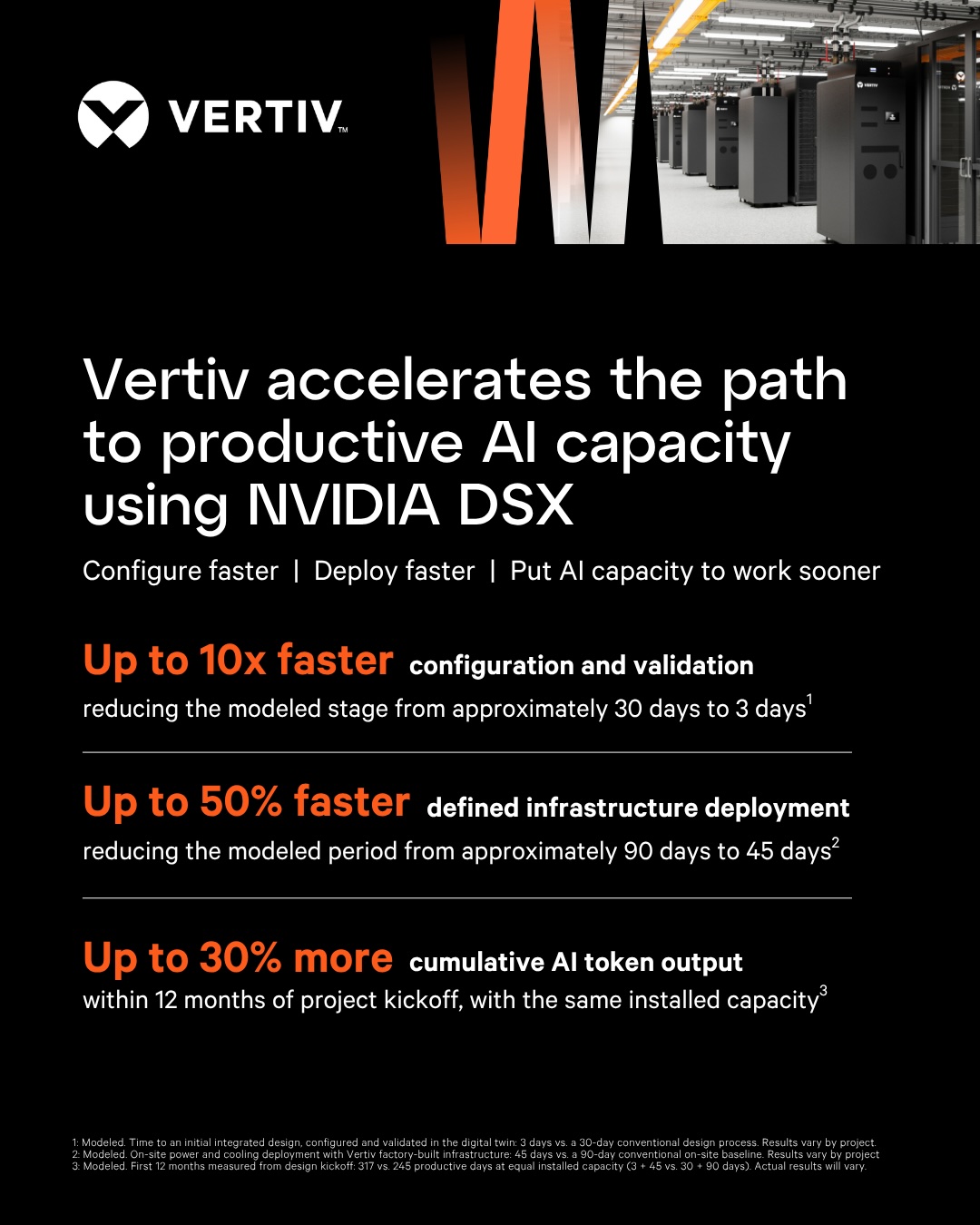
According to Vertiv, the modelled scenario reduces the time needed to configure and validate an AI factory design from approximately 30 days to three days, representing a tenfold improvement.
Vertiv is also making digital representations of its power and cooling equipment available through the SimReady Central Library on Hugging Face. These assets can be reused in digital-twin environments, helping engineering teams incorporate equipment into simulations and assess infrastructure options during the design process.
Factory-built infrastructure to accelerate deployment
Once the design has been validated, the approach shifts more assembly, integration and testing from the construction site to the factory.
The deployment model incorporates Vertiv OneCore, a hybrid-built data centre solution integrating critical power, thermal management and supporting infrastructure, alongside Vertiv SmartRun, a prefabricated overhead system for power distribution, liquid cooling, networking and containment.
By completing more work before equipment reaches the site, the approach is intended to reduce on-site assembly requirements, simplify integration and make deployment more predictable.
Vertiv estimates that, in its modelled scenario, this could reduce the infrastructure deployment period from approximately 90 days to 45 days.
Combined with the faster design and validation process, the two stages would take approximately 48 days instead of 120. The company estimates that this could bring productive AI capacity online about ten weeks earlier.
Vertiv further projects that the earlier start could deliver up to 30 per cent more cumulative AI token output during the first 12 months after project kickoff, compared with a conventional timeline using the same installed capacity. This is a modelled outcome based on defined assumptions, rather than a guaranteed performance improvement for every project.
Norway project demonstrates the deployment model
Polar Data Centers is applying Vertiv’s factory-built infrastructure approach to the first 41 MW phase of its planned AI data centre at Herøya, Norway. The wider development is designed to scale to 100 MW.
Vertiv is supplying prefabricated power and thermal management modules, SmartRun overhead infrastructure and SmartMod modular infrastructure, supported by its Unify software.
The deployment model is intended to simplify the integration of power, cooling and computing-space infrastructure for high-density workloads, including systems that use liquid cooling. Moving more assembly and testing into controlled factory conditions could also help reduce the amount of work required at the site before the facility becomes operational.
For Polar, the project provides an opportunity to apply a more repeatable approach to delivering capacity while retaining flexibility to meet customer requirements.
Integrated engineering for AI infrastructure
The collaboration reflects a broader shift towards designing AI data centres around the interaction of computing equipment and the infrastructure that supports it, rather than treating power, cooling and facility systems as separate engineering packages.
NVIDIA’s Vera Rubin DSX reference design provides a framework for aligning computing, power and cooling requirements, while Omniverse enables teams to simulate infrastructure systems in a virtual environment before deployment. Vertiv contributes power and thermal management systems, while Dassault Systèmes provides the 3DEXPERIENCE platform for integrated engineering.
The companies plan to demonstrate the approach at NVIDIA GTC Berlin, including virtual validation of power and cooling requirements and the transition from digital design to factory-built infrastructure.
As AI computing facilities grow in scale and power density, the ability to coordinate these systems early in the project could become an important factor in managing construction complexity and bringing additional computing capacity into service. The Herøya project will provide a practical example of how the model can be applied to a large-scale development.

-
Product on sale
 AWEBook Volume 2Original price was: KShs 3,500.00.KShs 3,000.00Current price is: KShs 3,000.00.