Last Updated 2 hours ago by Kenya Engineer
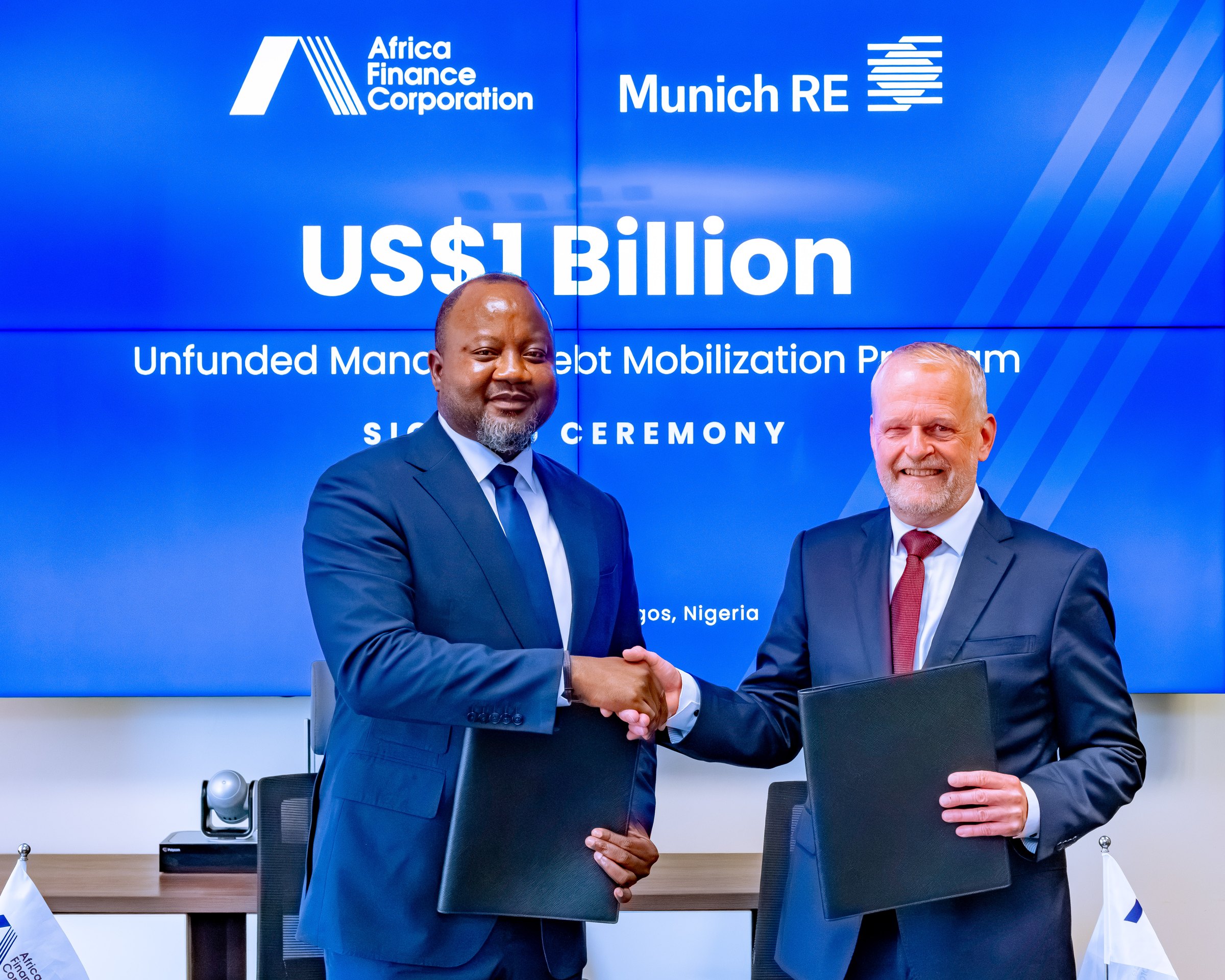
Africa Finance Corporation (AFC) and global reinsurer Munich Re have signed a US$1 billion Unfunded Managed Debt Mobilisation Programme aimed at expanding trade finance available to African banks and supporting cross-border commerce.
Announced in Lagos, Nigeria, on 27 October 2026, the programme provides committed risk-sharing support for AFC’s trade finance lending to African financial institutions. It is intended to help banks access additional financing capacity for transactions supporting imports, exports and trade between African economies.
The first phase covers 38 financial institutions across 11 African countries. Eligible transactions include commercial letters of credit, trade loans and trade guarantees, which enable banks to finance purchases of goods, facilitate payments and manage risks associated with domestic and international trade.
Pre-agreed risk-sharing to accelerate financing
Under the arrangement, AFC and Munich Re have established risk parameters and limits in advance. Eligible transactions can consequently receive risk-sharing cover automatically within the agreed framework, reducing the need to negotiate insurance or risk participation separately for each transaction.
AFC will retain part of the risk on every covered transaction, maintaining a shared financial interest in the performance of the underlying lending.
The programme is structured around trade finance transactions of up to 12 months. As transactions mature and associated exposure is released, the available capacity can be reused to support new financing. This revolving approach is intended to extend the reach of the initial risk-sharing commitment over successive transactions.
The partners will also review the programme’s scope over time, including the potential addition of other financial instruments and sectors.
Mobilising institutional capital
The agreement builds on a relationship dating back to 2018, when Munich Re began sharing risks on AFC loans on a transaction-by-transaction basis. The new programme moves the partnership towards a standing arrangement with pre-agreed terms, allowing eligible transactions to be covered within an established framework.
Banji Fehintola, Executive Board Member and Head of Financial Services at AFC, said the programme reflected a broader shift in development finance towards models that mobilise private capital alongside the lending capacity of development finance institutions.
He noted that managed debt mobilisation enables AFC to use its origination capabilities, structuring expertise and risk management systems to attract additional institutional capital while deploying its own balance sheet more efficiently.
The arrangement is also intended to support trade between African economies as implementation of the African Continental Free Trade Area deepens regional commercial links. Access to trade finance remains an important requirement for businesses seeking to participate in cross-border supply chains, particularly where banks face limits on the risks they can assume.
Wola Asase, Deputy Director and Head of Syndications at AFC Captive Insurance Company Ltd, said the programme would replace the previous deal-by-deal approach with pre-agreed parameters, allowing eligible transactions to benefit from a more streamlined process. She added that the wider platform could accommodate additional institutional investors as funders or risk-sharing partners.
Herbert Müller, Head of Global Credit Solutions at Munich Re, said the arrangement builds on the trust established between the two organisations through their cooperation since 2018. He described the programme as a way to expand support for African financial institutions while diversifying Munich Re’s business.
Insurance as a tool for financing development
The programme illustrates how insurance and reinsurance can support lending by transferring part of the potential losses associated with financial transactions. By sharing risk with a reinsurer, a lender can manage its exposure and potentially extend financing to transactions that might otherwise exceed its risk appetite.
For African businesses, the potential benefits include improved access to financing for imports, exports and regional trade. The extent of the impact will depend on how effectively participating banks translate the additional capacity into lending for their customers.
The initiative also forms part of AFC’s broader Managed Debt Mobilisation Programme, which is designed to bring other investors into its financing activities through direct funding or risk participation. AFC said it was in discussions with African and international institutional investors about participating in the platform.
The agreement follows AFC’s establishment in August 2026 of AFC Captive Insurance Company, a wholly owned Bermuda-based subsidiary backed by up to US$30 million in equity capital. The captive enables AFC to retain and manage a greater share of risk internally, while the Munich Re arrangement provides an additional mechanism for transferring risk to an external reinsurer.
Together, the initiatives expand the range of tools AFC can use to manage its exposures and mobilise financing. The US$1 billion programme’s practical contribution will ultimately be measured by the volume of trade finance it supports, the number of transactions financed over time and the extent to which participating banks can use the released capacity to fund new trade.

-
Product on sale
 AWEBook Volume 2Original price was: KShs 3,500.00.KShs 3,000.00Current price is: KShs 3,000.00.