Last Updated 3 hours ago by Kenya Engineer
The 5th Future Leaders Summit in Mombasa challenged young engineers to embrace artificial intelligence, rethink traditional career paths and turn technical innovations into commercially viable solutions that can drive Kenya’s industrial development.
Kenya’s next generation of engineers is entering a profession undergoing profound change. Artificial intelligence, machine learning, digital design tools and intelligent infrastructure systems are altering how engineering work is conceived, delivered and managed. But adapting to new technologies is only part of the challenge. Engineers must also develop the capacity to translate technical knowledge into solutions that address economic and societal needs.
That was a central message emerging from the 5th Future Leaders Summit, held on 24 November 2026 at PrideInn Paradise Beach Resort in Mombasa, as part of the 33rd International Convention of the Institution of Engineers of Kenya (IEK).
Held under the theme Preparing the Next Generation of Engineers for a Digital and Intelligent Future, the summit brought together engineering leaders, young professionals, students and industry representatives to examine the changing demands of engineering practice and the competencies required by tomorrow’s professionals.
The discussions reflected a growing recognition that the future of engineering will be shaped by more than technical qualifications. Digital competence, entrepreneurship, leadership, adaptability and the ability to commercialise innovations are becoming increasingly important to the profession.
Artificial intelligence is changing the engineering profession
IEK President Eng. Harrison Keter urged young engineers to embrace artificial intelligence and machine learning, describing the technologies as increasingly important to the future of engineering.
He challenged emerging professionals to keep pace with technological developments and invest in continuous learning rather than depend entirely on the knowledge acquired during formal education.
Keter argued that the growing convergence of human and machine intelligence would shape tomorrow’s engineering workplaces. Rather than viewing artificial intelligence as a direct replacement for engineers, he encouraged professionals to understand how the technology could complement their capabilities.
The implications extend across virtually every engineering discipline. In civil and structural engineering, intelligent software is improving design workflows, modelling and structural analysis. In electrical engineering, machine learning is supporting demand forecasting, fault detection and predictive maintenance. Manufacturing engineers are increasingly working with automated production systems, robotics and real-time industrial monitoring.
For young engineers, the challenge is to understand these tools sufficiently to apply them responsibly and effectively. Technical judgement, professional accountability and an understanding of the physical systems being designed will remain essential even as software assumes a greater share of routine analytical work.
The ability to work alongside intelligent systems, interpret their outputs and recognise their limitations is likely to become an important professional competency.
Engineering education must prepare graduates for a different economy
A related concern was raised by the summit’s Chief Guest, Prof. Shaukat Abdulrazak, Principal Secretary for Science, Research and Innovation.
Abdulrazak called for changes in engineering education to ensure that graduates are better prepared for the realities of a technology-driven economy.
His contribution went beyond the need to introduce emerging technologies into university curricula. He challenged the traditional expectation that engineering education should primarily prepare graduates to seek employment, arguing that the country also needs engineers capable of establishing enterprises and creating employment opportunities.
Kenya has considerable technical and innovative talent, but the transition from research and invention to commercially successful products remains a challenge.
Promising ideas frequently struggle to reach the market because of limited financing, inadequate business skills, weak institutional support and insufficient collaboration between researchers and industry.
Abdulrazak argued that engineering training should incorporate entrepreneurship, financial management, project management and research and development alongside conventional technical competencies.
This is an important consideration for universities and professional institutions. Engineering graduates may leave university with the ability to design a system, develop a prototype or solve a technical problem, but bringing that solution to market requires a different set of skills.
Understanding customer requirements, assessing production costs, protecting intellectual property, securing investment, managing teams and navigating regulatory requirements are all part of the commercialisation process.
The PS cited Kenya’s more than 2,000 startups as evidence of the country’s growing innovation potential and called for stronger collaboration between IEK, the Kenya National Innovation Agency, the National Research Fund and the National Commission for Science, Technology and Innovation.
Such collaboration could help connect engineering research with industrial requirements, financing opportunities and pathways to commercial production.
From prototypes to commercially viable products
Perhaps the most significant challenge emerging from Abdulrazak’s address was the need to move beyond the production of prototypes.
Engineering innovation is frequently measured by the development of a new design, technology or working model. Yet a prototype, however technically impressive, does not automatically translate into an industrial solution.
For innovation to contribute meaningfully to economic development, it must progress through testing, refinement, manufacturing, market adoption and continued improvement.
Abdulrazak encouraged engineers to establish businesses around locally developed technologies rather than rely exclusively on formal employment.
He identified agriculture, manufacturing, healthcare, housing and information and communication technology as sectors offering opportunities for engineering entrepreneurship.
These sectors present practical opportunities for engineers to develop locally relevant technologies. Agricultural machinery and irrigation systems, for example, could improve productivity and support value addition. Locally manufactured medical equipment could contribute to healthcare delivery while reducing dependence on imported products. Engineering solutions in housing and construction could support more efficient use of materials and improve access to appropriate building technologies.
The underlying issue is the ability to connect technical innovation with identifiable market needs.
For Kenya, this has implications beyond individual entrepreneurs. A stronger engineering-led startup ecosystem could contribute to industrialisation, local manufacturing capacity, technology transfer and employment creation.
It would also give engineering graduates additional career pathways at a time when competition for conventional professional positions remains significant.
Digital skills and the changing requirements of engineering practice
The summit also examined the digital competencies that engineers will need as the profession adopts increasingly sophisticated technologies.
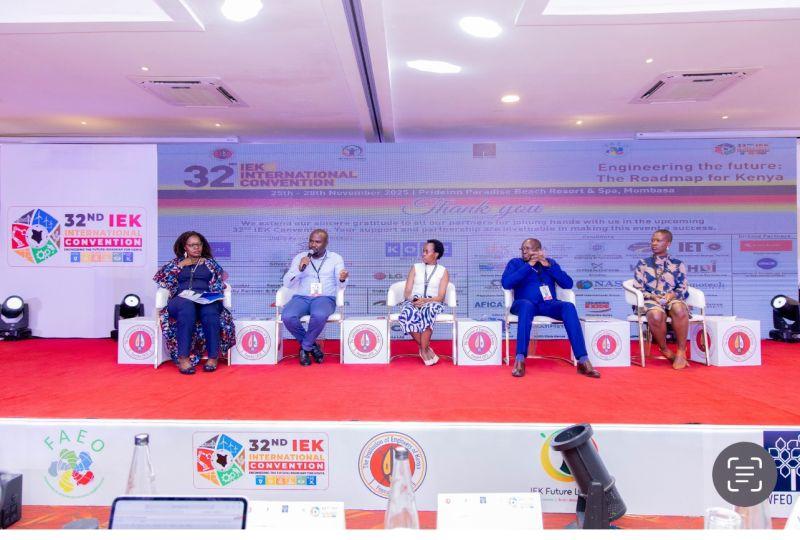
A panel discussion on digital skills and future competencies brought together professionals from different areas of engineering and project delivery.
Among the participants were Ruchika Gajjar, BIM Manager and Director of HI-CAD Africa Ltd; Clement Kitetu of the Institute of Applied Project Management; Ing. Sophia Abena Tijani, President-Elect of the Ghana Institution of Engineering; and Eng. John Karanja PE, MIEK.
The diversity of professional experience represented in the discussion reflected the increasingly interconnected nature of engineering practice.
Building Information Modelling (BIM), for instance, has expanded the use of digital representations of infrastructure and buildings beyond conventional design drawings. It allows project teams to coordinate information, identify potential clashes, manage changes and improve collaboration across different disciplines.
Similar developments are taking place in other sectors through digital twins, industrial automation, intelligent monitoring systems and data-driven asset management.
These technologies are changing the way engineers interact with projects throughout their lifecycles, from initial planning and design to construction, operation and maintenance.
For young professionals, acquiring digital skills will increasingly involve more than learning how to operate particular software packages. It will require an understanding of how digital information is generated, analysed, shared and applied in engineering decisions.
The growing use of data science and artificial intelligence also creates opportunities for engineers to work across traditional disciplinary boundaries.
Mentorship and professional development remain essential
Technology and entrepreneurship featured prominently in the summit’s discussions, but the development of future engineering leaders also depends on access to professional guidance and opportunities to learn from experienced practitioners.
IEK has continued to promote mentorship and professional development initiatives aimed at supporting students and graduate engineers as they transition into professional practice.
One such initiative is its Adopt a Student or Graduate Engineer programme, which seeks to connect aspiring engineers with sponsors and mentors who can support their professional development.
Keter also highlighted the importance of mentorship and encouraged young engineers to take initiative in developing solutions to societal challenges.
He pointed to the continent’s youthful population as an important resource for future economic and technological development, noting that Africa is projected to account for 42 per cent of the world’s youth population by 2030.
This presents an opportunity for the engineering profession to strengthen its contribution to innovation and development, provided that young people have access to the education, professional networks, technology and institutional support required to turn their ideas into practical solutions.
Mentorship is particularly important in a profession where academic knowledge must be complemented by experience in design, construction, operations, safety and professional responsibility.
Building an engineering profession ready for the future
The discussions at the 5th Future Leaders Summit point to a broader transition taking place within the engineering profession.
The engineer of the future will increasingly operate at the intersection of technical expertise, digital technology, business development and leadership. While the fundamentals of engineering will remain important, the ability to adapt to new tools, collaborate across disciplines and respond to changing economic demands will increasingly influence professional success.
For Kenya, the challenge is to ensure that this transition translates into tangible national benefits.
Universities must continue reviewing their training approaches. Professional institutions need to strengthen mentorship and continuing professional development. Industry must create opportunities for young engineers to participate in research, innovation and technology adoption. Government agencies and financing institutions must also improve the pathways through which promising engineering ideas can progress from laboratories and workshops into commercial production.
The emphasis on entrepreneurship is particularly important. A country that produces technically competent graduates but struggles to commercialise their innovations risks losing much of the economic value created through its investment in engineering education.
The message from Mombasa was that young engineers must prepare for a profession that is changing rapidly, but they must also be equipped to influence the direction of that change.
The future of engineering in Kenya will depend on more than how well its engineers adapt to intelligent technologies. It will also depend on how effectively they use those technologies to solve local problems, build competitive industries and create opportunities for others.
The next generation must be prepared to do both.

-
Product on sale
 AWEBook Volume 2Original price was: KShs 3,500.00.KShs 3,000.00Current price is: KShs 3,000.00.