Last Updated 6 hours ago by Kenya Engineer
The rapid expansion of artificial intelligence is creating new demands on the electrical infrastructure that supports data centres. Beyond the need for more computing capacity, operators are having to address lengthy grid connection processes, increasingly concentrated power loads, indoor space constraints and the challenge of maintaining stable electricity supply as computing demand fluctuates.
A new medium-voltage power system introduced by Vertiv is designed to address several of these challenges by moving critical power protection infrastructure closer to the utility connection point.
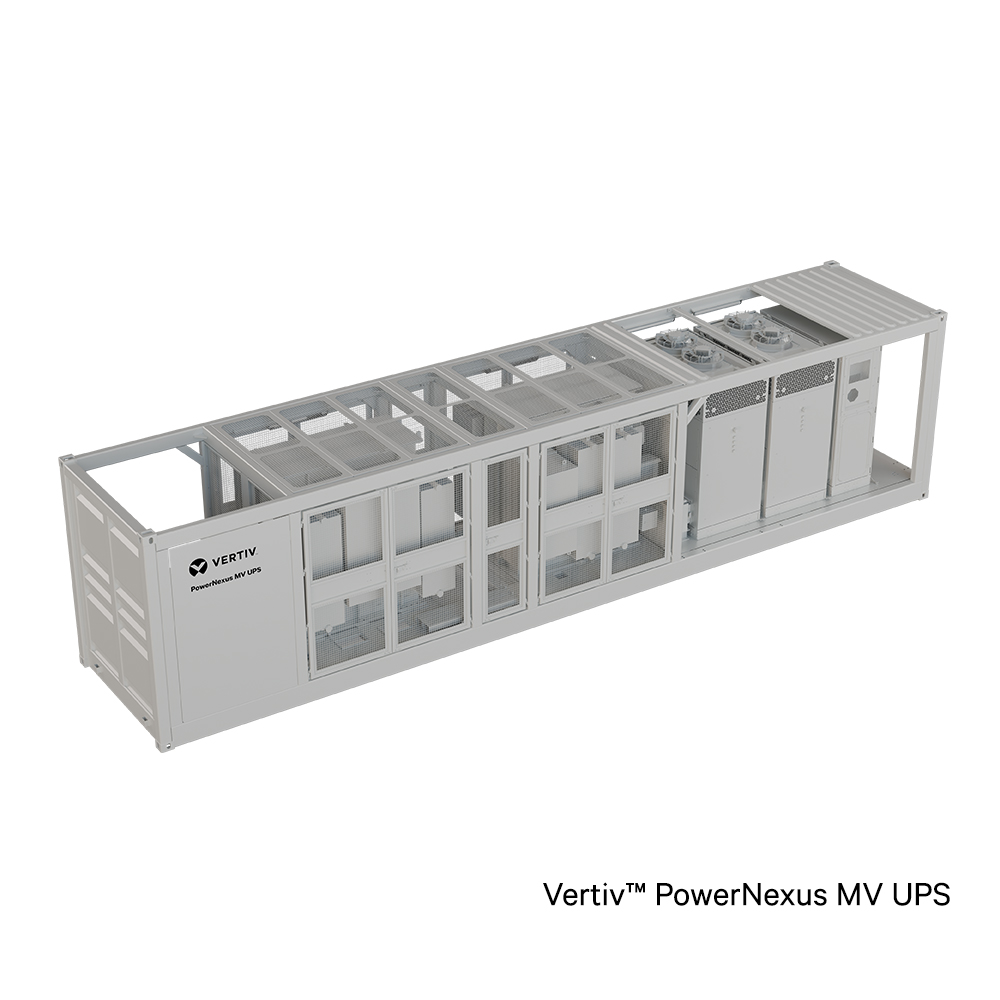
The company unveiled the Vertiv™ PowerNexus MV UPS on 20 November 2026, describing it as an outdoor-rated medium-voltage uninterruptible power supply (UPS) platform that combines power protection, fault ride-through capabilities and artificial intelligence (AI) power smoothing.
The system targets colocation, neocloud and hyperscale data centre operators seeking to improve power infrastructure deployment while preserving indoor space for computing equipment.
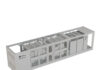
Unlike conventional data centre power arrangements, which typically accommodate much of the critical power infrastructure within dedicated indoor electrical rooms, the PowerNexus architecture places the equipment on an outdoor-rated skid. This arrangement is intended to free up valuable building space for servers and other computing equipment, an increasingly important consideration as operators seek to increase computing density.
Addressing the changing power demands of AI
AI workloads are changing the electrical characteristics of modern data centres. Training and running large AI models can involve rapid changes in computing demand, producing corresponding fluctuations in electricity consumption.
These variations can introduce power quality challenges, particularly when large groups of computing systems operate simultaneously. They also create additional demands on the electricity grid, which must accommodate increasingly large and dynamic loads.
The Vertiv PowerNexus MV UPS is designed to manage these fluctuations through a combination of medium-voltage power protection and AI power smoothing. The latter is intended to absorb rapid changes in data centre demand before they are transmitted to the wider electricity network.
Its fault ride-through capability is designed to maintain stable operation during certain grid disturbances, helping protect critical equipment against voltage fluctuations and upstream electrical faults.
The system is also designed to integrate with long-duration battery energy storage systems, providing backup power for critical loads during interruptions to the utility supply.
According to Vertiv, the platform can support battery-backed operation for up to four hours when integrated with suitable long-duration storage systems. This could reduce dependence on conventional diesel generators for certain backup applications, although the actual requirement would depend on the site’s storage capacity, load profile and backup architecture.
Medium-voltage protection and operating efficiency
One of the system’s principal engineering features is its ability to extend power protection towards the medium-voltage connection point.
The platform is designed to provide Class 1 output voltage quality in accordance with IEC 62040-3, the international standard governing the performance and testing of uninterruptible power systems.
Vertiv reports peak operating efficiency of up to 98.5% through its line-interactive topology. Higher conversion efficiency can reduce electrical losses within the power protection system, with potential benefits for operating costs and cooling requirements.
The outdoor skid architecture also offers an alternative approach to allocating space within data centre facilities. As AI infrastructure increases the power density of server installations, reducing the footprint of supporting electrical equipment can allow developers to accommodate additional computing capacity within an existing building envelope.
The system is designed around a single-vendor architecture integrating the UPS, batteries and other powertrain components. Vertiv says this approach can simplify coordination during system design and deployment.
For engineering teams, the availability of a Power Systems Computer Aided Design (PSCAD) model is another significant feature. The model allows customers to simulate system behaviour, evaluate power quality and examine interactions between the UPS and the wider electricity network before installation.
This type of modelling is particularly relevant for large installations where the interaction between power electronics, energy storage, computing loads and the utility network can influence overall system performance.
Customer testing examines performance under demanding conditions
Vertiv conducted proof-of-concept demonstrations with QTS, SoftBank and Rosendin at its Global Power Research and Customer Experience Centre in Bologna, Italy.
Testing covered both steady-state and dynamic operating conditions. According to the company, the system maintained stable performance across loads ranging from zero to 100%, while achieving Class 1 voltage accuracy during rapid load changes.
The demonstrations also included tests involving significant voltage disturbances, including a complete voltage sag lasting 150 milliseconds and a 25% overvoltage condition lasting five seconds.
These tests were intended to assess the system’s ability to maintain power quality and protect critical loads under conditions that could otherwise affect sensitive data centre equipment.
Ryan Kuithe, senior vice president of facilities operations at QTS, said the demonstrations validated the system’s ability to maintain stable power during dynamic load changes and voltage disturbances.
While the results provide an indication of the platform’s performance under the tested conditions, its suitability for individual projects will depend on the electrical characteristics of the installation, utility requirements and integration with other power infrastructure.
New laboratory to support medium-voltage power research
The product launch is accompanied by plans to expand Vertiv’s research and testing capabilities through a dedicated Medium Voltage Laboratory at its Global Large Power Research and Customer Experience Centre in Bologna.
Scheduled to become operational in 2027, the facility will support research and development, full-voltage validation, customer demonstrations, technical training and system-level testing of medium-voltage power architectures.
Its planned areas of work include medium-voltage UPS systems, medium-voltage to 800 VDC power architectures and battery energy storage technologies.
The inclusion of 800 VDC is particularly relevant to the future of AI infrastructure. As processors and computing systems become more power-intensive, data centre operators and equipment manufacturers are examining higher-voltage direct-current distribution architectures as a way of improving power delivery efficiency and managing the electrical demands of increasingly dense computing installations.
The facility is expected to provide customers with an opportunity to evaluate emerging power architectures under controlled conditions before deploying them in operational environments.
Implications for the future of data centre infrastructure
The development reflects a wider shift in how electrical infrastructure for large data centres is being designed.
As AI computing expands, the challenge is no longer confined to installing sufficient generating capacity or securing a connection to the electricity grid. Developers must also consider how large and rapidly changing loads interact with the network, how power quality is maintained and how electrical infrastructure can be accommodated without reducing the space available for computing equipment.
Medium-voltage power systems, battery storage and advanced power management technologies are becoming increasingly important elements of this infrastructure.
For emerging data centre markets such as Kenya, these developments offer useful insight into the engineering considerations that will accompany future investment in large-scale digital infrastructure. Reliable electricity supply, adequate grid capacity, efficient power distribution and the integration of energy storage will all influence the long-term performance and economics of data centre projects.
The Vertiv PowerNexus MV UPS is expected to begin shipping in mid-2027. Its commercial deployment will provide a further indication of how medium-voltage power architectures can contribute to meeting the growing electricity demands of AI infrastructure.

-
Product on sale
 AWEBook Volume 2Original price was: KShs 3,500.00.KShs 3,000.00Current price is: KShs 3,000.00.