

Last Updated 2 hours ago by Kenya Engineer
Women’s participation in the global workforce has grown steadily over the past few decades, largely because of greater access to education. Yet, despite this progress, women remain significantly underrepresented in senior leadership positions across many industries, including the built environment.
South Africa has one of the world’s most progressive constitutions, with strong protections for gender equality. Government has introduced several legislative and policy initiatives aimed at advancing women. While these measures have created opportunities, they have not fully translated into equal representation in executive and decision-making roles. Gender bias, limited access to mentorship and sponsorship, and structural barriers continue to slow the advancement of women into leadership.
This is not a South African challenge alone. Across Africa, the details differ from one country and sector to another, but the pattern is familiar: women enter professions in growing numbers, then become less visible as authority, budgets, project responsibility and institutional influence increase. McKinsey’s 2025 study of 324 organisations employing about 1.4 million people across India, Nigeria and Kenya illustrates the point. In Kenya’s private sector, women’s representation narrows sharply towards senior leadership, leaving women with only 28% of C-suite positions. Nigeria shows a different pattern – women’s representation remains close to 30% from management upwards – but a smaller pool of women at entry level limits the leadership pipeline from the outset.
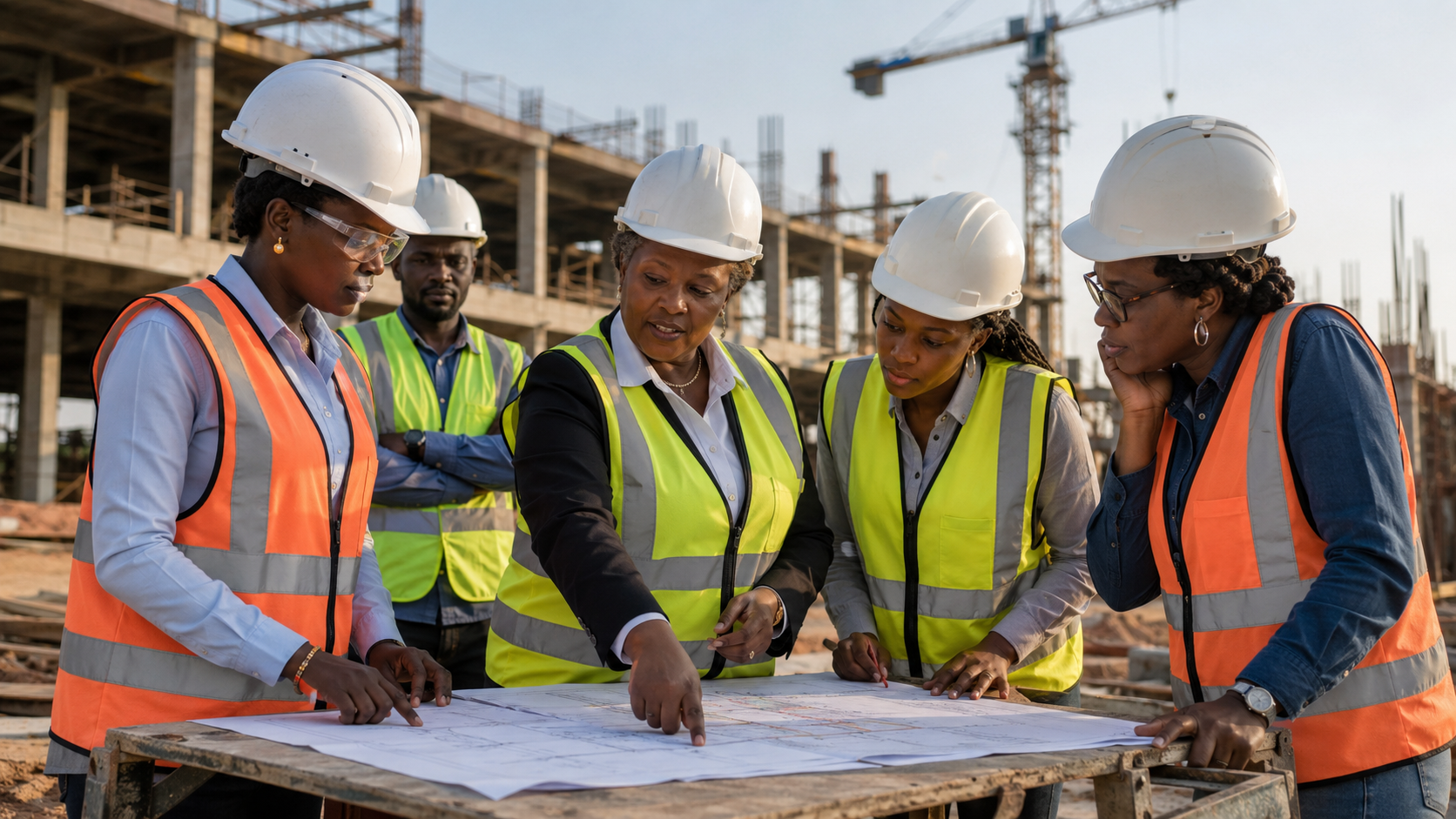
The construction and wider built-environment sector illustrates this challenge clearly. Although more women are entering the professions as engineers, architects, quantity surveyors, project managers and construction managers, relatively few occupy executive or other high-influence positions. This represents not only a loss of talent but also a missed opportunity to strengthen innovation, governance, organisational performance and the quality of infrastructure delivered to African communities.
The wider leadership gap remains stubborn. According to the 2025 McKinsey Women in the Workplace report, women hold only 29% of C-suite roles in the corporate pipeline it studied in the United States and Canada. It was the eleventh consecutive year in which women remained underrepresented at every level, with the sharpest gap in senior leadership. The African evidence may not be identical, but it points in the same direction: progress at entry level does not automatically translate into influence at the top.
Celebrating Women’s Month is important, particularly in South Africa where it has a special place in the national calendar, but genuine transformation cannot be achieved through annual commemorations alone. Across the continent, organisations that are serious about gender equality must create environments where women are continuously supported, developed and empowered throughout their careers. Leadership is cultivated through intentional investment, not symbolic recognition.
For many years, workplaces and leadership structures were designed around traditional male career paths. Today, women are demonstrating capable, innovative and transformational leadership across every sector. They are not occupying leadership positions merely to improve representation; they are driving organisational performance, strengthening governance, leading complex infrastructure programmes and creating more inclusive workplaces. Despite these achievements, women continue to face unconscious bias, unequal pay, limited sponsorship opportunities and a shortage of visible female role models, all of which can restrict career progression.
Kenya offers a timely illustration of both progress and unfinished work. Eng. Margaret Ogai served as CEO/Registrar of the Engineers Board of Kenya (EBK), and the regulator’s current Acting CEO/Registrar, Eng. Grace Onyango, continues that visible line of female leadership. The Institution of Engineers of Kenya (IEK) has also elected Eng. Grace Kagondu as Honorary Secretary and Eng. Ingaiza Murambi as Honorary Treasurer for its 2026-2028 Council. These appointments should not be treated as isolated exceptions or as proof that the work is complete. They demonstrate the leadership capacity available to the profession when women are given room to lead.
The pipeline nevertheless remains thin. In a 2025 interview with Kenya Engineer, Eng. Ogai estimated that women accounted for only about 10-12% of registered engineers in Kenya, even though they represented about 30% of engineering students at universities. Her message to women engineers and students was simple: “Show up, every time.” Persistence matters, but institutions must also ensure that women who show up receive meaningful assignments, mentorship, sponsorship, fair evaluation and a credible path to decision-making roles.
Women in senior positions are often evaluated more critically than their male counterparts and expected to meet higher standards while balancing multiple professional and personal responsibilities. These challenges are particularly evident in construction, where demanding project environments, remote sites, inflexible work patterns and long-established cultural norms can discourage women from remaining in the sector or pursuing executive leadership.
Organisations therefore have a responsibility to remove these barriers and create pathways that enable women to realise their full leadership potential. That means moving beyond broad commitments to transparent recruitment and promotion criteria, structured mentorship and sponsorship, equitable pay, family-responsive workplace policies, safe and respectful project sites, succession planning, and measurable accountability for leaders. Women must also have access to the assignments that build executive credibility: major projects, commercial decisions, client relationships, budgets, technical committees and governance roles.
Achieving the United Nations Sustainable Development Goals by 2030, particularly Goal 5 on gender equality, requires more than increasing the number of women in leadership positions. It requires building organisations where women have equal opportunities to influence decisions, shape strategy and lead transformation. Lasting influence is created when a woman leader can open doors for others, strengthen the institution beyond her own tenure and make female leadership increasingly normal rather than exceptional. Ultimately, progress should be judged not only by how many women reach the top, but also by whether their authority is respected, their decisions carry weight and the path is easier for the next generation. That is influence that lasts.

-
Product on sale
 AWEBook Volume 2Original price was: KShs 3,500.00.KShs 3,000.00Current price is: KShs 3,000.00.