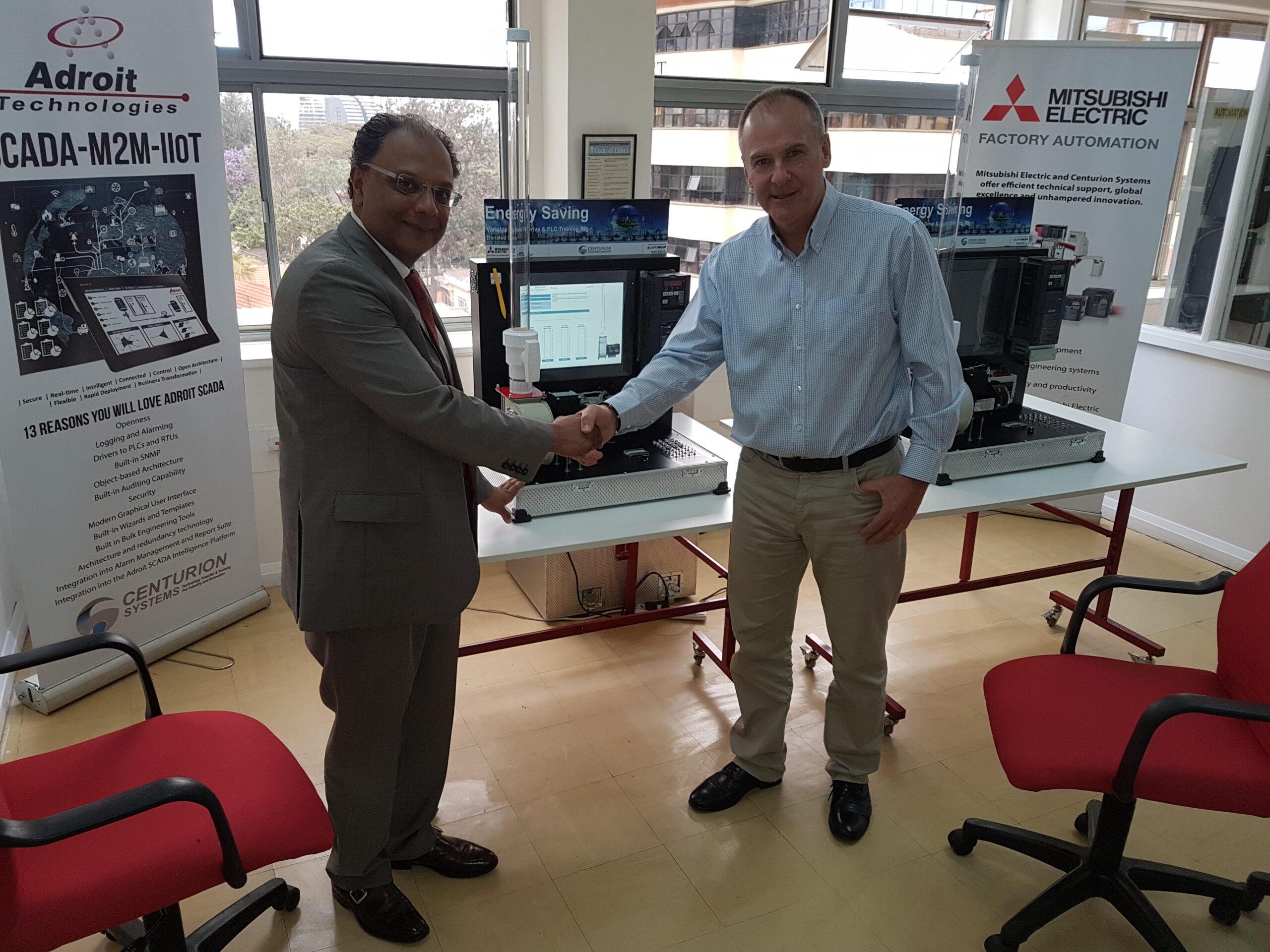


Last Updated 1 day ago by Kenya Engineer
As African industries confront rising production costs, skills shortages, aging infrastructure and pressure to become more competitive, industrial automation is moving from a technology conversation to a productivity conversation. For Adroit Technologies and its authorised East African partner, Centurion Systems Limited, the future of African industrialisation will depend on systems that are practical, scalable and suited to local operating realities.
Across Kenya and the wider region, manufacturers are under pressure to produce more efficiently while managing familiar constraints: intermittent power, infrastructure gaps, cost sensitivity, legacy equipment and limited access to specialised technical skills. Dr. Kevit Desai, Managing Director of Centurion Systems Limited, says sustainable and scalable industrialisation in Africa must begin with these realities, rather than imported assumptions. In his view, African factories need systems that can start small, deliver measurable value early and expand without forcing companies into complete system replacement.
Dave Wibberley, Director of Adroit Technologies, shares that view and sees industrialisation as central to Africa’s long-term economic independence. He identifies manufacturing as one of the strongest routes to job creation and wealth generation, but says competitiveness now depends on more than machinery alone. It requires investment in people, efficient systems and automated processes capable of producing at quality and price levels that can sustain industrial growth.
The discussion comes at a time when Kenya continues to prioritise manufacturing as part of its industrialisation agenda. Kenya’s State Department for Industry strategic planning documents identify manufacturing as a key pillar in the country’s ambition to become a middle-income, rapidly industrialising and globally competitive economy, with a target of raising manufacturing’s contribution to GDP to 15 percent by 2027. (industrialization.go.ke)
For many factories, however, the journey towards digital transformation is not straightforward. Desai says the biggest barriers are often structural rather than purely technological. Legacy infrastructure, fragmented systems, skills gaps and the absence of a clear digital strategy at management level all slow progress. In Kenya, the need to justify investment through an immediate return can make companies cautious. He identifies integration as one of the most important bottlenecks: bringing existing equipment, controls and processes into a coherent, data-driven operating environment.
This is where SCADA and industrial automation systems remain important. Supervisory Control and Data Acquisition systems have traditionally been used to monitor and control plant processes, machines and utilities. Wibberley describes Adroit Technologies’ SCADA software, Adroit, as a platform for real-time data acquisition, HMI visualisation and intelligent control across process control, manufacturing and other automation applications. (adroitscada.com)
But the role of SCADA is changing. What was once viewed mainly as a control-room platform is increasingly becoming the operational data layer of the factory. Desai describes this as a shift from isolated control systems to integrated, data-centric ecosystems. Through Industrial Internet of Things and cloud integration, he says SCADA platforms can support real-time analytics, remote access and predictive decision-making. In East Africa, he is seeing growing demand for hybrid solutions that combine on-premise reliability with cloud-enabled insights.
 Wibberley goes further, arguing that SCADA systems are evolving into AI-centric ecosystems. He says the next phase will involve cloud platforms and AI agents capable of helping manufacturers interrogate plant data in ways that were difficult only a few years ago. Instead of relying only on dashboards and alarms, future operators may be able to ask natural-language questions about quality, downtime, energy use or production anomalies and receive useful operational insights.
This shift is significant for African industry because it addresses two challenges at once: operational visibility and skills availability. In many plants, knowledge still sits with a small number of experienced operators or maintenance technicians. When systems capture, organise and analyse plant data, they can help reduce dependence on informal knowledge and make decision-making more consistent.
For Kenya and East Africa, the more realistic path to digitalisation may not be the full replacement of existing plant equipment. Many manufacturers cannot afford to remove legacy systems and start afresh. Desai says the practical approach is to layer intelligence onto existing infrastructure by connecting older equipment, extracting useful data, improving visibility and identifying efficiency gains without requiring major capital expenditure.
This incremental approach is especially relevant in sectors such as manufacturing, water, utilities, food processing, mining support services and energy, where plants often operate a mix of old and new machinery. Adroit Technologies has previously been associated with industrial automation software across sectors including mining, manufacturing, water, food processing, energy and public utilities. (Mining Safety)
Centurion’s own role in the region gives the conversation a local grounding. Desai says the company has more than 35 years of experience upgrading and transforming industrial applications and machinery in East Africa, and positions itself as both a manufacturing industry partner and a private technical training institution. (Centurion Systems Limited)
The business case for automation is often made through efficiency. Desai reports that, in Kenyan manufacturing and utilities, improved visibility and control can deliver quick gains. Monitoring energy consumption and equipment performance can help reduce downtime, detect process bottlenecks and prevent costly failures. He says some clients have achieved double-digit efficiency improvements by using SCADA-driven insights to identify and eliminate operational constraints.
Wibberley points to a global example in aluminium wheel manufacturing, where real-time quality and production-control data is sent to a cloud-based AI system. The system is used to identify potential quality problems early and tune machine parameters using learning from multiple machines across plants. He says the approach has helped save energy, improve quality and reduce scrap across various plants.
For engineers, the relevance is clear. Automation is no longer only about replacing manual intervention. It is increasingly about using plant data to improve process stability, quality, energy performance and maintenance planning. This is aligned with wider global thinking. The International Energy Agency notes that digitalisation can improve energy efficiency by gathering and analysing data, then using it to influence real-world energy use, either automatically or through human intervention. (IEA)
Energy is one of the most important areas where digitalisation can deliver value in Kenya. Electricity costs remain a major concern for many industrial users. Desai argues that automation enables more precise process control, reducing energy waste and resource inefficiencies. He says digital systems allow companies to monitor consumption in real time, optimise usage patterns and detect anomalies quickly.
Wibberley adds that cloud-based AI technologies can collect relevant manufacturing data and build models that help manufacturers understand and optimise energy use across multiple variables. He also points to the ability of SCADA systems to predict maximum demand during an electrical metering period, enabling load management to reduce costs.
This is where sustainability and cost begin to converge. In many African industries, cost remains the dominant driver. Desai acknowledges that Kenyan businesses often adopt sustainable practices when they clearly reduce operational expenses, including through lower energy consumption or reduced waste. He therefore sees sustainability as increasingly becoming part of operational excellence, rather than a separate corporate objective.
Wibberley says cost is likely to remain a primary driver until African economies become wealthier. That assessment may appear blunt, but it reflects the practical environment in which many industrial decisions are made. Investments that cannot demonstrate a financial return are difficult to justify. The opportunity for automation suppliers, therefore, is to frame digitalisation around measurable operational benefits: lower downtime, lower waste, lower energy use, better quality and improved maintenance planning.
Localisation is another recurring theme. Desai says solutions must be adapted to conditions such as unreliable connectivity, power fluctuations and varying skill levels on site. Systems must be robust, user-friendly and locally supportable. This local-support dimension is critical because digital transformation does not end at installation. It requires ongoing maintenance, training, troubleshooting and continuous improvement.
Wibberley says Adroit’s licensing model is designed to be scalable, supporting both small industrial monitoring projects and highly distributed redundant systems. He adds that the company offers remote health-monitoring services to help customers maintain system reliability.
The skills question may ultimately determine how far industrial digitalisation can go. Desai sees growing opportunities for Kenyan engineers and technicians in system integration, data analysis and industrial IT. These are practical, hands-on roles that sit at the intersection of electrical engineering, mechanical systems, automation, networking and data.
Wibberley also notes that automation opens opportunities beyond national borders. Through internet-based support and remote engineering, he says African engineers can participate in projects and services outside their immediate geography.
This is an important point for Kenya’s technical training ecosystem. As factories become more connected, the profile of the industrial technician is changing. Future technicians will still need to understand motors, drives, sensors, valves, pumps, panels and machines. But they will also need competence in PLCs, SCADA, networks, cybersecurity, databases, dashboards and data interpretation.
AI and predictive analytics will deepen this shift. Desai expects these technologies to be especially useful in maintenance and operational optimisation. Instead of reacting to equipment failures after they occur, manufacturers will increasingly be able to predict and prevent them. In the Kenyan context, where unplanned downtime can carry significant cost implications, he sees predictive maintenance as one of the strongest potential use cases for industrial AI.
Wibberley believes AI and predictive analytics will change how business is done as deployment becomes easier and cheaper. He says manufacturers will be able to build models that predict failures, quality problems and other production risks, supporting optimisation at lower cost.
Looking ahead five to ten years, Desai expects a more modern African industrial ecosystem to be highly connected, data-driven and resilient, with integrated systems enabling real-time decision-making. For Kenya, this would mean industries that are not only more efficient but also more globally competitive, supported by a stronger base of local technical expertise.
Wibberley, however, cautions that technology alone will not deliver industrial success. He says the fundamentals still matter: trained technicians and engineers, affordable energy, clear industrial policy, freer markets, investment in localisation and a shift away from exporting raw materials without adding value.
For companies beginning their digital transformation journey, both respondents recommend a practical starting point. Desai advises industries to begin with clear objectives rather than large ambitions, focusing first on areas where digitalisation can deliver immediate value, such as improved visibility, efficiency or cost reduction. Wibberley’s advice is similarly direct: start small, solve known critical problems, realise success early and then accelerate.
For Africa’s industrial sector, that may be the most realistic path. The factories of the future will not be built overnight. They will emerge through practical, well-integrated steps: connecting equipment, capturing data, training technicians, reducing waste, managing energy, improving quality and using AI where it solves real operational problems. In that process, SCADA and automation will not simply be control systems. They will become part of the industrial intelligence layer needed to make African manufacturing more resilient, competitive and sustainable.

-
Product on sale
 AWEBook Volume 2Original price was: KShs 3,500.00.KShs 3,000.00Current price is: KShs 3,000.00.