

Last Updated 2 months ago by Kenya Engineer
The return of the AJERI Scientific Conference places renewed attention on a young engineering journal seeking to give African researchers greater visibility and bring locally generated knowledge closer to industry, government and professional practice.
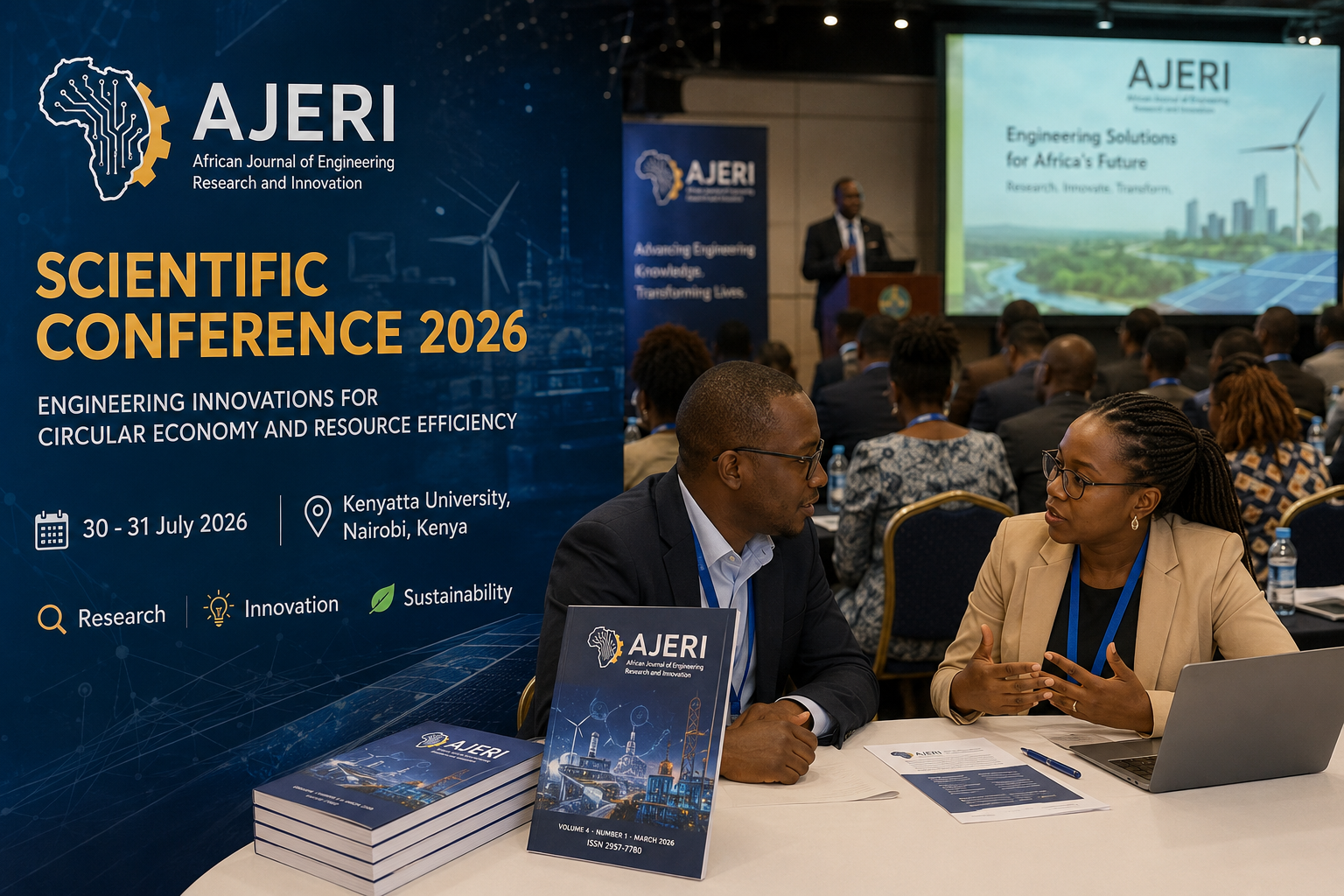
Engineers, researchers, innovators, policymakers and postgraduate students will gather at Kenyatta University on 30 and 31 July 2026 for the second African Journal of Engineering Research and Innovation Scientific Conference.
The conference, which will also accommodate virtual participation, is being organised under the theme “Engineering Innovations for Circular Economy and Resource Efficiency.” It follows the inaugural AJERI Scientific Conference held at the same university in July 2025 under the theme “Engineering for Transformation.”
While the two-day gathering provides an opportunity to discuss sustainable engineering solutions, it also represents a test of a broader initiative. AJERI is attempting to establish a credible platform through which African engineering research can be published, discussed and connected to the practical problems facing the continent.
The 2026 conference is expected to include keynote addresses, technical paper presentations, panel discussions, exhibitions, innovation showcases and networking sessions. Its stated objectives include strengthening collaboration between academia, industry and policymakers, promoting resource-efficient technologies, supporting graduate engineers and early-career researchers, and generating engineering knowledge that can inform regional development policy.
These ambitions are important because Africa does not suffer from a complete absence of engineering research. Universities across the continent produce postgraduate theses, technical studies, prototypes, design proposals and field investigations every year. The greater difficulty is ensuring that this work becomes visible, undergoes credible technical scrutiny and eventually reaches the institutions capable of applying it.
Building a home for African engineering research
The African Journal of Engineering Research and Innovation is published by the Institution of Engineers of Kenya. Its first volume appeared in 2023, and its publicly accessible archive now contains 14 issues, extending from Volume 1 Number 1 to Volume 4 Number 2, published in June 2026. The journal’s confirmed print ISSN is 2957-7780.
AJERI describes itself as an international, open-access engineering journal. Its editorial policy provides for peer review, research-integrity requirements, plagiarism checks and publication of four issues in each volume. The policy states that manuscripts should be reviewed by at least two experts in the relevant field and outlines provisions for corrections, retractions and the handling of publication disputes.
Maintaining a publication schedule across four consecutive volumes is in itself a meaningful early achievement. Academic journals frequently begin with enthusiasm but struggle to attract sufficient papers, sustain editorial work or publish consistently. AJERI has moved beyond producing an isolated inaugural issue and has developed an identifiable body of engineering literature.
Its value, however, lies not simply in the number of issues it has published. The subjects covered demonstrate an effort to give space to research connected to African infrastructure, industrial development, energy, environmental management and technology.
The June 2026 issue includes studies on the optimisation of solar photovoltaic systems in marine environments, the use of pulverised ceramic waste to improve expansive clay soils, GIS-supported modelling of Kenya’s electricity distribution network and the stabilisation of road subgrades using lime and rice husk ash.
The March 2026 issue addresses the performance of septic tanks in Kitale, artificial neural networks for suppressing noise in power-line communications, forensic investigation of reinforced-concrete failures, electrical-loss reduction on an 11 kV distribution line in Nairobi and sensor-based monitoring of storage tanks.
Earlier editions have examined the potential for offshore wind generation around Lamu, the suitability of Kenyan bentonite for geothermal drilling fluids, climate change and water-system management, and the role of forensic structural audits in addressing building failures.
This range is significant. Many international journals understandably prioritise subjects with broad global academic appeal. A regional journal can also accommodate studies whose importance is closely tied to a particular electricity feeder, road corridor, soil type, informal settlement, industrial process or municipal service.
Such research may not immediately attract a large international audience, but it can be highly relevant to utilities, county governments, contractors, regulators and engineering consultants operating under similar conditions.
Research that begins with local problems
Engineering solutions are shaped by context. Materials available in Kenya differ from those available elsewhere. The performance of infrastructure is influenced by local soils, rainfall, maintenance practices, procurement systems, construction supervision, energy costs and technical capacity.
Research based entirely on assumptions developed in Europe, North America or Asia may not capture these conditions adequately. Africa therefore needs platforms that can document what happens when engineering methods are tested against African materials, institutions and operating environments.
AJERI can contribute by preserving this knowledge and making it available beyond the university department or organisation in which it was produced.
A study of ceramic waste as a soil stabiliser, for example, speaks simultaneously to waste management, construction costs and the performance of infrastructure on expansive soils. Research on rice husk ash may create a link between agricultural residues and road construction. Investigations into distribution-system losses can support decisions on whether replacing conductors, installing compensation equipment or reconfiguring networks is technically and economically justified.
These are not abstract concerns. They demonstrate how research can help engineers make choices about materials, expenditure, safety, energy efficiency and environmental performance.
The 2026 conference builds on this approach by concentrating on circularity and resource efficiency. Its sub-themes include waste-to-resource technologies, sustainable construction materials, renewable energy, the water–energy–food nexus, smart infrastructure, environmental engineering, Industry 4.0, financing and skills development.
The circular economy requires engineers to look beyond the conventional model in which materials are extracted, processed, used and discarded. Products and infrastructure must increasingly be designed to consume fewer resources, last longer, generate less waste and allow materials to be recovered or reused.
For African economies, this is not only an environmental argument. Resource efficiency can reduce dependence on imported materials, lower production costs, create new value chains and extend infrastructure budgets. The practical question is how these principles can be applied under local industrial, financial and regulatory conditions.
That is where research presented at the conference could become useful.
Bringing the laboratory closer to the field
A journal and a conference perform related but different functions.
The journal creates a permanent record of research. The conference allows researchers to defend their methods, receive criticism, meet prospective collaborators and explain their findings to audiences outside their institutions.
The connection between the two is central to the AJERI model. Authors whose papers are accepted for presentation at the conference may have their work considered for publication in the journal.
Handled well, this arrangement can improve the quality of research before publication. Questions raised during technical sessions may expose weaknesses in data, assumptions or proposed solutions. Industry participants can point out practical constraints that may not be apparent in a laboratory or computer model. Policymakers can identify areas where technical evidence is missing from regulation or public investment decisions.
The conference could also help address the long-standing separation between universities and practising engineers.
Academic success is commonly measured through completed degrees and published papers. Industry, on the other hand, is concerned with reliability, cost, compliance, implementation time and return on investment. Valuable research can remain unused when it is presented only in academic language or when practitioners do not know it exists.
AJERI’s opportunity is to create a meeting point between these communities.
For this to happen, industry participation must extend beyond sponsorship and exhibition stands. Companies, utilities, public agencies and professional practices should arrive with real technical problems that researchers can investigate. Researchers must, in turn, explain not only what they discovered but how their findings could be tested, financed, standardised or deployed.
The most useful measure of the conference’s impact may therefore not be the number of delegates in attendance. It will be the collaborations, pilot projects, policy proposals and applied studies that emerge afterwards.
Creating opportunities for younger researchers
AJERI can also play an important role in the development of postgraduate students and early-career engineers.
Publishing research for the first time can be difficult. Authors must learn how to structure a technical paper, present reproducible methods, interpret results, reference previous work and respond to criticism from reviewers.
A journal connected to professional engineers can provide an entry point for researchers whose work is relevant but who may not yet have access to established international publishing networks. Its conference can give them experience in presenting to an audience that includes both academics and practitioners.
This should not mean lowering standards. Young researchers benefit most from detailed, rigorous and constructive review. The credibility of AJERI will ultimately depend on whether readers, employers and universities trust the quality of the work it publishes.
Its editorial board includes members associated with Kenya, Nigeria, Tunisia and South Africa, providing a foundation for a wider African outlook. The longer-term challenge will be expanding participation across more countries and institutions so that the word “African” is reflected not only in the journal’s title but also in its authorship, reviewers, research locations and readership.
What AJERI still needs to prove
AJERI remains a young publication, and a confirmed ISSN should not be confused with a measure of scholarly quality. The ISSN International Centre explains that an ISSN identifies a publication but does not guarantee the quality or validity of its contents.
The journal must therefore build its reputation through the consistency of its peer review, the competence and independence of its editorial structure, the quality of published papers and the influence those papers achieve after publication.
Its public archive currently makes complete issues available as downloadable PDF documents. While this provides open access to the material, AJERI would benefit from stronger article-level publishing infrastructure. Individual webpages for each paper, searchable metadata, persistent identifiers, clear publication histories and compatibility with academic discovery services would make the research easier to find, reference and cite.
The journal’s website would also benefit from publishing more information on review timelines, acceptance rates, corrections, research data, publication charges and geographic representation. AJERI’s editorial policy is relatively detailed, but its description combines language relating to double-blind review and open peer review. Greater clarity on which system is used in practice would strengthen confidence among prospective authors and readers.
International indexing will be another important step. AJERI’s own public archive does not prominently indicate inclusion in major scholarly indexes. Inclusion should not be pursued merely as a badge of prestige. Proper indexing improves discoverability, allows published research to enter wider academic conversations and helps institutions assess how often the work is being read and cited.
Good scholarly publishing practice increasingly depends on transparent peer-review procedures, clear editorial responsibilities, article metadata and reliable long-term access. These are among the principles promoted by organisations working to strengthen open-access publishing.
The conference must also avoid becoming an annual event whose papers and recommendations receive attention for two days and are then forgotten. Conference organisers could strengthen accountability by publishing proceedings, summaries of technical discussions and reports showing what resulted from earlier meetings.
A platform worth watching
AJERI is still developing, but it is addressing an important need.
Africa requires more than the transfer of finished technologies from elsewhere. It needs engineers who can investigate local failures, test available materials, improve indigenous technologies, adapt global innovations and generate evidence for decisions on infrastructure and industrial development.
A credible African engineering journal can help retain that knowledge. A well-designed scientific conference can bring it into conversation with the people who build, regulate, finance and operate engineering systems.
The second AJERI Scientific Conference will therefore be about more than circular manufacturing, renewable energy or sustainable infrastructure. It will also show whether AJERI can mature from an IEK publication into a widely trusted platform for African engineering knowledge.
That test will not be settled by the conference alone. It will be determined over time by the quality of the papers AJERI publishes, the diversity of researchers it attracts and the extent to which the knowledge it carries finds its way into actual projects, policies and engineering decisions.
-
Product on sale
 AWEBook Volume 2Original price was: KShs 3,500.00.KShs 3,000.00Current price is: KShs 3,000.00.