Last Updated 2 hours ago by Kenya Engineer
Structural failures rarely occur without an underlying sequence of events. In many cases, deterioration develops over time through corrosion, fatigue, excessive loading, foundation movement, material degradation, water ingress or other forms of damage. The challenge for engineers is identifying the warning signs early enough to intervene before the condition becomes critical.
Conventional structural inspections remain essential, but they have limitations. Visual inspections provide valuable information about visible defects, yet they are often periodic and may not reveal changes occurring between inspection visits. Some forms of deterioration develop internally or in locations that are difficult to access. Others may only become apparent when a structure is subjected to particular loading or environmental conditions.
Machine learning is opening new possibilities for structural health monitoring by enabling computers to analyse large volumes of engineering data and identify patterns that may be difficult to detect through conventional approaches alone.
When combined with structural engineering principles, monitoring systems and professional assessment, these techniques can support earlier identification of abnormal behaviour, improved estimates of deterioration and more targeted maintenance interventions.
The objective is not to replace structural engineers or produce an automated declaration that a building or bridge is safe. It is to improve the information available to engineers so that potential problems can be investigated and addressed before they develop into serious failures.
Understanding structural health monitoring
Structural health monitoring (SHM) is the systematic process of collecting and analysing information about the condition and behaviour of a structure.
Depending on the type of asset and the monitoring objective, information may be collected using strain gauges, accelerometers, displacement transducers, temperature sensors, load cells, inclinometers, acoustic emission equipment, cameras and other instruments.
For a bridge, accelerometers can record vibration as vehicles cross the structure. Strain gauges can measure changes in deformation at selected locations, while displacement sensors can monitor movement at bearings, joints or other critical components. Temperature sensors help engineers understand how environmental conditions influence structural behaviour.
For a building, monitoring may involve measuring settlement, lateral movement, vibration, crack development, deformation and changes in loading. For a dam, relevant measurements may include seepage, pore-water pressure, displacement, uplift pressure and reservoir conditions.
These instruments generate data that can be analysed to establish normal operating patterns and identify deviations that may indicate deterioration or damage.
The difficulty is that structural behaviour is influenced by many factors. A bridge may experience changes in vibration because of traffic volume, vehicle speed, temperature or wind, even when its structural condition has not changed. A building may exhibit movement due to normal thermal expansion or changes in occupancy and loading.
Engineers must distinguish between these expected variations and changes associated with actual structural damage. This is one of the areas where machine learning can provide additional analytical capability.
How machine learning identifies warning signs
Machine learning involves developing algorithms that learn patterns from data and use those patterns to make predictions, classifications or identify unusual behaviour.
In structural engineering, the algorithms can be trained using historical inspection records, sensor measurements, laboratory experiments, structural simulations or a combination of these sources.
One application is anomaly detection. A model learns the normal behaviour of a structure under different operating and environmental conditions. When new measurements deviate significantly from the established pattern, the system flags the observations for further investigation.
Another application is damage classification. Where labelled examples are available, supervised learning algorithms can be trained to recognise patterns associated with different damage conditions, such as cracking, corrosion-related deterioration, changes in stiffness or unusual vibration responses.
Regression models and time-series algorithms can also be used to estimate changes in structural parameters over time. Depending on the available data, these may support estimates of displacement, deformation, fatigue accumulation or the remaining useful life of particular components.
Computer vision offers a further application. Deep learning models can analyse photographs and video footage to identify visible defects such as cracks, spalling, exposed reinforcement, corrosion staining and surface deterioration. Images collected during drone inspections or routine surveys can be processed to identify areas requiring closer examination.
These methods address different engineering questions. An algorithm that identifies a crack in an image does not automatically determine whether the crack threatens structural stability. A model that detects unusual vibration does not necessarily establish the location or cause of the underlying problem. The output must be interpreted within the context of structural design, material behaviour, loading conditions and inspection evidence.
From sensor readings to engineering decisions
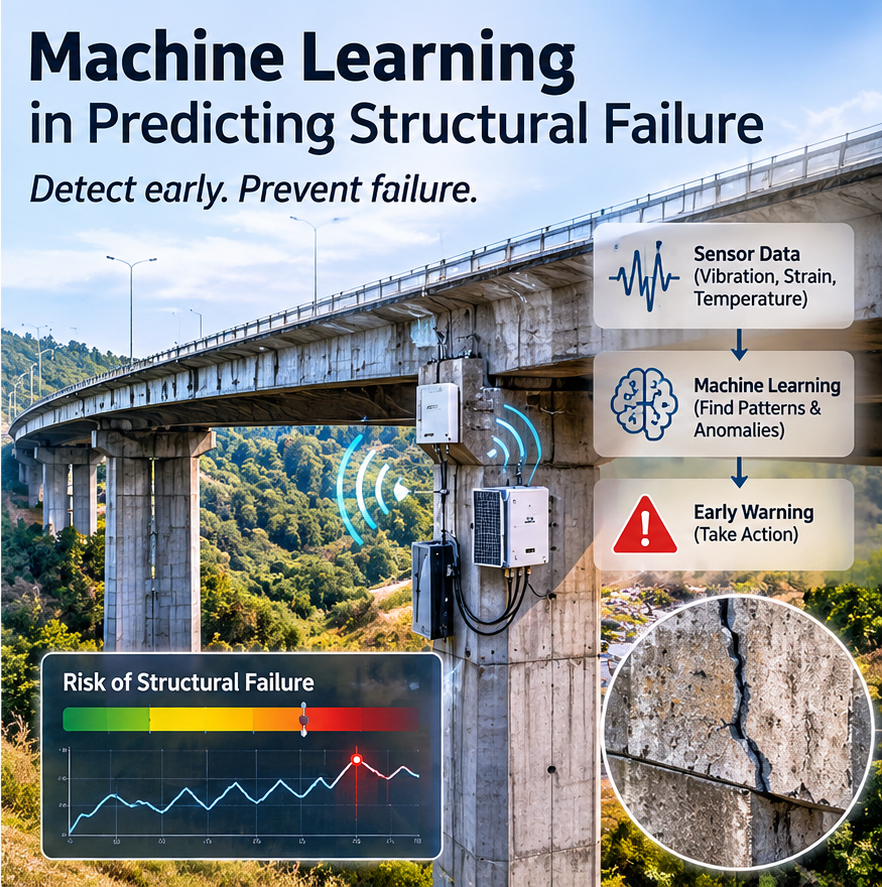
A typical machine-learning-based structural monitoring system begins with data acquisition.
Sensors installed at selected points collect information about the structure’s response to loading and environmental conditions. The data are transmitted to a local processing unit or central platform, where they are cleaned, organised and analysed.
The next stage involves establishing a baseline. This may be developed using measurements collected when the structure is known to be in an acceptable condition, supported by engineering calculations and finite element models.
Machine learning algorithms then examine new measurements and compare them with the expected behaviour. If the system identifies a significant deviation, it can generate an alert for engineering review.
The engineer may then examine the original sensor readings, compare them with other measurements, review inspection records and determine whether a physical inspection or more detailed structural analysis is required.
The process can be represented as:
Data collection → Data validation → Baseline modelling → Anomaly detection → Engineering assessment → Inspection and intervention.
The reliability of this process depends on the quality of the sensors, the suitability of the model and the way alerts are interpreted. Poorly installed sensors, missing readings, incorrect calibration or changes in monitoring conditions can produce misleading results.
Machine learning should consequently be treated as part of a wider structural health monitoring system, rather than as a standalone safety solution.
What bridge monitoring is revealing
Bridges provide some of the clearest examples of how machine learning can contribute to structural health monitoring.
Their behaviour is influenced by traffic loading, temperature, wind, fatigue, foundation conditions and material deterioration. Many bridges also remain in service for decades, making continuous assessment increasingly valuable as maintenance demands grow.
A 2024 study published in Sensors demonstrated a digital-twin-based structural health monitoring system for an operational railway bridge. The researchers used low-cost wireless accelerometers to collect vibration data as trains crossed the bridge.
The system combined local edge computing with cloud-based analytics. Machine learning was used to analyse vibration patterns and identify abnormal spectral peaks that could indicate changes in structural behaviour.
Importantly, the study used two years of vibration data collected under normal operating conditions to establish acceptable patterns. The researchers reported that the system could generate automated warnings of abnormal behaviour while using relatively inexpensive monitoring equipment.
The significance of the study is its demonstration that structural monitoring does not always require extensive and expensive instrumentation. Carefully selected sensors, suitable analytical methods and an appropriate monitoring architecture can provide useful information about an asset’s condition.
A separate 2024 study on the Z24 Bridge in Switzerland examined machine learning models for vibration-based structural damage assessment. The research investigated approaches including WaveNet and MiniRocket, with the objective of improving damage classification while reducing computational requirements.
The work also examined the possibility of processing data on embedded devices rather than relying entirely on remote cloud computing. This is relevant to infrastructure located in areas where communication networks may be unreliable or where continuous transmission of large datasets is expensive.
Such research points towards monitoring systems that can perform initial analysis close to the structure, transmitting important alerts and selected data for further engineering assessment.
The Stavå Bridge case: When monitoring detects a serious defect
A particularly instructive case comes from Norway.
In April 2021, the Stavå Bridge on the E6 highway was abruptly closed after a structural defect had seriously compromised its integrity. The Norwegian Public Roads Administration introduced a temporary solution and later reopened the bridge under strict vehicle restrictions and continuous manual traffic control while a replacement bridge was constructed.
A research paper published in Structure and Infrastructure Engineering in 2024 by Arnulf Hagen and Trond Michael Andersen examined how the developing defect was identified through the bridge’s monitoring system.
The system processed information from Internet of Things sensors as part of what the authors described as the bridge’s digital twin. The monitoring information supported online and offline diagnostics, helping engineers investigate the developing structural problem.
The authors reported that the critical damage was detected in time to stop its further development, although not early enough to avoid the incident altogether.
The study is particularly valuable because it illustrates the relationship between sensor monitoring, digital representations, machine learning and engineering assessment. The authors describe how combining physics-based methods with machine learning can support damage detection and diagnosis.
The case also highlights an important limitation. Even an advanced monitoring system cannot guarantee that every defect will be identified before it becomes serious. The effectiveness of the system depends on where sensors are installed, what they measure, how quickly data are processed and whether the developing failure mechanism produces detectable signals.
The lesson is that monitoring should be designed around the structural risks of a particular asset, not around the availability of sensors or analytical software.
Predicting deterioration in buildings and other structures
Although bridge monitoring has received considerable attention, machine learning has applications across several other areas of structural engineering.
In buildings, algorithms can analyse settlement measurements, crack observations, vibration data and changes in structural response to identify patterns associated with deterioration.
For reinforced concrete structures, image-processing models can assist with identifying surface cracks, concrete spalling and corrosion-related defects. When combined with inspection history and other measurements, these observations can help engineers prioritise locations for further investigation.
In steel structures, monitoring systems can examine vibration, strain and loading patterns to identify behaviour associated with fatigue or changes in stiffness. Machine learning can also assist with analysing inspection records and identifying components that may require more frequent assessment.
Dams and retaining structures present a different set of monitoring requirements. Changes in pore-water pressure, seepage, displacement and temperature may provide early indications of developing problems. Machine learning can help analyse the relationships between these variables, although the interpretation must remain grounded in geotechnical and hydraulic engineering principles.
For tunnels, underground structures and foundations, data from inclinometers, settlement markers, strain sensors and other instruments can be analysed to identify deviations from expected behaviour.
The range of possible applications is broad, but the reliability of any prediction depends on the failure mechanism being monitored and whether the available measurements can adequately represent it.
The importance of physics-informed machine learning
One of the major challenges in structural health monitoring is that real-world data are rarely as clean as laboratory datasets.
Temperature, humidity, traffic, wind, operational loads and seasonal changes can influence sensor readings. A model may interpret these normal variations as damage if it has not been trained to account for them.
This can lead to false alarms, unnecessary inspections and reduced confidence in the monitoring system. The opposite problem is equally serious: an algorithm may fail to identify genuine damage because the abnormal measurements fall within a range that the model considers acceptable.
Physics-informed machine learning offers one way of addressing these challenges.
Rather than relying exclusively on patterns learned from historical data, these approaches incorporate established engineering knowledge into the modelling process. The model may use physical relationships governing temperature-induced movement, structural stiffness, loading or material behaviour to distinguish expected responses from potentially damaging changes.
A 2025 study on monitoring a long highway viaduct examined a physics-informed approach to identifying displacement anomalies while accounting for temperature effects. The researchers developed a baseline model using temperature and time information to represent normal daily and seasonal movement. They then assessed whether deviations from that baseline could indicate abnormal structural behaviour.
This type of approach is important because structural monitoring is not merely a pattern-recognition problem. The algorithm must account for the physical processes that govern how the structure behaves.
Combining engineering models with machine learning can also improve interpretability. Engineers are more likely to trust an alert when they can examine the measurements, assumptions and physical relationships that contributed to the result.
Why predicting structural failure remains difficult
Despite advances in machine learning, predicting structural failure remains a challenging engineering problem.
The first difficulty is the availability of reliable training data. Serious structural failures are relatively rare, and detailed records of the conditions immediately preceding failure are often unavailable. Researchers may therefore rely on laboratory experiments, numerical simulations or artificially generated damage scenarios.
These datasets are useful for developing and testing algorithms, but they may not fully represent the complexity of structures operating under real conditions for decades.
The second difficulty is that structures are not identical. Two bridges may have similar designs but differ in materials, construction quality, foundation conditions, maintenance history and exposure to environmental factors. A model trained on one structure may not perform reliably when applied to another without further validation.
The third challenge is distinguishing deterioration from normal variation. Temperature, traffic and other operating conditions can produce changes in structural response that resemble damage. Monitoring systems must be designed to account for these influences.
There is also the problem of explainability. A machine learning model may identify an unusual pattern without providing a sufficiently clear explanation of its cause. For safety-critical infrastructure, an alert must be supported by evidence that engineers can investigate and validate.
Finally, structural failure can develop through several interacting mechanisms. Corrosion may reduce the effective cross-section of a steel component; repeated loading may contribute to fatigue; water ingress may accelerate deterioration; and foundation movement may introduce additional stresses. A model focused on one type of measurement may not capture the complete failure process.
For these reasons, machine learning outputs should be treated as engineering decision-support information. They should not replace inspections, structural calculations, code requirements or the professional responsibility of the engineer.
Implications for Kenya and Africa
The application of machine learning to structural health monitoring could be valuable across Africa, where governments and infrastructure operators must maintain extensive networks of roads, bridges, buildings, dams, industrial facilities and transport infrastructure.
The region’s challenge is not limited to constructing new infrastructure. Existing assets must be inspected, maintained and rehabilitated while operating within constrained budgets and growing demand.
Kenya’s road and bridge networks provide potential applications for data-driven monitoring. Selected bridges on heavily trafficked routes could be prioritised for instrumentation based on their age, structural form, traffic loading, exposure and known condition. Accelerometers, strain gauges, displacement sensors and temperature monitoring could provide additional information where conventional inspection alone is insufficient.
For dams and water infrastructure, monitoring could combine displacement, seepage, water pressure and environmental data to improve the identification of abnormal behaviour. For buildings, computer vision could assist with documenting visible defects and tracking changes over successive inspections.
However, the economics of implementation must be considered. It may not be practical to install extensive sensor networks on every bridge or public building. A risk-based approach would identify critical assets and locations where continuous or periodic monitoring offers the greatest benefit.
Low-cost sensors, edge computing, mobile inspection tools and cloud-based analytics could help make monitoring more accessible. Local universities and engineering institutions could also contribute through research into machine learning models suited to local materials, construction practices, climatic conditions and infrastructure types.
An important starting point would be the development of structured digital inspection records. Consistent information about asset age, design, materials, defects, maintenance interventions and inspection findings can provide a foundation for future predictive systems. Without this basic information, advanced algorithms will have limited value.
The engineer remains central
Machine learning is expanding the analytical tools available to structural engineers, but it does not change the fundamental responsibility of ensuring that structures are designed, inspected, maintained and operated safely.
The most effective systems combine reliable measurements, appropriate algorithms, established engineering principles and informed human assessment.
For infrastructure owners, this can mean moving from inspection schedules based largely on fixed intervals towards maintenance decisions informed by actual condition and risk. For engineers, it provides an additional means of examining structural behaviour and identifying changes that may warrant investigation.
The technology is still developing, and its performance must be demonstrated under the conditions in which it will be used. Models need validation, sensor systems require maintenance, and monitoring strategies must be reviewed as structures age or operating conditions change.
The objective is not to create a system that claims to know exactly when a bridge or building will fail. It is to improve the ability to recognise deterioration, understand emerging risks and intervene while there is still time to do so.
As the volume of infrastructure data grows, machine learning is likely to become an increasingly useful part of structural health monitoring. Its contribution will be greatest where data-driven predictions are combined with sound engineering judgement, effective asset management and timely maintenance.
References and further reading
- Armijo, A. and Zamora-Sánchez, D. (2024). Integration of Railway Bridge Structural Health Monitoring into the Internet of Things with a Digital Twin: A Case Study. Sensors, 24(7), 2115. https://doi.org/10.3390/s24072115
- Di Mucci, V.M. et al. (2024). Artificial Intelligence in Structural Health Management of Existing Bridges. Automation in Construction, 167, 105719. https://doi.org/10.1016/j.autcon.2024.105719
- Hagen, A. and Andersen, T.M. (2024). Asset Management, Condition Monitoring and Digital Twins: Damage Detection and Virtual Inspection on a Reinforced Concrete Bridge. Structure and Infrastructure Engineering, 20(7–8), 1242–1273. https://doi.org/10.1080/15732479.2024.2311911
- Bringing Intelligence to the Edge for Structural Health Monitoring: The Case Study of the Z24 Bridge (2024). IEEE Open Journal of the Industrial Electronics Society. https://doi.org/10.1109/OJIES.2024.3434341
- Physics-Informed Machine Learning for the Structural Health Monitoring and Early Warning of a Long Highway Viaduct with Displacement Transducers (2025). Mechanical Systems and Signal Processing. https://doi.org/10.1016/j.ymssp.2025.113659
- Zhang, B. et al. (2025). A Review of Methods and Applications in Structural Health Monitoring for Bridges. Measurement, 245, 116575. https://doi.org/10.1016/j.measurement.2024.116575
- Sun, L. et al. (2020). Review of Bridge Structural Health Monitoring Aided by Big Data and Artificial Intelligence: From Condition Assessment to Damage Detection. Journal of Structural Engineering. https://doi.org/10.1061/(ASCE)ST.1943-541X.0002535

-
Product on sale
 AWEBook Volume 2Original price was: KShs 3,500.00.KShs 3,000.00Current price is: KShs 3,000.00.