
Last Updated 1 hour ago by Kenya Engineer
Replacing a jaw crusher in an operating plant involves more than selecting a machine with the required capacity. The replacement must work within an existing arrangement of foundations, feed systems, conveyors, screens, electrical controls and maintenance access routes. A machine that meets its rated performance specifications may still require extensive modifications if these interfaces are not properly assessed.
The consequences can range from installation delays and additional civil works to reduced production, recurring blockages and unsafe maintenance conditions. A technical assessment before procurement helps identify these constraints while changes can still be incorporated into the design.
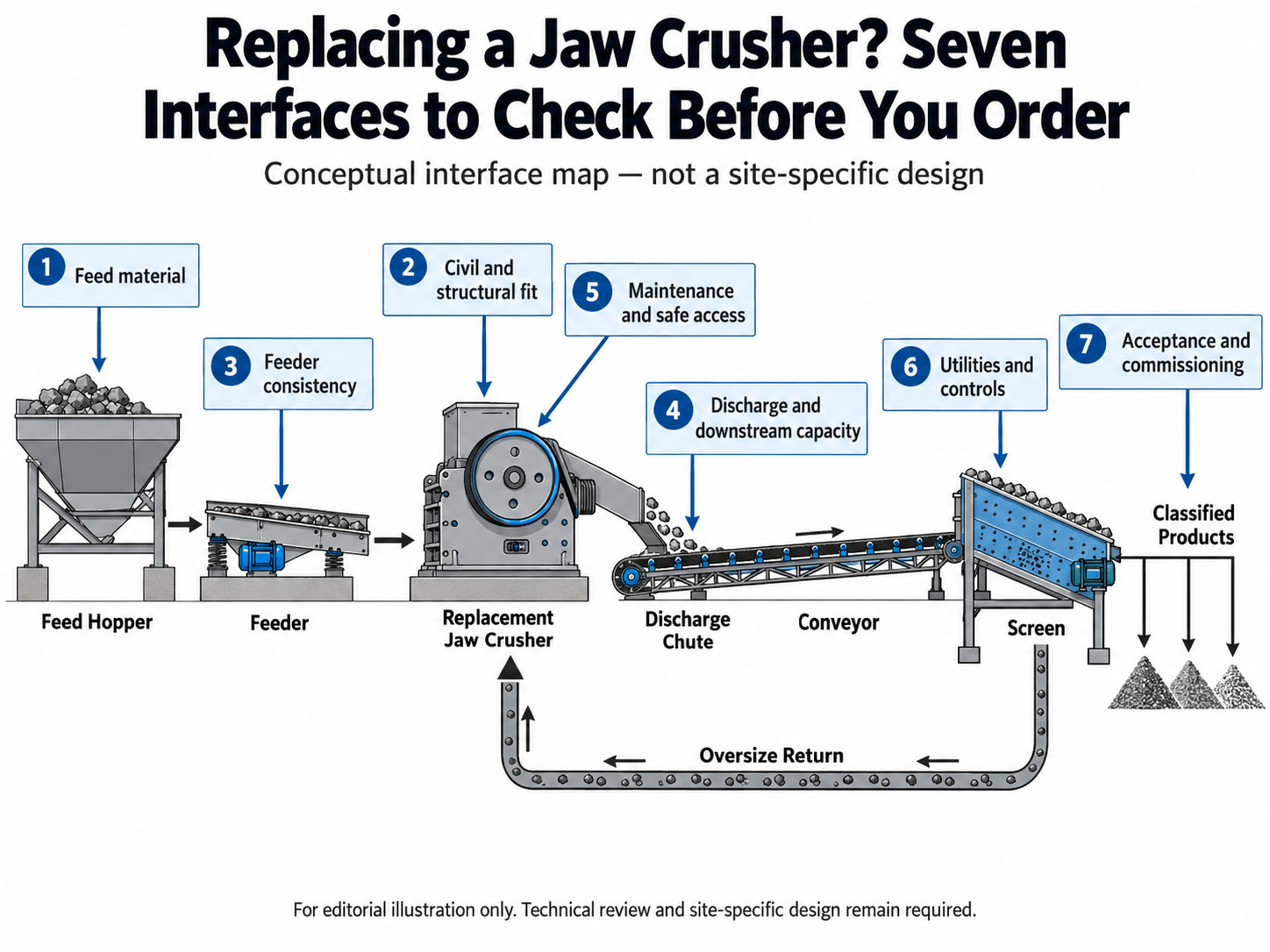
Seven areas deserve particular attention when planning a crusher replacement.
1. Establish the actual feed characteristics
Crusher selection begins with an understanding of the material entering the machine. Relevant information includes the maximum lump size, feed-size distribution, rock type, moisture content and proportion of fines. Where these properties vary between production periods or sources, the specification should account for that variation.
Rated throughput is dependent on the material and operating conditions under which performance is assessed. The dimensions of the feed opening alone do not establish whether the machine can handle the largest expected rocks, while motor power does not independently determine the resulting product size.
The proposed crusher configuration should be assessed against the actual feed characteristics, the permitted feed size and the required closed-side setting (CSS). The CSS, which describes the minimum discharge opening in the crushing cycle, influences the product grading and must be considered alongside the properties of the material and the capacity of downstream equipment.
2. Assess the existing foundation and supporting structure
A replacement crusher may fit within the available space but remain incompatible with the existing foundation. Differences in base dimensions, anchor positions, operating loads and discharge height can require substantial modifications to the installation.
An updated as-built survey should establish the dimensions and condition of the foundation, anchor locations, support levels, surrounding steelwork, feed chute and discharge arrangement. The assessment should also account for the space required to remove guards, replace wear components and carry out routine maintenance.
Civil and structural engineers should evaluate the proposed machine’s static and dynamic loads, anchorage and supporting structure using the manufacturer’s technical data. The suitability of an existing foundation should not be assumed from its dimensions or the weight of the previous machine.
Any required modifications should be identified before installation, with responsibility for design review and approval clearly assigned.
3. Check the feeder and feed arrangement
The performance of a crusher depends partly on how consistently material enters the crushing chamber. Surges, uneven distribution and prolonged periods without sufficient feed can reduce plant efficiency and complicate operation.
The assessment should cover feeder width, discharge position, material drop height, hopper geometry and any pre-screening arrangement. Chute dimensions and angles should be compatible with the expected lump size and the geometry of the replacement machine. Potential bridging points and obstructions should also be identified.
Feeder controls need to work with the operating condition of the crusher and the availability of downstream equipment. A control arrangement designed around the previous machine may require adjustment to suit the replacement’s operating characteristics.
The objective is to achieve a stable feed arrangement that supports the required production rate without introducing avoidable blockages or uneven loading.
4. Verify the discharge conveyor and screening circuit
The discharge point of a replacement crusher may differ from that of the existing machine in height, position or geometry. These differences can affect the transfer chute, conveyor loading and material flow through the plant.
The discharge opening, transfer height and receiving conveyor should be checked against the proposed installation. The review should consider material accumulation, spillage, dust generation and access to transfer points for inspection and cleaning.
The screening circuit also requires attention. The ability of a crusher to process incoming material does not guarantee that the entire plant can produce the same quantity of finished aggregate. Screen capacity, required product grading, recirculating oversize and conveyor limitations can all constrain output.
Production targets should consequently distinguish between fresh feed entering the plant, material passing through the crusher and saleable product leaving the circuit. These figures describe different stages of the process and should not be used interchangeably when assessing capacity.
5. Provide for safe access and maintenance
Adequate installation clearance does not necessarily provide sufficient room for maintenance. Jaw plates and other wear components may be heavy, requiring suitable lifting equipment, secure handling arrangements and an unobstructed removal route.
The design review should establish how components will be accessed, supported and removed. Platforms, walkways and working areas must allow maintenance personnel to carry out the required tasks without unnecessary exposure to moving machinery, falling material or suspended loads.
Guarding, isolation points, stored energy, access interlocks and emergency-stop arrangements should also be assessed. These considerations form part of the equipment integration process rather than being left until commissioning.
The equipment supplier should provide relevant component weights, lifting information and maintenance requirements. Site engineers and safety personnel must assess the actual installation and establish safe working procedures in accordance with applicable requirements.
6. Confirm electrical and control-system compatibility
A replacement crusher must operate within the site’s electrical and control infrastructure. The review should cover the available power supply, motor starting method, electrical protection, control signals and interfaces with the feeder and discharge conveyor.
Having sufficient electrical capacity does not, on its own, establish that the control system is suitable. Starting sequences, equipment interlocks and shutdown responses must be checked as part of the integration design.
For example, the control arrangement should define the response when the discharge conveyor stops, the crusher experiences an overload or a safety interlock is activated. The sequence must prevent upstream equipment from continuing to feed material into a system that cannot discharge it safely.
Electrical and control engineers should verify these functions before commissioning. Where the existing installation is being retained, its suitability should be confirmed against the replacement machine’s requirements rather than assumed from the previous configuration.
7. Define installation and performance acceptance criteria
Technical requirements should be agreed before the equipment is delivered. These should include approved arrangement drawings, foundation and anchorage information, operating limits, component weights, electrical requirements, maintenance documentation and the responsibilities of the parties involved in installation and commissioning.
Performance acceptance also requires clear criteria. The parties should agree on how feed rate, product grading and operating conditions will be measured, including the material characteristics under which the tests will take place.
A brief performance observation under unusual feed conditions may not represent the plant’s normal operating capability. Representative testing provides a more reliable basis for determining whether the installed equipment meets the agreed requirements.
The commissioning plan should identify the checks required before operation, the operating conditions to be recorded and the procedures for resolving any deficiencies identified during testing.
Integrating the crusher into the wider plant
A crusher replacement is best understood as an equipment integration exercise. The machine forms one part of a connected production system, and its performance depends on the compatibility of the surrounding equipment, structures and operating arrangements.
The conceptual process is straightforward: material passes from the feed hopper through the feeder into the crusher, then moves through the discharge chute and conveyor to the screening circuit. The foundation, electrical controls, safety systems and maintenance routes interact with this process throughout operation.
Before procurement, the engineering team should assemble a technical specification covering feed characteristics, expected throughput, target product grading, installation dimensions, structural information, downstream equipment constraints, electrical supply and maintenance requirements. The specification should also identify who is responsible for design approval, installation, inspection and commissioning.
Identifying incompatibilities at this stage is generally less disruptive than discovering them after delivery. A thorough interface assessment can reduce modifications, minimise installation delays and help ensure that the replacement crusher performs as intended within the existing plant.

-
Product on sale
 AWEBook Volume 2Original price was: KShs 3,500.00.KShs 3,000.00Current price is: KShs 3,000.00.