Last Updated 3 hours ago by Kenya Engineer
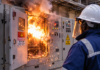
An electrical fault inside a switchgear assembly can develop into a violent event within seconds. What begins as a short circuit in one section of equipment may produce intense heat, rapidly expanding gases and destructive pressure. In some cases, the damage extends beyond the original fault location, affecting adjacent compartments and exposing personnel working nearby to serious injury.
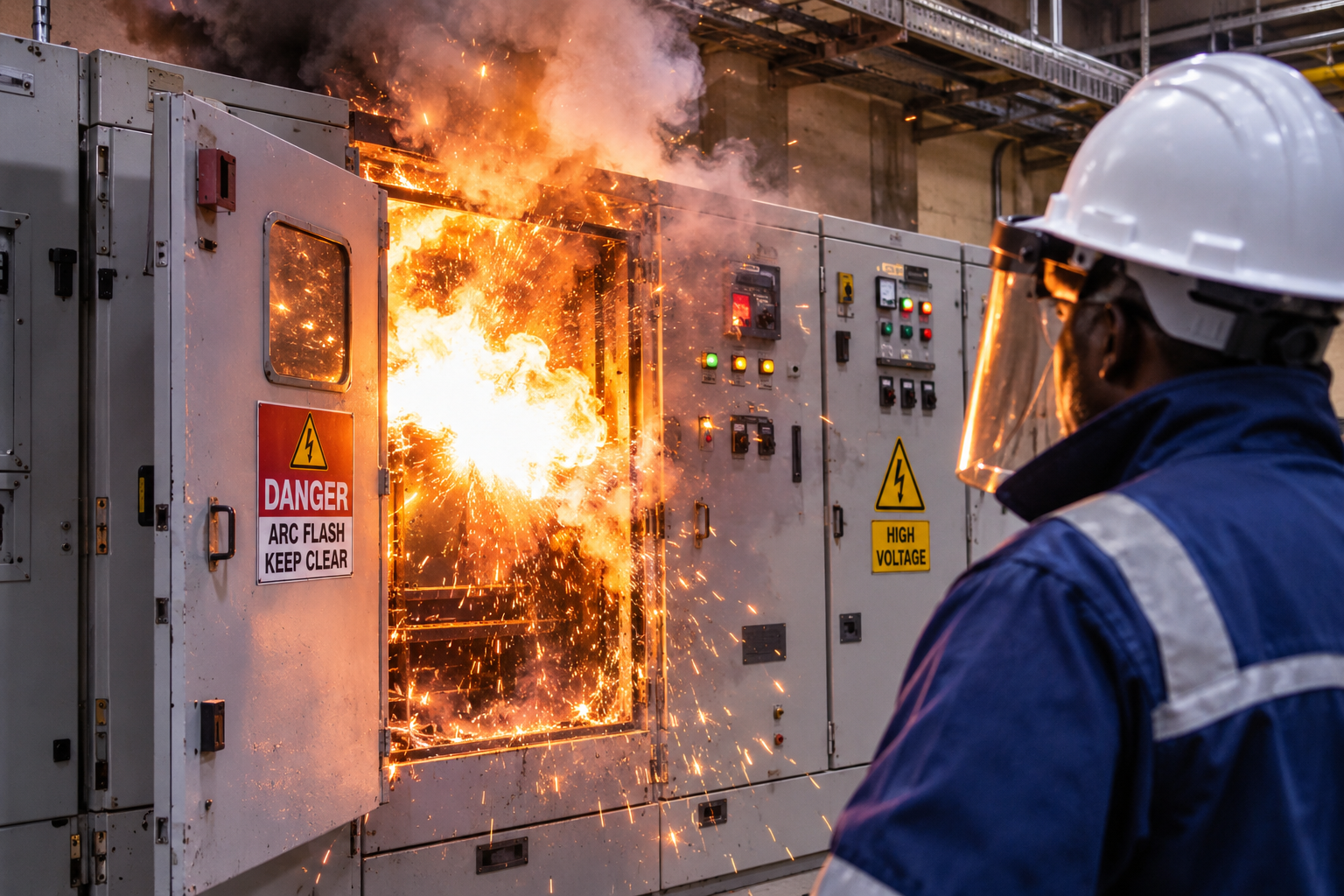
This is one of the less understood aspects of electrical safety. Many people associate electrical accidents primarily with electric shock or contact with exposed live conductors. Yet in industrial plants, commercial buildings and power distribution facilities, the danger can be considerably more complex. An electrical arc can generate temperatures capable of melting metal, ignite clothing and produce an explosive pressure wave. The resulting damage may extend well beyond the point where the fault originated.
Understanding how these events develop, why conventional protection systems may not always prevent them and what engineers can do to limit their consequences is an important part of managing electrical installations.
What happens during an arc flash?
Under normal operating conditions, air acts as an electrical insulator between conductors. However, when insulation breaks down under sufficient electrical stress, current can flow through the air, creating an electrical arc.
This discharge releases enormous amounts of energy in a very short time. The resulting temperatures can exceed 19,000°C, hot enough to vaporise copper and other metals. The intense heat also causes surrounding air to expand rapidly, creating a pressure wave that can damage equipment and injure anyone within its path.
An arc flash and an arc blast are closely related, but they describe different effects of the same event. Arc flash refers to the intense thermal energy and radiation released by the electrical discharge. Arc blast describes the mechanical effects associated with the rapid expansion of heated gases, including pressure, flying debris and the violent displacement of equipment components.
For a technician working in front of an electrical panel, the consequences can include severe burns, hearing damage, injuries from flying metal fragments and, in extreme cases, fatal trauma. The protective clothing normally worn for routine electrical work may offer little protection if it is not specifically rated for the anticipated arc exposure.
The US Occupational Safety and Health Administration (OSHA) identifies arc flash as a serious workplace hazard, noting that the temperatures involved can exceed 19,400°C.
When the fault spreads beyond its point of origin
The behaviour of an internal arc fault becomes particularly concerning when it occurs inside metal-enclosed switchgear.
A typical medium-voltage switchgear assembly contains several compartments housing circuit breakers, busbars, cable terminations and other electrical components. Metallic partitions and insulating barriers separate these sections, providing electrical isolation and helping to contain faults.
However, these barriers do not make the assembly immune to the consequences of an internal arc.
When an arc develops inside an enclosed compartment, the surrounding air heats up almost instantaneously. The resulting gases expand, generating pressure that acts on the enclosure, internal partitions, joints and pressure-relief arrangements. If the pressure exceeds what the assembly can withstand under the prevailing conditions, components may deform or fail, allowing hot gases and debris to affect adjacent sections.
The initial fault can also damage insulation, dislodge components or deposit conductive material on insulating surfaces. These conditions may create additional paths for current, resulting in secondary flashovers in other parts of the assembly.
This helps explain why some internal arc incidents appear to involve several sections of switchgear rather than remaining confined to the original fault location.
It is important to distinguish between the physical propagation of an arc and the development of secondary faults. An arc does not necessarily travel sequentially through every compartment. What happens depends on the switchgear construction, the fault conditions, the integrity of internal barriers and the effectiveness of pressure-relief arrangements.
The engineering concern, however, is the same: a fault originating in one location can have consequences for a much larger section of the installation.
This is why internal arc containment is an important consideration when specifying and installing medium-voltage switchgear.
Why circuit breakers alone are not enough
Circuit breakers are designed to interrupt abnormal electrical currents and protect installations against short circuits and overloads. They are indispensable to electrical protection, but their presence does not mean an installation is automatically protected against arc flash.
The amount of energy released during an arc fault depends significantly on how long the arc persists. Even where a protective device eventually interrupts the fault, substantial energy may already have been released.
The speed of fault clearance is therefore critical.
Several factors influence how quickly a protection system responds, including the available fault current, the characteristics of the protective device, relay settings and coordination between upstream and downstream circuit breakers.
There is also a complication that is sometimes overlooked. An arcing fault may produce less current than a conventional bolted short circuit. Depending on the protection settings, this can delay the operation of an overcurrent relay or circuit breaker.
Protection coordination studies are consequently important. They help engineers establish how protective devices should respond to different fault conditions while ensuring that the appropriate section of an installation is disconnected without unnecessarily interrupting the entire supply.
In some installations, additional technologies such as optical arc-flash detection systems can improve protection. These systems use sensors to detect the intense light associated with an electrical arc and can initiate rapid circuit interruption, often in combination with current detection.
The objective is to reduce the duration of the fault and, consequently, the energy released.
Low-voltage installations are not exempt
Arc flash is often associated with high-voltage substations and large industrial power systems. However, dangerous arc-flash incidents can also occur in low-voltage installations.
Distribution boards, motor control centres, generator panels and industrial switchboards operating at 400/415V can contain enough available fault energy to cause serious injuries.
Voltage alone does not determine the severity of an arc flash. Available fault current, the duration of the arc, equipment configuration and the distance between the worker and the arc all influence the level of exposure.
OSHA has specifically highlighted the danger of arc flash in systems operating at 120/208V, demonstrating that relatively low nominal voltages do not eliminate the risk.
This is particularly relevant in commercial and industrial facilities where technicians routinely open electrical panels to investigate faults, replace components or carry out maintenance.
A panel that has operated normally for years should not automatically be regarded as safe to work on while energised. A loose connection, damaged insulation or foreign object inside the enclosure may create conditions for an arc fault.
What causes internal arc faults?
Internal arc faults rarely occur without an underlying electrical or mechanical problem. In many cases, the conditions develop gradually before the actual failure.
Insulation deterioration is one common cause. Ageing, excessive temperatures, moisture, contamination and mechanical damage can weaken insulating materials until they can no longer withstand the electrical stresses imposed on them.
Loose connections are another concern. Poorly tightened terminals and deteriorating joints can develop localised heating and arcing, progressively damaging surrounding insulation and components.
Dust and other contaminants can also compromise insulation, particularly in environments where switchgear is exposed to industrial processes, moisture or inadequate ventilation. Conductive deposits on insulating surfaces may create unwanted current paths, eventually resulting in flashover.
Foreign objects present an additional risk. A loose screw, wire strand or maintenance tool left inside an electrical enclosure can bridge conductors and initiate a short circuit.
The condition of the protection system is equally important. Incorrect relay settings, poorly coordinated circuit breakers and neglected maintenance can increase the time taken to clear a fault.
These are reasons why switchgear maintenance should extend beyond checking whether equipment is operational. Inspection must also establish whether the equipment remains capable of performing safely under abnormal conditions.
Engineering out the risk
Preventing arc-flash injuries requires more than providing technicians with protective clothing. The most effective approach begins with eliminating exposure where possible, reducing the likelihood of faults and limiting the energy released when a fault occurs.
An important starting point is an arc-flash risk assessment. This involves examining the electrical installation, calculating the potential incident energy at relevant equipment and determining the boundaries within which personnel may be exposed to hazardous levels of energy.
IEEE 1584-2018, the Guide for Performing Arc-Flash Hazard Calculations, is one of the principal international references used for this purpose. It provides calculation methods for estimating incident energy and arc-flash boundaries in applicable three-phase AC systems.
The calculations require reliable information about the installation, including transformer characteristics, available short-circuit current, conductor lengths, protective device settings and equipment configuration.
The results help engineers identify equipment presenting significant hazards, establish appropriate working procedures and specify suitable protective measures.
Switchgear selection is another important consideration. For medium-voltage metal-enclosed switchgear, IEC 62271-200 provides requirements for internal arc classification and testing.
Equipment with an internal arc classification (IAC) has undergone specified tests to assess its ability to withstand an internal arc under defined conditions. These tests examine the behaviour of the enclosure, including the effects of hot gases and pressure on accessible sides of the equipment.
Depending on the design, protective features may include reinforced enclosures, compartmentalised construction, pressure-relief flaps and ducts that direct hot gases away from personnel.
However, internal arc classification should not be interpreted as a guarantee that equipment will withstand every possible fault without damage. The declared classification, fault current, test duration, accessibility conditions and installation arrangements all matter. Pressure-relief paths must also be installed and maintained in accordance with the manufacturer’s requirements.
For existing installations, improving protection coordination and introducing faster fault detection may offer significant safety benefits. These interventions should be based on proper engineering studies rather than adjustments made simply to achieve faster tripping.
Maintenance and safe working procedures
Many electrical incidents occur during maintenance, testing and fault investigation rather than during normal equipment operation.
There is often pressure to restore power quickly, particularly in facilities where an interruption affects production or essential services. This can create situations in which technicians are expected to work on energised equipment when a safer alternative would be to isolate the supply.
De-energising equipment before maintenance should be the preferred approach wherever practicable.
A proper isolation procedure involves identifying all possible energy sources, disconnecting the supply, applying lockout and tagging arrangements, and verifying the absence of voltage using an appropriately rated and tested instrument.
This last step is particularly important. Switching off a circuit breaker does not, on its own, establish that equipment is safe to touch. Alternative supplies, backfeeds and stored electrical energy must also be considered.
Modern installations can have several sources of electrical energy. Standby generators, solar photovoltaic systems, battery storage and automatic transfer switches may all introduce additional supply paths that must be accounted for during isolation.
Where energised work is genuinely necessary, it should only proceed under an appropriately assessed and authorised procedure, with suitable protective equipment, tools and working boundaries.
Arc-rated personal protective equipment may include flame-resistant clothing, protective hoods, face shields, hearing protection and other equipment selected according to the assessed incident energy. Ordinary workwear and general-purpose face shields should never be assumed to offer adequate arc-flash protection.
Even appropriate arc-rated clothing has limitations. It is intended to reduce the severity of thermal exposure, not to make unsafe working practices acceptable.
Electrical safety in Kenya
Kenya’s expanding industrial, commercial and infrastructure sectors make electrical safety an increasingly important consideration.
Manufacturing plants, hospitals, shopping centres, data centres, commercial buildings and other facilities depend on increasingly complex electrical distribution systems. These installations may incorporate transformers, standby generators, automatic transfer systems, motor control centres and, increasingly, solar and battery storage technologies.
Each additional component introduces protection, isolation and maintenance considerations that must be addressed during design and operation.
The National Building Code 2024 provides a regulatory framework for electrical installations in buildings, while the Energy Act 2019 and the Electric Power (Electrical Installation Work) Rules, 2006 establish important requirements governing electrical installation work and the licensing of electrical workers and contractors.
For facility owners, compliance should extend beyond the initial installation. Electrical distribution equipment needs a planned maintenance programme covering inspections, testing, protection system verification and the replacement of deteriorating components.
There is also a need for better awareness of arc-flash hazards among technicians and maintenance personnel. Electrical safety training should address more than shock prevention. Workers need to understand the risks associated with opening switchgear, the importance of isolation, the warning signs of deteriorating equipment and the limitations of personal protective equipment.
For engineers, the responsibility begins much earlier, at the design and equipment specification stage. Available fault levels, equipment breaking capacities, protection coordination, internal arc classification and safe maintenance access should all be considered before an installation is commissioned.
Looking beyond normal operating conditions
Electrical equipment is generally selected and assessed according to its ability to perform under specified operating conditions. But safety engineering must also consider what happens when those conditions are no longer maintained.
An internal arc fault is a reminder that the consequences of an electrical failure can extend beyond the component where the problem originated. A damaged connection or insulation failure can develop into an event involving intense heat, pressure, mechanical damage and secondary electrical faults.
The responsibility of engineers is consequently twofold: to minimise the likelihood of such failures and to ensure that, when they occur, their consequences are contained as far as reasonably practicable.
For facility operators, this means taking maintenance, protection testing and safe working procedures seriously, rather than treating them as activities to be undertaken only when equipment develops a problem.
A reliable electrical installation is not merely one that keeps the lights on and machines running. It is one designed to protect the people who depend on it, including those who must work inside its electrical infrastructure.

-
Product on sale
 AWEBook Volume 2Original price was: KShs 3,500.00.KShs 3,000.00Current price is: KShs 3,000.00.