
Last Updated 2 hours ago by Kenya Engineer
Ethiopia is building a new international airport on a scale that reflects the extraordinary growth of its national airline and the increasingly important role Addis Ababa plays in African air transport.
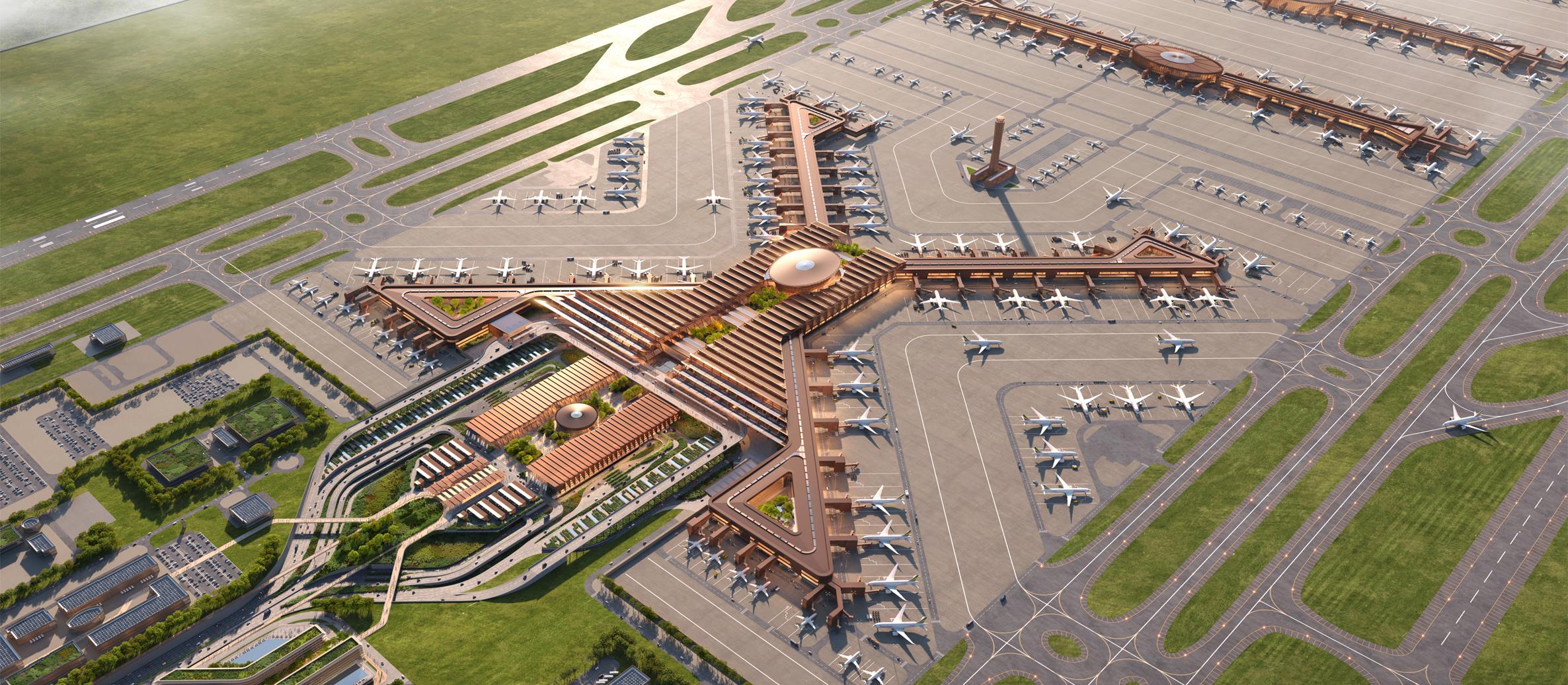
The Bishoftu International Airport, about 40 kilometres south of Addis Ababa, is designed to begin operations with capacity for 60 million passengers a year and eventually expand to 110 million. The first phase is estimated at about US$12.5 billion, making it one of the largest infrastructure investments currently being undertaken in Africa. Phase one is targeted for completion in 2030.
But the significance of Bishoftu is not just its passenger capacity. It is an attempt to create an entirely new aviation ecosystem around Ethiopian Airlines, with four runways, a major passenger terminal, large-scale cargo facilities, a dedicated fuel farm, ground transport links, utilities and an airport city.
The project is being developed because Addis Ababa Bole International Airport is approaching the limits of what its expanded infrastructure can handle. Bole’s expansion has taken its nominal annual capacity to about 25 million passengers, but Ethiopian Airlines’ continued growth has created a requirement for a second, much larger hub rather than repeated incremental expansion of the existing airport. The solution is therefore a multi-airport system in which Bole continues to operate while Bishoftu becomes the principal long-term hub.
Designing around aircraft performance
One of the more interesting engineering considerations in the selection of Bishoftu was elevation.
The new airport site sits at roughly 1,910 metres above sea level, considerably lower than Bole’s elevation of about 2,334 metres. For aviation infrastructure, elevation matters because air density affects aircraft performance, including take-off performance, payload and fuel efficiency.
The site thus offers an operational advantage while remaining sufficiently close to Addis Ababa to function as the airline’s principal hub. The airport occupies an approximately 3,500-hectare development area, creating enough room not only for the initial airfield and terminal but also for the long-term expansion envisaged by the masterplan.
The scale of the airside infrastructure is equally significant. The airport is planned around four runways, with associated taxiways and aircraft movement areas. The supporting engineering package includes substantial earthworks, pavement construction, drainage and airfield lighting and navigation infrastructure.
At this scale, the engineering challenge is less about constructing a runway than about creating a complete airfield capable of handling large volumes of simultaneous aircraft movements without the bottlenecks that can undermine capacity elsewhere in the airport system.
A terminal designed as a system rather than a building
The passenger terminal is planned at about 1.1 million square metres, while the cargo facilities will occupy more than 100,000 square metres.
That makes the terminal itself a major infrastructure project, but its real function will be determined by how effectively it integrates passenger processing, baggage handling, aircraft stands, security, customs, immigration and landside access.
The airport’s cargo role is particularly important for Ethiopian Airlines. Addis Ababa has developed into one of Africa’s major aviation gateways, and the new airport is intended to support not only passenger traffic but also the movement of high-value and time-sensitive freight.
The cargo infrastructure thus forms part of the airport’s core economic proposition rather than being an auxiliary facility added to a passenger airport.
The same principle applies to the fuel system. A dedicated fuel farm is being designed to store and distribute Jet A-1 and provide for future sustainable aviation fuel requirements. The fuel-farm environmental assessment places the facility directly alongside the cargo area and identifies it as critical infrastructure for the airport’s continuous operation.
Building an airport city
Bishoftu is also being conceived as more than an airfield and terminal.
The project includes an airport city, ground transportation infrastructure and supporting utilities. That changes the engineering challenge considerably. The airport must operate as a self-contained infrastructure system while also connecting efficiently with Addis Ababa and surrounding communities.
Road access, power, water, wastewater treatment, telecommunications, fuel distribution, drainage and emergency services must therefore be designed to a standard appropriate for an international aviation hub.
This is one reason the project has been subjected to separate environmental and social assessments for the runway and taxiway system, cargo facilities, airport city and fuel farm. Rather than treating the airport as a single construction package, the assessments recognise the different environmental and operational risks associated with its major components.
A project still moving through procurement
Although the airport formally broke ground on January 10, 2026, the delivery structure is still being assembled.
Ethiopian Airlines Group has divided the major works into four principal EPC-F procurement packages covering the main facilities, support facilities, airfield and infrastructure works, and off-site links.
The prequalification stage has already attracted some of the world’s largest construction companies. Shortlisted firms include China Communications Construction Company-led and China Civil Engineering-led joint ventures, Webuild-led combinations, Samsung C&T, VINCI Construction Grands Projets and other major international contractors.
Early works and project preparation have commenced, while the main works are being procured through a competitive process. Reuters reported that Ethiopian Airlines had allocated about US$610 million for earthworks, with the principal contractors expected to begin their packages later in 2026.
Financing a $12.5 billion aviation project
The financing structure is as ambitious as the physical infrastructure.
The African Development Bank has been appointed Initial Mandated Lead Arranger for the project and committed a US$500 million loan while leading efforts to mobilise additional lenders. Ethiopian Airlines is expected to contribute equity, with the balance being raised through debt financing.
The AfDB’s project documentation had initially put the total project cost at about US$10 billion, while subsequent project development and the current Ethiopian Airlines project specification place the first-phase investment at approximately US$12.5 billion. The difference illustrates how the scope and cost of a project of this scale can evolve as detailed engineering, systems and supporting infrastructure are incorporated.
The financing model is effectively project finance, with the airport intended to generate the revenues required to support the investment. That makes the commercial performance of the future hub almost as important as the engineering.
Why Bishoftu
Bishoftu is ultimately an infrastructure bet on Ethiopian Airlines.
The airline has built one of Africa’s strongest international networks around Addis Ababa, turning the Ethiopian capital into a major transit point between Africa, the Middle East, Asia, Europe and the Americas. The new airport is intended to give that model enough physical capacity to continue expanding.
The engineering challenge is thus to build a hub whose airside, terminal, cargo, fuel, transport and utility systems can grow together without one component becoming a constraint on the others.
That is what makes Bishoftu particularly relevant to engineers across Africa. It is an example of infrastructure being designed around a long-term economic system rather than around a single transport facility.
If the project reaches its planned 110-million-passenger ultimate capacity, Bishoftu will rank among the world’s largest aviation hubs. But its more immediate test will be whether Ethiopia can turn a vast greenfield site into an integrated airport system, deliver the infrastructure within its financing envelope and create enough operational capacity to keep pace with the airline that made the project necessary.

-
Product on sale
 AWEBook Volume 2Original price was: KShs 3,500.00.KShs 3,000.00Current price is: KShs 3,000.00.