
Last Updated 2 hours ago by Kenya Engineer
Namibia has commissioned what its developers describe as Africa’s first fully integrated green hydrogen facility, bringing solar power generation, battery storage, hydrogen production, refuelling and industrial applications together at a single site in Walvis Bay.
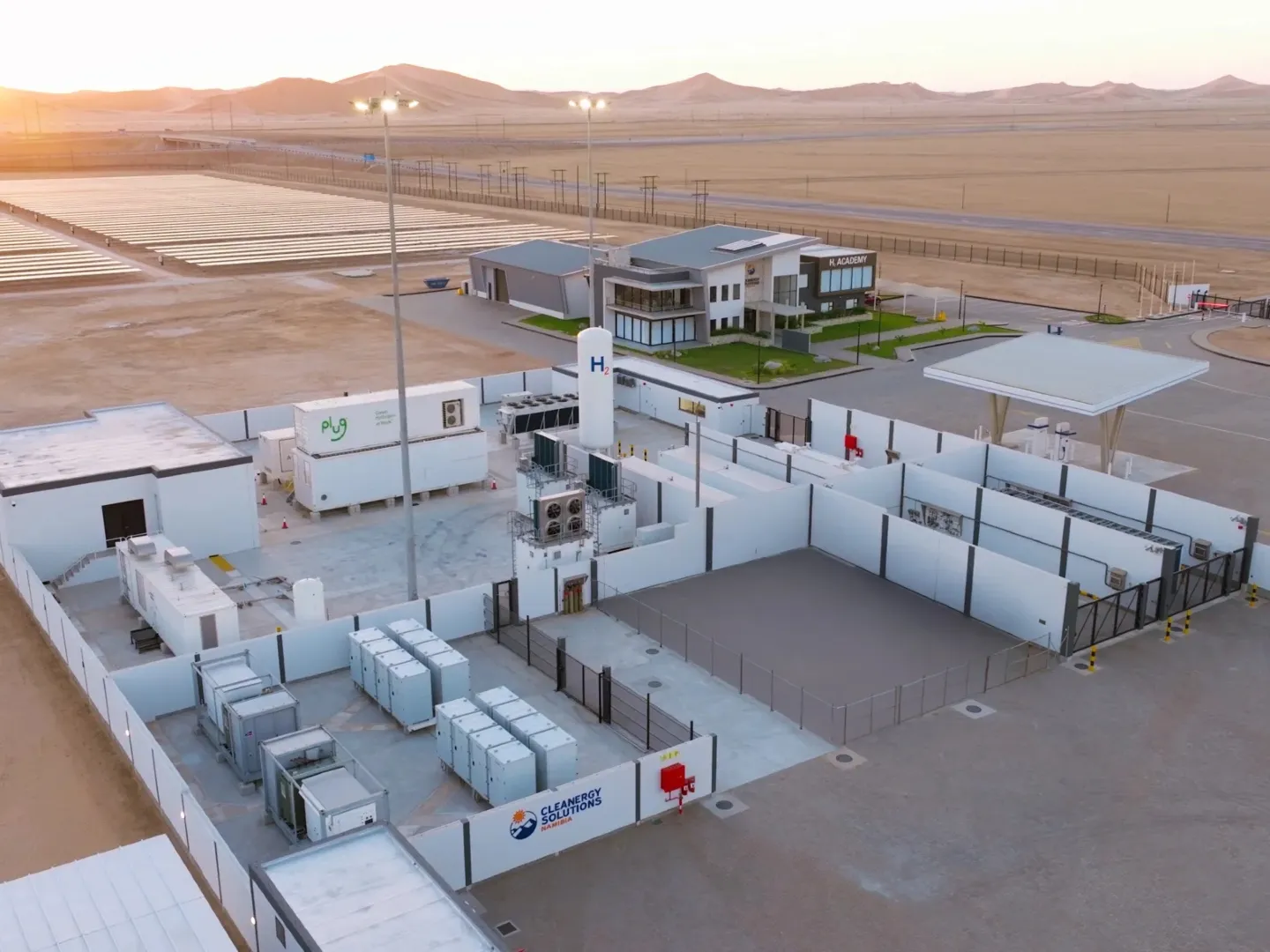
Developed by CMB.TECH Namibia, the facility combines a 5 MWp solar photovoltaic plant with a 5 MW proton exchange membrane (PEM) electrolyser and a 5.9 MWh battery energy storage system. The facility operates off-grid, using electricity generated by the solar plant and stored in the battery system to produce green hydrogen.
The project represents a shift from treating green hydrogen simply as another form of energy production towards building an integrated hydrogen ecosystem in which renewable electricity, storage, fuel production and end-use are designed to operate together.
Located in Walvis Bay, Namibia’s major Atlantic port, the facility is initially intended to supply hydrogen for industrial and transport applications, including dual-fuel trucks, generators and a planned hydrogen-powered freight locomotive.
How the system works
At the centre of the facility is the 5 MW PEM electrolyser.
Green hydrogen is produced by using electricity from renewable sources to split water into hydrogen and oxygen. In this installation, electricity generated by approximately 7,000 solar panels is supplied to the electrolyser, while the battery system helps manage the variability of solar generation and allows the hydrogen production system to continue operating beyond periods of direct sunlight.
The solar installation occupies approximately 6.5 hectares and has a generation capacity of 5 MWp.
The battery energy storage system has a capacity of 5.9 MWh. Together, the solar plant and battery provide the electricity required for the electrolyser without relying on the national grid.
The resulting hydrogen is compressed and stored before being supplied for different applications.
According to the environmental assessment for the facility, the system includes hydrogen storage at 300 bar and 500 bar, with the higher-pressure storage supporting vehicle refuelling. The facility includes a hydrogen fuelling station capable of dispensing hydrogen for heavy-duty vehicles, as well as equipment for transporting hydrogen to other applications.
The site therefore brings together several systems that are normally developed as separate components: renewable electricity generation, energy storage, electrolysis, hydrogen compression and storage, distribution and end-use.
That integration is the defining feature of the project.
From sunlight to transport fuel
The first users of the hydrogen will include CMB.TECH’s own industrial and transport operations. The company plans to use the fuel in dual-fuel trucks and generators, while a hydrogen-powered freight locomotive is also planned.
CMB.TECH is effectively acting as its own initial customer, giving the facility a guaranteed hydrogen offtake from the beginning. This addresses one of the challenges facing many emerging green hydrogen projects: building production capacity before establishing a market for the fuel.
The project is also designed as a demonstration platform for wider applications. Plans include expansion into maritime applications, including potential hydrogen refuelling infrastructure for the port and shipping sector.
The location at Walvis Bay is particularly significant because the port is an important logistics gateway for Namibia and the wider southern African region. The integration of hydrogen production with transport and port activities could eventually allow renewable hydrogen to become part of a broader low-carbon logistics system.
Siemens provides the control architecture
A facility combining solar generation, batteries, electrolysers, compressors, hydrogen storage and vehicle refuelling requires the different systems to operate together safely and reliably.
Siemens supplied the integrated electrical, automation and safety systems for the facility.
This includes the systems required to coordinate power generation, distribution, hydrogen production and safety functions across the plant. Siemens has described the project as demonstrating how multiple technologies can be brought together through a common control and automation architecture.
This integration becomes increasingly important as hydrogen facilities grow.
Solar power is inherently variable. Electrolysers have operating requirements that need to be managed within the available electrical supply. Batteries can smooth fluctuations and provide energy during periods when solar output falls, while hydrogen storage provides another form of energy buffering.
The facility combines electrical storage and chemical energy storage within the same energy system. The battery stores electricity. The electrolyser converts electricity into hydrogen. The hydrogen is then stored for subsequent use as a fuel.
This creates a chain linking renewable generation to transport and industrial energy demand.
Green hydrogen
Hydrogen has attracted growing interest because some sectors are difficult to decarbonise through direct electrification alone.
Passenger vehicles, for example, can increasingly use batteries, while many industrial and transport applications require different solutions because of their energy requirements, operating cycles or the weight of batteries needed.
Heavy trucks, mining equipment, rail locomotives, shipping and some industrial processes are among the areas where hydrogen and hydrogen-derived fuels are being investigated.
Green hydrogen is particularly attractive because the hydrogen is produced using renewable electricity rather than electricity generated from fossil fuels.
The technology does not eliminate the need for energy. Instead, it converts renewable electricity into a storable fuel that can subsequently be transported and used in applications where direct use of electricity may be difficult.
Namibia has significant solar and wind resources, giving the country an opportunity to produce renewable electricity at potentially competitive costs.
The country’s government is therefore pursuing a broader strategy to develop green hydrogen and green ammonia production, with the long-term ambition of establishing a new industrial sector around renewable energy and hydrogen.
A small plant with a much larger ambition
At 5 MW, the Walvis Bay facility is not yet a large industrial hydrogen plant. Its significance lies partly in what comes next.
CMB.TECH says the next stage is to expand the system to 250 MW, with an eventual ambition of reaching 500 MW. The company has described the current facility as a “living lab” for an integrated hydrogen economy.
Scaling from 5 MW to hundreds of megawatts, however, will introduce substantially different engineering and commercial requirements.
A larger facility would require much greater renewable generation capacity, larger electrolysis systems, expanded hydrogen storage and compression infrastructure and more extensive distribution networks.
Water supply would also become increasingly important. The current facility uses potable water supplied by NamWater, with the environmental assessment estimating average consumption of approximately 14 cubic metres per day.
At much larger production scales, water sourcing, treatment and efficient use will become important elements of project design, particularly in a country such as Namibia where water resources are limited.
Building an African hydrogen industry
The Walvis Bay project also illustrates an important feature of Africa’s emerging hydrogen sector. Rather than focusing exclusively on exporting hydrogen or ammonia to overseas markets, the project is initially using the fuel within Namibia itself.
That creates a pathway for hydrogen technology to develop around domestic applications before potentially expanding into international markets. The facility includes a Hydrogen Academy intended to support skills development and train local personnel in the emerging industry.
This is significant because developing a hydrogen economy requires more than electrolysers and solar panels. It requires engineers capable of designing and operating renewable power systems, electrical and control engineers, hydrogen process specialists, technicians, safety professionals, maintenance teams and people able to manage the specialised storage and transportation of hydrogen.
The project is consequently also being positioned as a platform for building local technical capacity.
From demonstration to infrastructure
Namibia’s Walvis Bay facility is part of a much larger national push.
Other projects are being developed around the country’s green hydrogen strategy, including major proposals for hydrogen and green ammonia production. The country’s Green Hydrogen Programme identifies Namibia’s solar and wind resources as a potential foundation for large-scale renewable energy development and green industrialisation.
The country is attempting to build an ecosystem rather than a single hydrogen plant. That ecosystem could eventually include renewable power plants, electrolysers, hydrogen pipelines and storage, ammonia production, industrial users, heavy transport, ports and export infrastructure.
For Africa, the significance extends beyond Namibia.
The continent has enormous renewable energy resources but continues to face challenges in electricity access, industrialisation and dependence on imported fuels. Green hydrogen could provide another route for converting renewable resources into industrial energy and exportable commodities.
But the technology remains capital-intensive, and its economics depend heavily on the cost of renewable electricity, electrolysers, storage, water, transport infrastructure and reliable hydrogen demand.
The Walvis Bay facility provides an opportunity to test these systems in an operating environment rather than only at the planning stage.
A model for integrated clean energy
The most important feature of the Walvis Bay project may be its architecture.
Instead of building a solar farm and separately considering how its electricity might be used, the project connects generation directly to energy storage, hydrogen production and identifiable end-users.
That creates a complete chain from sunlight to electricity, electricity to hydrogen, hydrogen to storage and storage to transport and industrial applications.
For Namibia, it is a first practical step towards a hydrogen economy. For the wider African energy sector, it provides a working example of how renewable electricity can be integrated with hydrogen production and energy storage within a single industrial system.
The current 5 MW installation may be modest compared with the hundreds of megawatts envisioned for its next phases. But if those expansions can be delivered, the Walvis Bay project could evolve from a demonstration facility into one of the building blocks of Namibia’s ambition to become a major renewable-energy and green-hydrogen hub.
The engineering challenge now is to prove that the model can be scaled economically, safely and reliably.
-
Product on sale
 AWEBook Volume 2Original price was: KShs 3,500.00.KShs 3,000.00Current price is: KShs 3,000.00.