
Last Updated 1 hour ago by Kenya Engineer
Nigeria’s Lagos–Calabar Coastal Highway is one of the country’s most ambitious road projects, but its engineering significance goes beyond its 700-plus-kilometre length. The project is an attempt to build a continuous high-capacity transport corridor through some of Nigeria’s most densely populated and environmentally sensitive coastal areas.
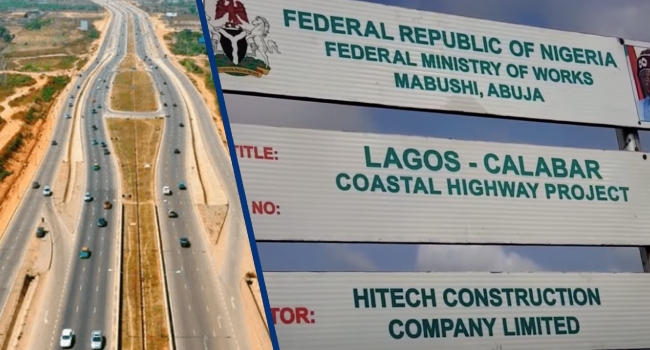
The highway is planned to run from Lagos through Ogun, Ondo, Edo, Delta, Bayelsa, Rivers, Akwa Ibom and Cross River before reaching Calabar. The Federal Government describes the full route as approximately 750 kilometres, while the initial project documentation for Section 1 covers the first 47 kilometres from Victoria Island to Eleko.
The first section reveals the unusual engineering requirements of the project.
Rather than a conventional flexible asphalt pavement, the Lagos Section 1 contract calls for a continuously reinforced concrete pavement, or CRCP, constructed as a dual carriageway. The contract includes drainage and culverts, median barriers, street lighting and relocation of utilities including electricity, gas and water infrastructure. Hitech Construction Africa Limited is the contractor.
CRCP is particularly interesting for a project exposed to heavy traffic and difficult coastal conditions. Unlike conventional jointed concrete pavement, continuously reinforced concrete pavement uses longitudinal reinforcement to control cracking rather than relying on frequent transverse contraction joints. The objective is a durable pavement system capable of carrying substantial traffic with relatively low maintenance over its design life.
But the pavement is only one component of the engineering challenge.
The Lagos section passes through an area where the road corridor intersects rapidly developing urban districts, existing utilities and a complicated coastal drainage environment. Construction therefore requires substantial earthworks and ground preparation before the concrete pavement can be placed. During inspections, the Federal Ministry of Works specifically highlighted the work below the finished pavement, including the layers that provide the structural foundation for the concrete carriageway.
The highway has also been designed with future transport integration in mind.
The first-phase 47.7-kilometre dual carriageway includes a central reserve designed to accommodate a future railway, alongside tolling infrastructure, pedestrian crossings, wildlife crossings and connections to wider trade routes. This means the road reservation is effectively being designed as a multimodal corridor rather than simply as a highway.
The project has already moved beyond the purely conceptual stage.
Section 1 was divided into a 47.4-kilometre first phase from Ahmadu Bello Way Junction in Victoria Island to Eleko Village, followed by the remaining approximately 55.6 kilometres to the Lagos-Ogun border. The first 47.4-kilometre section was completed sufficiently for temporary traffic opening in December 2025.
Work is also progressing elsewhere along the corridor. In Akwa Ibom and Cross River, Hitech is responsible for a 71.4-kilometre section identified as Sections 3A and 3B. The sections were flagged off in April 2025.
The financing architecture is equally significant.
The first phase has been supported by a US$747 million syndicated financing arranged with Deutsche Bank as global coordinator. The financing syndicate includes First Abu Dhabi Bank, Afreximbank, the Abu Dhabi Exports Office, the ECOWAS Bank for Investment and Development and Zenith Bank. The facility supports the initial 47.47-kilometre stretch rather than the entire coastal highway, whose overall cost has been estimated at roughly US$11 billion.
ICIEC, the Islamic Corporation for the Insurance of Investment and Export Credit, has separately provided risk-mitigation support for a US$300 million Islamic financing facility associated with the first phase. Its coverage is designed to reduce the sovereign-financing risk borne by the participating financial institutions.
The scale of the financing reflects the fact that the project is much more than a single road contract. A coastal highway of this length requires bridges and culverts, drainage structures, interchanges, utility relocations, service facilities, lighting, environmental mitigation and land acquisition. In several sections, the engineering solution must also respond to flooding, soft ground and the vulnerability of coastal communities and ecosystems.
The project presents Nigeria with a particularly demanding balance between speed of construction and long-term durability.
A road built along the coast cannot be designed only around vehicle loading. Drainage, groundwater, erosion, pavement subgrade conditions and changing rainfall patterns all affect the service life of the asset. The ability to maintain the road and associated drainage system will ultimately be as important as the initial construction programme.
Its strategic significance extends beyond Lagos and Calabar.
A continuous coastal corridor would provide an alternative east-west transport route linking some of Nigeria’s most important commercial centres and ports. It could shorten journeys, improve access to tourism and industrial locations and create a continuous logistics spine along the southern part of the country.
The engineering test will be whether the completed corridor performs as one system rather than as a series of disconnected contracts. The Lagos–Calabar Coastal Highway is being built section by section, but its economic value depends on those sections eventually functioning as a single resilient transport corridor.
-
Product on sale
 AWEBook Volume 2Original price was: KShs 3,500.00.KShs 3,000.00Current price is: KShs 3,000.00.