
Last Updated 3 hours ago by Kenya Engineer
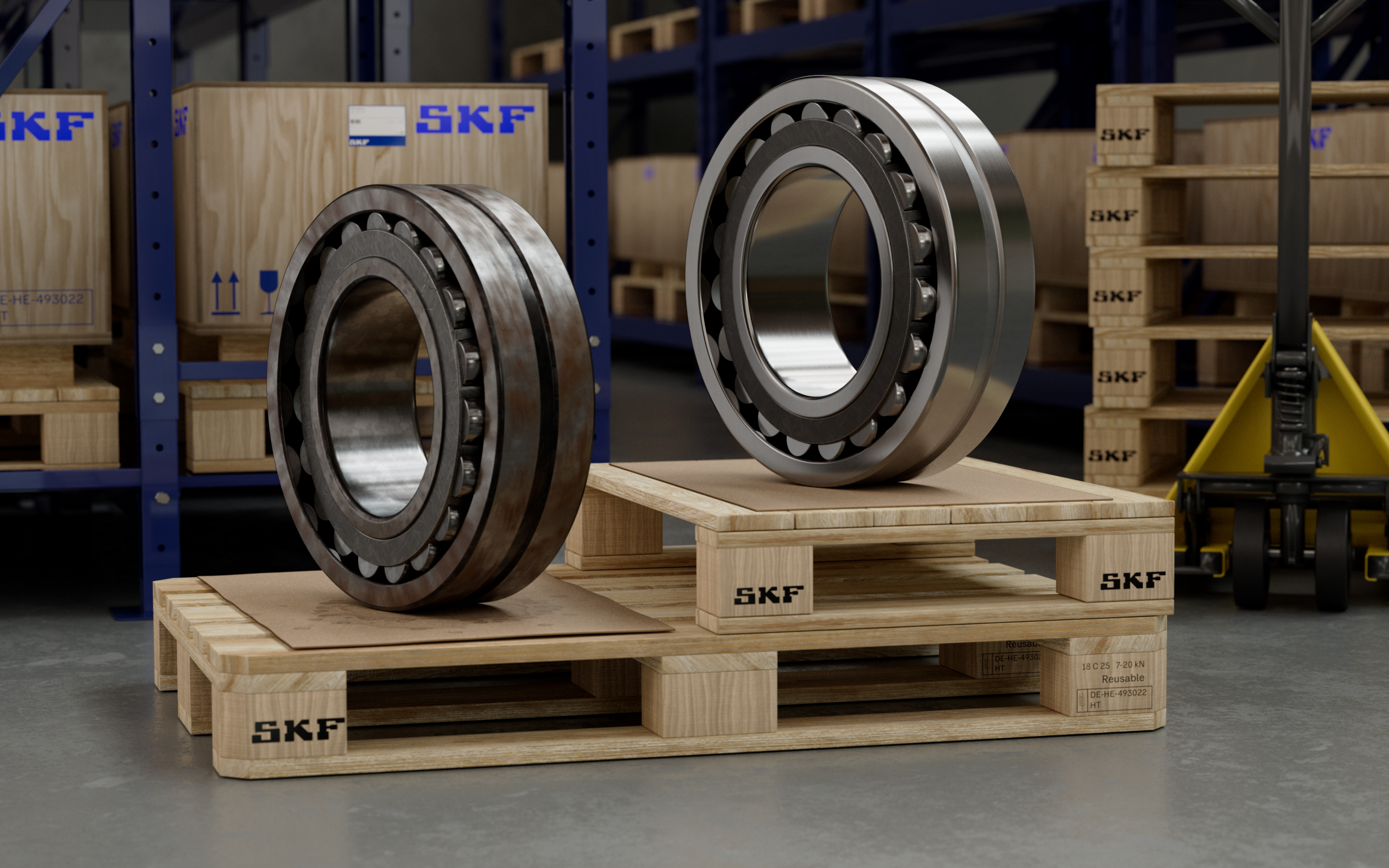
SKF South Africa has completed what it describes as Africa’s first component-replacement bearing remanufacturing service, restoring four critical bearings used on a High Pressure Grinding Roll (HPGR) in the mining industry and reducing the required turnaround time from about six months to eight weeks.
The intervention, carried out for a longstanding mining-sector customer, also reduced the cost of the bearing solution by approximately 50% compared with replacing the bearings with new units.
The project involved four large-size 240/800 ECAK30/C4L bearings operating on an HPGR, equipment used in mining operations to crush and process material under extremely high pressure. The demanding operating conditions place substantial loads on the bearings, making their reliability critical to the availability of the equipment and, ultimately, production.
According to SKF South Africa Service Delivery Manager Lourens Pretorius, the customer faced a significant challenge when the four bearings required remanufacturing. Manufacturing new bearings would have involved a lead time of approximately six months, while the HPGR needed to be returned to operation much sooner.
The solution was to go beyond conventional bearing remanufacturing by replacing the rolling elements with oversized rollers. The approach allowed SKF to restore the bearings while controlling their internal clearance and completing the work within eight weeks.
“We have remanufactured large-size bearings for the customer in the past, but we have never replaced components on a bearing before,” Pretorius said.
The project represents the first time SKF South Africa has completed a component-replacement remanufacturing Service Level of this kind in Africa.
Engineering around bearing clearance
A key technical consideration in the project was the radial internal clearance of the bearings.
Bearing clearance is the amount of internal space between the rolling elements and raceways when the bearing is not under load. SKF classifies clearances into different ranges, with C3 representing greater-than-normal clearance and C4 representing a higher clearance range. The C4 range can itself be divided into lower and higher portions, such as C4L and C4H.
Pretorius explained that measuring the existing clearance is an important first step when a bearing is received for remanufacturing because the machining and restoration processes can affect the final clearance.
In the case of the four HPGR bearings, the existing radial internal clearances were already within the C4H range.
Under a conventional Service Level 3 (SL3) remanufacturing process, further removal of bearing material could have resulted in the clearance moving into the C5 range. Such a change would not have provided the required operating characteristics for the application.
SKF therefore adopted a different approach.
The rolling elements were replaced with oversized rollers, allowing the internal clearance to be brought back within the required range. The modified bearings were ultimately restored to C3 clearance.
“This is why, to mitigate this issue, the rolling elements were substituted with oversize rollers to control the bearing’s radial internal clearance,” Pretorius explained.
The intervention enabled the bearings to be remanufactured and returned to service within eight weeks.
The project was undertaken using SKF’s Service Level 4 (SL4) remanufacturing approach, which allows critical bearing components such as rolling elements, cages and guide rings to be replaced where necessary. This goes beyond more conventional remanufacturing processes focused primarily on restoring existing components.
Extending the life of high-value components
SKF established its specialist bearing remanufacturing facility at its Jet Park head office in Johannesburg in 2008. The facility is intended to extend the usable life of bearings that might otherwise be replaced, allowing high-value components to be returned to service for a second, third or even fourth operating cycle where their condition makes this technically viable.
For industrial operators, the economics can be significant. Remanufactured bearings can cost up to about half the price of new units, while also potentially offering substantially shorter lead times.
The HPGR project demonstrates another advantage: remanufacturing can provide an alternative to waiting for a completely new component when an application is experiencing critical downtime.
In this case, the difference was particularly significant. Instead of waiting approximately six months for new bearings, the customer was able to have the four existing units restored in eight weeks.
For mining operations, where the availability of major processing equipment directly affects production, the reduction in downtime can have considerable commercial value.
The solution also reduces the need for new raw materials. Rather than manufacturing four entirely new large bearings, SKF was able to retain the major bearing assemblies while replacing the components required to restore their performance.
Components that cannot be economically or technically remanufactured are recycled, according to SKF.
From remanufacturing to lifecycle engineering
The project illustrates how bearing maintenance is increasingly moving beyond the traditional model of replacing components once they reach the end of their initial service life.
For large industrial bearings, replacement can involve substantial material consumption, manufacturing capacity, transportation and lead time. Remanufacturing creates another option in which the condition of the component is assessed and engineering intervention is used to determine which parts need to be restored, machined or replaced.
This approach also requires detailed knowledge of bearing geometry, materials, operating loads and internal clearances.
The HPGR application is particularly demanding because the grinding rolls operate under extremely high forces. Any bearing solution therefore has to account not only for the physical restoration of the bearing but also for the operating requirements of the equipment in which it is installed.
SKF says the remanufactured bearings will continue to be supported jointly with the customer through aftermarket services, including servicing, repairs and maintenance.
This provides an opportunity to monitor the bearings throughout their subsequent operating life and potentially extract further value from the components.
Reducing downtime and total cost of ownership
The financial benefit of the project extends beyond the initial 50% cost saving.
By returning the bearings to service more quickly, the remanufacturing intervention also reduced the period during which the HPGR could have remained unavailable. For mining companies, equipment downtime can translate directly into lost production, making lead time an important component of total cost.
The ability to restore an existing bearing in eight weeks rather than wait six months for new units therefore provides both a direct component-cost advantage and a potential production-availability benefit.
It also supports a lifecycle approach to industrial asset management, where the objective is not simply to purchase the cheapest replacement component but to maximise the useful life and value of equipment over multiple operating cycles.
For SKF South Africa, the project represents a significant expansion of its remanufacturing capability. For the wider African mining industry, it points to the potential for more sophisticated component-recovery and lifecycle-management strategies as operators seek to control maintenance costs, reduce downtime and improve the environmental performance of their operations.
The project also demonstrates that remanufacturing is not necessarily limited to cleaning, inspection and reconditioning. In applications where component condition and operating requirements demand it, remanufacturing can involve engineering modifications and replacement of critical components.
In this case, replacing the rolling elements with oversized rollers provided a way to overcome a clearance challenge that would otherwise have limited the conventional remanufacturing route.
The result was a restored set of four large HPGR bearings, delivered in eight weeks rather than six months and at about half the cost of new bearings.
For an industry in which equipment availability, maintenance costs and resource efficiency are increasingly important, the project provides a practical example of how advanced remanufacturing can become part of a broader strategy for extending asset life and improving industrial sustainability.
-
Product on sale
 AWEBook Volume 2Original price was: KShs 3,500.00.KShs 3,000.00Current price is: KShs 3,000.00.