

Last Updated 2 months ago by Kenya Engineer
Every year, thousands of students sit with their parents, teachers and career masters to make one of the biggest decisions of their lives: choosing a university course.
For many, engineering quickly appears on the shortlist. It is respected, intellectually challenging and has long been associated with innovation and national development.
Yet it is also one of the professions surrounded by the most questions.
Will Artificial Intelligence replace engineers?
Is engineering still marketable?
Which engineering course has the brightest future?
Will I find a job after graduation?
These are valid questions. The world of work is changing rapidly, and young people deserve honest answers before committing four or five years of their lives to a degree programme.
The good news is this: engineering is not becoming less relevant. It is becoming more important than ever before.
The only difference is that tomorrow’s engineers will look very different from yesterday’s.
Engineering is entering its most exciting era
Every major challenge facing humanity today has an engineering dimension. From the transition to renewable energy, Climate change, Artificial Intelligence, Smart cities, Affordable housing, Electric vehicles, Food security, Clean water, Modern healthcare, Cybersecurity, Industrial automation to Space exploration.
Behind every one of these developments are engineers designing, improving, testing and maintaining the systems that make them possible.
Far from replacing engineers, technologies such as Artificial Intelligence are becoming powerful tools that help engineers solve problems faster, analyse larger volumes of data and make better decisions.
History offers useful perspective.
Calculators did not replace mathematicians.
Computer-Aided Design (CAD) did not replace architects.
Excel did not replace accountants.
Similarly, Artificial Intelligence is unlikely to replace engineers. Instead, it will transform how engineering is practised, allowing engineers to focus less on repetitive calculations and more on creativity, innovation and solving complex real-world problems.
Engineering is no longer just about machines and buildings
Ask many people what comes to mind when they hear the word “engineer,” and they are likely to picture someone wearing a hard hat on a construction site.
That image tells only a small part of the story.
Today’s engineers are designing intelligent transport systems, developing medical technologies, building autonomous robots, protecting computer networks, creating renewable energy solutions, programming industrial machines and analysing vast amounts of data generated by modern infrastructure.
Engineering has become one of the most diverse professions in the world.
Whether your interests lie in technology, healthcare, agriculture, transport, manufacturing, energy or the environment, there is almost certainly an engineering discipline connected to it.
Which engineering course should you choose?
There is no single “best” engineering course.
The right choice depends on your interests, strengths and the kinds of problems you would like to solve throughout your career.
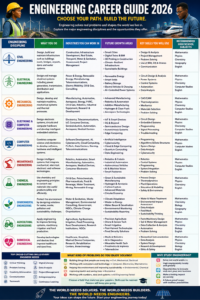
Civil Engineering
If you enjoy designing structures and shaping communities, Civil Engineering remains one of the most impactful careers. The future of the profession lies in smart cities, digital construction technologies, resilient infrastructure, Building Information Modelling (BIM), green buildings and climate-resilient design.
Electrical Engineering
As the world shifts towards renewable energy, battery storage, electric mobility and intelligent power systems, Electrical Engineering is entering an exciting period of growth. Engineers in this field are helping build the power networks that will support tomorrow’s economies.
Mechanical Engineering
Mechanical engineers continue to form the backbone of manufacturing, transport and industrial production. Increasingly, however, they are working alongside robotics, automation, advanced manufacturing technologies and artificial intelligence to create smarter, more efficient systems.
Electronic and Computer Engineering
This discipline sits at the heart of the digital economy. From embedded systems and Internet of Things (IoT) devices to telecommunications, semiconductor technologies and intelligent electronics, demand for these skills is expected to continue growing.
Mechatronics Engineering
For students fascinated by robots, automation and intelligent machines, Mechatronics combines mechanical, electrical, electronic and software engineering into one rapidly expanding discipline. It is likely to become one of the defining engineering fields of the coming decades.
Environmental Engineering
Climate change, pollution control, waste management and sustainable development are creating growing demand for engineers capable of protecting natural resources while supporting economic growth.
Agricultural Engineering
With increasing pressure to feed a growing global population, agriculture is becoming more technology-driven. Precision farming, drone technology, automated irrigation and smart food systems are transforming this field into one of the most innovative areas of engineering.
Biomedical Engineering
As medicine and technology become increasingly interconnected, Biomedical Engineering offers opportunities to develop medical equipment, diagnostic technologies, prosthetics, rehabilitation devices and healthcare innovations that improve lives.
Chemical Engineering
Chemical engineers are helping shape cleaner industries through green manufacturing, battery technologies, hydrogen production, pharmaceuticals, advanced materials and sustainable industrial processes.
The future belongs to engineers who keep learning
Perhaps the biggest change facing the profession is that earning an engineering degree is no longer the end of learning.
It is only the beginning.
Tomorrow’s engineers will need to continually develop new skills throughout their careers.
Programming.
Data analytics.
Artificial Intelligence.
Cybersecurity.
Project management.
Communication.
Business and entrepreneurship.
Engineers who embrace continuous learning will remain highly valuable regardless of how technology evolves.
Those who stop learning may struggle to keep pace.
The engineer employers will be looking for
Technical knowledge will always matter.
However, employers are increasingly searching for engineers who can do much more than solve equations.
They want professionals who can communicate effectively, collaborate with multidisciplinary teams, manage projects, analyse data, understand business challenges and develop practical solutions to complex problems.
The engineer who combines technical excellence with leadership, creativity and digital skills will stand out in virtually every industry.
Universities must prepare students for the future
Engineering education is also evolving.
Students entering university today should expect exposure not only to traditional engineering principles but also to modern tools and technologies such as Artificial Intelligence, Building Information Modelling (BIM), Geographic Information Systems (GIS), drones, cloud computing, Internet of Things (IoT) platforms, digital twins, programming and industrial automation.
These technologies are increasingly becoming part of everyday engineering practice across the world.
Universities that successfully integrate them into their curricula will better prepare graduates for the workplaces of tomorrow.
What about employment?
This remains one of the biggest concerns among students and parents.
Like many professions, engineering graduates can face challenges entering the job market immediately after graduation. The transition from university to industry is not always smooth, and stronger collaboration between universities, employers and professional bodies is needed to expand internship opportunities, graduate trainee programmes and mentorship.
At the same time, the nature of engineering careers is changing.
Many engineers are no longer waiting for employment opportunities.
They are creating them.
Engineering graduates are establishing renewable energy companies, automation firms, technology startups, consulting practices, manufacturing businesses and digital engineering enterprises that serve clients locally and internationally.
The profession increasingly rewards innovation, adaptability and entrepreneurship.
A message to parents
Parents naturally want their children to pursue careers that offer stability and meaningful opportunities.
Engineering continues to provide both.
However, success in engineering depends less on prestige and more on passion.
Encourage your child to choose engineering because they enjoy solving problems, asking questions, building things and understanding how the world works—not simply because engineering has traditionally been viewed as a prestigious profession.
Students who genuinely enjoy the discipline are more likely to thrive throughout their studies and careers.
A message to students
If you enjoy mathematics, science, creativity and finding practical solutions to everyday challenges, engineering may be one of the most rewarding professions you could choose.
Do not be discouraged by headlines suggesting that technology will replace engineers.
Technology is changing engineering—but it is also creating entirely new opportunities for engineers willing to embrace change.
Some recent reports have highlighted vacant engineering places in a few university programmes. Rather than seeing this as evidence that engineering is losing relevance, it may be more useful to ask whether we are doing enough to inspire young people, modernise engineering education and communicate the remarkable opportunities the profession offers in a rapidly changing world.
The future will need engineers to design cleaner energy systems, smarter cities, safer transport networks, more resilient infrastructure, sustainable industries and technologies that have not yet been imagined.
The world will always need people who can identify problems, think critically and build solutions.
That has always been the work of engineers.
And for the next generation, that work may be more important than ever before.

-
Product on sale
 AWEBook Volume 2Original price was: KShs 3,500.00.KShs 3,000.00Current price is: KShs 3,000.00.