

Last Updated 1 hour ago by Kenya Engineer
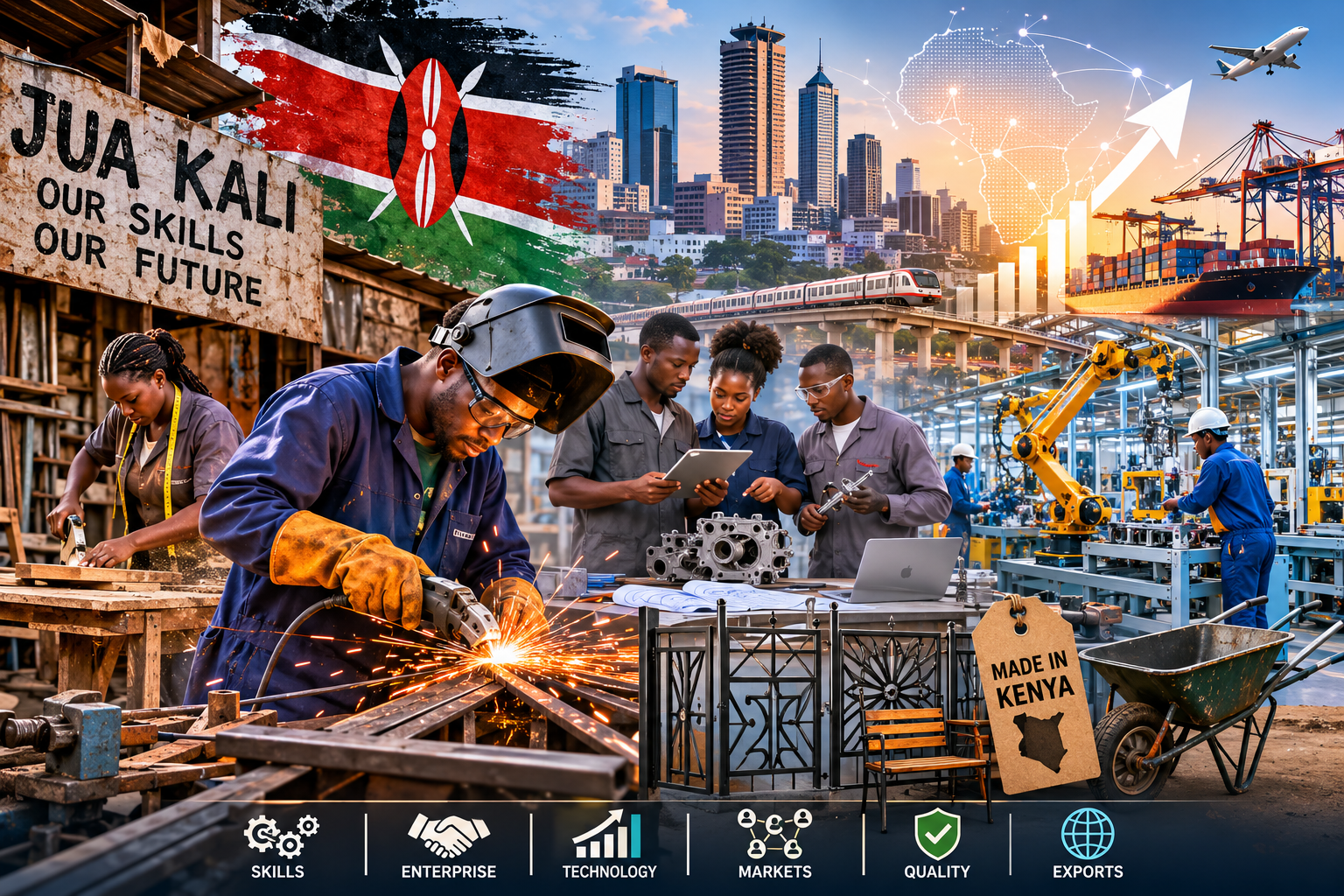
Kenya has millions of people earning a living outside the formal economy, including a large base of artisans and small manufacturers. But the question is no longer simply how to “support Jua Kali”. The bigger question is how Kenya can turn its enormous reservoir of practical skills into a more productive, technologically capable and internationally competitive manufacturing system.
Walk through almost any Kenyan town and the evidence is impossible to miss.
There are people welding gates, repairing machinery, making furniture, fabricating agricultural equipment, repairing engines, producing cooking appliances, shaping steel, modifying trailers, making school desks and turning sheets of metal into products that did not exist a few hours earlier.
This is Kenya’s Jua Kali economy.
It is often described primarily as a source of employment, particularly for people who cannot find work in the formal economy. That description is true, but incomplete. Jua Kali is also one of the country’s largest reservoirs of practical manufacturing knowledge.
The question, therefore, is not whether Kenya has manufacturing talent. It clearly does.
The question is why so much of that talent remains trapped at a very small scale.
The issue is particularly visible when a Kenyan artisan or small manufacturer produces an item locally and discovers that an apparently similar product imported from China can sit on a shop shelf for less money.
China is an important case study because Chinese products are everywhere in the Kenyan market. But the real story is bigger than China. It is a story about scale, productivity, technology, finance, infrastructure, industrial organisation, markets and government policy.
And if Kenya is serious about transforming its Jua Kali sector, it needs to look not only at China, but also at countries such as Singapore, India and Vietnam that have taken different approaches to developing small and medium-sized enterprises and integrating them into larger manufacturing systems.
The objective should not be to turn every Kenyan fundi into a Chinese factory. It should be to create a system in which a fundi with the right skills can become a workshop owner, a workshop can become a manufacturer, a manufacturer can become a supplier to a larger company, and some of those companies can eventually become exporters.
An economy built around informal enterprise
Kenya’s dependence on small and informal businesses is not a marginal feature of the economy.
The 2026 Economic Survey reports that total recorded employment, excluding small-scale agriculture and pastoral activities, reached 21.6 million in 2025. The informal sector accounted for 18.1 million of those jobs, and 87.2 per cent of the 822,100 jobs created during the year were in the informal sector. (Kenya National Bureau of Statistics)
Those numbers should change how Kenya thinks about the informal economy. The Jua Kali sector should not simply be regarded as an unfortunate holding ground for people waiting for formal employment. It is already a major part of the country’s productive economy.
But there is an important distinction. Not every informal worker is a manufacturer, and not every Jua Kali enterprise has the same potential to scale.
A person repairing shoes, a mechanic repairing a truck, a welder producing gates and a workshop producing hundreds of standardised metal components every month are all participating in different economic activities.
Treating all of them as one group called “Jua Kali” makes policy easier to announce but harder to implement.
A more useful approach is to view the sector as a manufacturing and enterprise pipeline.
At one end is the apprentice learning a practical skill. Further along is the artisan selling his or her labour. Then comes the workshop owner who employs other people. Beyond that is the small manufacturer with machinery, repeat customers and production systems. Further still is the medium-sized manufacturer supplying larger companies or government projects. At the top are firms capable of exporting, developing products and competing internationally.
Kenya’s challenge is that too many businesses never make that journey.
A 2026 study of Jua Kali artisans in Nairobi’s Eastlands found that 86.3 per cent of the artisans surveyed had acquired their skills through apprenticeship, while only 12.7 per cent had obtained their skills through TVET institutions. Yet only 52.2 per cent of those interviewed actually owned artisanal businesses. The study also found significant problems with business sustainability, certification, business management and access to proper workshops. (Springer)
This tells us something important. Kenya has a remarkably effective mechanism for creating practical skills, but a much weaker mechanism for converting those skills into sustainable and scalable businesses.
The Jua Kali sector is not failing at everything
Before discussing its problems, it is worth acknowledging something that is often missed. Jua Kali has competitive advantages.
A small Kenyan workshop can make one customised gate when the customer wants a particular design. It can modify an agricultural machine to suit a particular farm. It can repair a broken component rather than requiring the owner to purchase an entirely new machine. It can respond to a customer within hours or days rather than waiting for an imported product to arrive.
That flexibility has economic value.
Large-scale factories are extremely efficient when producing large quantities of standardised products. They are not necessarily efficient at producing one unique item.
The Kenyan artisan can therefore compete where proximity, customisation, repair, flexibility and small production runs matter.
The problem arises when the Kenyan workshop is asked to compete on standardised mass-produced products against a factory that makes thousands or millions of identical units.
That is where the economics change dramatically.
A workshop producing 20 items cannot buy steel in the same quantities as a factory producing 20,000. It cannot spread the cost of a CNC machine over the same number of products. It cannot employ a specialist whose entire job is to operate one stage of the production process. It cannot negotiate logistics rates on the same scale.
And if every product is individually measured, cut, welded, finished and assembled, much of the work is being performed repeatedly by skilled labour.
That does not mean the artisan is inefficient as an individual. It means the production system around the artisan is operating at a very different scale.
Why can a Chinese product travel thousands of kilometres and still be cheaper?
This is probably the most frequently asked question in the Jua Kali debate.
If a product is manufactured in China, loaded into a container, transported across the Indian Ocean, cleared through customs, moved to a Kenyan warehouse and finally delivered to a shop, how can it possibly cost less than something produced a few kilometres away?
The answer is that transport is only one component of the final cost.
Imagine two businesses producing an identical metal product.
One Kenyan workshop buys small quantities of steel, cuts each piece manually, welds it individually, purchases electricity at relatively small volumes, employs workers who perform several different tasks, buys components from different suppliers and produces perhaps a few dozen units a month.
The Chinese manufacturer may buy raw materials in enormous quantities, use specialised machinery, produce thousands of units in a long production run, purchase components from suppliers located within the same industrial cluster, automate repetitive operations and distribute the fixed cost of its machinery across tens of thousands of products.
The cost of shipping the finished item to Kenya may therefore be significant while still being relatively small per unit.
This is the mathematics of economies of scale.
Kenya’s own manufacturing research supports the importance of this problem. A recent KIPPRA study found that manufacturing costs, measured through cost of goods sold, make up the largest share of total costs for Kenyan listed manufacturers, with raw materials and electricity making significant contributions to production expenses. (kippra.or.ke)
A World Bank analysis of Kenya’s furniture industry reached a similar conclusion more than a decade ago. It found that Kenyan furniture producers were disadvantaged by productivity, machine time, overheads and production organisation, and recommended clustering Jua Kali firms so that they could share facilities, specialise and benefit from economies of scale. (World Bank)
China: The lesson is scale
China is an obvious benchmark for Kenya because Chinese manufactured goods are visible throughout the Kenyan market.
But the comparison must be made carefully.
It would be wrong to assume that every Chinese product is cheap because the Chinese government subsidises it. China certainly has a long history of active industrial policy, including infrastructure development, industrial zones, investment incentives and support for strategic industries. KIPPRA itself notes the role of large-scale production and special economic zones in China’s manufacturing rise. (KIPPRA Repository)
But government support does not explain the price of every Chinese product.
A large part of China’s competitiveness comes from the accumulated advantages of an enormous manufacturing ecosystem: large domestic demand, specialised suppliers, production clusters, logistics networks, machinery, engineering skills, export infrastructure and companies that have spent decades learning how to manufacture at scale.
This distinction matters.
If Kenya simply subsidised a small workshop to produce 100 units of something that a Chinese factory produces 100,000 units of, Kenya could spend public money without solving the underlying productivity problem.
The objective should instead be to ask: What prevents Kenyan producers from reaching economically viable levels of scale and productivity?
That question leads directly to energy, machinery, raw materials, finance, workspace, standards, skills and markets.
Energy is part of the equation
Manufacturing requires energy, and energy costs become particularly important as production becomes more mechanised.
Kenya has made some progress in recognising this. EPRA’s Time-of-Use tariff provides a 50 per cent discount on the energy charge during qualifying off-peak periods, and the scheme has been extended to some small commercial customers. (EPRA)
But there is an obvious limitation.
A small workshop may not have enough predictable production to justify reorganising its entire operation around off-peak electricity. A cluster of manufacturers sharing equipment, however, can potentially use machines much more intensively and organise production schedules around cheaper periods.
This is another reason why industrial clustering matters.
The solution to Jua Kali’s energy problem may not always be to give every artisan a cheaper electricity tariff individually.
It may be to create productive environments in which hundreds of enterprises can share industrial infrastructure and use energy more efficiently.
The workshop itself is part of industrial policy
A manufacturer cannot build a serious business if the place from which the business operates is insecure.
Kenya’s government acknowledged this problem in 2026 when it established a technical working group to address long-running land and workspace problems affecting Jua Kali production zones. The State Department for MSMEs said many designated common-user production zones remain entangled in land disputes despite being intended to provide shared production environments where MSMEs can reduce costs and achieve economies of scale. (State Department for MSMEs)
This is not only a land administration problem, It is an industrial policy problem.
A proper manufacturing cluster can provide electricity, water, roads, waste management, security, storage and shared machinery. It can make it easier for suppliers to locate nearby. It can create a market for specialised skills.
A metalworker does not necessarily need to own a laser cutter if the cluster has one. A small furniture manufacturer does not necessarily need to buy a powder-coating line if several manufacturers can share one. A workshop producing agricultural machinery does not necessarily need its own materials-testing laboratory if a common facility provides one.
The economics change when businesses stop trying to individually own every piece of infrastructure.
From Jua Kali sheds to common manufacturing facilities
Kenya has actually recognised this concept in its industrial policy.
The Kenya Industry Strategic Plan 2023–2027 identifies industrial parks, clusters and cottage and micro-industries as mechanisms for grouping enterprises so they can share infrastructure, utilities and materials, while also benefiting from joint training, procurement and waste utilisation. It also identifies common manufacturing facilities and modern technology transfer as tools for supporting MSMIs. (KIPPRA Repository)
The problem is therefore not necessarily the absence of ideas but execution, continuity and scale.
A genuinely modern Jua Kali manufacturing cluster should look very different from a collection of roadside workshops.
Imagine a regional metal-fabrication cluster with reliable electricity, CNC plasma cutting, laser cutting, press brakes, lathes, milling machines, welding bays, compressors, powder coating, material stores, CAD facilities, testing equipment and training rooms.
An individual entrepreneur could rent machine time rather than purchasing a KSh10 million machine. A farmer ordering 100 irrigation components could deal with a cluster rather than ten unrelated workshops. Several small manufacturers could combine their steel purchases. A larger company could place a subcontracting order with the cluster.
That is how a collection of small businesses starts behaving like an industrial ecosystem.
Singapore offers Kenya a different lesson
China teaches Kenya about scale, Singapore offers another lesson: upgrading.
This is particularly relevant because Singapore has increasingly been used in Kenya’s economic conversation as a benchmark.
Singapore’s transformation is remarkable partly because the country did not begin with today’s advanced manufacturing base.
When Singapore started its industrialisation drive in the 1960s, it had little natural-resource advantage and limited industrial capacity. It developed Jurong Industrial Estate and initially attracted labour-intensive manufacturing, including garments and other relatively simple products. Over subsequent decades it moved towards electronics, precision engineering, petrochemicals, aerospace, biomedical manufacturing and other higher-value industries. (EDB Singapore)
The lesson is not that Kenya can simply copy Singapore, Kenya is vastly larger, has different institutions, a different geography and a much larger informal economy.
But Singapore demonstrates the importance of deliberately moving enterprises and workers up the value chain.
One of the most interesting aspects of the Singapore model is the relationship between large companies and smaller local businesses.
Singapore’s SMEs have long served as suppliers of parts, components and manufacturing services to multinational corporations. Its PACT programme now supports partnerships between multinational corporations or large local enterprises and smaller local firms, including supplier development, co-innovation, technical capability training and internationalisation. (EDB Singapore)
This is a fundamentally different way of thinking about SME policy. The objective is not only “Give the small business money.” But rather “Help the small business become good enough to supply a demanding customer.”
That customer could provide a market, technical specifications, quality requirements and a reason to invest in better equipment.
The SME gains capability. The larger company gains a local supplier. The economy gains a stronger supply chain.
Singapore’s support system goes beyond cheap loans
Singapore’s Enterprise Development Grant, for example, supports qualifying projects involving business upgrading, innovation, productivity and market access, with support of up to 50 per cent of qualifying costs for local SMEs. (Enterprise Singapore)
Its network of SME Centres assists around 25,000 enterprises each year through business advisory services, capability workshops and group-based upgrading projects. (Enterprise Singapore)
And its industrial estates are designed as ecosystems rather than simply pieces of land. Singapore’s newer Jurong Innovation District brings together factories, research institutions, technology providers, training organisations and suppliers. (EDB Singapore)
That concept is highly relevant to Kenya. A Kenyan Jua Kali cluster should not only provide sheds, It should provide an environment in which productivity can increase.
There is an important lesson in Singapore’s relationship with multinational companies
Kenya sometimes approaches foreign investment primarily as a source of capital. Singapore treated foreign investment as something that could also help build domestic capability.
Large manufacturers brought technology, markets, management systems and demanding production standards. Local companies had opportunities to become suppliers.
Singapore’s PACT programme illustrates the principle particularly clearly. The programme helps large firms and SMEs work together on supplier development, technical capability, co-innovation and internationalisation. Singapore’s Ministry of Trade and Industry says the programme has supported 137 partnerships and benefited more than 2,500 Singapore-based companies since 2010. (Ministry of Trade and Industry)
This suggests a question Kenya should ask whenever a major foreign manufacturer establishes operations here: How many Kenyan companies will become suppliers? Not just how many people will be employed. How many local firms will manufacture components? How many will provide engineering services? How many will acquire new technology? How many will meet international quality standards? How many will eventually supply other markets?
That is how foreign investment becomes industrial development rather than simply an island of production inside the Kenyan economy.
Vietnam offers yet another lesson
Vietnam provides another useful comparison because it has been deliberately building supporting industries and domestic production capability while integrating itself into global manufacturing value chains.
In May 2026, Vietnam approved a 2026–2035 supporting-industry development programme aimed at increasing domestic production capacity, raising localisation and enabling Vietnamese enterprises to participate more deeply in global supply chains. The programme specifically targets domestic capability in materials, components, spare parts and production inputs. (moit.gov.vn)
Again, Kenya should not copy Vietnam mechanically. The lesson is the principle of supplier development.
When a country imports a finished machine, the industrial question should not stop at the machine. What components could eventually be produced locally? Which maintenance services can be localised? Could packaging be produced locally? Could metal parts, electrical panels, fasteners, castings, fabricated structures or control systems eventually be supplied by Kenyan companies?
Industrialisation is often built from these incremental steps.
India has taken the cluster idea even further
India provides another useful example because of its huge population of micro and small enterprises.
Its MSME Cluster Development Programme defines a cluster as enterprises that can share common physical infrastructure and address common challenges such as technology, skills, quality and market access. (my.msme.gov.in)
The principle is straightforward. A small company cannot afford everything. But 100 companies collectively represent a much larger economic base.
That collective demand can justify testing laboratories, training centres, design facilities, waste treatment, machinery, warehousing, procurement and marketing infrastructure.
Kenya already has the raw ingredients for such a model through its many Jua Kali clusters. The missing step is turning geographical concentration into economic cooperation.
What should Kenya actually do?
The answer is not to ban Chinese goods. Nor is it to tell Kenyan consumers that they must buy locally regardless of price or quality. That would punish consumers without necessarily making local manufacturers more productive.
Kenya needs a more sophisticated industrial strategy. The first principle should be productive protection rather than permanent protection. Where a Kenyan industry can realistically manufacture a product but is still too small to compete against highly scaled imports, government can consider tariffs, standards, procurement preferences or other measures that provide room for the industry to develop.
But protection should come with expectations.
If an industry receives support for five or ten years, there should be measurable improvements in productivity, quality, local value addition, technology, employment and eventually export competitiveness.
Protection should be a bridge to competitiveness, not a permanent shelter from it.
Kenya already has a framework for local procurement
The country does not need to invent the concept from scratch.
Kenya’s procurement law already provides preferences for locally manufactured goods and citizen contractors. The Public Procurement and Asset Disposal Regulations provide for exclusive preference in certain circumstances for Kenyan-made goods and allow procurement to be unbundled into practicable quantities so that MSMEs can participate. They also provide margins of preference for qualifying Kenyan-manufactured goods in international tendering. (new.kenyalaw.org)
The opportunity is to make these provisions work as an industrial strategy.
Consider a large public housing programme.
Instead of awarding one enormous contract that only a large multinational can realistically execute, selected components could be standardised and divided into production lots.
Doors could be produced by several certified manufacturers. Window frames could be produced regionally. Balustrades could be manufactured by metal-fabrication clusters. Electrical enclosures could be produced locally. Furniture could be standardised and supplied by multiple workshops.
The government would not simply be “supporting Jua Kali”. It would be creating a predictable market around which manufacturing capacity can develop. A business is much more likely to invest in a machine when it knows there is a credible market for the additional capacity.
Finance should follow orders and production capacity
The traditional approach to supporting small businesses has often focused on loans. But a KSh500,000 loan does not automatically turn an artisan into a manufacturer. What the business often needs is a combination of a market, equipment and working capital.
Suppose a large contractor requires 5,000 standard metal components over six months. A Jua Kali manufacturer might have the skills but not the machine or working capital.
A financial institution could finance the machinery against a credible purchase order. A common manufacturing facility could provide some of the equipment. Government or an industry association could help verify quality.
Now the loan is connected to production. That is fundamentally different from simply giving someone money and hoping the business grows.
Standards should turn a “fundi-made” product into a recognised product
Quality is another area where the conversation must become more serious.
There is no reason why locally manufactured products should be excused for poor quality simply because they are made by small businesses.
A Kenyan-made product should be expected to meet appropriate standards.
But compliance must also be practical.
A small manufacturer should be able to access testing, certification, design support and metrology without having to navigate a system designed entirely around large factories.
The objective should be to move from: “I know this fundi; he makes good products.” to: “This manufacturer produces this standardised product, to these specifications, under this certification, with this warranty.”
That transition is one of the foundations of industrialisation.
The steel question cannot be ignored
For a country aspiring to expand fabrication and engineering manufacturing, the steel value chain deserves particular attention.
A metal fabricator is downstream from an enormous industrial chain. Someone must collect scrap. Someone must sort it. Someone must process it. Someone must produce steel. Someone must roll or shape it. Someone must manufacture components. Someone must fabricate finished products.
Every inefficiency upstream eventually reaches the artisan.
Kenya’s industrial strategy has recognised the need to develop iron and steel production and add value to locally available scrap and minerals. (KIPPRA Repository)
This is why industrial policy cannot focus only on the final product sitting on a shop shelf.
If the steel sheet, aluminium, electrical component, bearing, motor or other input is expensive, protecting the final product alone may not solve the competitiveness problem.
The entire value chain has to be examined.
What about taxes?
This is where policy becomes more difficult.
If a local manufacturer pays tax on imported inputs while competing against a finished imported product that enters under a different tariff structure, the effective protection can become distorted.
The EAC Common External Tariff attempts to address this through different rates for different stages of production: 0 per cent for raw materials and capital goods, 10 per cent for some intermediate goods, 25 per cent for intermediate goods available in the region and 35 per cent for imported finished products available in the region, with some sensitive products attracting higher rates. (East African Community)
The principle makes sense. But the real-world tariff structure needs constant review.
If the input required by a Kenyan manufacturer attracts a high effective tax burden while a competing finished product attracts relatively favourable treatment, local production can be disadvantaged before the manufacturer even switches on the machine.
KIPPRA’s recent work makes a similar point in recommending predictable taxation of imported raw materials and intermediate goods, alongside measures to reduce electricity costs. (KIPPRA Repository)
The answer, therefore, is not simply “raise import taxes”. It is to examine effective protection across the entire value chain.
Buy Kenya, Build Kenya must become a productivity strategy
Kenya has used phrases such as Buy Kenya, Build Kenya for years. The idea is sound. But buying Kenyan products cannot be the end goal.
The end goal should be to make Kenyan products increasingly good enough, affordable enough and scalable enough that Kenyan consumers choose them without being forced to.
That requires a progression. At first, government procurement can create demand. That demand can justify investment. Investment can increase production capacity. Production can create economies of scale. Economies of scale can lower prices. Lower prices can increase private-market demand. Higher demand can justify further investment. Eventually, the manufacturer should no longer depend on government protection. That is what successful industrial policy should look like.
The opportunity may be in aggregation
Perhaps Kenya’s greatest unrealised opportunity is that it already has clusters. Jua Kali artisans often work side by side. But physical proximity does not automatically create economies of scale.
A 2026 study of Nairobi’s Jua Kali sector observed that artisans frequently work alongside one another but do not necessarily combine their businesses to take advantage of economies of scale. The study also found that many operate without proper workshops. (Springer)
Imagine changing that.
Ten welders could remain independent businesses but jointly purchase steel.
Five furniture makers could share a CNC router.
Twenty metal fabricators could share a powder-coating line.
Several agricultural-equipment manufacturers could jointly employ a CAD engineer.
A cluster could maintain one quality-control laboratory.
A group could bid collectively for a large order while individual businesses manufacture different components.
This is not about destroying entrepreneurship, It is about creating industrial scale without requiring every entrepreneur to become a large corporation.
The question of automation
There is also a legitimate fear that introducing machinery into Jua Kali could destroy jobs. That concern should not simply be dismissed. If one machine can perform the work previously done by ten people, some tasks will disappear.
But the alternative is not necessarily preserving ten low-productivity jobs forever.
A manufacturer that remains uncompetitive may eventually lose all its jobs when customers switch to imports.
The better approach is to use technology to increase productivity while moving workers into higher-value activities.
Instead of ten people manually cutting identical pieces of steel, some could operate CNC machinery, others could handle assembly, quality control, maintenance, CAD design, sales and logistics.
The objective should be more value per worker, not simply more workers per product. This is one of the clearest lessons from countries that successfully industrialised.
The artisan should not disappear
There is a danger in discussing industrialisation as though the answer is to replace every fundi with a machine. That would be a mistake. Kenya needs both.
There will always be demand for customised fabrication, repairs, maintenance and craftsmanship.
The artisan who can diagnose a broken machine, improvise a repair and get a customer back into production is performing an economically valuable function that cannot always be replaced by a mass-production factory.
The goal is therefore not to eliminate Jua Kali. It is to create different levels of Jua Kali enterprise, with pathways between them.
Some will remain specialised craft businesses. Others will become workshops. Some will become manufacturers. Some will become component suppliers. Some will become exporters. And some will eventually graduate into formal industrial companies.
What Kenya can realistically borrow from Singapore
Singapore is not a template that Kenya can copy. But several principles are transferable.
The first is the idea that industrial land should be treated as productive infrastructure.
The second is that small businesses need access to technology and professional expertise, not just credit.
The third is that government can help create relationships between large companies and smaller suppliers.
The fourth is that foreign investors can be used to develop domestic capabilities rather than operating independently of the local economy.
The fifth is that enterprise support should be connected to measurable upgrading.
And perhaps most importantly, Singapore demonstrates that industrialisation is not a one-time project.
The country that began with garments and simple manufactured goods is still deliberately upgrading its manufacturing base decades later. Its current strategy includes advanced manufacturing, automation, artificial intelligence, research and development and new industrial ecosystems. (EDB Singapore)
That is an important lesson for Kenya. Industrial policy is not something a country completes. It is something a country continuously improves.
A possible Kenyan model
The most useful way forward may be to build a ladder rather than a single programme.
| Stage | What the enterprise needs | What government/industry can provide |
| Apprentice/artisan | Skills, tools, customers | Apprenticeship, certification, business training |
| Small workshop | Secure premises, equipment, working capital | Industrial workspace, shared machinery, finance |
| Micro-manufacturer | Repeat orders, quality systems, productivity | Procurement, standards, technical support |
| SME manufacturer | Scale, specialised skills, larger finance | Supplier-development programmes, technology finance |
| Industrial supplier | International-quality production | MNC linkages, testing, certification, export support |
| Export manufacturer | Global market access and continuous innovation | Trade facilitation, R&D, standards, regional integration |
The objective would not be to force every enterprise upwards. Rather, the system should make it possible for capable enterprises to move upwards.
That is the missing ladder.
Kenya’s real manufacturing question
The debate about Jua Kali is often framed as a choice between two extremes. One side says Kenya should protect local artisans from imports. The other says Kenyan businesses must simply become competitive and stop asking for protection.
Both positions contain part of the truth. A manufacturer cannot be protected indefinitely from competition. But it is also unreasonable to expect a small workshop operating with limited machinery, expensive inputs, insecure premises and little access to finance to compete immediately with an industrial ecosystem that has spent decades developing scale and specialised supply chains.
The answer lies somewhere between protection and pure exposure to competition. Kenya needs a deliberate transition from low-productivity survival enterprise to competitive manufacturing.
China shows what scale can achieve. Singapore shows what deliberate industrial upgrading and supplier development can achieve. India shows the potential of clusters and shared infrastructure. Vietnam shows how supporting industries can be deliberately developed to connect domestic firms to global value chains.
Kenya already has something these countries needed at the beginning of their own journeys: a large population of people who know how to make, repair, fabricate and solve practical problems with their hands.
What Kenya lacks is not entrepreneurial energy. It lacks enough mechanisms to aggregate that energy into productive scale.
From fundi to manufacturer
The ultimate question, therefore, should not be: How do we help the Jua Kali artisan survive? That question is too small. The better question is: How do we help the Jua Kali artisan who has the capability and ambition become a manufacturer?
That means secure industrial space. It means affordable and reliable energy. It means access to modern machinery without requiring every small business to buy an entire factory. It means predictable taxes on inputs. It means working-capital finance linked to real orders. It means standards and certification. It means government procurement that creates genuine markets. It means large manufacturers deliberately developing Kenyan suppliers. It means foreign investors creating local value chains. It means technical training that does not discard the practical strengths of apprenticeship. And it means accepting that some businesses will fail, some will remain small and some will grow.
The objective is not to make every Jua Kali business successful. It is to create an economic environment in which the best ones have a realistic path to becoming much bigger.
Kenya should also stop measuring success only by the number of people who enter the informal sector.
A stronger measure would be how many businesses graduate from one level of capability to another: how many acquire machinery, how many become certified, how many win formal contracts, how many employ ten people instead of two, how many supply larger manufacturers, how many export and how much value each worker creates.
That is the difference between an economy that merely creates livelihoods and one that builds industrial capacity.
The Jua Kali sector does not need to become less Kenyan. It needs to become more productive, more connected and more ambitious.
The fundi with a welding machine today could become a manufacturer of agricultural equipment tomorrow. The small furniture workshop could become a regional supplier. The mechanic could become a specialised engineering company. The metalworker could become a component manufacturer. The apprentice could become an employer.
The opportunity is already there.
The challenge for Kenya is to build the industrial system that allows them to climb.
That is the real Jua Kali question.

-
Product on sale
 AWEBook Volume 2Original price was: KShs 3,500.00.KShs 3,000.00Current price is: KShs 3,000.00.