Last Updated 3 months ago by Kenya Engineer
The Finnish communications specialist and UK-based Beechat Network Systems will evaluate the integration of the Kaonic 1S software-defined radio into Savox MissionCore, potentially extending secure voice, data and sensor connectivity from command vehicles to dismounted personnel, drones and remote mission assets.
Savox Communications has entered into a collaboration with Beechat Network Systems to evaluate whether Beechat’s Kaonic 1S secure mesh radio can operate within the Savox MissionCore environment.
The companies have formalised the cooperation through a Memorandum of Understanding, with the initial work focusing on interoperability rather than an announced procurement or commercial deployment. The evaluation will cover mounted, dismounted and sensor-enabled operational scenarios.
The collaboration is intended to introduce mobile ad hoc networking, commonly known as MANET, into MissionCore. This would enable military personnel, vehicles, unmanned aerial vehicles, sensors and command posts to form a decentralised communications network without depending entirely on mobile towers, fixed servers or other established infrastructure.
Connecting mounted and dismounted operations
Savox launched MissionCore as an open and interoperable mission platform built around a modular, software-defined and Internet Protocol-based architecture. The platform brings voice, video and operational data into a common command, control, communications, computers, intelligence, surveillance and reconnaissance—or C4ISR—environment.
Its modular approach is intended to allow defence organisations to modernise existing battlefield communications systems without replacing every legacy radio, vehicle installation or command application simultaneously.
The proposed Kaonic integration would extend this connectivity from vehicle-based and command-level systems to personnel operating away from those platforms. Information collected by dismounted teams, drones and remote sensors could consequently be shared with command elements and other units through the MissionCore environment.
Savox said the architecture would allow mission-critical voice, data and sensor information to move more efficiently between command structures, deployed personnel and remote assets, improving situational awareness and supporting faster operational decisions.
“Modern operations require seamless movement of mission-critical voice and data across the battlespace,” said Savox Communications CEO Jerry Kettunen.
“Our collaboration with Beechat demonstrates how MissionCore can integrate MANET capabilities to support connectivity in denied and degraded conditions.”
How the Kaonic mesh works
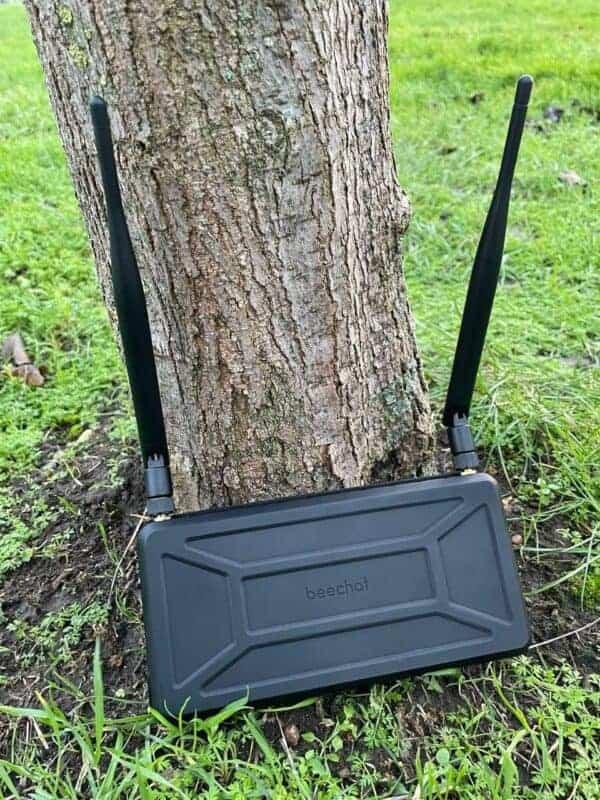
The Kaonic 1S is a tactical multiple-input, multiple-output software-defined radio running on an embedded Linux platform. Unlike a conventional radio whose functionality is largely determined by fixed hardware, a software-defined radio can have many of its operating characteristics, networking functions and signal-processing capabilities configured or updated through software.
Beechat’s documentation indicates that Kaonic supports communications over sub-gigahertz frequencies and the 2.4GHz band. It uses the decentralised Reticulum networking stack together with Beechat’s HopSync frequency-hopping technology. The manufacturer says the architecture can support multi-node networks and unmanned-system formations across as many as 128 network hops.
In a MANET arrangement, participating radios act both as communications endpoints and as relay nodes. Data can therefore travel through several radios before reaching its intended destination.
The network can reorganise its available routes as personnel, vehicles and drones move or as particular nodes become unavailable. This self-forming and self-healing behaviour is particularly important in areas where terrain, infrastructure damage, electronic interference or deliberate disruption makes conventional network coverage unreliable.
Beechat CEO Nicholas Quinn said Kaonic 1S was designed to provide secure and decentralised communications without relying on fixed infrastructure.
“Integrating this capability with MissionCore highlights how resilient connectivity can support coordination and situational awareness in complex environments,” he said.
Interoperability will be the critical test
The companies will evaluate how reliably the two systems exchange information across vehicle-mounted equipment, dismounted radios, situational-awareness applications and remotely deployed sensors.
For engineers, successful integration will involve more than establishing a basic radio connection. The evaluation is likely to examine data routing, cybersecurity, identity management, encryption, radio-frequency performance, latency, power consumption and the ability to maintain usable bandwidth as nodes move or network conditions deteriorate.
Interoperability with existing military radios, mapping systems, sensors and command applications will also be important. An open architecture can reduce dependence on a single equipment supplier, but only when interfaces, data formats and security policies are implemented consistently across the connected systems.
No performance results, customer commitments or field deployment timelines were disclosed in the announcement. The collaboration therefore remains an engineering validation programme rather than confirmation that the combined system has entered operational service.
Part of a wider dual-use technology drive
Beechat Network Systems is among the companies selected for NATO’s 2026 Defence Innovation Accelerator for the North Atlantic cohort. NATO describes the company’s project as a zero-trust tactical mesh communications system incorporating cryptographic identity.
The DIANA programme supports companies developing technologies that can address both defence and civilian security requirements. Participants gain access to accelerator programmes, testing facilities, technical advisers, operational users and potential pathways into NATO member markets.
In Finland, the VTT Dual-Use LaunchPad is operating as a NATO DIANA accelerator with focus areas that include advanced communications, new radio and antenna technologies, secure networks, radio-frequency data analysis, 5G and 6G systems, and quantum technologies.
Although the Savox-Beechat collaboration is primarily framed around defence operations, infrastructure-free mesh communications could also have applications in disaster response, search-and-rescue operations, border surveillance and the management of remote industrial or energy installations. This would, however, depend on the radio spectrum regulations, cybersecurity requirements and operational needs of each market.
For African countries, where security and emergency teams may operate across extensive areas with limited terrestrial communications infrastructure, such systems could offer an additional layer of resilient connectivity. Savox and Beechat have not announced a deployment associated with the collaboration in Kenya or elsewhere in Africa.
The significance of the project will therefore depend on whether the forthcoming interoperability tests demonstrate that the Kaonic radio can be integrated into MissionCore without compromising security, reliability or ease of operation. If validated, the arrangement could provide a more continuous communications link between command vehicles, personnel in the field and an expanding range of unmanned and sensor-based mission systems.

-
Product on sale AWEBook Volume 2Original price was: KShs 3,500.00.KShs 3,000.00Current price is: KShs 3,000.00.